
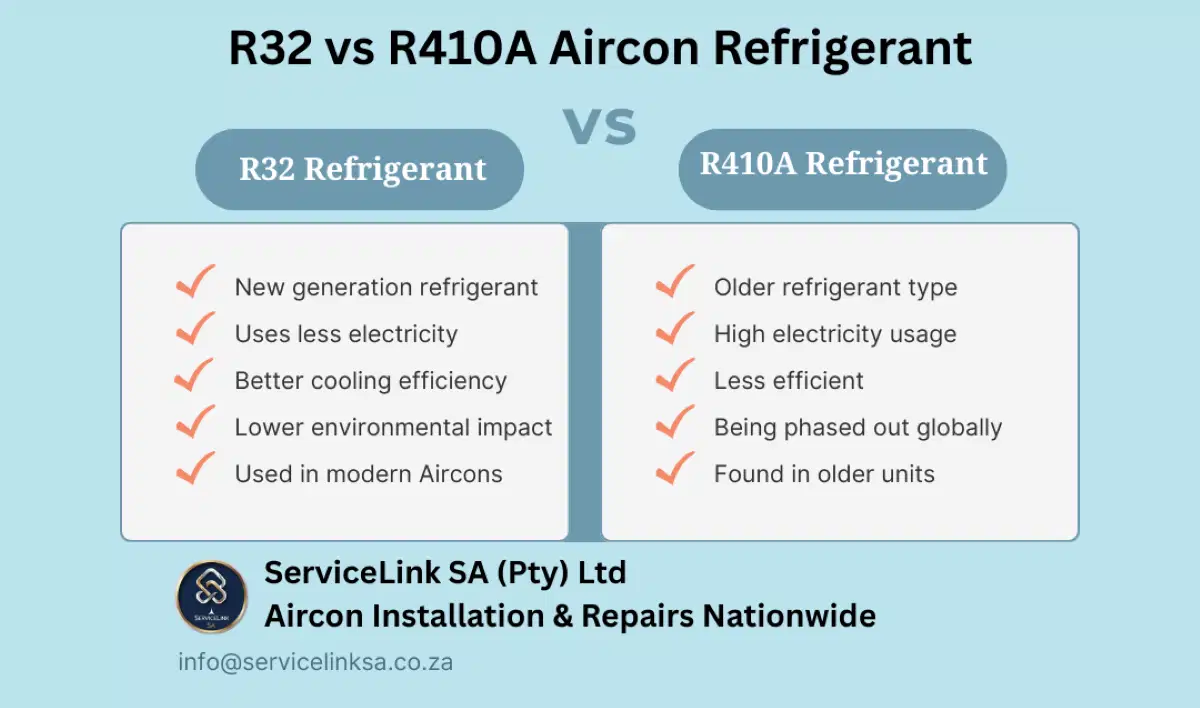
Aircon Refrigerants R32 vs R410a South Africa: Which Is Better, Safer & Future-Proof?
Choosing the right refrigerant is now one of the most important decisions when buying, repairing, or installing an air conditioner in South Africa. With global phase-downs, new safety standards, and efficiency improvements, homeowners and businesses are asking critical questions:
- Is R32 better than R410a?
- Is R410a being phased out in South Africa?
- Can you retrofit R32 into older aircons?
- Which refrigerant is safer, cheaper, and future-proof?
- What do new regulations mean for my existing system?
- How much does refrigerant cost in South Africa?
This comprehensive guide explains everything in simple terms so you can make the best decision for your property – whether you’re in Johannesburg, Pretoria, Cape Town, Durban, or anywhere in South Africa.
📅 2026 Update: This guide reflects current South African regulations, including DEFF F-Gas regulations, SAQA gas handling certification, and SABS flammable refrigerant safety standards. All information is verified with certified refrigeration technicians.
Need Refrigerant Services Near You?
Get quotes from certified technicians for gas top-ups, leak repairs, and new R32 installations.
✓ Gas top-up specialists ✓ Leak detection ✓ Certified refrigerant handlers
Table of Contents
❄️ What Is Aircon Refrigerant?
Refrigerant is the gas inside your air conditioner that makes cooling possible. It’s the lifeblood of any air conditioning system.
How it works:
- Refrigerant absorbs heat from inside your home (evaporator coil)
- It’s compressed and moved to the outdoor unit
- Heat is released outside (condenser coil)
- The cooled refrigerant returns inside to repeat the cycle
Without refrigerant, your aircon cannot cool. If your system is low on gas, it will blow warm air, run constantly, and eventually damage the compressor.
Common refrigerants in South Africa:
- R410a – Older standard, still common in systems installed before 2020-2022
- R32 – New standard, used in most modern inverter aircons
- R22 – Older refrigerant, being phased out globally (obsolete in new systems)
If your aircon is not cooling properly, you may need gas top-up or repair services.
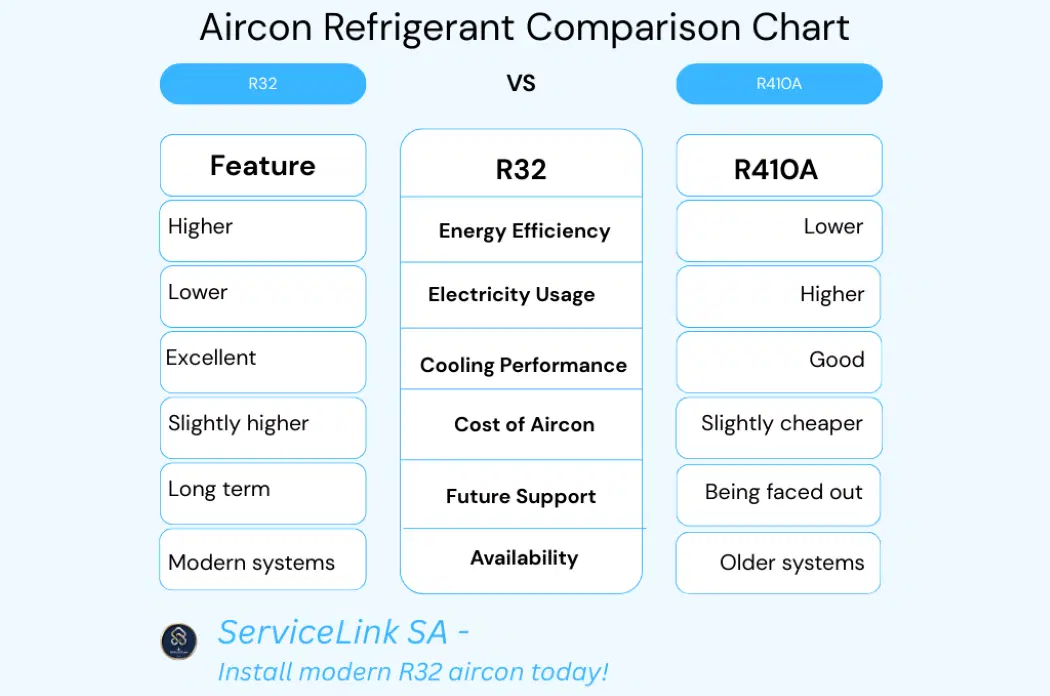
📊 R32 vs R410a Comparison Overview
Here is the key comparison at a glance:
| Feature | R32 | R410a |
|---|---|---|
| Global Warming Potential (GWP) | 675 | 2088 |
| Ozone Depletion Potential (ODP) | 0 | 0 |
| Energy efficiency | Higher (5-10% better) | Lower |
| Electricity consumption | Lower | Higher |
| Flammability | Mildly flammable (A2L class) | Non-flammable (A1 class) |
| Future availability | Long-term (current standard) | Being phased down |
| Charge size (for same cooling) | Smaller (uses less gas) | Larger |
| Cost per kg | Moderate | Increasing |
Winner overall: R32 – better efficiency, lower environmental impact, and future-proof.
🌍 Why R32 Refrigerant Is Replacing R410a
The biggest reason for the global switch is environmental protection.
🌡️ Global Warming Potential (GWP) Comparison:
R32 GWP: 675
R410a GWP: 2088
R410a is 3x worse for climate
Under the Montreal Protocol (Kigali Amendment), countries including South Africa have committed to phasing down high-GWP refrigerants. This is enforced locally by the Department of Forestry, Fisheries and the Environment (DEFF) through F-Gas regulations.
Additional reasons for the switch:
- Higher energy efficiency – R32 systems use less electricity
- Lower refrigerant charge – needs less gas for same cooling
- Better heat transfer properties
- Lower cost to manufacture
- Compliance with international standards
📈 What Is GWP and Why It Matters
GWP = Global Warming Potential
It measures how much heat a gas traps in the atmosphere compared to CO2. The lower the number, the less harmful to the environment.
- R32 GWP: 675 – moderate impact
- R410a GWP: 2088 – high impact
- CO2 (reference): 1
Why this matters for you:
- Future legality: High-GWP refrigerants face production quotas and phase-downs
- Availability: R410a will become harder to find and more expensive
- Cost: As supply decreases, prices rise
- Environmental responsibility: Lower GWP means smaller carbon footprint
South Africa’s F-Gas regulations, managed by DEFF, align with global phase-down schedules. New systems must use refrigerants with lower GWP.
📅 Is R410a Being Phased Out in South Africa?
Yes — gradually.
R410a is not banned immediately, but the phase-down is underway:
- Manufacturers are shifting production to R32
- Most new aircons (2022 onwards) use R32
- R410a will remain available for servicing existing systems, but prices will rise
- Long-term (5-10 years), R410a will become scarce and expensive
What this means for you:
- If buying new: Choose R32 – it’s the current and future standard
- If you have R410a: Don’t panic – your system will work fine for years, but repairs may cost more over time
- If replacing: R32 is the obvious choice
See modern installations in your area: Johannesburg, Pretoria, Sandton, Durban, Cape Town.
🚫 Can You Replace R410a With R32?
NO – This is extremely important:
You cannot retrofit R32 into an aircon designed for R410a. The systems are incompatible.
Reasons why:
- Different pressures: R32 operates at higher pressures than R410a in some conditions
- Different oil types: R32 uses different compressor oil (POE oils, but with different specifications)
- Component design: Compressors, expansion valves, and piping are designed for specific refrigerants
- Safety: R32 is mildly flammable – systems have specific safety requirements
- Equipment damage risk: Using wrong refrigerant destroys the compressor
What to do if your R410a system has a leak:
- Repair the leak and recharge with R410a (best option for existing system)
- If the system is old and has major issues, consider replacing with a new R32 unit
For gas-related issues, always use certified repair technicians who understand refrigerant compatibility.
🛡️ Is R32 Refrigerant Safe?
Yes, when installed professionally.
R32 is classified as A2L refrigerant – meaning it’s mildly flammable, but with very low burning velocity. It’s significantly safer than older flammable refrigerants (like R290/propane).
Safety measures required:
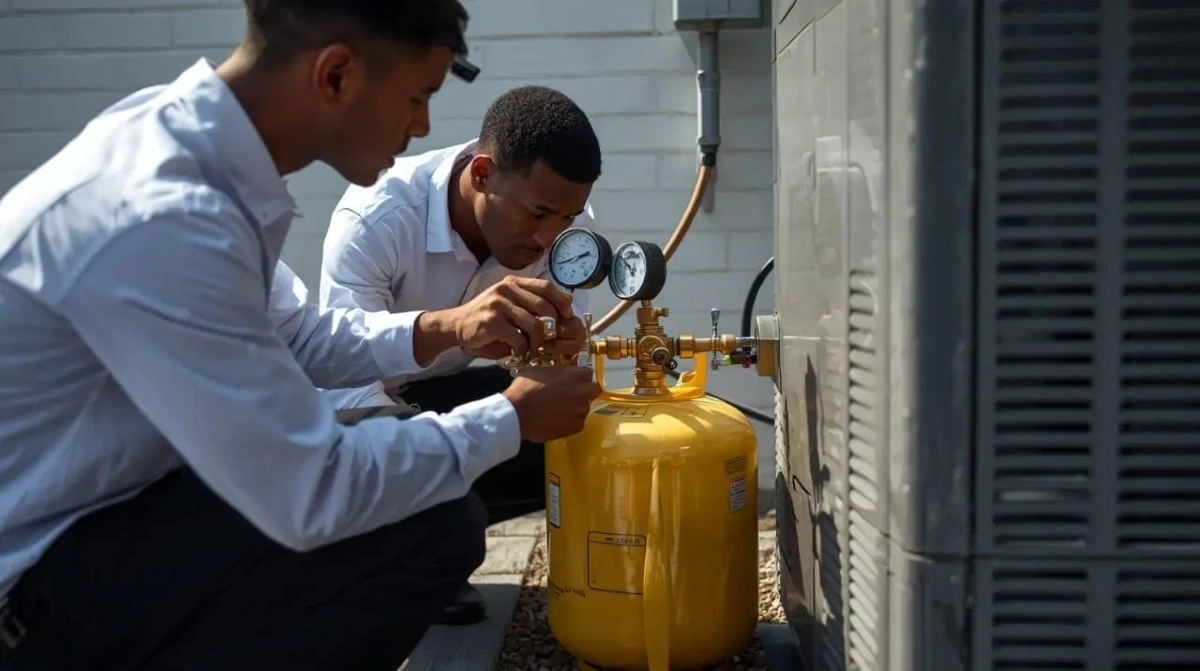
- Professional installation by certified technicians
- Proper ventilation in mechanical rooms
- Correct pipe sizing and joint brazing
- Leak detection systems in some applications
- Certified tools and recovery machines
- Compliance with SABS flammable refrigerant safety standards
Is R32 safe in homes? Yes. Millions of R32 aircons are installed worldwide, including in bedrooms, living areas, and offices. The risk is extremely low when installed correctly.
Technician certification: Only SAQA-certified refrigeration technicians with gas handling cards are legally allowed to work with refrigerants. Never allow unqualified individuals to handle gas.
⚡ Which Refrigerant Is More Energy Efficient?
R32 wins – it’s 5-10% more efficient than R410a.
Reasons:
- Better heat transfer: R32 has superior thermodynamic properties
- Higher efficiency: Requires less compression work for same cooling
- Lower compressor load: Reduces electricity consumption
- Smaller charge size: Needs less refrigerant for same capacity
Real-world impact: For a typical 12,000 BTU aircon running 8 hours daily, R32 can save R300-600 per year in electricity compared to R410a. Over 10 years, that’s R3,000-6,000 saved – enough to offset any price difference.
Combined with inverter technology, R32 systems are the most efficient choice for South African homes.
💰 Refrigerant Cost Comparison South Africa (2026)
| Refrigerant | Cost per kg | Typical Charge (12,000 BTU) | Total Gas Cost | Trend |
|---|---|---|---|---|
| R32 | R450 – R650 | 0.8 – 1.2 kg | R400 – R780 | Stable |
| R410a | R500 – R800 | 1.2 – 1.6 kg | R600 – R1,280 | Increasing |
| R22 (older) | R800 – R1,500 | 1.0 – 1.4 kg | R800 – R2,100 | Scarce, expensive |
Note: These are refrigerant costs only. Labour, leak testing, and repairs are additional. A full gas top-up service typically costs R900 – R2,500 including labour.
R410a is currently moderately priced but expected to rise as phase-downs progress. R32 is stable and widely available.
🔧 Installation Requirements for R32 Aircons
R32 systems have specific installation requirements that differ from R410a:
- Proper piping: Clean, dehydrated copper pipes with correct flaring
- Correct gas charge: Precise amount – R32 systems are sensitive to over/under-charging
- Leak testing: Mandatory before commissioning
- Vacuum pump: Deep evacuation (500 microns or lower) to remove moisture
- Safety compliance: Ventilation, electrical bonding, and leak detection where required
- Certified technician: Must have R32 handling certification
Professional aircon installation is critical for R32 systems. Incorrect installation can lead to poor performance, higher electricity bills, and safety risks.
🔍 How to Check Which Refrigerant Your Aircon Uses
Method 1: Check the outdoor unit label
Every aircon has a specification label on the outdoor unit (side or back panel). It will clearly state:
- “Refrigerant: R32”
- or “Refrigerant: R410A”
Method 2: Check the indoor unit or manual
The indoor unit may also have a label, or you can check the original user manual.
Method 3: Ask a professional
If unsure, request a free inspection – a technician can identify the refrigerant type immediately.
✅ Which Refrigerant Should You Choose in South Africa?
Choose R32 if:
- Buying a new air conditioner
- Replacing an old system
- Wanting long-term investment (10-15 years)
- Concerned about electricity bills
- Wanting environmentally responsible choice
- Future-proofing your home
R32 is the clear winner for new installations
Keep R410a if:
- Your existing R410a system works fine
- You’re repairing a leak (recharge with R410a)
- System is relatively new (under 5 years)
But plan for R32 when replacement is needed
📋 Environmental Regulations in South Africa
These organisations guide refrigerant regulations and compliance:
- Department of Forestry, Fisheries and Environment (DEFF) – F-Gas regulations, refrigerant phase-down schedules, import quotas
- South African Qualifications Authority (SAQA) – Gas handling certification for technicians
- South African Bureau of Standards (SABS) – Flammable refrigerant safety standards (SANS 10147)
Key requirements:
- Only certified technicians may handle refrigerants
- Leak checks required regularly for commercial systems
- Recovery machines must be used during servicing
- Records must be kept for certain systems
- Importers have annual quotas for high-GWP refrigerants
⚠️ Warning: Illegal Refrigerant Handling
Only certified technicians may handle refrigerants.
In South Africa, it is illegal for uncertified individuals to purchase, handle, or discharge refrigerants. This protects:
- Your safety – incorrect handling can cause injury or fire
- Your equipment – wrong gas destroys compressors
- The environment – illegal venting harms the ozone layer and climate
- Legal compliance – fines and penalties apply
Always choose insured contractors with proper credentials. See contractor liability insurance and how to choose the right contractor.
🚨 Signs Your Aircon Needs Refrigerant Service
Weak cooling / warm air
Air blowing but not cold – classic low gas symptom
Ice buildup on pipes
Frozen evaporator coil or suction line
Hissing sounds
Possible gas leak from pipes or connections
High electricity bills
System running longer to try to cool
System runs constantly
Never reaches set temperature
Oil stains near connections
Oil indicates refrigerant leak
If you notice any of these signs, contact a technician immediately. Running with low gas damages the compressor.
💰 Cost of Refrigerant Recharge in South Africa
Typical costs for professional gas top-up services:
| Service | Price Range | Includes |
|---|---|---|
| Gas top-up (R32) | R900 – R2,200 | Leak check, repair if minor, gas refill |
| Gas top-up (R410a) | R1,000 – R2,500 | Leak check, repair if minor, gas refill |
| Full system evacuation | R1,500 – R3,000 | Recover all gas, vacuum, recharge |
| Major leak repair | R2,000 – R5,000+ | Find and fix leak, then recharge |
Factors affecting cost:
- Size of unit (more gas for larger units)
- Leak severity (minor vs major repair)
- Accessibility of pipes and connections
- Refrigerant type (R32 slightly cheaper than R410a)
- Location (Cape Town may have different rates than Johannesburg)
🏆 R32 vs R410a Final Verdict
R32 is the clear winner for South Africa
Reasons:
- More efficient – lower electricity bills
- Future-proof – current and future standard
- Lower environmental impact – 70% lower GWP
- Better performance – superior heat transfer
- Cost-effective long-term – saves electricity
- Widely available – supported by all major brands
Most modern aircon brands now use R32 exclusively.
❓ Frequently Asked Questions
Is R32 better than R410a in South Africa?
Yes, R32 is better. It is more energy efficient (5-10% savings), has lower environmental impact (GWP 675 vs 2088), and is the current global standard. All major manufacturers now produce R32 units. For new installations in South Africa, R32 is the recommended choice for long-term value and compliance.
Is R410a being phased out in South Africa?
Yes, gradually. While still available for servicing existing systems, production of R410a equipment has largely stopped. Manufacturers have switched to R32 for new units. Under the DEFF F-Gas regulations, high-GWP refrigerants face import quotas and phase-downs. R410a will become more expensive and harder to find over the next 5-10 years.
Can R32 be used in old R410a aircons?
No, absolutely not. R32 cannot be retrofitted into systems designed for R410a. The pressures, oil types, and component specifications are different. Using R32 in an R410a system will damage the compressor and create safety risks. Always use the refrigerant specified on the unit’s label.
Is R32 refrigerant safe for home use?
Yes, when installed professionally. R32 is classified as A2L (mildly flammable) but has very low burning velocity. It is significantly safer than many other flammable refrigerants. Millions of R32 units are installed worldwide in homes, bedrooms, and offices. Safety depends on correct installation by SAQA-certified technicians following SABS standards.
Which refrigerant lasts longer?
Both last equally long. Refrigerant does not get “used up” over time. If your system is low on gas, it has a leak that must be repaired. The refrigerant itself doesn’t degrade or expire. However, R32 systems tend to have longer overall lifespans because they’re paired with modern inverter technology and better components.
Is R32 cheaper to run than R410a?
Yes, R32 is more energy efficient. R32 systems typically use 5-10% less electricity than comparable R410a units. For a typical household with multiple aircons, this can save R500-1,500 per year in electricity costs. Combined with inverter technology, the savings are even greater.
Should I replace my R410a aircon with R32?
Not immediately if it’s working well. Keep your R410a system until it needs major repairs or replacement. However, when it’s time to replace, choose R32. If your R410a system has a major compressor failure or recurring leaks, replacement with a new R32 unit is often more cost-effective than expensive repairs.
How do I know what refrigerant my aircon uses?
Check the specification label on the outdoor unit. It will clearly state “Refrigerant: R32” or “Refrigerant: R410A”. If you can’t find the label, check the indoor unit or original manual. When in doubt, request a free inspection – a technician can identify it immediately.
What are the regulations for refrigerant handling in South Africa?
Only SAQA-certified technicians with gas handling cards may purchase, handle, or discharge refrigerants. DEFF F-Gas regulations control imports and phase-downs. SABS SANS 10147 covers flammable refrigerant safety. Illegal venting or handling can result in fines and legal action.
Where can I find certified R32 installers near me?
Request free quotes through ServiceLink SA – we connect you with certified technicians who have R32 handling certification and experience. Available in Johannesburg, Pretoria, Cape Town, Durban, and surrounding areas.
Written by ServiceLink SA Technical Team
21+ years construction and HVAC industry experience
Our team includes qualified refrigeration mechanics who work with refrigerants daily. This guide is based on current South African regulations, manufacturer specifications, and real-world experience with R32 and R410a systems. We reference DEFF, SAQA, and SABS standards to ensure accuracy and compliance.
✅ Action Plan – Choose Your Refrigerant Wisely
- Identify your current refrigerant – Check the label on your outdoor unit
- If buying new: Choose R32 – it’s future-proof and more efficient
- If your R410a system needs gas: Repair leaks and recharge with R410a (never mix refrigerants)
- If your system is old and failing: Consider replacing with a new R32 inverter system
- Always use certified technicians – Verify SAQA gas handling certification
- Get multiple quotes – Compare prices for gas top-up or new installation
- Keep maintenance records – Document all refrigerant work for warranty purposes
❄️ Need Refrigerant Services Near You?
Get quotes from certified technicians for gas top-ups, leak repairs, and new R32 installations.
✓ Gas top-up specialists ✓ Leak detection ✓ Certified refrigerant handlers
Gauteng •
Johannesburg •
Pretoria •
Sandton •
Durban •
Cape Town
External references and industry standards:
- Department of Forestry, Fisheries and Environment (DEFF) – F-Gas regulations and refrigerant phase-down
- South African Qualifications Authority (SAQA) – Gas handling certification and trade tests
- South African Bureau of Standards (SABS) – Flammable refrigerant safety standards (SANS 10147)
Prices and regulations accurate as of February 2026. Always verify current requirements with certified professionals.