
Aircon Not Responding to Temperature Settings?
Get free quotes from verified local technicians for thermostat diagnosis and repair.
Find Aircon Repair Technicians Near Me
Servicing Johannesburg, Pretoria, Cape Town, Durban, and across South Africa
Aircon Thermostat Repair: Fix Your AC’s Brain in 5 Steps
🌡️🔧 From inaccurate temperatures to short cycling—diagnose and fix thermostat problems before they ruin your comfort
You set your aircon to 23°C. The room feels like 19°C—freezing. Or worse, you set it to 22°C, but the room stays at 26°C, and the unit never shuts off.
Your aircon has a thermostat problem. And it’s driving you crazy.
The thermostat is your aircon’s brain. It tells the compressor when to turn on and off based on the room temperature. When it fails, nothing works right—short cycling, inaccurate temperatures, constant running, or no cooling at all.
I’ve seen homeowners replace perfectly good aircons because of a R300-R600 thermostat sensor. I’ve also seen them suffer through hot summers because they didn’t know a simple fix was available.
In this guide, I’ll show you common air conditioner thermostat problems, how to diagnose them, and when to call a professional for aircon thermostat repair.
For more troubleshooting, check aircon not turning on guide and same-day repair services. Ready to fix your thermostat? Let’s go.
📋 Table of Contents
🧠 How Your Aircon Thermostat Works
Understanding how the thermostat works helps you diagnose problems.
What the thermostat does: Measures the room temperature. Compares it to your set temperature. Tells the compressor to turn on (if room is warmer than set) or off (if room has reached set temperature). Controls the fan operation.
Where it’s located: Split systems have a temperature sensor (thermistor) inside the indoor unit. Some units also have a sensor in the remote control. Window units have the thermostat built into the control panel.
How it senses temperature: Most modern aircons use a thermistor (electronic sensor). Older units may use a mechanical thermostat (bimetallic strip).
Signs of thermostat failure: Room temperature doesn’t match set temperature. Unit short cycles (turns on/off frequently). Unit runs constantly without reaching temperature. No response to remote temperature changes. Different temperatures in different modes.
📌 Important Distinction:
A “thermostat problem” could be: the remote (not sending correct signals), the temperature sensor (faulty reading), or the control board (not processing signals). Diagnosis matters—each has different repair costs.
Read our PCB board problems guide.
🌡️ Symptom #1: Inaccurate Temperature Reading
This is the most common air conditioner thermostat problem. The set temperature doesn’t match reality.
What you’ll notice: You set the aircon to 23°C, but the room feels like 19°C (too cold). Or you set it to 22°C, but the room feels like 26°C (too warm). You use a separate thermometer to confirm the room temperature is different from the set point.
What’s happening: The temperature sensor (thermistor) is reading incorrectly. It may be dirty, damaged, or failing. The sensor may be located in a bad spot (near a heat source or cold draft). The remote’s sensor may be conflicting with the indoor sensor.
What to do: Try DIY fixes first (clean sensors, move remote). If problem persists, a technician can test and replace the thermistor.
🔄 Symptom #2: Short Cycling (On/Off Frequently)
A failing thermostat can cause your aircon to turn on and off every few minutes.
What you’ll notice: The aircon runs for 5-10 minutes, shuts off for 5-10 minutes, then starts again. The cycle repeats constantly. The room temperature fluctuates noticeably. This is different from normal cycling (15-30 minute cycles).
What’s happening: The thermostat is reading temperature incorrectly or has a “dead band” (temperature difference between on and off) that’s too narrow. The sensor may be located near a cold draft (causing false readings). The control board may be faulty.
Other possible causes: Oversized aircon (most common cause of short cycling). Dirty filter. Low refrigerant. Don’t assume it’s the thermostat—check other causes first.
What to do: Check if your unit is oversized. Clean your filter. If the problem persists, call a technician to test the thermostat.
Read our short cycling guide.
Thermostat Problems Driving You Crazy?
Get free quotes from verified local technicians for thermostat diagnosis and repair.
Get Free Quotes From Local Technicians
Thermostat sensor replacement from R300-R600.
🔄 Symptom #3: Unit Runs Constantly
Your aircon never shuts off, even when the room feels cold enough.
What you’ll notice: The aircon runs for hours without stopping. The room reaches the set temperature (or feels colder), but the unit keeps running. Your electricity bill increases significantly.
What’s happening: The thermostat is not sensing that the set temperature has been reached. The sensor may be reading warmer than reality. The control board may not be processing the signal. The unit may be in “continuous fan” mode (check your remote).
Other possible causes: Undersized aircon (can’t reach set temperature). Low refrigerant (can’t reach set temperature). Dirty filter (restricted airflow).
What to do: Check that you’re not in “Fan only” mode. Clean your filter. If the problem persists, call a technician.
📱 Symptom #4: No Response to Remote
You change the temperature on the remote, but the aircon doesn’t respond.
What you’ll notice: You press the temperature up/down buttons. The remote display changes. But the aircon continues at the old temperature. The room doesn’t get warmer or cooler. Other remote functions (mode, fan speed) may still work.
What’s happening: The remote is sending the signal, but the aircon’s receiver or control board isn’t processing it correctly. The temperature sensor may be faulty. The control board may have a software glitch.
What to do: Try resetting the aircon (turn off breaker for 5 minutes). Replace remote batteries. Clean the remote’s infrared LED. If the problem persists, call a technician.
Read our remote not working guide.
🔄 Symptom #5: Different Temperatures in Different Modes
The temperature feels different in Cool mode vs Heat mode vs Fan mode.
What you’ll notice: In Cool mode, 23°C feels comfortable. In Heat mode, 23°C feels too hot or too cold. Or the unit doesn’t maintain temperature consistently across modes.
What’s happening: Different sensors may be used for different modes. One sensor may be faulty. The control board may have calibration issues specific to heating or cooling.
What to do: This requires professional diagnosis. A technician can test each sensor individually.
📱 Remote vs Built-in Sensor: Which Is Failing?
Many modern aircons have two temperature sensors: one in the remote and one in the indoor unit.
Remote sensor (follow me function): Senses temperature at the remote’s location. More accurate if you keep the remote near you. Can be turned on/off (check your manual). When active, the aircon uses the remote’s temperature reading. When inactive, it uses the indoor unit’s sensor.
Built-in sensor (indoor unit): Senses temperature at the indoor unit (usually mounted high on the wall). May read warmer than reality (hot air rises). Less accurate if the unit is in a poor location.
How to tell which is failing: Move the remote to a different location. Does the temperature reading change? If yes, the remote sensor is working. If the room feels different from the set temperature consistently, suspect the built-in sensor.
Common issues: Remote sensor blocked by dirt on the sensor hole. Remote sensor affected by heat from your hand. Built-in sensor dirty or damaged. Remote in a bad location (near heat source or cold draft).
Read our smart aircon systems guide.
🛠️ DIY Fixes to Try First (Free)
Before calling a technician for how to fix aircon thermostat, try these free fixes:
1. Clean the remote sensor hole. Look for a small hole on the remote (usually near the display). Use a soft brush or compressed air to remove dust. Dirt blocks accurate temperature reading.
2. Replace remote batteries. Low batteries can cause erratic temperature readings and signal issues. Replace with fresh alkaline batteries.
3. Move the remote away from heat/cold sources. Don’t place the remote near windows (sun), electronics (heat), or air vents (cold drafts). Keep it in the middle of the room.
4. Reset the aircon. Turn off the breaker for 5 minutes. Turn back on. This resets the control board and may clear glitches.
5. Check the “Follow Me” or “I Feel” function. If enabled, the aircon uses the remote’s temperature sensor. If the remote is in a bad location, disable this function. Check your manual for how to toggle.
6. Clean the indoor unit sensor. The built-in sensor is behind the front panel (near the filter). Gently wipe with a dry cloth. Do not use water or cleaners.
7. Ensure the unit has good airflow. A dirty filter or blocked vents cause temperature stratification (hot air at ceiling, cold air at floor), confusing the sensor. Clean your filter monthly.
If none of these work, call a professional.
Read our filter cleaning guide.
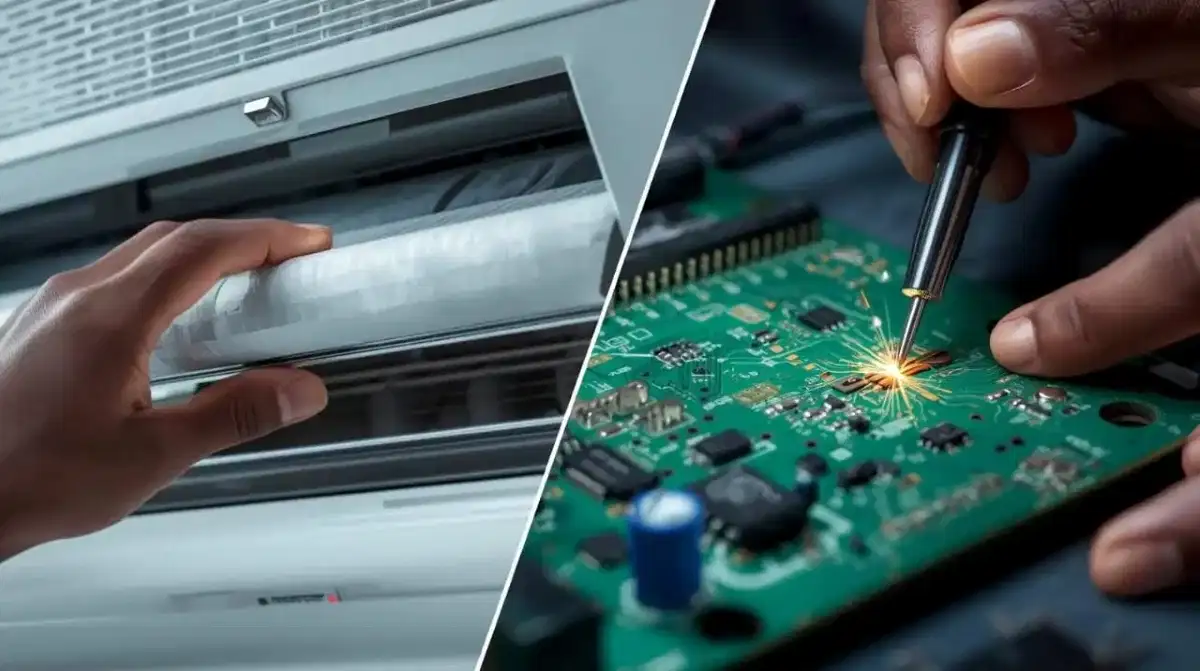
🔧 Professional Repair Process
Here’s what a technician does for ac thermostat replacement or repair:
Step 1: Verify the problem – Use a separate thermometer to measure room temperature. Compare to aircon’s reading. Test different modes (Cool, Heat, Fan).
Step 2: Check remote sensor – Test remote function. Clean sensor hole. Check batteries. Verify “Follow Me” function.
Step 3: Test built-in sensor (thermistor) – Measure resistance with a multimeter. Compare to manufacturer’s specifications (resistance changes with temperature). If outside specification, replace sensor.
Step 4: Check wiring and connections – Ensure sensor is properly connected to the control board. Look for loose or corroded connections.
Step 5: Test control board – If the sensor is good but the unit still doesn’t respond correctly, the control board may be faulty. This is a more expensive repair.
Step 6: Replace faulty component – Sensor replacement (R300-R600 for part + labour). Control board replacement (R1,500-R4,000).
Time: 30-60 minutes for sensor replacement. 1-2 hours for control board replacement.
💰 Cost Breakdown: What You’ll Pay
Here’s what aircon thermostat repair costs in South Africa:
DIY fixes: R0 (clean sensors, move remote, replace batteries). Always try these first.
Thermistor (temperature sensor) replacement: R300 – R600 for part + labour. Most common thermostat repair.
Remote control replacement: R150 – R400 for universal remote. R400 – R800 for original brand remote.
Control board (PCB) replacement: R1,500 – R4,000 depending on unit. Only if the sensor is not the problem.
Technician call-out fee: R300 – R600 (often waived if you proceed with repair).
Total typical cost (sensor replacement): R500 – R900 including call-out.
Read our PCB board problems guide.
📱 Upgrade to Smart Thermostat
If your thermostat is failing and your aircon is compatible, consider upgrading to a smart AC controller.
What a smart controller does: Replaces your remote (not the built-in sensor). Adds Wi-Fi control, scheduling, geofencing, and energy monitoring. Costs R1,500-R2,500. Works with most aircons that have an infrared remote.
Benefits over traditional thermostat: More accurate temperature control (uses external sensors). Schedule different temperatures for different times. Remote control from anywhere. Energy usage tracking. Integration with Google Home/Alexa.
When to upgrade: If your remote is failing. If you want smart features. If your built-in sensor is failing (smart controller won’t fix this—it still uses the aircon’s sensor).
Read our smart thermostat guide and smart AC setup guide.
❓ Frequently Asked Questions
How do I know if my aircon thermostat is bad?
Signs of bad thermostat include: inaccurate temperature (room doesn’t match setting), short cycling (turns on/off frequently), unit runs constantly without reaching temperature, no response to remote changes, or different temperatures in different modes. Try DIY fixes first; if they don’t work, call a technician.
Can I replace my aircon thermostat myself?
For split systems, NO—the temperature sensor is inside the unit and requires professional access. For window units, MAYBE—some have accessible mechanical thermostats. For smart AC controllers (add-on devices), YES—DIY installation takes 10 minutes. For built-in sensors, always call a professional.
How much does it cost to replace an aircon thermostat?
Aircon thermostat repair costs: sensor replacement R500-R900, control board replacement R1,500-R4,000, remote replacement R150-R800. DIY fixes (cleaning sensors, moving remote) are free. Smart AC controller upgrade costs R1,500-R2,500.
Why does my aircon temperature not match the remote setting?
Possible causes: dirty temperature sensor (clean it), remote in a bad location (move it), “Follow Me” function disabled (enable it), faulty thermistor (needs replacement), or control board issue. Start by cleaning the sensor and moving the remote.
What is the “Follow Me” function on my aircon remote?
The “Follow Me” function (also called “I Feel” on some brands) uses the remote’s built-in temperature sensor instead of the indoor unit’s sensor. The aircon cools based on the temperature where YOU are, not where the wall unit is. Check your manual to enable/disable this feature.
Can a dirty air filter cause thermostat problems?
Yes indirectly. A dirty filter restricts airflow, causing temperature stratification (hot air at ceiling, cold air at floor). The thermostat sensor (mounted high on the wall) reads the hot air and thinks the room is warmer than it is. The aircon runs longer than needed. Clean your filter monthly.
Why does my aircon keep turning on and off every few minutes?
This is short cycling. The most common cause is an oversized aircon (cools too quickly). Other causes: dirty filter, faulty thermostat (reading temperature incorrectly), or low refrigerant. Read our short cycling guide for detailed diagnosis.
How do I calibrate my aircon thermostat?
Most modern aircons do not have user-accessible calibration. Thermostat calibration requires professional tools (multimeter to test thermistor resistance). Some smart AC controllers offer calibration features. If your temperature is consistently off, call a technician to test and replace the sensor.
Can a power surge damage my aircon thermostat?
Yes. Power surges can damage the temperature sensor, control board, or remote. If your thermostat problems started after a storm or load-shedding, surge damage is likely. Install a surge protector to prevent future damage. Read our load-shedding guide.
Should I repair or replace my aircon if the thermostat is faulty?
Repair. A faulty thermostat is almost always repairable (sensor replacement R500-R900). Only consider replacement if: the unit is over 10 years old, the control board is also faulty (R1,500-R4,000 repair), and other components are failing. Use the 50% Rule from our repair vs replacement guide.
✅ Final Thoughts: Don’t Suffer Through Inaccurate Temperatures
Aircon thermostat problems are frustrating but usually easy to fix. Most are caused by dirty sensors, bad remote placement, or simple settings issues—free to fix. When sensors fail, replacement costs R500-R900.
Key takeaways for thermostat repair:
- Try DIY fixes first – clean sensors, move remote, replace batteries. Free and often works.
- Inaccurate temperature = most common problem – usually a dirty sensor or bad remote placement.
- Short cycling is often NOT the thermostat – check for oversized unit first.
- Sensor replacement costs R500-R900 – cheap fix for most thermostat problems.
- Control board replacement costs R1,500-R4,000 – only if sensor is not the problem.
- “Follow Me” function uses remote sensor – enable it for more accurate temperature where you sit.
- Clean your filter monthly – dirty filters confuse thermostat sensors.
Your action plan: First, clean the remote sensor hole and indoor unit sensor. Second, move the remote away from heat/cold sources. Third, replace remote batteries. Fourth, reset the aircon (turn off breaker for 5 minutes). Fifth, if problems persist, request quotes from local technicians for sensor testing and replacement.
Thermostat Problems? Don’t Suffer Through Inaccurate Temperatures
Get free quotes from verified local technicians for thermostat diagnosis and repair.
📞 Call us: 073 138 4726 for immediate help finding aircon repair technicians near you.
📚 Official resources & standards referenced:
- ECASA – Thermostat electrical standards and safety requirements
- Department of Energy – Thermostat calibration and energy efficiency guidelines
- SABS – Temperature sensor standards
Information provided for general guidance based on South African market conditions. Temperature sensor replacement should be performed by qualified technicians.
Written by: Innocent T Hanyani
Construction & Home Services Industry Specialist | 21+ Years Experience
Innocent T Hanyani has over two decades of experience working across South Africa’s construction, maintenance, and home services sectors. Throughout his career, he has worked closely with contractors, service providers, and property owners, gaining practical insight into how projects are quoted, managed, and completed. His work focuses on helping homeowners understand how to find reliable contractors, compare quotes, and avoid common industry pitfalls when hiring service professionals. His insights are based on practical industry experience as well as ongoing research into contractor platforms, service marketplaces, and hiring trends across South Africa.