

Electrician Call Out Fees & Repair Costs South Africa 2025
⚡ What does an electrician charge in South Africa right now?
Whether you’re dealing with a tripping circuit breaker in your Johannesburg home, a faulty socket in your Cape Town apartment, or need urgent electrical repairs after loadshedding in Pretoria, understanding electrician call out fees and repair costs is essential before you pick up the phone.
This comprehensive 2025 guide provides accurate, up-to-date pricing for electrical services across South Africa. We’ve analysed hundreds of quotes from registered electricians in Johannesburg, Pretoria, Cape Town, Durban, Centurion, Sandton, and regional areas to bring you the most reliable pricing available.
📅 2025 Update: All prices reflect Q1 2025 market rates based on verified quotes from registered electricians. Prices include VAT where indicated. Actual costs may vary based on your location, time of day, and specific electrical issue.
Need an urgent electrician near you?
Get free, no-obligation quotes from registered, verified electricians in your area – compare prices and save.
Available in Johannesburg, Pretoria, Cape Town, Durban, and across South Africa
📋 Table of Contents – Electrician Pricing 2025
🔧 Electrician Call Out Fees Explained – What Are You Paying For?
An electrician call out fee (also called a trip fee or first-hour charge) is the amount you pay simply for the electrician to arrive at your property. This fee typically covers:
- Travel time and fuel costs
- Vehicle and equipment expenses
- Basic diagnostic assessment
- Minimum labour commitment (often first hour)
- Testing equipment usage
- Business overheads
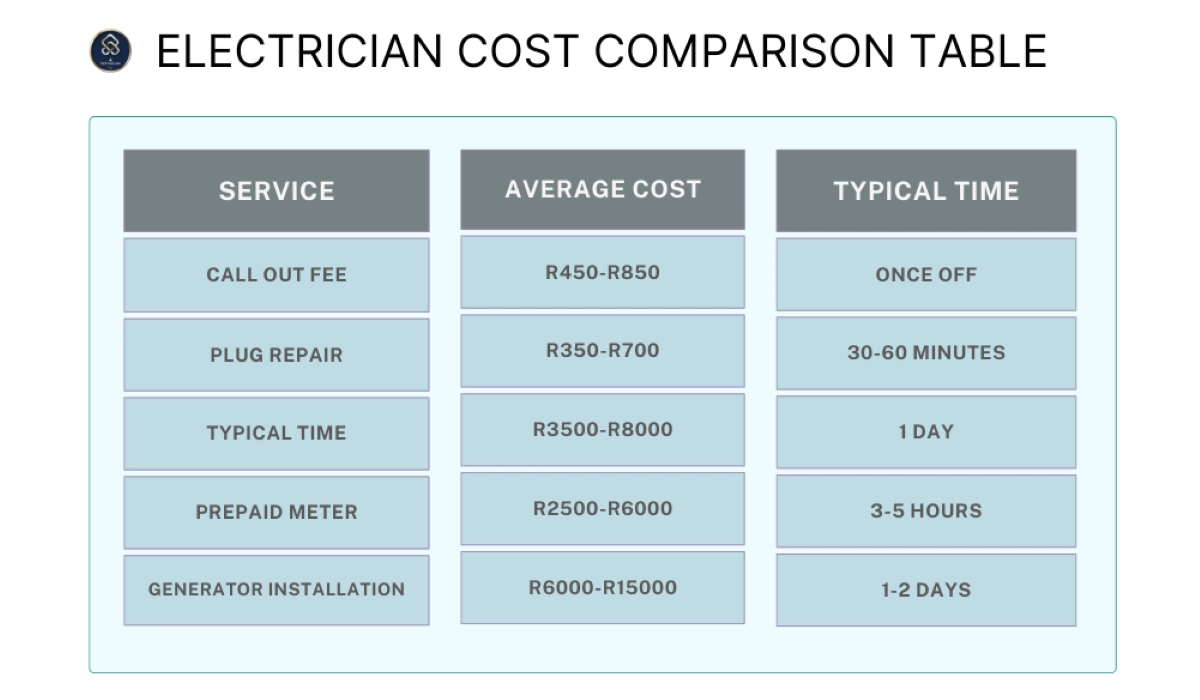
In South Africa, electrician call out fees typically range from R450 – R950 depending on your location, time of day, and the electrician’s qualifications. Some companies include the first hour of labour in this fee; others charge it separately.
Average Call Out Fees by Region (2025)
| Location | Standard Call Out (Day) | After Hours Call Out | Includes First Hour? |
|---|---|---|---|
| Johannesburg | R550 – R850 | R850 – R1,400 | Usually |
| Pretoria | R500 – R800 | R800 – R1,350 | Usually |
| Centurion | R500 – R780 | R780 – R1,300 | Usually |
| Sandton | R600 – R950 | R950 – R1,500 | Usually |
| Cape Town | R550 – R900 | R900 – R1,450 | Usually |
| Durban | R500 – R820 | R820 – R1,380 | Usually |
| Umhlanga | R520 – R850 | R850 – R1,400 | Usually |
| Midrand | R550 – R850 | R850 – R1,400 | Usually |
Pro Tip: Always ask “Is the call-out fee waived if I proceed with the repair?” Many electricians in Johannesburg and Pretoria offer this – saving you R500+ if you approve the work on the spot.
⏱️ Electrician Hourly Rates South Africa 2025
After the call-out fee, you’ll be charged for labour – either by the hour or as a fixed price for specific jobs. Understanding electrician hourly rates helps you budget accurately and compare quotes fairly.
Average Hourly Rates by Qualification
| Electrician Type | Hourly Rate (Day) | After Hours | Weekend/Public Holiday |
|---|---|---|---|
| Apprentice/Helper | R250 – R400 | R350 – R550 | R400 – R600 |
| Qualified Electrician (Wireman’s License) | R450 – R750 | R650 – R1,100 | R750 – R1,200 |
| Master Electrician | R650 – R950 | R900 – R1,400 | R1,000 – R1,500 |
| Electrical Contractor (with team) | R800 – R1,200 | R1,100 – R1,700 | R1,200 – R1,800 |
What Affects Hourly Rates?
- Qualifications: Wireman’s license vs general electrician – registered electricians command higher rates
- Experience: 10+ years vs newly qualified – expect R100-200/hour premium for experienced tradespeople
- Location: Sandton and Cape Town rates are typically 10-20% higher than regional areas
- Specialisation: Industrial/commercial electricians charge more than residential-only
- Emergency response: After-hours rates apply outside 8am-5pm weekdays
- Minimum charges: Most electricians bill in 30-minute or 1-hour minimum increments
⚠️ Important: Be wary of electricians charging significantly below market rates (e.g., R300/hour for a qualified electrician). This often indicates lack of proper qualifications, insurance, or COC registration – which can void your insurance and create safety risks. Always verify ECASA registration.
🌙 After Hours Electrician Call Out Fees – Emergency Pricing
Electrical emergencies don’t respect office hours. Whether it’s a power outage at 10pm, sparking switchboard, or complete blackout during loadshedding, after-hours service commands premium rates. Here’s what to expect:
Emergency Call Out Fees by Time
| Time Period | Call Out + First Hour | Additional Hourly | Typical Availability |
|---|---|---|---|
| Weekdays 5pm – 10pm | R950 – R1,400 | R650 – R950 | Most services |
| Weekdays 10pm – 6am | R1,300 – R1,900 | R850 – R1,300 | Limited |
| Saturday day | R800 – R1,200 | R550 – R850 | Good availability |
| Saturday night | R1,200 – R1,700 | R750 – R1,200 | Limited |
| Sunday/public holiday | R1,000 – R1,500 | R700 – R1,100 | Limited |
When Is It Worth Paying Emergency Rates?
Genuine electrical emergencies include:
- Sparkling or smoking outlets/switches – fire risk, immediate attention required
- Complete power loss with no signs of returning (especially with vulnerable family members)
- Burning smell from DB board – potential fire hazard
- Exposed live wires after storm damage or accident
- Earth leakage constantly tripping with no reset – indicates serious fault
Non-emergencies (can wait until morning):
- Single power outlet not working (isolated issue)
- Light bulb replacement
- Flickering lights without other symptoms
- Non-urgent COC certificate inspections
Emergency tip: Save contact details of 2-3 registered emergency electricians in your area before you need them. In a crisis, you won’t have time to research. Pre-qualify electricians now and keep their numbers handy.
💰 Common Electrical Repair Costs – Fixed Price Guide
Many electrical jobs are quoted as fixed prices rather than hourly rates. Here are typical costs for common residential electrical repairs across South Africa (including labour and standard materials, excluding major rewiring):
| Repair Type | Typical Price Range | Time Required | Common in Areas |
|---|---|---|---|
| Faulty power outlet replacement | R350 – R650 | 30-60 min | All areas |
| Light switch replacement | R300 – R550 | 30-45 min | All areas |
| Circuit breaker replacement | R600 – R1,200 | 45-90 min | Older homes, JHB PTA |
| Earth leakage unit replacement | R850 – R1,600 | 1-2 hours | All areas |
| Light fitting installation | R400 – R900 | 45-90 min | All areas |
| Ceiling fan installation | R800 – R1,800 | 1.5-3 hours | Warmer regions |
| Extractor fan installation | R700 – R1,500 | 1.5-2.5 hours | Bathrooms, kitchens |
| Geyser timer installation | R600 – R1,200 | 1-2 hours | All areas |
| New power point installation | R600 – R1,300 | 1-2 hours | All areas |
| Doorbell/Intercom repair | R400 – R900 | 30-90 min | All areas |
| Fault finding (diagnostic only) | R450 – R950 | 30-90 min | Complex issues |
| DB Board rewiring (partial) | R1,500 – R3,500 | 2-4 hours | Older homes |
Note: These prices assume standard accessibility and no major complications. Older homes in Pretoria or Johannesburg with vintage wiring may incur additional costs for rewiring or upgrades to meet SANS 10142 standards.
🔍 Diagnostic Fees & Quotation Charges – What’s Fair?
One of the most confusing aspects of electrical pricing is the diagnostic fee – the charge for identifying the problem before repair work begins. Here’s how it typically works:
Diagnostic Fee Models
- Included in call-out: Many electricians include basic diagnostics in the first hour’s labour
- Separate fixed fee: R300 – R750 for standard fault finding, credited if you proceed with repair
- Hourly diagnostic: Charged at standard labour rate, with minimum 30-60 minutes
- Free quotation: Some companies offer free no-obligation quotes for larger jobs (e.g., DB board upgrades)
What Fair Diagnostic Costs Look Like
| Problem Type | Typical Diagnostic Time | Fair Diagnostic Fee | Complexity |
|---|---|---|---|
| Dead outlet (single) | 15-30 min | R300 – R500 | Low |
| Tripping circuit breaker | 30-60 min | R450 – R750 | Medium |
| Intermittent power issues | 45-90 min | R600 – R950 | High |
| Earth leakage tripping | 45-90 min | R600 – R900 | Medium-High |
| Lights flickering throughout | 45-90 min | R600 – R950 | Medium-High |
Smart move: Always ask “If I approve the repair immediately, will the diagnostic fee be waived or reduced?” Most reputable electricians in Cape Town, Durban, and Gauteng will credit diagnostic fees against the final bill – it’s standard practice.
📍 Electrician Costs by Location – Regional Variations 2025
Where you live in South Africa significantly impacts what you’ll pay for electrical services. Here’s how prices vary across major centres:
⚡ Johannesburg Electrician Fees
As South Africa’s economic hub, Johannesburg has competitive pricing with many registered electricians servicing the area.
- Call out fee: R550 – R850 (R850 – R1,400 after hours)
- Hourly rate (qualified): R500 – R750
- Typical 3-bedroom home inspection: R1,200 – R2,500
- Suburb variations: Sandton and Fourways typically 10-15% higher than average
⚡ Pretoria Electrician Fees
Pretoria (Tshwane) offers slightly more competitive rates than Johannesburg, with a strong market for residential electrical work.
- Call out fee: R500 – R800 (R800 – R1,350 after hours)
- Hourly rate (qualified): R450 – R700
- Typical 3-bedroom home inspection: R1,100 – R2,300
- Suburb variations: Centurion and Pretoria East slightly higher
⚡ Cape Town Electrician Fees
Cape Town’s unique geography and coastal conditions affect pricing, with marine-grade requirements for some areas.
- Call out fee: R550 – R900 (R900 – R1,450 after hours)
- Hourly rate (qualified): R500 – R800
- Typical 3-bedroom home inspection: R1,300 – R2,700
- Suburb variations: Atlantic Seaboard and City Bowl premium rates
⚡ Durban Electrician Fees
Durban’s humid coastal climate requires electricians familiar with corrosion-resistant installations and lightning protection.
- Call out fee: R500 – R820 (R820 – R1,380 after hours)
- Hourly rate (qualified): R450 – R750
- Typical 3-bedroom home inspection: R1,200 – R2,500
- Suburb variations: Umhlanga and Ballito premium rates
Regional & Estate Areas
- Hartbeespoort: R550 – R850 call out (estate living often requires additional access coordination)
- Midrand: R550 – R850 call out (similar to Johannesburg rates)
- Stellenbosch: R550 – R880 call out (wine estate premium for travel)
🚗 Trip Fee vs Labour Rate – Understanding the Difference
This distinction confuses many homeowners. Let’s clarify:
Trip Fee (Call Out)
- ✓ Fixed amount just to attend the job
- ✓ Covers travel, vehicle costs, time to site
- ✓ Usually non-refundable (even if you cancel)
- ✓ Typically R450 – R950 depending on location/time
- ✓ May include first 15-30 minutes of labour
- ✓ Sometimes waived if you proceed with work
Labour Rate
- ✓ Charged after call-out (or from arrival)
- ✓ Based on actual time spent on the job
- ✓ Usually billed in 30-minute or 1-hour increments
- ✓ R450 – R950/hour depending on qualification
- ✓ Applies to diagnostics, repairs, installation
- ✓ Should be clearly stated before work begins
Real-World Examples
| Scenario | Trip Fee | Labour Time | Total Bill |
|---|---|---|---|
| Replace single faulty outlet | R650 | 45 min @ R600/hr | R650 + R450 = R1,100 |
| Tripping breaker – fix in 30 min | R650 (includes first 30 min) | 0 (included) | R650 total |
| Complex fault (2.5 hours) | R650 | 2.5 hrs @ R600 = R1,500 | R650 + R1,500 = R2,150 |

📊 What Affects Electrical Repair Costs in 2025?
Beyond location and time of day, several factors influence what you’ll pay for electrical work:
1. Job Complexity & Accessibility
- Simple jobs: Outlet/switch replacement in easy-to-reach locations – lower end of scale
- Complex jobs: Fault finding in old wiring, concealed conduits, multi-storey homes – higher rates
- Accessibility: Attic spaces, crawl spaces, or difficult-to-reach areas add 20-40% to labour time
- Wall type: Brick vs drywall – brick cutting adds R500-1,500 per opening
2. Materials & Parts Quality
- Standard components: Local brands (Crabtree, CBI, etc.) – included in typical quotes
- Premium brands: European or specialised components – add 30-100% to material costs
- Specialty items: Surge protectors, timers, smart switches – additional R300-2,000+
- Minimum markup: Most electricians add 20-40% markup on supplied parts
3. Property Age & Wiring Condition
- Homes pre-1990: Often have older wiring that may need upgrades when making changes
- Homes pre-1970: May have vulcanised rubber wiring (VRI) – requires full rewiring, R30,000-80,000+
- Alterations history: Previous DIY work can complicate repairs and increase diagnostic time
4. Safety & Compliance Requirements
- COC compliance: Any work that affects the installation may require updated COC certification (R800-1,800)
- Earth leakage requirements: SANS 10142 now requires earth leakage protection on all circuits in new work
- Surge protection: Increasingly recommended (sometimes required) for sensitive electronics
⚠️ Hidden Costs to Watch For in Electrical Quotes
Many homeowners discover unexpected charges only after work begins. Here’s what to ask about upfront:
Removal & disposal
Removing old fittings, cables, or DB boards – R200-800 depending on volume.
Plaster & paint repairs
Chasing walls for new cables requires plastering and painting – R500-2,000+ per wall.
Specialist tools
Fault finding in difficult locations may need thermal imaging or specialist testers – sometimes extra.
COC issuance
Certificate of Compliance – R800-1,800 extra if not included in the quote.
Travel beyond radius
Some electricians charge extra for locations outside their standard service area.
VAT (15%)
Always confirm if quoted prices include VAT – many trade quotes exclude it.
Red flags in quotes:
- Vague descriptions like “electrical work” – insist on itemised breakdown
- No mention of materials – ask for brands and specifications
- Pressure to decide immediately – reputable electricians provide written quotes valid for 30 days
- Cash-only requests – suggests tax avoidance and may affect warranty
- No ECASA or CIDB registration mentioned – verify before hiring
📋 Flat Rate Pricing vs Time & Materials – Which Is Better?
Electricians typically quote in two ways:
✅ Flat Rate Pricing
A single fixed price for the complete job, regardless of how long it takes.
Best for:
- Common jobs with predictable scope
- Budget certainty (you know the final cost upfront)
- Simple repairs like outlet replacement
- Comparing quotes easily
Typical markup: 10-20% contingency built in
⏱️ Time & Materials
Hourly rate + materials cost, billed after work completion.
Best for:
- Complex fault finding (unknown scope)
- Renovations with uncertain discoveries
- Jobs where issues may be hidden
- When you trust the electrician implicitly
Risk: Final cost unknown until completion
Which Should You Choose?
- For known issues (replace outlet, install light, etc.) – flat rate gives certainty
- For mystery problems (intermittent tripping, partial power loss) – T&M with capped hours is often fairer
- Ask for a “not to exceed” quote – some electricians will quote T&M but cap the maximum you’ll pay
Compare Electrician Quotes in Your Area
Get 3-4 quotes from registered, vetted electricians near you – compare pricing, read reviews, and save up to 25% on electrical repairs.
Service available in Gauteng, Cape Town, Durban, and nationwide
📄 Electrical COC Certificate Costs – What to Expect
An Electrical Certificate of Compliance (COC) is legally required when selling a property or after any significant electrical work. Here’s what it costs:
| Property Type | COC Only (Inspection) | COC + Minor Repairs | Validity Period |
|---|---|---|---|
| 1-bedroom flat/apartment | R800 – R1,200 | R1,500 – R2,500 | 2 years |
| 2-bedroom home | R1,000 – R1,500 | R1,800 – R3,200 | 2 years |
| 3-bedroom home | R1,200 – R1,800 | R2,200 – R4,500 | 2 years |
| 4+ bedroom / large home | R1,500 – R2,500 | R2,800 – R6,000+ | 2 years |
| Townhouse complex | R900 – R1,400 | R1,600 – R3,000 | 2 years |
Note: If your property has non-compliant issues (common in older homes), the electrician must fix them before issuing a COC – this can add R2,000 – R15,000+ to the total. Read our detailed guide: Electrical Compliance Certificates South Africa – Complete Guide.
❌ 10 Common Mistakes When Hiring an Electrician – And How to Avoid Them
Learn from others’ expensive errors:
- Hiring based solely on lowest price: The cheapest quote often means unqualified labour, no insurance, and substandard work. You’ll pay twice when it fails or causes a fire.
- Not checking qualifications: Anyone can call themselves an electrician. Always verify Wireman’s License (Registration Number) and ECASA membership.
- Skipping the written quote: Verbal agreements lead to disputes. Always get an itemised written quote before work starts.
- Ignoring insurance verification: If an uninsured electrician causes a fire or injury, you could be liable. Ask for public liability insurance certificates.
- Not asking about COC: Any work that affects the electrical installation requires a COC. If they don’t mention it, they’re likely not registered.
- Paying 100% upfront: Never pay the full amount before work is completed and inspected. 30-50% deposit maximum for materials.
- Choosing “handyman specials”: Handymen are not qualified electricians. Electrical work must be done by registered persons to be legal and safe.
- Not clarifying call-out fee policy: Surprised by a R950 charge just for showing up? Always ask: “What’s your call-out fee and what does it include?”
- Ignoring warranty terms: Reputable electricians offer 3-12 month warranties on workmanship. Get it in writing.
- Not comparing multiple quotes: Prices vary by 30-50% between electricians. Always get at least 3 quotes for any significant work.
Read our complete guide: How to Choose a Reliable Electrician in South Africa for detailed vetting steps.
❓ Frequently Asked Questions – Electrician Fees & Costs
What is the average call out fee for an electrician in South Africa?
The average electrician call out fee ranges from R450 – R950 depending on your location and time of day. In major centres like Johannesburg and Cape Town, expect R550-900 during business hours. After-hours fees are typically 50-80% higher.
How much do electricians charge per hour in South Africa 2025?
Qualified electricians charge R450 – R750 per hour for standard daytime work. Master electricians and contractors range from R650 – R1,200/hour. Rates in Sandton and Atlantic Seaboard are typically at the higher end.
Is the call-out fee charged if the electrician can’t fix the problem?
Yes, in most cases. The call-out fee covers arrival and diagnostic time, even if the problem can’t be immediately resolved or requires parts. However, reputable electricians will apply the call-out fee toward the repair cost if you proceed with them.
Why are after-hours electrician fees so much higher?
After-hours rates (evenings, weekends, public holidays) are higher because electricians are working outside normal hours, often with limited support staff, and providing emergency availability. It’s standard practice across all trades, with premiums of 50-100% common.
Do I need a COC for minor electrical repairs?
For minor repairs like replacing a faulty outlet or switch, a full COC isn’t typically required. However, any work that adds new circuits, alters the DB board, or involves major changes does require a COC. Always ask your electrician if the work will need certification.
What’s the difference between a registered electrician and a handyman?
A registered electrician holds a Wireman’s License, is registered with the Department of Employment and Labour, can issue COCs, and is trained to comply with SANS 10142 standards. A handyman has no electrical qualifications and cannot legally do electrical work or issue certificates.
How much does it cost to replace a circuit breaker?
Replacing a single circuit breaker typically costs R600 – R1,200 including parts and labour. The price varies based on the breaker type (standard vs specialised) and accessibility of your DB board. Full DB board upgrades range from R4,500 – R15,000.
Do electrician prices include VAT?
Not always. Many trade quotes are provided exclusive of VAT, meaning 15% will be added to the final invoice. Always confirm: “Is this price inclusive or exclusive of VAT?” to avoid surprises.
How can I verify an electrician is registered?
Ask for their Wireman’s License number and check with ECASA (Electrical Contractors Association) or verify their CIDB grading. Registered electricians will have documentation and be happy to provide it – it’s a legal requirement.
What should I do if I suspect I was overcharged?
First, request an itemised invoice and compare with the quote. If prices don’t match, discuss with the electrician. For unresolved disputes, you can contact the Electrical Contractors Association or use our dispute resolution process for ServiceLink-connected jobs.
✅ Final Thoughts – Smart Hiring for Electrical Work in 2025
Understanding electrician call out fees and repair costs is your first step to avoiding overpaying and ensuring quality work. Key takeaways from this 3,700+ word guide:
- Call-out fees: R450 – R950 standard, R800 – R1,900 after hours
- Hourly rates: R450 – R750 for qualified electricians, higher in premium areas
- Common repairs: R350 – R1,600 depending on complexity
- Always verify: Wireman’s License, ECASA registration, insurance, and COC ability
- Get multiple quotes: Prices vary by 30-50% – compare before committing
- Watch for hidden costs: VAT, disposal, plaster repairs, travel fees
💡 Most homeowners pay:
R650 – R1,500
for common electrical call-outs and repairs in 2025
Your 5-Step Action Plan
- Identify the problem – Note symptoms, when it occurs, and any patterns
- Get 3-4 quotes from registered electricians in your area
- Compare like-for-like – Ensure all quotes include the same scope of work
- Verify credentials – Check registration, insurance, and references
- Confirm warranty – Get workmanship warranty in writing (minimum 3-6 months)
Ready to Find a Trusted Electrician Near You?
Compare quotes from registered, verified electricians in your area – free, no obligation, and you keep 100% of the savings.
📞 Call us: 073 138 4726 for urgent electrical needs
📚 Industry standards and resources:
- ECASA (Electrical Contractors Association of South Africa) – Industry standard rates and registered contractors
- CIDB (Construction Industry Development Board) – Verify contractor grading and registration
- SABS (SANS 10142) – South African wiring regulations and compliance standards
- Eskom – Supply standards and connection requirements
Prices accurate as of February 2025. Always verify current rates with local electricians. This guide is for informational purposes and does not constitute a quote.
Written by: Innocent T Hanyani
21+ years construction and digital industry experience, ServiceLink SA
Innocent has overseen thousands of electrical installations and repairs across South Africa, working closely with registered electricians and industry bodies including ECASA. His expertise ensures this guide reflects current industry practices and pricing realities.