
Garage Door Safety Features South Africa – Protect Your Family & Comply with Regulations
🛡️ Auto-reverse, safety beams, manual release – the life-saving features every garage door MUST have. Plus how to test them.
Your garage door is the heaviest moving object in your home. In South Africa, with our unique challenges like loadshedding and varying climates from Cape Town to Johannesburg and Durban, safety isn’t optional – it’s essential. Every year, children, pets, and adults are injured by garage doors that lack proper safety features or have malfunctioning systems. This comprehensive guide covers all the mandatory and recommended safety features for garage doors in South Africa, how to test them, and what the law requires. Whether you’re installing a new door or checking an existing one, this information could save a life.
🔒 Concerned About Your Garage Door Safety?
Get a professional safety inspection from qualified technicians. They’ll check all safety features and ensure your door meets SABS standards.
Servicing Johannesburg, Pretoria, Cape Town, Durban, and all major areas
📖 Table of Contents – Garage Door Safety Features
⚠️ SAFETY FIRST – Understanding the Dangers
Garage doors can kill. A typical garage door weighs 100-200kg. A broken spring or malfunctioning safety feature can cause the door to crash down with tremendous force. Children and pets are most at risk. This is not scare-mongering – it’s reality. In South Africa, we’ve seen tragic accidents that could have been prevented with proper safety features and regular testing.
Common Garage Door Hazards
- Crushing: Door closing on a person, pet, or object.
- Shearing: Gaps between panels that can pinch fingers.
- Entanglement: Loose clothing or fingers caught in moving parts.
- Spring failure: Broken spring releasing stored energy explosively.
- Cable snap: Broken cable whipping with lethal force.
- Fall hazard: Door falling unexpectedly due to spring or cable failure.
The good news? All of these hazards can be mitigated with proper safety features, regular maintenance, and testing. Let’s explore each safety feature in detail.
⚖️ Legal Requirements – What South African Law Says
In South Africa, garage door safety is governed by several regulations. Here’s what you need to know.
SANS 10400-T (Building Regulations)
This is the primary standard for garage doors. It requires:
- All automated garage doors must have safety devices that reverse the door if it meets an obstruction.
- Doors must have manual release mechanism for use during power failures.
- Springs must be contained or shielded to prevent injury if they break.
- Gaps that could trap fingers must be minimised or protected.
OHSA (Occupational Health and Safety Act)
While primarily for workplaces, OHSA sets standards for:
- Spring tension safety: Springs must be maintained and inspected.
- Electrical safety: Motors must be properly earthed and installed by qualified persons.
- Risk assessment: Employers must assess risks from automated doors.
What This Means for Homeowners
- If you’re installing a new automated door, the installer must ensure these safety features are present and functioning.
- If you have an existing door, you are responsible for maintaining safety features.
- Insurance claims may be invalid if an accident occurs due to non-compliant or malfunctioning safety features.
Compliance Note: Always use CIDB-registered and PSIRA-registered installers. They know the regulations and will ensure your installation meets all safety requirements.
🔄 Auto-Reverse – The Most Critical Safety Feature
Auto-reverse is exactly what it sounds like: when the door meets an obstruction while closing, it automatically reverses direction and opens.
How It Works
- Force sensing: The motor detects when it encounters resistance above a certain threshold and reverses.
- Obstruction detection: Can be mechanical (door hits object) or electronic (sensors detect object).
- Must reverse within 1 second of contacting an obstruction.
Why It’s Critical
- Prevents crushing children, pets, or objects.
- Protects your car from damage if you accidentally close door on it.
- Reduces force on door mechanism if something jams.
How to Test Auto-Reverse
- Place a roll of paper towels, a small block of wood, or an empty cardboard box on the floor under the centre of the door.
- Press the close button and allow the door to close on the object.
- The door should stop and reverse within 1 second of contact.
- If the door doesn’t reverse or crushes the object, disconnect the opener and call a technician immediately.
Test Frequency: Test auto-reverse every 3 months. This simple 30-second test could save a life. Mark it on your calendar.
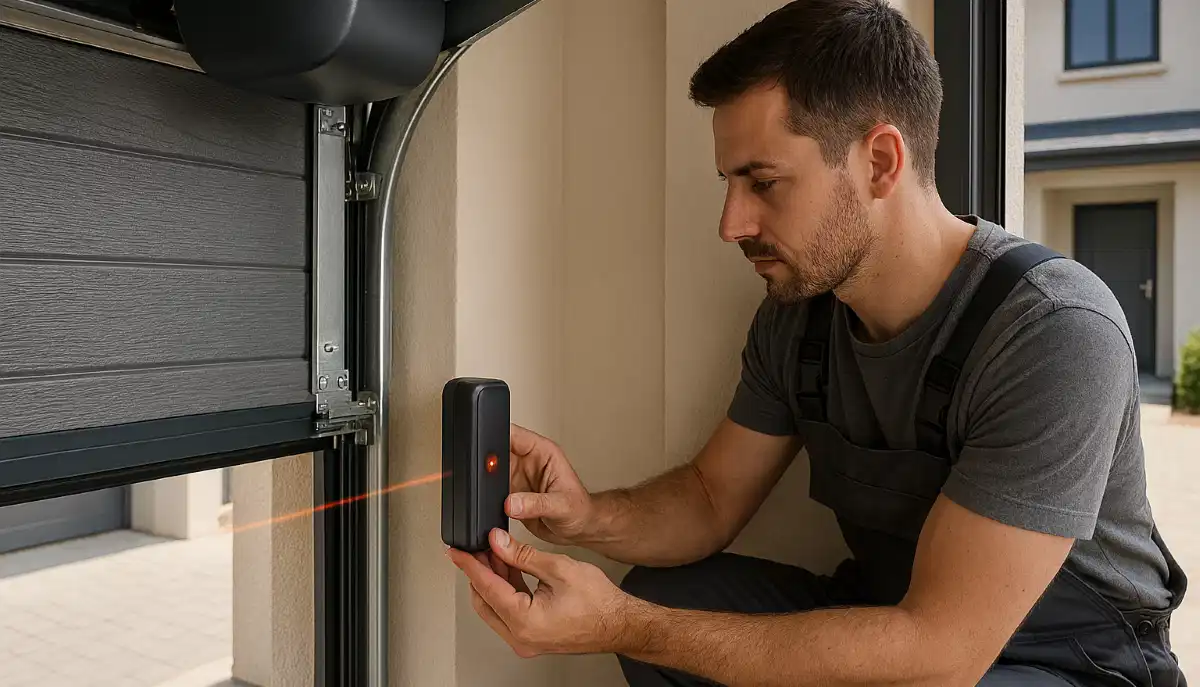
👁️ Safety Beams – The Invisible Shield
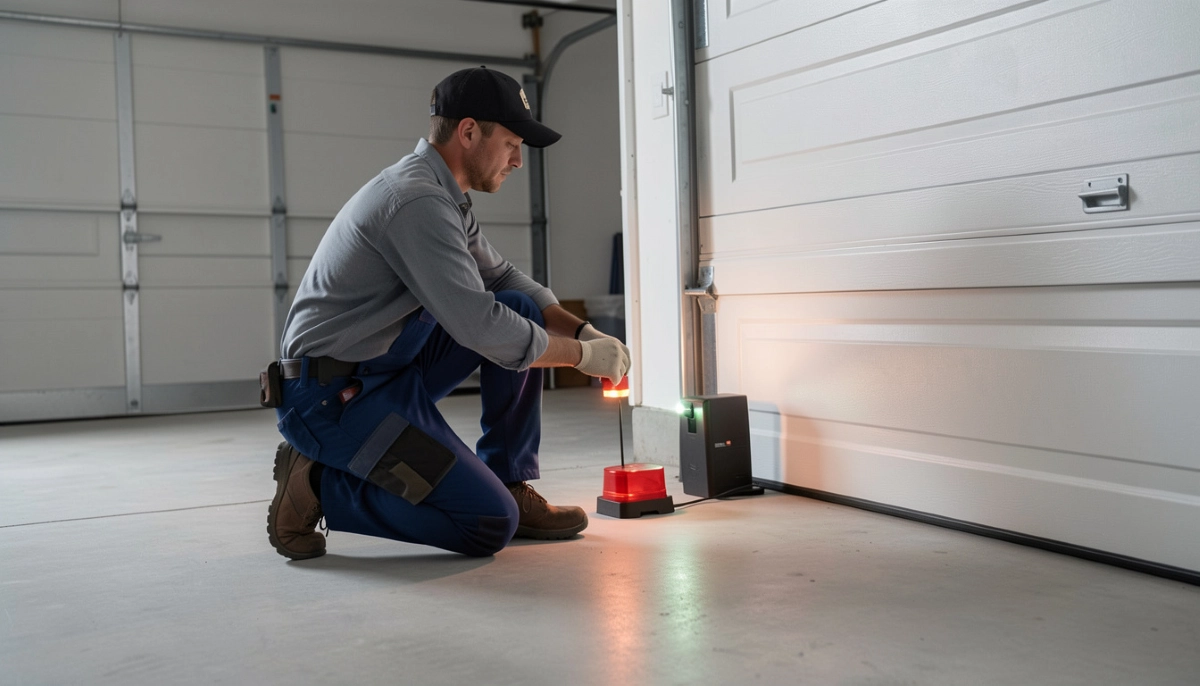
Safety beams (also called photo eyes or photocell sensors) are those small units mounted on each side of the door, near the floor.
How They Work
- One sensor emits an invisible infrared beam.
- The other sensor receives the beam.
- If the beam is broken while the door is closing, the door immediately reverses.
- This detects objects that might not trigger the force sensor (like a child or pet).
Common Problems
- Misalignment: If sensors aren’t pointing at each other, the beam is broken and door won’t close.
- Dirty lenses: Dirt or spider webs can block the beam.
- Sunlight interference: Direct sunlight can overwhelm the sensor.
- Wiring issues: Loose connections cause intermittent problems.
How to Test Safety Beams
- With the door open, press the close button.
- As the door starts closing, wave a broom handle or your leg in front of one sensor (without touching it).
- The door should immediately stop and reverse.
- Test both sensors (wave in front of each).
- If the door doesn’t reverse, clean the lenses and check alignment. If still not working, call a professional.
Indicator Lights
- Most sensors have small LED lights.
- Steady light: Properly aligned and working.
- Flashing or off: Misaligned or faulty.
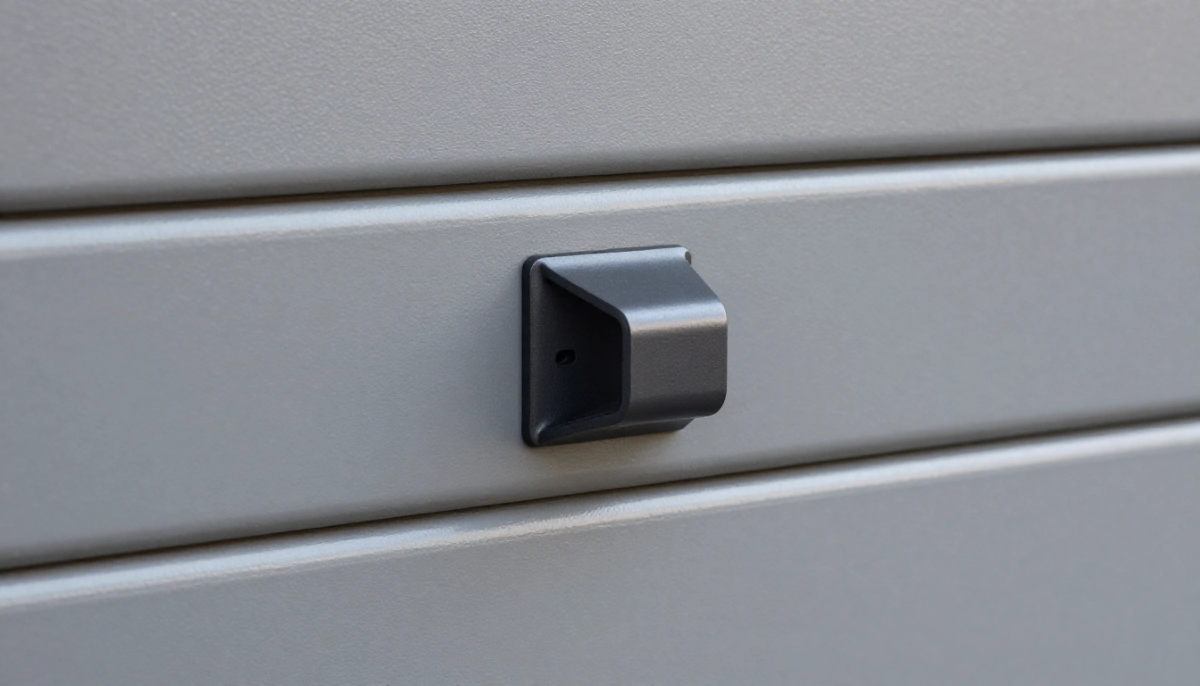
🆘 Manual Release – Escape During Emergencies
The manual release (usually a red cord with a handle) allows you to disengage the motor and operate the door manually. This is critical during loadshedding or motor failure.
How It Works
- Pulling the release cord disconnects the door from the motor carriage.
- The door can then be opened or closed manually.
- To re-engage, pull the cord towards the motor or operate the door slightly until it clicks back in.
Safety Considerations
- Know where it is: Everyone in the household should know the location of the release cord.
- Practice using it: Test the release twice a year so you’re comfortable with it.
- Door may be heavy: After release, the door may be heavy to lift – be prepared.
- Springs still under tension: Even with motor disengaged, springs are still under tension. Manual operation is safe, but be careful.
Loadshedding Importance
In South Africa, with frequent loadshedding, the manual release is essential. Without it, you could be trapped in or out of your garage. If you have battery backup, you may not need it often, but you should still know how to use it.
Pro Tip: Teach every family member how to use the manual release. In an emergency, you don’t want to be searching for instructions.
🔄 Spring Containment & Cable Safety
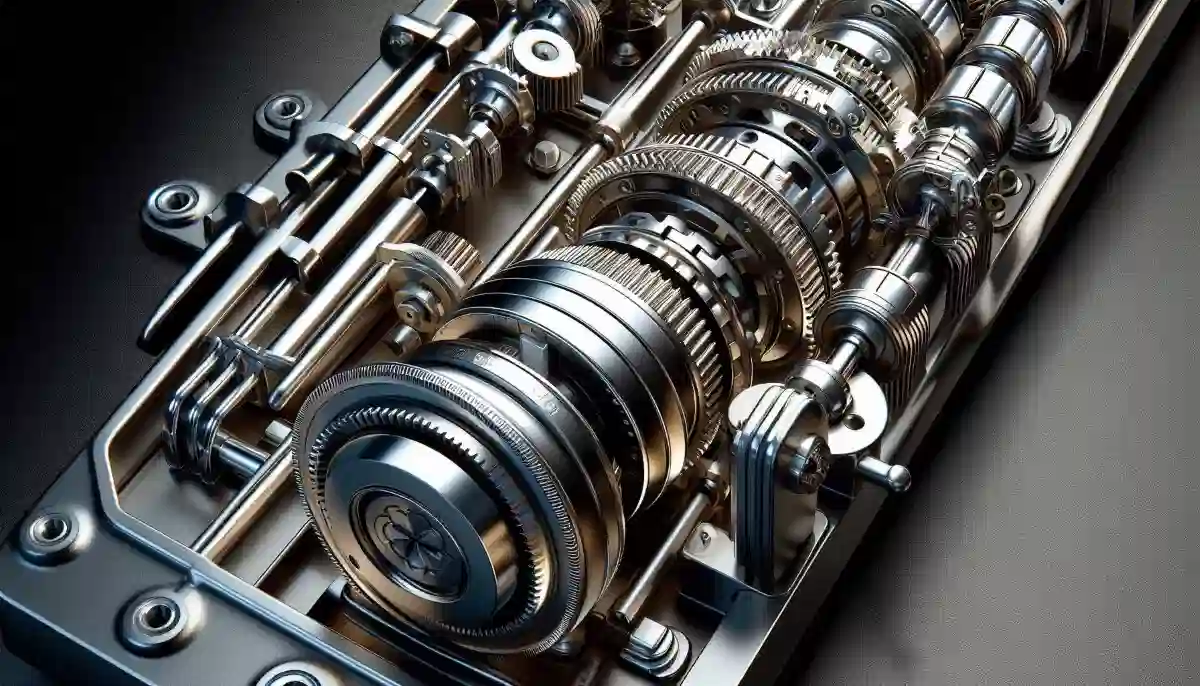
Springs and cables are under extreme tension. When they fail, they can cause catastrophic injury.
Spring Containment Systems
Torsion springs should be mounted on a containment cable or inside a tube. If the spring breaks, the containment system prevents pieces from flying.
- Safety cables: Run through the centre of extension springs. If a spring breaks, the cable stops it from flying.
- Spring shields: Some doors have shields covering springs.
Cable Safety Devices
- Safety cables: Secondary cables that catch the door if main cables break.
- Cable stops: Prevent cables from whipping if they break.
- Regular inspection: Look for fraying, rust, or damage.
Warning Signs
- Visible gap in spring (broken spring).
- Frayed or rusted cables.
- Door that’s hard to lift or falls quickly.
- Loud bang (spring or cable broke).
CRITICAL: Never attempt DIY spring or cable repair. These components are under lethal tension. Always call a professional.
🔧 Worried About Your Springs or Cables?
Don’t take risks. Get a professional safety inspection. Technicians will check spring containment, cable condition, and all safety components.
✋ Pinch Point Protection – Keeping Fingers Safe
Pinch points are areas where fingers can be caught between moving parts.
Where Pinch Points Occur
- Between panels: As sectional doors open and close, the gaps between panels can pinch.
- Hinges: Fingers can be caught in hinge points.
- Rollers and tracks: Fingers inserted into tracks can be crushed.
Protection Features
- Pinch-resistant panels: Specially designed hinges that keep gaps small and fingers safe.
- Hinge covers: Some doors have covers over hinges.
- Track guards: Prevent access to roller area.
Child Safety
Children are naturally curious about moving doors. If you have young children, consider:
- Installing a door with pinch-resistant panels.
- Teaching children never to play near the garage door.
- Keeping remotes out of reach of children.
🔐 Rolling Code Technology – Security Safety
While primarily a security feature, rolling codes also contribute to safety by preventing unauthorised access.
How It Works
- Each time you use your remote, the code changes.
- The motor and remote sync to the new code.
- This prevents “code grabbing” – criminals can’t capture and replay your remote signal.
Why It Matters for Safety
- Prevents strangers from opening your door.
- Reduces risk of home invasion.
- Protects family from unwanted entry.
Is Your System Rolling Code?
Most modern motors from Centurion and ET Systems use rolling codes. If your system is more than 10-15 years old, it may use fixed codes – consider upgrading.
⚡ Loadshedding – South Africa’s Unique Safety Challenge
Loadshedding creates specific safety concerns for garage doors.
The Risk
- During power outages, automated doors won’t work without battery backup.
- People may be trapped inside or outside their homes.
- In emergencies, inability to open door can be life-threatening.
Safety Solutions
- Battery backup: Essential for all automated doors in South Africa. Provides 5-30 cycles depending on battery size.
- Manual release knowledge: Everyone should know how to use it.
- Regular testing: Test battery every 3 months, replace every 2-3 years.
- Consider solar: Solar trickle chargers keep batteries topped up.
Power Surge Risks
When power returns, surges can damage motors and safety components. Consider:
- Surge protectors: Install on motor power supply.
- Whole-house surge protection: Protects all electronics.
✅ Complete Safety Testing Checklist
Use this checklist to test all safety features. Perform these tests every 3 months.
🔧 Monthly Quick Checks
- ☐ Visual inspection of springs and cables (from safe distance).
- ☐ Check sensor indicator lights – both steady?
- ☐ Listen for unusual noises.
- ☐ Ensure manual release cord is accessible.
📋 Quarterly Full Tests
- ☐ Auto-reverse test with object.
- ☐ Safety beam test – wave object in front.
- ☐ Balance test – door should stay at halfway.
- ☐ Manual release operation.
- ☐ Battery backup test (during loadshedding or by disconnecting power).
- ☐ Remote range test.
If Any Test Fails
Stop using the automatic opener immediately. The door can still be used manually, but until safety features are repaired, it’s not safe for automated operation. Call a professional technician.
🔧 Maintenance That Keeps Safety Features Working
Regular maintenance isn’t just about longevity – it’s about safety.
Critical Maintenance Tasks
- Lubrication: Keeps moving parts operating smoothly, reducing strain on safety systems.
- Track cleaning: Prevents binding that could interfere with auto-reverse.
- Sensor cleaning: Dirty lenses can’t detect obstructions.
- Tightening hardware: Loose bolts can affect alignment and operation.
- Spring inspection: Catch problems before they become dangerous.
See our maintenance guide for detailed instructions on safe DIY maintenance.
💰 Insurance Implications – Don’t Void Your Cover
Many homeowners don’t realise that insurance policies have requirements for garage door safety.
What Insurers Require
- Doors must meet SABS standards for safety.
- Safety features must be maintained and functional.
- Installations must be done by qualified professionals.
What Could Void Cover
- DIY installation that doesn’t meet standards.
- Disabled or bypassed safety features.
- Failure to maintain safety systems.
- Using non-compliant components.
Real-World Example
A child was injured by a garage door with disabled safety beams. The homeowner’s insurance claim was denied because the safety features were intentionally bypassed. Don’t let this happen to you.
🏠 Real-Life Safety Scenarios
These scenarios show why safety features matter.
Scenario 1: Child Runs Under Closing Door
A toddler chased a ball under a closing garage door.
Safety beams detected the child – door reversed.
Working safety beams prevented a tragedy.
Scenario 2: Car Slightly Parked Inside
Homeowner accidentally closed door on car boot.
Auto-reverse sensed resistance – door reopened.
Minor scratch instead of major damage.
Scenario 3: Loadshedding – Family Trapped
Power outage, no battery backup, family in garage.
Manual release allowed escape.
They knew how to use it from regular practice.
Scenario 4: Broken Spring
Spring broke with loud bang.
Spring containment cable prevented flying debris.
No injuries – containment system worked.
❌ 7 Common Safety Mistakes Homeowners Make
Learn from others’ errors: These mistakes compromise safety and put families at risk.
Mistake #1: Disabling Safety Features
Some homeowners disable sensors or auto-reverse because they find them annoying. This is incredibly dangerous. If your safety features are causing problems, fix them – don’t disable them.
Mistake #2: Never Testing Safety Features
Safety features can fail without you knowing. If you never test them, you won’t know they’re broken until someone gets hurt. Test every 3 months.
Mistake #3: Ignoring Warning Signs
Unusual noises, jerky movement, or doors that don’t close properly are warning signs. Ignoring them can lead to catastrophic failure.
Mistake #4: DIY Spring Repair
The most dangerous mistake. Garage door springs are under extreme tension. DIY repair kills people. Always call a professional.
Mistake #5: No Battery Backup in South Africa
With loadshedding, a door without battery backup is a safety hazard. You could be trapped during an emergency.
Mistake #6: Children Playing Near Garage Door
Teach children that the garage door is not a toy. Keep remotes out of reach.
Mistake #7: Using Unqualified Installers
That cheap handyman may not know safety regulations. Always use CIDB-registered and PSIRA-registered professionals.

❓ Frequently Asked Questions – Garage Door Safety
What safety features are required on garage doors in South Africa?
Under SANS 10400-T, automated doors must have auto-reverse, safety beams (photo electric sensors), manual release, and spring containment systems. These are mandatory, not optional.
How often should I test my garage door safety features?
Every 3 months. Test auto-reverse with an object, test safety beams by breaking the beam, and check that manual release works. Also test battery backup during loadshedding.
Can I disable my garage door sensors if they’re causing problems?
Absolutely not. Disabling safety sensors is dangerous and illegal. If sensors are causing issues (e.g., door won’t close), fix them – don’t disable them. Clean lenses, check alignment, or call a professional.
How do I know if my garage door springs are safe?
Perform a visual inspection monthly from a safe distance. Look for gaps in springs, rust, or distortion. Also do the balance test – door should stay at halfway. If you see any issues, call a professional immediately.
What should I do if my garage door won’t reverse when tested?
Stop using the automatic opener immediately. The door can still be used manually. Call a professional technician to diagnose and repair the problem. Failed auto-reverse is a serious safety hazard.
Do I need battery backup for loadshedding?
Yes, absolutely. Without battery backup, your automated door won’t work during power outages. This is a safety issue – you could be trapped. Most motors can accept a backup battery – install one if you don’t have it.
How do I use the manual release cord?
Pull the red cord downwards firmly. This disconnects the door from the motor. You can then open/close manually. To re-engage, pull the cord towards the motor or operate the door slightly until it clicks back. Practice twice a year.
Are old garage doors safe?
Old doors (pre-2000s) may lack modern safety features like auto-reverse and safety beams. They may also have worn springs and cables. Consider upgrading to a modern door or adding safety features to an existing door.
Will my insurance cover garage door accidents?
It depends. If safety features were disabled, not maintained, or non-compliant, your claim may be denied. Ensure your door meets SABS standards and safety features are functional. Check with your insurer for specific requirements.
How much does it cost to add safety features to an existing door?
R2,000 – R5,000+ depending on what’s needed. Adding safety beams to an automated door is R1,500 – R3,000. Spring containment systems add R1,000 – R2,500. A full safety upgrade is much cheaper than a tragedy.
✅ Final Thoughts – Safety Is Non-Negotiable
Your garage door is a powerful machine. Respect it. Maintain it. Test its safety features. These few minutes of attention every month could save a life – possibly the life of someone you love.
Your 4-Step Safety Action Plan:
- Test today: Go test your auto-reverse and safety beams right now. It takes 2 minutes.
- Schedule regular checks: Put quarterly safety tests on your calendar.
- Upgrade if needed: If your door lacks modern safety features, invest in them.
- Teach your family: Ensure everyone knows about manual release and garage door dangers.
🔑 The Bottom Line:
A 2-minute safety test every 3 months
could save your child’s life. Don’t skip it. Don’t delay it.
🛡️ Want Peace of Mind?
Get a professional safety inspection. Our network of qualified technicians will check every safety feature and ensure your door meets all regulations.
📞 Call our safety helpline: 073 138 4726
📚 Official Safety Resources:
- SABS – SANS 10400-T safety requirements for garage doors.
- OHSA – Occupational Health and Safety – garage door regulations.
- NHBRC – New home safety compliance guidelines.
- Centurion Systems – Safety beam specifications and installation guides.
This guide is for informational purposes. Always consult with a qualified professional for safety inspections and repairs.
Written by: ServiceLink SA Research Team
Industry analysis and safety research for South African homeowners
Our team has decades of combined experience in garage door installation and safety compliance. We’ve compiled this guide based on SABS standards, manufacturer specifications, and real-world safety incidents to help protect South African families.