Inverter vs Non-Inverter Aircon South Africa – 2026 Complete Guide
Choosing between an inverter vs non-inverter aircon in South Africa is one of the most important decisions you will make when installing a new air conditioner. This single choice affects your:
- Electricity bill for the next 10–15 years
- Cooling comfort and temperature stability
- Maintenance costs and frequency of repairs
- Lifespan of the system
- Overall investment value and return on investment
Many homeowners choose incorrectly, trying to save money upfront, only to lose tens of thousands of rands later in electricity and replacement costs. With Eskom electricity tariffs rising every year, this decision has never been more critical.
This guide explains everything in simple, practical terms so you can choose confidently – whether you’re in Johannesburg, Pretoria, Cape Town, Durban, or anywhere in South Africa.
📅 2026 Update: All prices, savings calculations, and comparisons reflect current market conditions. This guide references energy efficiency labelling standards and Eskom’s latest tariff structures.
Get Free Quotes From Certified Installers Near You
Compare prices for inverter and non-inverter aircons from registered professionals in your area.
✓ Free inspections ✓ Verified technicians ✓ Compare installation costs
Table of Contents
🔌 What Is an Inverter Air Conditioner?
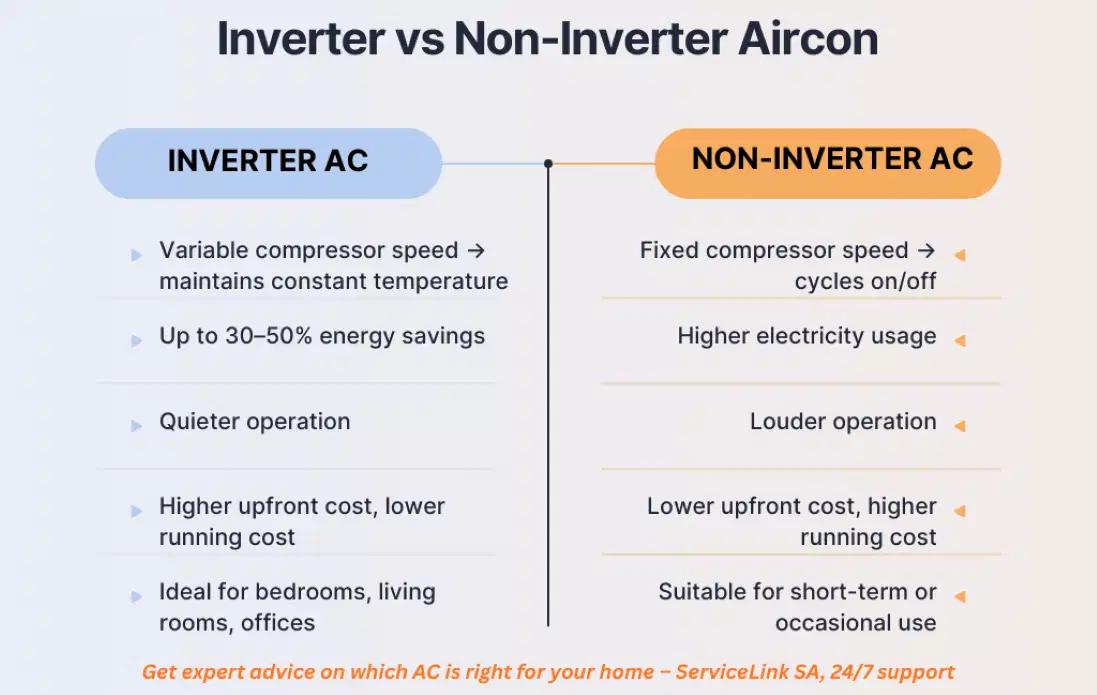
An inverter air conditioner adjusts its compressor speed automatically instead of switching on and off repeatedly. This variable speed technology is the key to its superior performance and efficiency.
Think of it like a car:
Non-inverter = full throttle, then stop, full throttle, then stop
Inverter = smooth speed adjustment
This allows inverter aircons to:
- Use less electricity – only as much as needed at any moment
- Maintain stable temperatures – no hot/cold swings
- Last longer – reduced stress on components
- Run quieter – no sudden start-up noise
This is why inverter air conditioners have become the preferred choice across South Africa, especially in areas like Sandton, Fourways, and Durban where aircons run for extended periods.
⚡ What Is a Non-Inverter Air Conditioner?
Non-inverter aircons (also called fixed-speed or on/off aircons) operate using compressors that run at a single fixed speed.
They work like a light switch:
- ON → cool → OFF → warm → ON again
This constant starting and stopping:
- Uses more electricity – each start-up draws high power
- Causes temperature fluctuations – swings of 2-3°C
- Wears out components faster – compressor stress
- Creates noise spikes – loud start-up and stop
They are cheaper initially, but more expensive long term – a fact many homeowners discover too late.

📊 Inverter vs Non-Inverter Aircon Comparison Chart South Africa
Here is the most important comparison at a glance:
| Feature | Inverter Aircon | Non-Inverter Aircon |
|---|---|---|
| Electricity usage | 30–60% lower | Higher baseline |
| Purchase cost | Higher | Lower |
| Lifespan | 10–15 years | 6–10 years |
| Noise level | Quiet, smooth | Louder, start-up spike |
| Comfort | Stable temperature (±0.5°C) | Fluctuating (±2-3°C) |
| Maintenance costs | Lower | Higher |
| Compressor wear | Low (variable speed) | High (on/off cycling) |
| Loadshedding tolerance | Better (soft start) | Higher surge risk |
💰 Electricity Savings: The Most Important Factor
Electricity costs in South Africa are rising rapidly. Eskom tariff increases have averaged 10-15% annually, and this trend is expected to continue. This makes inverter aircons far more economical over time.
📊 Real-world example (12000 BTU unit, 8 hours/day):
Inverter: R500/month
Non-inverter: R900/month
Monthly saving: R400
Yearly saving
R4,800
5-year saving
R24,000
10-year saving
R48,000
This alone makes inverter aircons the smarter investment. The R48,000 saved over 10 years is enough to buy three new inverter aircons – meaning the non-inverter owner pays for their unit multiple times over.
🔋 Why Inverter Aircons Use Less Electricity
Inverter compressors adjust speed instead of switching on and off. This reduces:
Power surges
Non-inverter units draw 3-5x running current at startup. Inverter units ramp up smoothly, eliminating surges.
Electricity spikes
Smooth power consumption means no sudden spikes on your meter.
Mechanical stress
Less stress means less energy wasted overcoming inertia.
Temperature overshoot
Non-inverter overcools then warms up; inverter maintains perfectly.
This improves efficiency significantly. Inverter aircons typically achieve COP (Coefficient of Performance) ratings of 4.0-5.0, compared to 2.5-3.0 for non-inverter units.
🏷️ Purchase Cost Comparison South Africa (2026)
Here is typical pricing for inverter vs non-inverter units (unit only, excluding installation):
| Unit Size | Inverter Price | Non-Inverter Price | Price Difference |
|---|---|---|---|
| 9,000 BTU | R6,500 – R10,000 | R4,500 – R7,000 | +R2,000-3,000 |
| 12,000 BTU | R8,000 – R13,000 | R6,000 – R9,000 | +R2,000-4,000 |
| 18,000 BTU | R13,000 – R20,000 | R10,000 – R15,000 | +R3,000-5,000 |
| 24,000 BTU | R18,000 – R30,000 | R15,000 – R22,000 | +R3,000-8,000 |
Installation cost is similar for both types – typically R1,800 – R4,000 per unit depending on complexity. See our aircon installation cost guide for detailed breakdowns.
Inverter costs more initially but saves much more long term – typically payback period of 1-3 years depending on usage.
📋 Real Case Study: Johannesburg Homeowner Saved R36,000
Client: 3-bedroom house in Sandton
Installation: 4 units (3x 12000 BTU, 1x 18000 BTU)
Inverter option:
Total cost: R52,000
Monthly electricity: R1,200
Non-inverter option:
Total cost: R44,000
Monthly electricity: R1,800
Monthly saving: R600
Yearly saving: R7,200
10-year saving: R72,000
Additional inverter cost: R8,000
Net benefit over 10 years: R64,000
The homeowner recovered the extra R8,000 investment in 14 months and saved R64,000 over the system’s life. This is typical for South African homes.
⏳ Lifespan Comparison
Inverter Aircon
10 – 15 years
with proper maintenance
Non-Inverter Aircon
6 – 10 years
with proper maintenance
Why the difference?
- Non-inverter compressors start and stop constantly – each start-up causes wear and electrical stress
- Inverter compressors run continuously at varying speeds – less mechanical stress
- Non-inverter units experience more voltage fluctuations during start-up
- Inverter units have soft-start technology, reducing wear on electrical components
Over 15 years, you might replace a non-inverter unit twice while one inverter unit still runs perfectly. This alone justifies the higher initial cost.
🌡️ Comfort and Temperature Stability
This is a huge advantage for inverter aircons that many homeowners don’t appreciate until they experience it.
Non-Inverter Temperature Swings
±2-3°C
Cold → warm → cold → warm
Unit cools to 22°C, switches off, room warms to 25°C, switches on again. Constant noticeable fluctuation.
Inverter Temperature Stability
±0.5°C
Smooth, consistent temperature
Unit adjusts speed continuously, maintaining exactly 23°C with barely noticeable variation.
This is especially important in:
- Bedrooms – temperature swings disrupt sleep
- Offices – consistent comfort improves productivity
- Babies’ rooms – stable temperature is safer and more comfortable
- Medical rooms – where temperature control matters
🔇 Noise Comparison
Inverter aircons are significantly quieter for two reasons:
- No start-up bang – non-inverter compressors make a loud “thump” when starting
- Lower running noise – inverter units run at lower speeds most of the time
Typical noise levels:
- Inverter: 19-35 dB (indoor unit) – whisper quiet
- Non-inverter: 30-50 dB – clearly audible, especially at night
For light sleepers or bedrooms, inverter is the only sensible choice.
🛠️ Maintenance Cost Comparison
| Maintenance Item | Inverter Aircon | Non-Inverter Aircon |
|---|---|---|
| Annual service cost | R650 – R1,200 | R650 – R1,200 (similar) |
| Compressor failure risk | Low | Higher |
| PCB issues | Slightly higher (more electronics) | Lower |
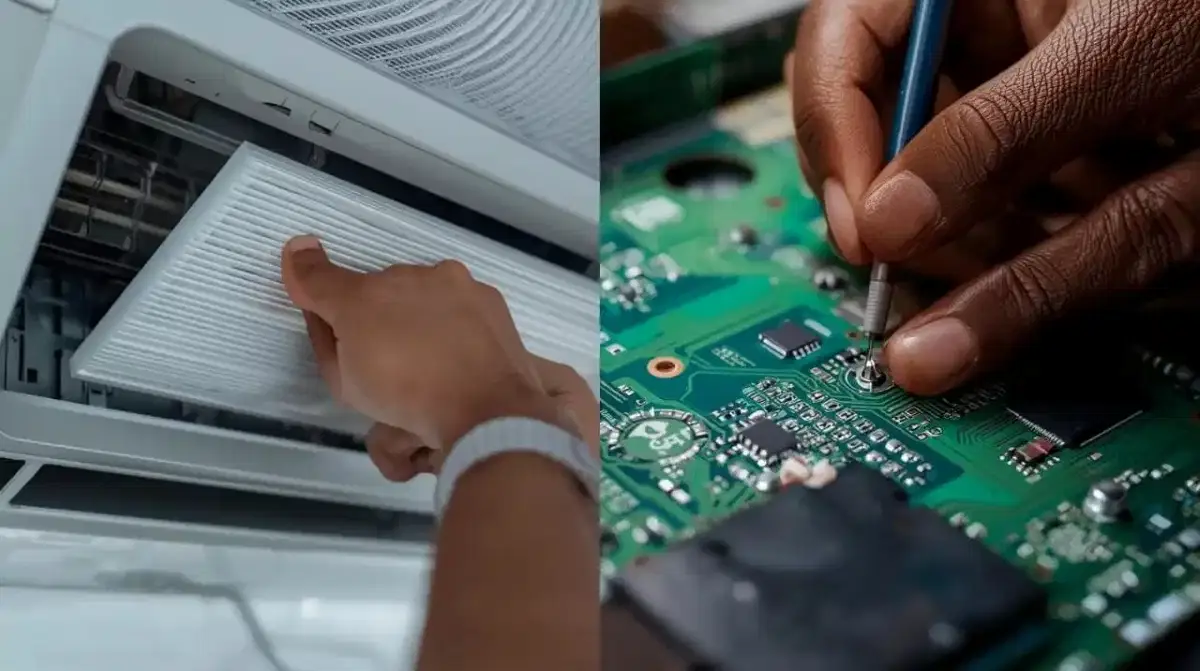
| Typical 10-year repair costs | R2,000 – R5,000 | R4,000 – R10,000 |
Inverter aircons generally have lower overall maintenance costs because they experience less mechanical stress. However, when inverter PCBs fail, repairs can be more expensive. Quality brands like Daikin, Samsung, and LG have excellent reliability records.
🤔 When Non-Inverter Aircon Makes Sense
Non-inverter may be suitable in these limited situations:
✅ Rare usage
If used only a few days per year (guest room, occasional office), payback period extends beyond lifespan.
✅ Very small room
Under 10m² where a small non-inverter might run less frequently.
✅ Extreme budget constraints
If you genuinely cannot afford the upfront cost – but consider financing through pay-later options.
✅ Rental properties
Where tenant pays electricity and you want lowest capital outlay.
For 95% of South African homes, inverter is superior. Don’t let the exceptions guide your decision unless they clearly apply to you.
⚡ Loadshedding Performance
With ongoing loadshedding, this matters:
- Inverter aircons have soft-start technology – they ramp up power gradually, reducing stress on your electrical system when power returns
- Non-inverter units draw massive start-up current – up to 5x running current, which can trip breakers when power is restored
- Inverter units handle voltage fluctuations better – they can operate at reduced capacity during brownouts
- Inverter units are more compatible with backup power – solar, battery, and generator systems handle inverter loads better
See our loadshedding backup guide for more on running aircons during power outages.
🌍 Environmental Benefits
Inverter aircons are better for the environment:
- 30-60% less electricity – reduces carbon footprint
- Longer lifespan – fewer units end up in landfills
- Modern refrigerants – most use R32, which has lower global warming potential than older gases
- Eskom pressure reduction – less demand on the national grid during peak times
🚨 Biggest Mistake Homeowners Make
Choosing non-inverter to save money upfront
This is the most common and expensive mistake. Homeowners see the lower price tag and think they’re saving money. In reality, they’re committing to:
- R3,000-8,000 per year in extra electricity
- Shorter lifespan – replace sooner
- Higher repair costs
- Poorer comfort and more noise
Over 10 years, this “saving” costs R30,000 – R80,000 extra. Don’t fall for it.
❓ Frequently Asked Questions
Is inverter aircon worth it in South Africa?
Yes, absolutely. Inverter air conditioners reduce electricity usage by 30–60%, last longer, and provide better comfort. Due to rising electricity prices in South Africa – Eskom tariffs have increased 150% over the past decade – inverter aircons offer significantly better long-term value despite higher upfront cost. Payback period is typically 1-3 years, after which you’re saving money every month.
How much electricity does inverter aircon save?
Inverter air conditioners typically save between 30% and 60% electricity compared to non-inverter units. This can reduce monthly electricity costs by R200 to R600 depending on usage and unit size. For a typical 3-bedroom home with 4 units, annual savings of R5,000-R10,000 are common. See our installation cost guide for detailed calculations.
Why is inverter aircon more expensive?
Inverter aircons use advanced compressor technology with variable speed drives and sophisticated PCB controls that adjust power continuously. This technology improves efficiency, reduces wear, and increases lifespan. The components are more expensive to manufacture, but the investment pays back through lower electricity bills – typically within 1-3 years in South Africa.
Which aircon lasts longer – inverter or non-inverter?
Inverter air conditioners last longer, typically 10–15 years compared to 6–10 years for non-inverter units. Reduced compressor stress is the main reason – inverter compressors run smoothly at varying speeds while non-inverter units suffer from constant start-stop cycling, which causes mechanical and electrical wear. Premium inverter brands like Daikin, Samsung, and LG often reach 15+ years.
Is inverter aircon better for bedrooms?
Yes, inverter aircons are ideal for bedrooms for two reasons: they are significantly quieter (no start-up noise, lower running noise) and they maintain stable temperature without the 2-3°C swings of non-inverter units. This improves sleep quality dramatically. Most bedroom installations in Sandton, Fourways, and Cape Town now use inverter technology.
Do inverter aircons break easily?
No, inverter aircons are generally more reliable due to smoother operation and reduced compressor stress. However, they have more complex electronics (PCBs) which can occasionally fail. Quality brands with good local support – like Daikin, Samsung, and LG – have excellent reliability records. Proper installation by certified aircon installers is critical for longevity.
Is non-inverter aircon cheaper to run?
No, non-inverter aircons are more expensive to run because they use 30-60% more electricity. They only have lower initial purchase price. Over 10 years, a non-inverter unit typically costs R20,000-R50,000 more in electricity than an equivalent inverter unit. With Eskom tariffs rising, this gap will only widen.
How do inverter aircons handle loadshedding?
Inverter aircons handle loadshedding better than non-inverter units because they have soft-start technology – they ramp up power gradually when electricity returns, reducing stress on your electrical system. They also tolerate voltage fluctuations better. For running during loadshedding, they’re more compatible with solar and battery backup systems. See our loadshedding guide for details.
What size inverter aircon do I need?
Sizing is the same for inverter and non-inverter – use our BTU calculator based on room size, sun exposure, and insulation. Inverter units are available in all standard sizes from 9000 BTU to 36000 BTU and beyond.
How do I get inverter aircon installed near me?
Request free quotes from certified installers in your area. Compare prices, check credentials, and ensure they have experience with inverter installations. Professional installation is essential for inverter performance – incorrect installation can negate the efficiency benefits.
Written by ServiceLink SA Research Team
21+ years construction and digital industry experience
Our team has analysed thousands of inverter vs non-inverter installations across South Africa. This guide is based on real electricity bills, lifespan data, and installer feedback – not manufacturer marketing. We reference Eskom tariff data, energy efficiency labelling, and solar compatibility standards.
✅ Action Plan – Choose Your Aircon
- Confirm inverter is right for you – For 95% of homes, yes
- Calculate room sizes – Use our BTU calculator
- Choose your brand – See best aircon brands
- Get multiple quotes – Compare at least 3 installers
- Verify credentials – Check SAQA registration and experience
- Consider payback period – Usually 1-3 years for inverter
- Check warranty – Minimum 5 years on compressor
- Schedule installation – Before summer peak
- Enjoy lower bills – Monitor your savings
📞 Get Inverter Aircon Installation Quotes Near You
Compare prices from certified installers for top inverter brands – Daikin, Samsung, LG, and more.
✓ Free inspections ✓ Verified technicians ✓ Best inverter prices
Gauteng •
Johannesburg •
Pretoria •
Cape Town •
Durban •
Sandton •
Fourways •
Bellville
External references and industry standards:
- Eskom – Loadshedding schedules and inverter appliance guidelines
- SolarISSA – Solar + inverter AC compatibility information
- Energy Rating South Africa – Official energy efficiency labelling
- SABS – SANS 10147 refrigeration safety standards
Prices and savings calculations accurate as of February 2026. Actual savings depend on usage patterns and local electricity tariffs.