
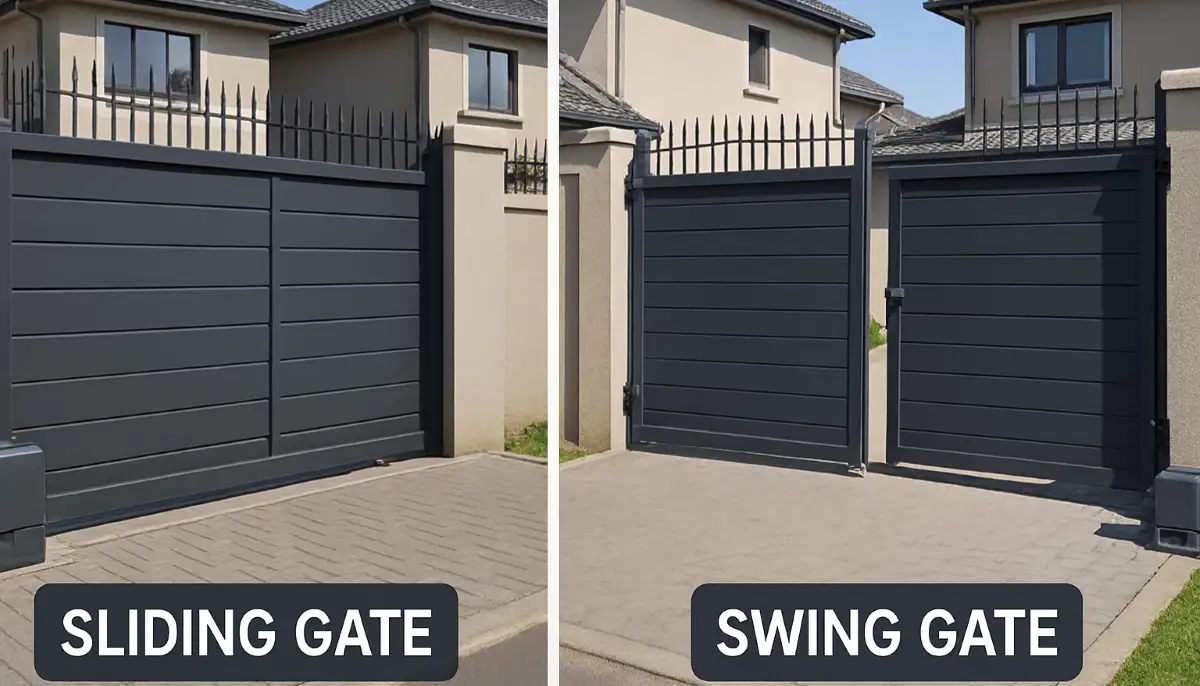
Sliding vs Swing Gates South Africa – Complete Comparison Guide
🚪 Sliding gate or swing gate? Space, cost, security & automation – we help you choose the perfect entrance for your property.
One of the biggest decisions when securing your property is choosing between a sliding gate and a swing gate. It’s not just about looks – the choice affects how much space you need, what motor you’ll use, installation costs, security, and even your daily convenience. Whether you’re building a new home in Sandton, securing a smallholdings in Pretoria, or renovating a coastal property in Cape Town, this comprehensive guide compares sliding vs swing gates across every important factor. We’ll help you make the right choice for your specific property, budget, and lifestyle.
📋 Not Sure Which Gate Type to Choose?
Get free advice and quotes from experienced gate installers in your area. They’ll assess your property and recommend the perfect solution.
Servicing Johannesburg, Pretoria, Cape Town, Durban, and all major areas
📖 Table of Contents – Sliding vs Swing Gates
📊 Quick Comparison: Sliding vs Swing Gates
Here’s your at-a-glance comparison of sliding and swing gates across key factors.
| Feature | Sliding Gate | Swing Gate |
|---|---|---|
| Space Required | Minimal – slides along fence line | Large – requires swing radius (equal to gate width) |
| Slope Suitability | Excellent – follows terrain contours | Poor – requires level ground |
| Security | Superior – difficult to force open | Moderate – can be lifted off hinges |
| Gate Cost (material only) | Higher (R8,000 – R25,000+) | Lower (R6,000 – R20,000+) |
| Motor Cost (installed) | R7,000 – R11,500 (single motor) | R9,500 – R16,000 (pair for double gate) |
| Installation Complexity | Higher – needs track or cantilever system | Moderate – needs strong posts |
| Aesthetic | Modern, sleek, industrial | Traditional, elegant, grand |
| Maintenance | Moderate – track cleaning, wheel replacement | Higher – hinge maintenance, alignment |
| Wind Resistance | Excellent – low profile | Poor – acts as sail |
| Ideal For | Narrow driveways, slopes, high security | Wide entrances, level ground, traditional homes |
Key Insight: There’s no universal “best” choice – it depends entirely on your property’s layout, slope, and your priorities. Use this guide to find YOUR best match.
⬅️ Sliding Gates – The Space-Saving Champion
Sliding gates move horizontally along a track or on rollers, sliding to the side to open. They’re the most popular choice for modern South African homes.
Pros of Sliding Gates
- Space efficient: Requires no swing radius – ideal for properties where the driveway is close to the boundary wall or house.
- Works on slopes: Can follow the contour of your driveway, even on steep inclines.
- Superior security: Difficult to force open. Can’t be lifted off hinges like swing gates.
- Wind resistant: Low profile means wind passes over – no sail effect.
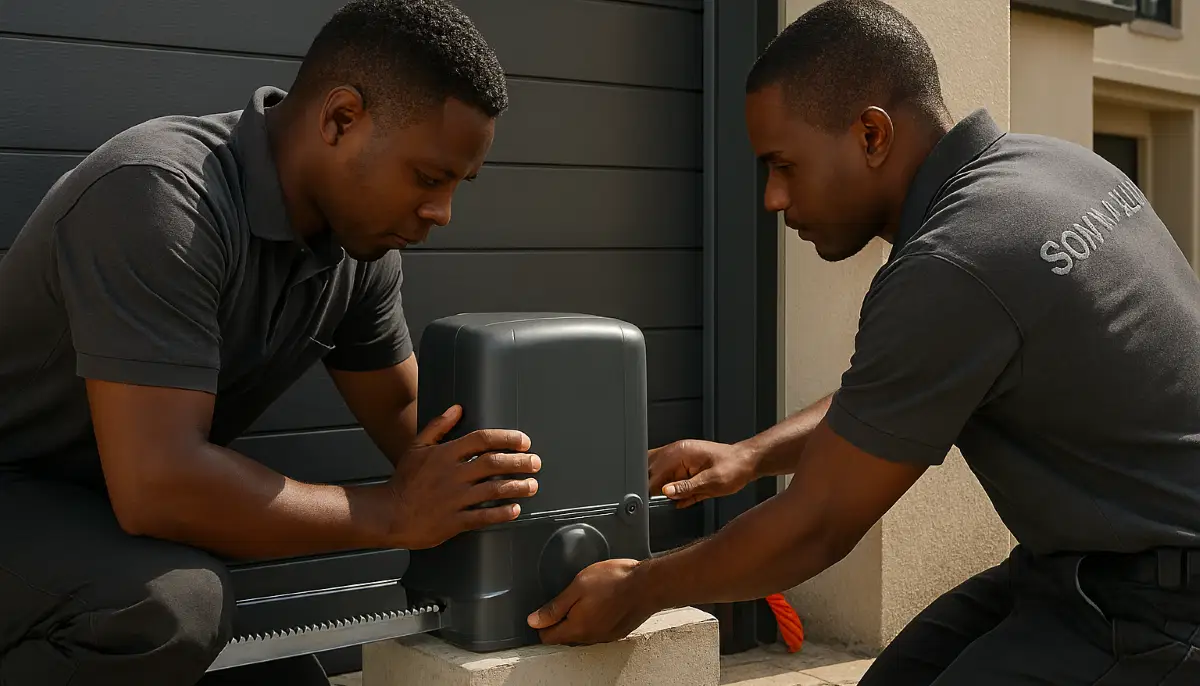
- Automation friendly: Simple to automate with rack and pinion system.
- Modern aesthetic: Sleek, contemporary look suits modern architecture.
Cons of Sliding Gates
- Higher initial cost: More complex mechanism means higher gate and installation costs.
- Space alongside required: Needs space along the fence line for the gate to slide into.
- Track maintenance: Ground track can collect debris; needs regular cleaning.
- Wheel wear: Rollers and wheels eventually need replacement.
- Not suitable for very wide openings: Very wide gates become heavy and may sag.
Typical Sliding Gate Costs
- Gate only (4m x 1.8m steel): R8,000 – R15,000
- Gate only (4m x 1.8m aluminium): R12,000 – R22,000
- Motor (installed): R7,000 – R11,500 (Centurion D5 Evo or equivalent)
- Complete installed (gate + motor): R15,000 – R35,000+
Types of Sliding Gates
- Tracked sliding: Runs on a ground track. Most common, affordable, but track can collect debris.
- Cantilever sliding: No ground track – gate is suspended from above. More expensive, no track to clean, ideal for uneven ground.
- Vertical sliding: Rare in residential, used for space constraints.
🚪 Swing Gates – The Traditional Elegance
Swing gates operate like regular doors, hinged at the sides and swinging inward or outward. They’re the classic choice for grand entrances.
Pros of Swing Gates
- Elegant appearance: Creates a grand, welcoming entrance. Traditional and timeless.
- Lower gate cost: Simpler construction means lower material cost than sliding gates.
- No track to clean: No ground track means no debris collection.
- Suitable for very wide openings: Can be made for extremely wide entrances.
- Can be single or double: Flexibility in design – single for narrow, double for wide.
- Pedestrian access: Easy to incorporate a small pedestrian gate within one leaf.
Cons of Swing Gates
- Large space required: Needs swing radius equal to gate width. If space is tight, you can’t use swing gates.
- Poor on slopes: Requires level ground. On slopes, gates won’t close properly or will scrape.
- Security concerns: Can be lifted off hinges (though anti-lift hinges exist).
- Wind vulnerable: Acts as a sail – strong winds can damage gates or motors.
- More complex automation: Needs two motors for double gates, increasing cost.
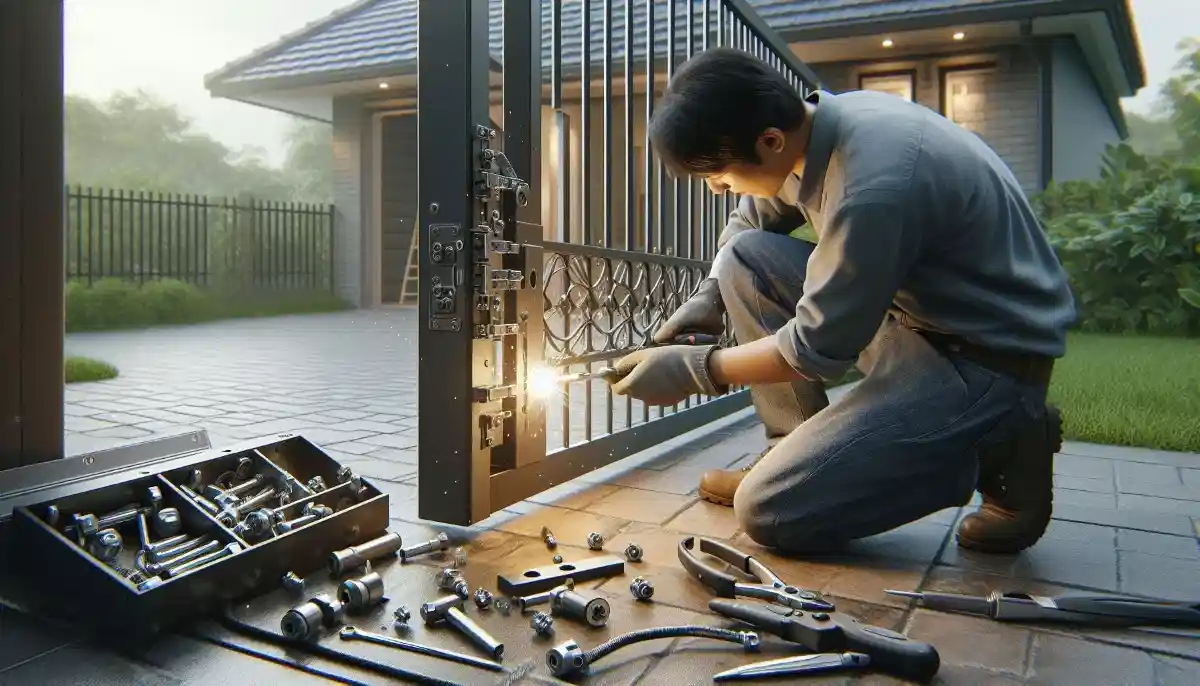
- Hinge maintenance: Hinge pins wear and can sag over time.
Typical Swing Gate Costs
- Single gate only (steel): R4,000 – R10,000
- Double gate set (steel): R8,000 – R20,000
- Motors (pair, installed): R9,500 – R16,000 (ET Wingo or equivalent)
- Complete installed (double gate + motors): R18,000 – R40,000+
Types of Swing Gates
- Inward swinging: Opens into property. Requires space inside.
- Outward swinging: Opens onto street/pavement. May need council approval.
- Single swing: One large gate leaf. Requires more swing radius.
- Double swing: Two leaves, each half the width. Requires less swing radius per leaf.
📏 Space Requirements – The Deciding Factor
For many properties, space is the deciding factor. Here’s how to calculate what you need.
Swing Gate Space Requirements
A swing gate needs a clear swing radius equal to the width of the gate leaf. For a 4m double gate (two 2m leaves), each leaf needs 2m of clear space to swing open. That means:
- Inward swinging: 2m of clear driveway space inside the property.
- Outward swinging: 2m of clear space onto the street/pavement.
If your driveway is narrow or your house is close to the gate, swing gates may be impossible.
Sliding Gate Space Requirements
A sliding gate needs space alongside the opening equal to the gate width. For a 4m gate, you need 4m of clear fence line for the gate to slide into. That means:
- The gate slides onto your property along the boundary wall/fence.
- No space is needed in the driveway itself.
Quick Space Checklist
- ✅ Choose sliding if: Your driveway is narrow, house is close to gate, or you have long boundary walls.
- ✅ Choose swing if: You have plenty of space inside or outside, and a grand entrance is desired.
Space-Saving Tip: If you love the look of swing gates but have limited space, consider double swing gates. Two leaves each half the width require half the swing radius.
⛰️ Slope Suitability – Gates on Uneven Ground
South African properties are rarely perfectly flat. Here’s how gate types handle slopes.
Sliding Gates on Slopes
Excellent. Sliding gates can follow the contour of your driveway. Whether your driveway slopes up, down, or sideways, a sliding gate can be designed to match the terrain. Cantilever sliding gates are particularly good for slopes as they have no ground track to bind.
Swing Gates on Slopes
Poor. Swing gates require level ground. On a slope:
- The gate will swing uphill/downhill, causing it to drag or not close properly.
- The bottom of the gate may hit high spots or leave gaps at low spots.
- Automation becomes difficult – motors struggle with uneven movement.
Slope Decision Guide
- ✅ If your driveway slopes more than 1:20 (5%): Choose sliding.
- ✅ If your driveway is perfectly level: Either works.
🏠 Not Sure What Works on Your Property?
Get a professional site assessment. Local gate installers will measure your space, check the slope, and recommend the perfect gate type for your specific situation.
🔒 Security Comparison – Which is Safer?
Security is often the primary reason for installing a gate. Here’s how they compare.
Sliding Gate Security
Superior. Sliding gates are inherently more secure because:
- They can’t be lifted off hinges – they’re supported along their entire length.
- The motor and rack mechanism make it difficult to force open manually.
- Anti-lift and anti-jump devices can be fitted to prevent lifting off the track.
- No gap between gate and posts when closed (if properly designed).
Swing Gate Security
Moderate. Swing gates have vulnerabilities:
- Can be lifted off hinges (though anti-lift hinges are available).
- Hinges can be cut or forced.
- Gap between gate leaves can be a weak point.
- Can be forced open with a vehicle if not properly locked.
However, with quality locks, anti-lift hinges, and proper automation, swing gates can still provide excellent security.
Security Upgrades for Both
- Anti-lift devices: Prevent gates from being lifted off track or hinges.
- Electric locking: Motors with electronic locks secure the gate when closed.
- Intercom/CCTV integration: See who’s at the gate before opening.
- Safety beams: Detect attempts to force gate open.
⚙️ Automation Costs – Motor Requirements
The gate type dramatically affects automation costs. See our gate motor guide for detailed pricing, but here’s the comparison.
Sliding Gate Motor Costs
- One motor only. Sliding gates need a single motor, regardless of gate width.
- Motor cost (installed): R7,000 – R11,500 (Centurion D5 Evo or ET Drive 600).
- Rack installation: Usually included, but may be extra if gate needs rack.
Swing Gate Motor Costs
- Two motors for double gates. Each leaf needs its own motor.
- Motor cost (pair, installed): R9,500 – R16,000 (ET Wingo or equivalent).
- Single swing gate: One motor only, but gate must be very sturdy.
- Underground motors: More expensive option for hidden installation.
Automation Cost Comparison (Typical)
- Sliding gate + motor: R15,000 – R35,000 total
- Swing gate (double) + motors: R18,000 – R40,000 total
- Generally, sliding gates have higher gate cost but lower motor cost. Swing gates have lower gate cost but higher motor cost. The totals are often similar.
🛠️ Installation Complexity & Timeline
Sliding Gate Installation
- Complexity: Higher. Requires precise ground preparation, concrete base for track (if tracked), and alignment.
- Timeline: 2-3 days typically.
- Challenges: Ground must be prepared, track must be perfectly level, cantilever systems require precise engineering.
Swing Gate Installation
- Complexity: Moderate. Requires strong posts, precise hinge alignment, and motor mounting.
- Timeline: 1-2 days typically.
- Challenges: Posts must be perfectly vertical and strong enough to support gate weight. Hinges must align exactly.
Installation Requirements
- Both need: Professional installation. This is not DIY work.
- Both need: Electrical supply at gate location.
- Both need: Concrete footings for posts or track.
🎨 Aesthetics – Which Looks Better?
Beauty is subjective, but here’s how the styles generally compare.
Sliding Gate Aesthetics
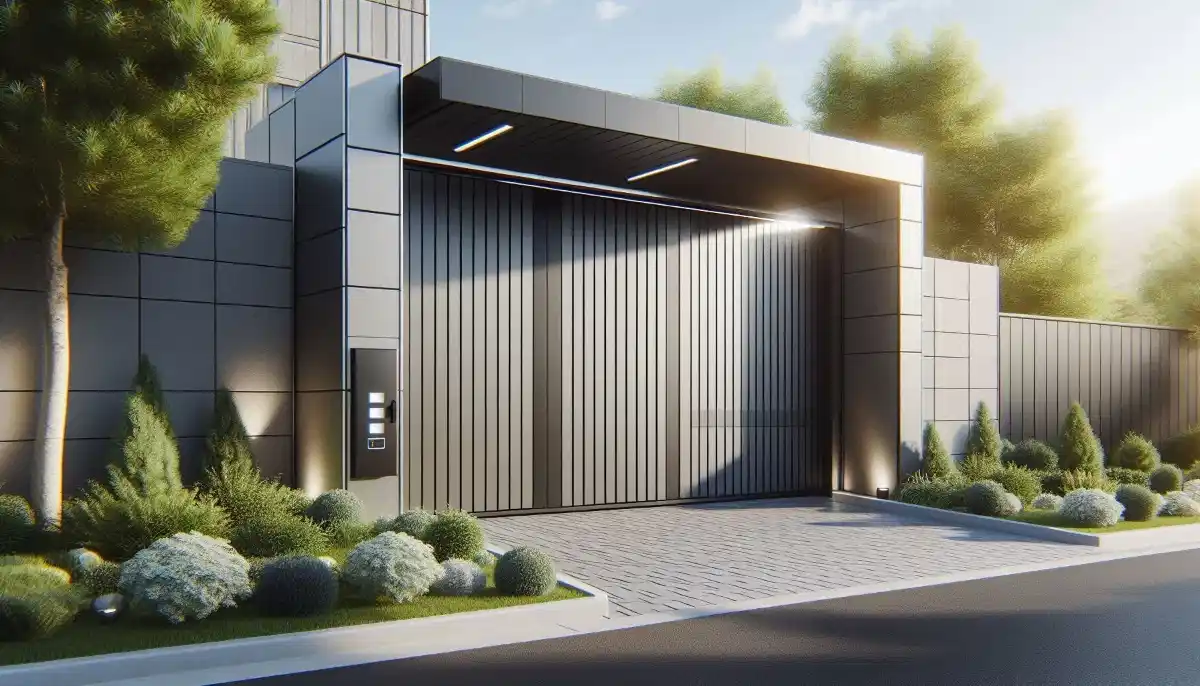
- Modern, sleek, minimalist. Suits contemporary architecture.
- Can be designed with horizontal lines, laser-cut patterns, or solid panels.
- Less imposing – slides away when open, so entrance feels open.
- Industrial look if not carefully designed.
Swing Gate Aesthetics
- Traditional, elegant, grand. Suits classical, Cape Dutch, or Mediterranean styles.
- Creates a statement – double swing gates opening make a grand entrance.
- Can be highly decorative with scrollwork, finials, and ornate details.
- Visible when open – gates project into property, creating a framed entrance.
Material Considerations
- Both types can be made in steel, aluminium, or wood. See our steel vs aluminium guide for material choices.
- Aluminium suits modern sliding gates perfectly – lightweight and corrosion-resistant.
- Steel works for both – can be made ornate for swing gates or sleek for sliding.
- Wood is traditionally used for swing gates, less common for sliding.
🔧 Maintenance Requirements
Sliding Gate Maintenance
- Track cleaning: If tracked, clean debris from track regularly (monthly).
- Wheel inspection: Check wheels for wear every 6 months. Replace when worn.
- Rack lubrication: Lubricate rack every 6 months.
- Motor maintenance: As per manufacturer (battery checks, limit switches).
Swing Gate Maintenance
- Hinge lubrication: Lubricate hinge pins every 6 months.
- Check for sagging: Inspect gate alignment – adjust if gate sags.
- Post inspection: Ensure posts remain solid and vertical.
- Motor maintenance: Similar to sliding, plus check arm connections.
Overall
Both require similar effort – sliding needs track cleaning, swing needs hinge attention. Neither is significantly more or less maintenance overall.
🏠 Realistic Installation Examples
Let’s look at real-world scenarios from across South Africa.
Example 1: Narrow Driveway, Randburg
4m sliding gate, limited space between house and boundary.
Total: R24,500
Includes: Steel sliding gate, Centurion D5 Evo motor, installation, battery backup.
Sliding was the only option – no space for swing.
Example 2: Grand Entrance, Constantia
Double aluminium swing gates, level driveway.
Total: R38,000
Includes: Aluminium double swing gates, ET Wingo motors, installation, intercom integration.
Homeowner wanted the grand look – swing perfect.
Example 3: Sloped Driveway, Ballito
Cantilever sliding gate on steep slope.
Total: R42,000
Includes: Aluminium cantilever sliding gate, Centurion D5 Evo, no track, installation.
Slope made swing impossible – cantilever sliding was perfect.
Example 4: Farm Entrance, Hartbeespoort
Double steel swing gates, wide entrance.
Total: R28,500
Includes: Steel double gates, Gemini motors, installation.
Plenty of space, traditional farm look.
✅ Decision Guide – How to Choose
Use this simple flow to make your decision:
🔍 Quick Decision Flow:
- ➡️ Step 1: Measure your space. Do you have enough room for a swing gate to open? If NO → CHOOSE SLIDING.
- ➡️ Step 2: Check your slope. Is your driveway sloped more than 5%? If YES → CHOOSE SLIDING.
- ➡️ Step 3: Consider security priorities. Maximum security needed? Sliding has edge.
- ➡️ Step 4: Think about aesthetics. Want grand, traditional entrance? Swing may suit. Prefer modern, sleek? Sliding.
- ➡️ Step 5: Compare costs. Get quotes for both – totals may be similar.
- ➡️ Step 6: Get professional advice. Local installer can assess your property.
| Situation | Recommended Gate Type |
|---|---|
| Narrow driveway (less than gate width inside/outside) | SLIDING – only option |
| Sloped driveway | SLIDING – swing won’t work |
| Maximum security required | SLIDING – more secure |
| Grand entrance, traditional home, level ground | SWING – aesthetic win |
| Wide opening, plenty of space | Either – personal preference |
| Coastal location (corrosion concerns) | Aluminium version of either |
| Very windy area | SLIDING – less wind resistance |
❌ 7 Common Mistakes When Choosing Gate Type
Learn from others’ errors: These mistakes cost homeowners thousands in modifications or replacements.
Mistake #1: Choosing Swing Gates Without Checking Space
The most common mistake. Homeowners fall in love with the look of swing gates, only to find they don’t have room for them to open. Measure first.
Mistake #2: Ignoring the Slope
Swing gates on slopes won’t close properly, will drag, and motors will struggle. If your driveway slopes more than 5%, sliding is the only practical choice.
Mistake #3: Not Checking HOA or Estate Rules
Many estates have strict rules about gate types, colours, and styles. Check before you order.
Mistake #4: Undersized Posts for Swing Gates
Swing gates need massive, well-concreted posts. Flimsy posts will lean, causing gates to sag and not close.
Mistake #5: Forgetting About Wind
In windy areas (Cape Town, Port Elizabeth), swing gates act as sails. They can be damaged by strong winds, and motors must work harder.
Mistake #6: Not Planning for Automation
Even if you’re not automating now, design the gate to be automated later. Swing gates need proper hinges and space for arms.
Mistake #7: Choosing Based on Cost Alone
The cheaper option (often swing) may be impossible on your property. Get professional advice before deciding.
❓ Frequently Asked Questions – Sliding vs Swing Gates
Which is cheaper – sliding or swing gate?
It depends. Swing gates have lower gate cost but need two motors for double gates. Sliding gates have higher gate cost but only one motor. Totals are often similar – typically R15,000 – R40,000 for either type fully installed.
Which gate type is more secure?
Sliding gates are generally more secure. They can’t be lifted off hinges, are harder to force open, and have fewer weak points. However, swing gates with anti-lift hinges and quality locks can also be very secure.
Can I have a swing gate on a sloping driveway?
Not recommended. Swing gates require level ground to close properly and operate smoothly. On a slope, they’ll drag, leave gaps, and motors will struggle. Sliding gates are designed for slopes.
How much space do I need for a swing gate?
You need a clear swing radius equal to the gate leaf width. For a 4m double gate (two 2m leaves), you need 2m of clear space inside (for inward swing) or outside (for outward swing). Measure carefully.
How much space do I need for a sliding gate?
You need space alongside the opening equal to the gate width. For a 4m gate, you need 4m of clear fence line for the gate to slide onto. The driveway itself remains clear.
Which gate type is better for windy areas?
Sliding gates are much better in wind. Swing gates act as sails and can be damaged, and motors must work harder to hold them in position.
Can I automate an existing manual swing gate?
Yes, usually. The gate must be in good condition, properly aligned, and have strong hinges/posts. A professional will assess and recommend suitable motors. See our gate motor guide.
Which gate type lasts longer?
Both can last 20+ years with proper maintenance. Sliding gates need track and wheel maintenance; swing gates need hinge attention. Material choice (steel vs aluminium) affects lifespan more than gate type.
Are sliding gates more difficult to maintain?
Not really. Sliding gates need track cleaning (if tracked) and wheel checks. Swing gates need hinge lubrication and alignment checks. Both are similar in overall maintenance effort.
Which looks better – sliding or swing?
Subjective. Swing gates offer a grand, traditional look. Sliding gates are modern and sleek. Choose based on your home’s architecture and personal preference, assuming space and slope allow either.
✅ Final Thoughts – Making the Right Choice
The choice between sliding and swing gates comes down to three factors: space, slope, and style. For most properties, one of these factors will make the decision obvious.
Your 4-Step Decision Plan:
- Measure your space and slope. This will eliminate one option immediately for many properties.
- Consider security and wind. Sliding has advantages here.
- Think about aesthetics. Which suits your home’s architecture?
- Get professional quotes for both. Use our quote service to connect with local installers.
🔑 The Bottom Line:
If space allows and ground is level, swing gates offer timeless elegance.
If space is tight or ground slopes, sliding gates are the only practical choice.
Both can provide excellent security and automation when professionally installed.
🚪 Ready to Install Your New Gate?
Get free, no-obligation quotes from experienced gate installers who can assess your property and recommend the perfect solution.
📞 Call our gate advisory line: 073 138 4726
📚 Official Resources & Standards:
- Adams Doors – Slide vs swing gate comparison and design guide.
- Centurion Systems – Motor selection guide for both gate types.
- SABS – Gate safety regulations and installation standards.
- CIDB – Verify contractor grading for gate installation.
This guide is for informational purposes. Always consult with a qualified professional for your specific gate project.
Written by: Innocent T Hanyani
21+ years construction and digital industry experience, ServiceLink SA
Innocent has overseen thousands of gate installations across South Africa, from narrow suburban driveways to grand estate entrances. His practical experience helps homeowners avoid costly mistakes.