
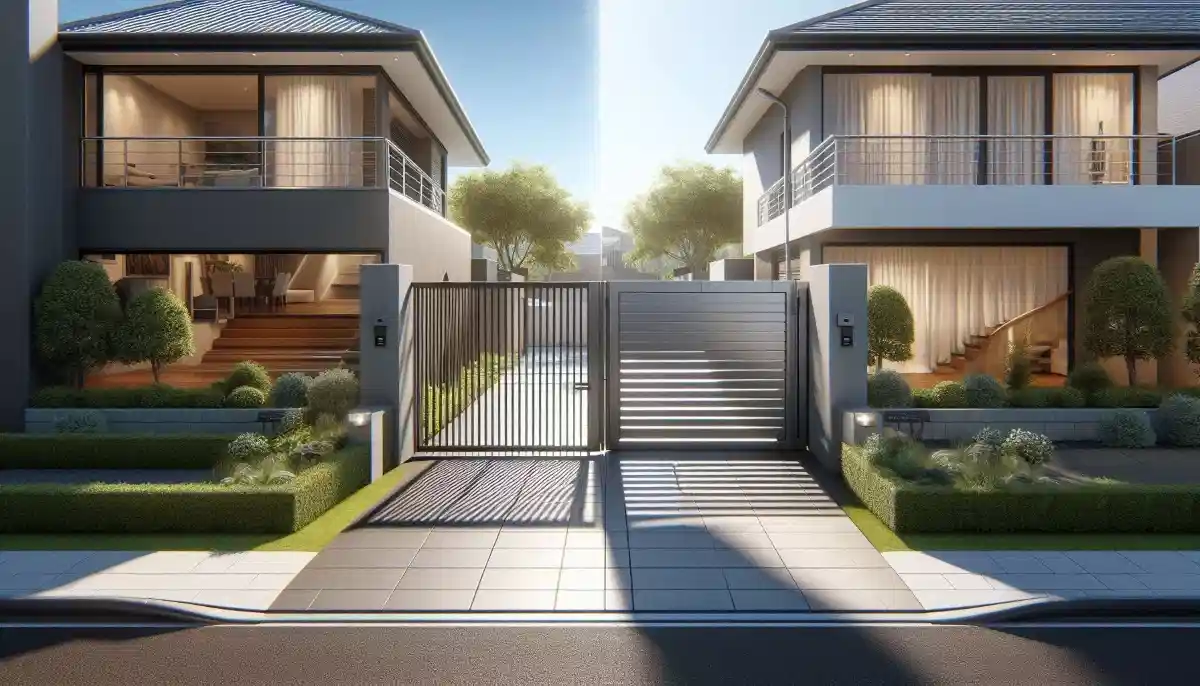
Steel vs Aluminium Gates South Africa – Complete Material Comparison Guide
⚖️ Steel for maximum security? Aluminium for coastal living? Wood for aesthetics? We help you choose the perfect gate material for your property.
Your gate is the first thing people see and the last line of defence for your property. Choosing between steel, aluminium, or wood is one of the most important decisions you’ll make. Whether you’re securing a home in Johannesburg, battling coastal corrosion in Durban, or seeking that classic Cape Dutch look in Stellenbosch, the material you choose affects security, maintenance, automation suitability, and long-term costs. This comprehensive guide compares steel vs aluminium gates (and touches on wood) to help you make an informed decision that balances your budget, location, and lifestyle.
📋 Planning a New Gate Installation?
Get free, no-obligation quotes from experienced gate fabricators and installers in your area. They’ll advise on the best material for your specific location and needs.
Servicing Johannesburg, Pretoria, Cape Town, Durban, and all major areas
📖 Table of Contents – Steel vs Aluminium Gates
📊 Quick Comparison: Steel vs Aluminium vs Wood Gates
Here’s your at-a-glance comparison of the three main gate materials used in South Africa.
| Feature | Steel | Aluminium | Wood |
|---|---|---|---|
| Initial Cost | Moderate (R8,000 – R25,000+) | Higher (R12,000 – R35,000+) | Lower to High (R7,000 – R30,000+) |
| Long-term Cost | Moderate (rust prevention) | Low (minimal maintenance) | High (sealing, staining, repairs) |
| Maintenance | Medium – rust prevention, repainting every 3-5 years | Low – occasional cleaning | High – sealing/staining every 1-2 years |
| Corrosion Resistance | Good (if galvanised) / Poor (if not) | Excellent – ideal for coastal | Poor – rots in damp conditions |
| Weight | Heavy (80-150kg+) | Lightweight (30-60kg) | Medium-heavy (50-100kg) |
| Security | Superior – very difficult to cut/break | Good – but can be cut with tools | Moderate – can be forced or cut |
| Automation Suitability | Good (requires strong motor) | Excellent – easy on motors | Fair (requires proper hinges) |
| Aesthetic | Versatile – traditional to modern | Sleek, modern, clean lines | Natural, warm, traditional |
| Lifespan (with care) | 15-25 years | 20-30+ years | 10-20 years |
Key Insight: There’s no single “best” material – it depends on your location, security needs, budget, and aesthetic preferences. Use this guide to find YOUR best match.
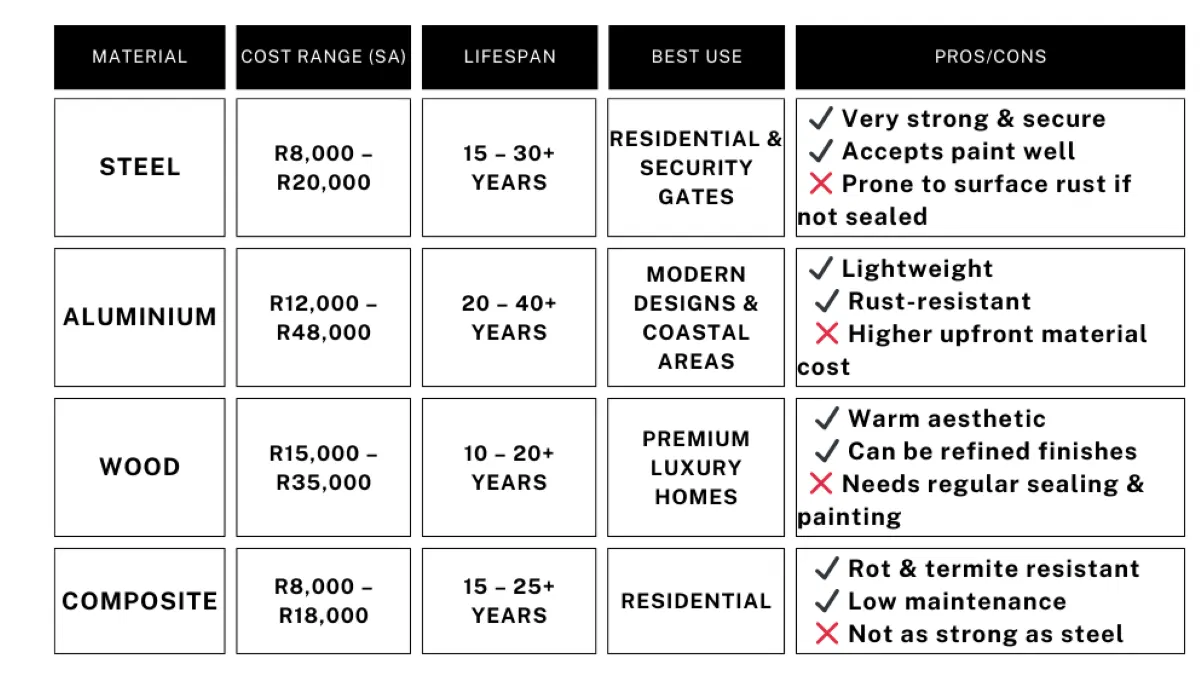
🛡️ Steel Gates – The Security Champion
Steel has been the traditional choice for South African gates for decades, and for good reason.
Pros of Steel Gates
- Superior security: Steel is extremely strong and resistant to cutting, bending, or forcing. A well-made steel gate is a formidable barrier.
- Strength and durability: Can withstand significant impact and daily use without deforming.
- Cost-effective: Generally cheaper than aluminium for equivalent sizes, especially for custom designs.
- Design versatility: Can be formed into various styles – from simple tubular frames to ornate wrought iron looks.
- Paintable: Can be repainted to match your home’s colour scheme.
Cons of Steel Gates
- Rust and corrosion: The biggest enemy. Without proper galvanisation and maintenance, steel gates rust, especially in coastal areas.
- Heavy weight: A large steel gate can weigh 150kg or more, requiring a powerful (and more expensive) gate motor and robust hinges/posts.
- Maintenance: Regular inspections for rust, touching up paint, and repainting every 3-5 years are necessary.
- Can dent: While strong, steel can dent from significant impacts.
Typical Steel Gate Costs
- Standard sliding gate (4m x 1.8m): R8,000 – R15,000 (material only)
- Custom designed steel gate: R12,000 – R25,000+
- Installation labour: R2,500 – R5,000 (extra)
Best for:
Inland areas (Johannesburg, Pretoria, Midrand) where rust is less aggressive. Properties where security is the absolute top priority. Budget-conscious projects where long-term maintenance is acceptable.
Pro Tip: If choosing steel, insist on hot-dip galvanisation after fabrication, not just a coat of paint. This zinc coating is the only real protection against rust. Powder coating over galvanisation is the gold standard.
✨ Aluminium Gates – The Coastal Champion
Aluminium has gained massive popularity, especially in coastal regions, for its rust-proof properties and modern aesthetic.
Pros of Aluminium Gates
- Rust-proof: Aluminium doesn’t rust. It forms a protective oxide layer that prevents corrosion. Perfect for Durban, Cape Town, Ballito, and all coastal areas.
- Lightweight: Typically 50-70% lighter than steel. This puts less strain on motors, hinges, and posts, and makes automation easier and cheaper.
- Low maintenance: A simple wash with soapy water keeps it looking new. No painting required (though it can be painted if desired).
- Modern appearance: Aluminium suits contemporary architecture with clean lines and slim profiles.
- Powder coating: Factory-applied powder coating lasts for years without fading or chipping.
Cons of Aluminium Gates
- Higher initial cost: Aluminium gates typically cost 30-50% more than equivalent steel gates.
- Less strong: While strong enough for security, aluminium can be cut with power tools more easily than steel. It’s also more prone to denting from impacts.
- Not easily repairable: Dents in aluminium are difficult to repair – often the section needs replacement.
- Galvanic corrosion risk: If connected directly to steel posts or components without isolation, galvanic corrosion can occur.
Typical Aluminium Gate Costs
- Standard sliding gate (4m x 1.8m): R12,000 – R22,000 (material only)
- Custom designed aluminium gate: R18,000 – R35,000+
- Installation labour: R2,500 – R5,000 (extra – similar to steel)
Best for:
Coastal properties anywhere in South Africa. Modern homes where aesthetics matter. Homeowners who want minimal maintenance and are willing to pay a premium for it.
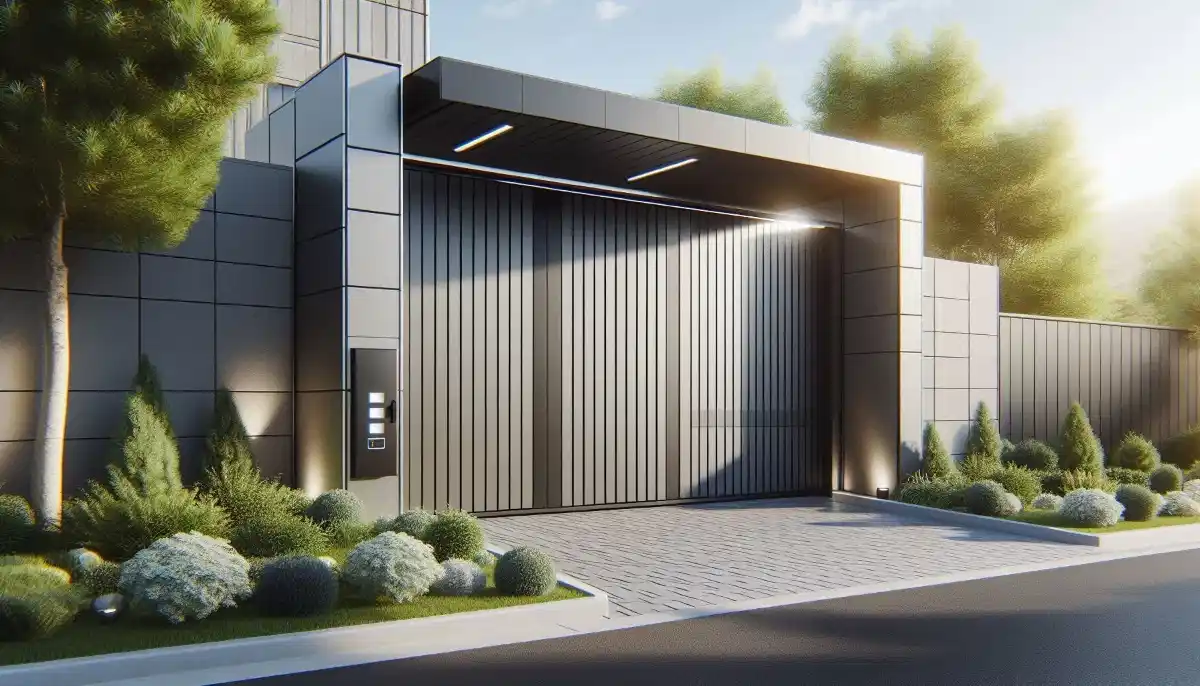
🌳 Wood Gates – The Aesthetic Choice
Wood gates offer natural beauty that neither steel nor aluminium can match, but they come with significant trade-offs.
Pros of Wood Gates
- Aesthetic appeal: Unmatched natural warmth and beauty. Perfect for Cape Dutch, farm-style, or rustic properties.
- Lower initial cost: Basic wood gates can be cheaper than metal options.
- Customisable: Can be carved, shaped, and designed in ways metal cannot.
- Privacy: Solid wood gates offer complete privacy (unlike open metal designs).
Cons of Wood Gates
- High maintenance: Wood needs sealing, staining, or painting every 1-2 years. It rots, warps, and cracks if neglected.
- Susceptible to weather: Sun dries and cracks it; rain causes rot and swelling; insects can destroy it.
- Heavy: Solid wood gates are heavy, requiring strong motors and robust hinges.
- Security: Wood can be forced, kicked through, or cut more easily than steel.
- Shorter lifespan: Even with care, wood gates typically last 10-20 years before needing replacement.
Typical Wood Gate Costs
- Basic meranti or pine gate: R7,000 – R15,000
- Hardwood (iroko, mahogany) gate: R15,000 – R30,000+
- Installation labour: R2,500 – R5,000
Best for:
Properties where aesthetics absolutely trump all other considerations. Homes in dry inland areas (less rot risk). Owners committed to regular maintenance.
🤔 Still Not Sure Which Material to Choose?
That’s what local experts are for. Get free advice and quotes from experienced gate fabricators who understand your area’s specific challenges.
🔒 Security Comparison – Which Material Is Safer?
Security is often the primary reason for installing a gate. Here’s how the materials stack up.
Steel: The Security King
Steel is the undisputed champion for security. It’s extremely difficult to cut through with basic tools, resists being forced open, and provides a strong psychological deterrent. For maximum security, choose:
- Thick-walled steel tubing (minimum 1.6mm wall thickness)
- Close-spaced vertical bars (no gaps wider than 150mm)
- Reinforced hinges and locking points
- Anti-lift devices on sliding gates
Aluminium: Good Security with Trade-offs
Aluminium provides good security for most residential applications, but it’s not as strong as steel. An angle grinder can cut through aluminium tubing faster than steel. However:
- For most homes, aluminium is “secure enough” – criminals typically look for easier targets.
- Thicker aluminium sections (2-3mm) improve security.
- Aluminium gates are often paired with high-security locks and access control.
Wood: Moderate Security
Wood gates can be forced, kicked, or cut more easily than metal. Solid wood offers privacy but not high security. If choosing wood for aesthetic reasons, consider reinforcing with a hidden steel frame or using hardwood species.
Security Tip: The gate material is only one part of security. A quality motor with battery backup, proper locking mechanisms, and integration with your home security system matter just as much.
🧹 Maintenance Requirements Compared
This is where the materials differ most dramatically. Your willingness to maintain should heavily influence your choice.
Steel Maintenance
- Frequency: Inspect every 3-6 months for rust. Repaint every 3-5 years.
- Tasks: Touch up paint chips immediately. Sand and treat any rust spots. Repaint entire gate periodically.
- Coastal areas: Maintenance doubles. Inspect monthly, wash frequently to remove salt.
Aluminium Maintenance
- Frequency: Clean every 6-12 months. Inspect annually.
- Tasks: Wash with soapy water and a soft cloth. Check for any damage (dents). Ensure powder coating isn’t chipped (rare).
- Coastal areas: Still low maintenance – just wash more frequently to remove salt deposits.
Wood Maintenance
- Frequency: Seal/stain every 1-2 years. Inspect every 3 months.
- Tasks: Sand and reapply wood sealer or stain. Check for rot, warping, insect damage. Replace damaged boards promptly.
- Coastal areas: Very high maintenance – moisture and sun accelerate deterioration.
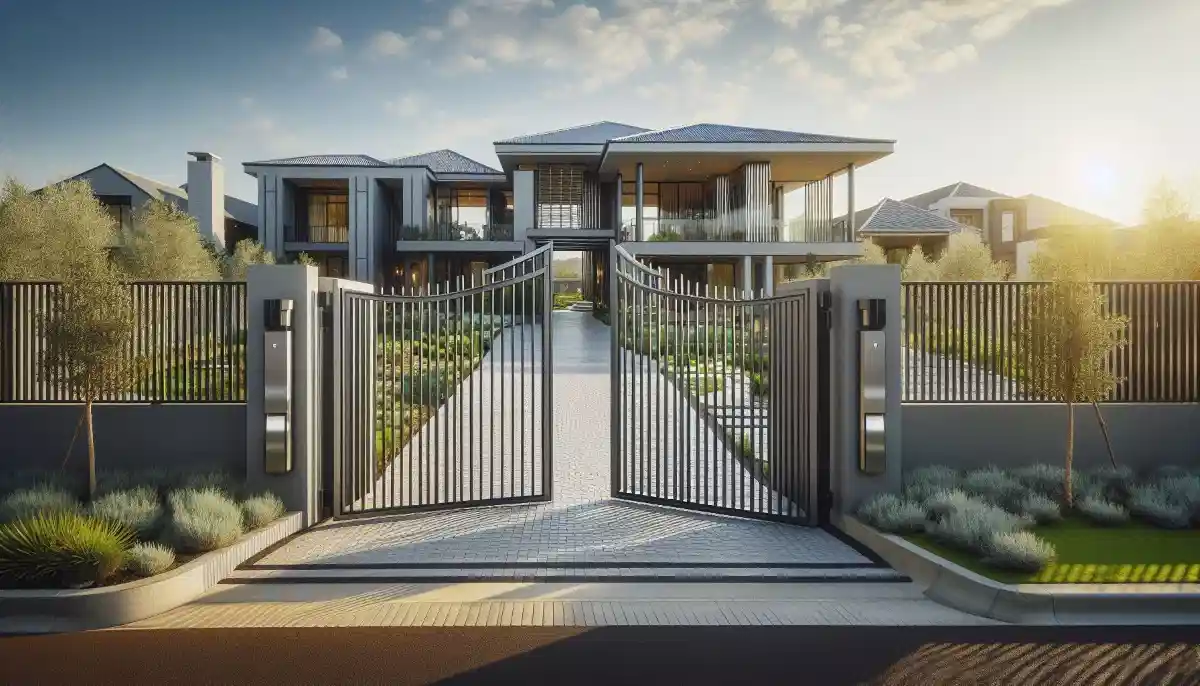
🌊 Coastal Considerations – Rust & Corrosion
If you live anywhere near the ocean, this section is the most important in this guide.
Coastal Reality: Salt air destroys steel. A standard steel gate in Durban or Cape Town can show rust within 6-12 months if not properly protected. Within 5-7 years, it may need replacement.
The Verdict for Coastal Homes
Aluminium is the only sensible choice within 5km of the ocean. The higher initial cost is recouped within a few years by avoiding constant rust treatment and repainting. Steel gates in coastal areas require:
- Hot-dip galvanisation (not just electroplating)
- Heavy-duty powder coating
- Monthly washing to remove salt
- Annual rust inspections and touch-ups
Even with all that, they won’t last as long as aluminium.
Wood in Coastal Areas
Wood also suffers in coastal climates – the combination of moisture, salt, and sun accelerates rot and warping. Only suitable if you’re committed to very high maintenance.
⚙️ Automation Suitability & Motor Requirements
The weight of your gate directly affects which motor you need and how well automation works.
Aluminium – The Automation Dream
Because aluminium gates are so light, they’re the easiest to automate. Benefits include:
- Can use smaller, less expensive motors (e.g., ET Drive 600 instead of Centurion D5 Evo)
- Less strain on motor, longer motor life
- Faster operation possible
- Easier on hinges and posts
Steel – Needs More Power
Heavy steel gates require robust motors. For a standard 4m steel sliding gate, you’ll need at least a Centurion D5 Evo or equivalent. Very heavy custom steel gates may need commercial motors like Centurion D10, which cost significantly more.
See our gate motor installation guide for detailed motor pricing.
Wood – Motor Requirements Vary
Solid wood gates are heavy – similar to steel. They need appropriately sized motors and robust hinges. Hollow-core wood gates are lighter but less secure.
💰 Cost Comparison – Initial Price vs Long-Term Value
Don’t just look at the upfront cost. Consider the total cost of ownership over 10-20 years.
| Cost Factor | Steel | Aluminium | Wood |
|---|---|---|---|
| Initial Cost (4m sliding) | R10,000 – R18,000 | R15,000 – R25,000 | R9,000 – R20,000 |
| Motor Cost (suitable) | R8,000 – R12,000 (D5 Evo) | R7,000 – R9,500 (ET Drive 600) | R8,000 – R12,000 (D5 Evo) |
| Annual Maintenance Cost | R500 – R1,500 (paint, rust treatment) | R0 – R200 (cleaning only) | R1,000 – R3,000 (sealing, repairs) |
| 10-Year Total Cost (est.) | R25,000 – R45,000 | R22,000 – R35,000 | R28,000 – R60,000+ |
| Resale Value Impact | Positive if maintained | Very positive (low maintenance) | Neutral to negative if worn |
The Surprising Truth: Despite higher initial cost, aluminium often works out cheaper over 10-15 years when you factor in maintenance, motor replacement, and longer lifespan. Steel can be cheaper upfront but costs more in the long run, especially in coastal areas.
🎨 Aesthetics & Design Options
Your gate sets the tone for your entire property. Here’s what each material offers aesthetically.
Steel Design Options
Steel is incredibly versatile. It can be:
- Simple and industrial: Clean lines, tubular frames.
- Ornate and decorative: Wrought iron styles with scrolls and details.
- Combined with other materials: Steel frames with wooden infill or laser-cut sheets.
- Powder coated any colour: Match your home’s exact colour scheme.
Aluminium Design Options
Aluminium excels at modern, minimalist designs:
- Sleek and slim profiles: Thin frames with large glass or infill panels.
- Horizontal lines: Popular contemporary look.
- Mixed materials: Aluminium frames with timber-look infill or glass.
- Wide colour range: Powder coating in any colour, including woodgrain finishes.
Wood Design Options
Wood offers natural beauty that can’t be replicated:
- Traditional styles: Cape Dutch, farm-style, rustic.
- Solid privacy: Full-height boards for complete seclusion.
- Carved details: Custom carving for unique properties.
🔄 Sliding vs Swing Gates – How Material Choice Affects Operation
The gate type you choose (sliding or swing) interacts with material choice. See our sliding vs swing gates guide for detailed comparison, but here’s how material fits in.
Sliding Gates
- Steel sliding gates: Heavy but work well. Need robust track and motor. Ensure wheels and track are heavy-duty.
- Aluminium sliding gates: Ideal – lightweight, easy on track and motor. Less strain on cantilever system.
- Wood sliding gates: Very heavy. Require commercial-grade track and motor. High maintenance due to ground contact.
Swing Gates
- Steel swing gates: Strong but heavy on hinges and posts. Ensure posts are concreted and reinforced.
- Aluminium swing gates: Lightweight, easy on hinges. Can use smaller motors (ET Wingo works well).
- Wood swing gates: Heavy, need strong posts and hinges. Risk of sagging over time.
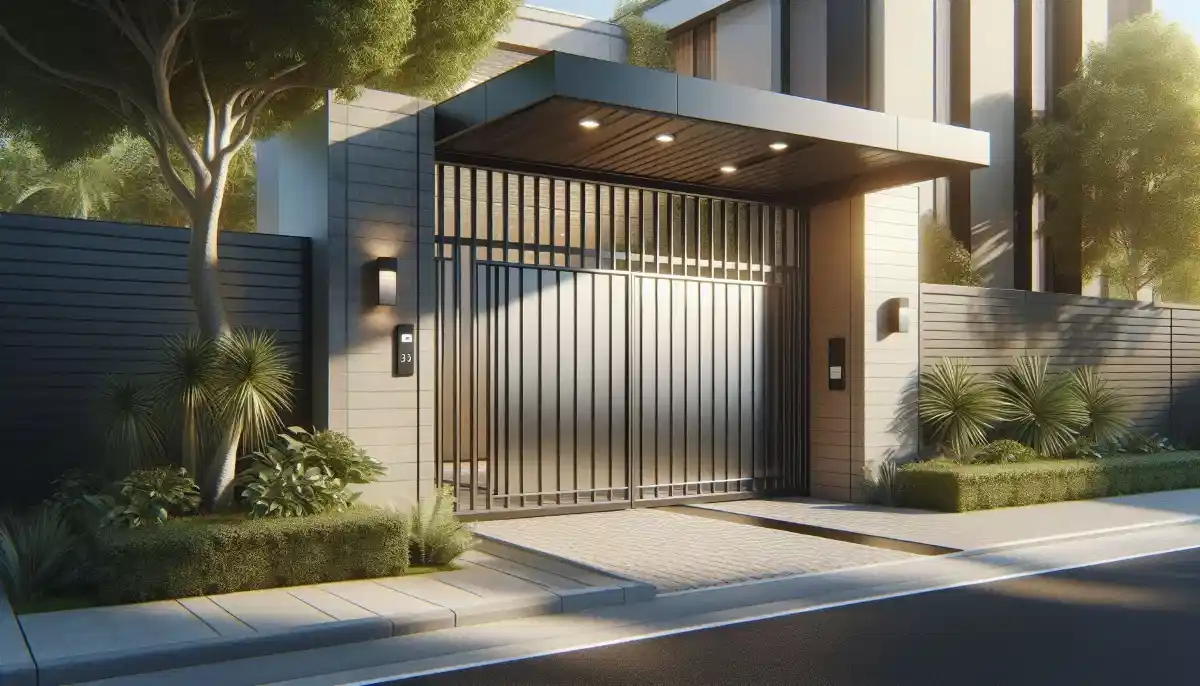
🏠 Realistic Installation Examples – What Real Homeowners Paid
Let’s look at real-world examples from across South Africa to see how material choices played out.
Example 1: Inland Home, Fourways
4m steel sliding gate with automation.
Total: R22,500
Includes: Galvanised steel gate, Centurion D5 Evo motor, installation, 2 remotes. Owner plans to repaint every 4 years.
Example 2: Coastal Home, Umhlanga
4.5m aluminium sliding gate with automation.
Total: R31,500
Includes: Powder-coated aluminium gate, ET Drive 600 motor, installation, battery backup. Owner expects zero rust, minimal maintenance.
Example 3: Smallholding, Hartbeespoort
Double wooden swing gates, rustic style.
Total: R28,000
Includes: Meranti double gates, ET Wingo motors, installation. Owner committed to annual sealing.
Example 4: Security Estate, Centurion
Custom steel gate with laser-cut design.
Total: R34,000
Includes: Decorative laser-cut steel gate, Centurion D5 Evo, installation. Estate rules required specific aesthetic.
❌ 7 Common Mistakes When Choosing Gate Material
Learn from others’ errors: These mistakes cost homeowners thousands in replacements and repairs.
Mistake #1: Choosing Steel for a Coastal Property
The most common and expensive mistake. Within 3-5 years, rust takes over. If you’re within 5km of the ocean, aluminium is worth the premium.
Mistake #2: Ignoring Maintenance Requirements
That beautiful wood gate needs sealing every year. That steel gate needs rust checks. Be honest with yourself – if you won’t maintain it, choose aluminium.
Mistake #3: Buying Based on Price Alone
The cheapest quote often means thin steel, poor galvanisation, and short lifespan. A slightly more expensive gate that lasts twice as long is better value.
Mistake #4: Not Checking HOA or Estate Rules
Many estates have strict rules about gate materials, colours, and styles. Check before you order, or you may have to replace it.
Mistake #5: Undersizing the Motor for a Heavy Gate
Putting a small motor on a heavy steel gate is a recipe for failure. The motor will struggle and die early. Match the motor to the gate weight.
Mistake #6: Forgetting About Future Automation
Even if you’re not automating now, you might in future. Ensure the gate is designed to be automated – proper hinges, clearance, and structure.
Mistake #7: Not Getting Professional Advice
Gate material selection is complex. A local fabricator knows what works in your area. Use our installer selection guide to find someone trustworthy.
❓ Frequently Asked Questions – Steel vs Aluminium Gates
Which is better for coastal areas – steel or aluminium?
Aluminium, without question. Steel rusts rapidly in salt air, no matter how well it’s painted. Aluminium is naturally corrosion-resistant and is the only sensible choice for homes near the ocean in Cape Town, Durban, or anywhere along the coast.
Is aluminium gate as secure as steel?
For most residential applications, yes, aluminium provides adequate security. It can be cut more easily than steel, but a determined thief with power tools will get through either. The gate’s locking mechanism, motor, and overall design matter more than the material for security.
How much more expensive is an aluminium gate than steel?
Aluminium gates typically cost 30-50% more than equivalent steel gates upfront. However, when you factor in the cost of maintenance (rust prevention, repainting) over 10-15 years, aluminium often works out cheaper, especially in coastal areas.
Can steel gates last in coastal areas if well maintained?
With extreme maintenance – hot-dip galvanisation, industrial-grade powder coating, monthly washing, and annual rust treatment – a steel gate might last 10-12 years in a coastal area. But it’s a constant battle. Aluminium is the better long-term solution.
What maintenance does an aluminium gate need?
Very little. A wash with soapy water every 6-12 months is usually sufficient. Check that the powder coating isn’t chipped (rare). Ensure drainage holes (if any) aren’t blocked. That’s it.
Can aluminium gates be painted?
Yes, but it requires special etching primer and appropriate paint. Most aluminium gates come factory-powder coated in your chosen colour and shouldn’t need repainting for 15-20 years. Repainting is usually only done if you want a colour change.
Which gate material is best for automation?
Aluminium is best because it’s lightweight, putting less strain on the motor and mechanical parts. You can often use a smaller, less expensive motor. Steel gates need more powerful (and costly) motors. See our gate motor guide.
How long do steel gates last compared to aluminium?
A well-maintained steel gate in an inland area can last 15-25 years. An aluminium gate in any area can last 20-30+ years with minimal maintenance. In coastal areas, aluminium outlasts steel by decades.
Can I get a gate that looks like wood but is low maintenance?
Yes! Both steel and aluminium can be powder-coated with woodgrain finishes that look remarkably like real wood. Aluminium with woodgrain finish is a popular choice – the look of wood with zero maintenance.
What thickness of steel or aluminium should I choose?
For steel, look for minimum 1.6mm wall thickness for structural tubes. For aluminium, 2-3mm is typical for residential gates. Thicker is stronger but heavier. Your fabricator should advise based on gate size and type.
✅ Final Thoughts – Your Gate Material Decision Guide
Choosing between steel, aluminium, and wood doesn’t have to be overwhelming. Use this simple decision flow:
🔍 Quick Decision Guide:
- ➡️ Live within 5km of the ocean? → Choose ALUMINIUM (non-negotiable).
- ➡️ Security is your absolute top priority? → Choose STEEL (with proper galvanisation).
- ➡️ Want the look of wood but hate maintenance? → Choose ALUMINIUM with woodgrain finish.
- ➡️ On a tight budget and willing to maintain? → STEEL can work (inland only).
- ➡️ Love natural wood and committed to upkeep? → WOOD is beautiful but demanding.
- ➡️ Want the best long-term value with least hassle? → ALUMINIUM wins every time.
Your 4-Step Action Plan:
- Assess your location: Coastal or inland? This is the most important factor.
- Consider your maintenance willingness: Be honest – will you paint every 3-5 years?
- Set your budget: Include long-term costs, not just upfront.
- Get expert advice: Use our quote service to connect with local fabricators who know what works in your area.
🔑 The Bottom Line:
Choose steel for security and budget (inland).
Choose aluminium for coastal living and zero maintenance.
Choose wood only if you love it and will maintain it.
🚪 Ready to Get Your New Gate?
Get free, no-obligation quotes from experienced gate fabricators and installers who can advise on the perfect material for your specific property.
📞 Call our gate advisory line: 073 138 4726
📚 Official Resources & Standards:
- Inso – Aluminium gate material guide and specifications.
- Corobrik – Steel gate standards and construction guidelines.
- SASW – Steel Window and Gate Association of South Africa.
- SAIA – Aluminium industry corrosion standards.
This guide is for informational purposes. Always consult with a qualified fabricator and installer for your specific project.
Written by: Innocent T Hanyani
21+ years construction and digital industry experience, ServiceLink SA
Innocent has overseen thousands of gate installations across South Africa, from coastal homes in Durban to security estates in Johannesburg. His practical experience with material failures and successes informs this guide.