

Decided Satellite Is Right for You?
Get a free quote from a verified, accredited DSTV installer near you.
Professional installation ensures perfect signal.
Servicing Gauteng, Western Cape, KwaZulu-Natal, Johannesburg, Cape Town, Durban, and across South Africa
DSTV Stream vs Satellite Decoder: Which One Is Right for Your Home?
📺 No dish? No problem. But is streaming really better than traditional satellite? Here’s the complete comparison.
You want DSTV. But you’re not sure if you want the traditional satellite dish or the newer streaming option.
Your friend swears by DSTV Stream – “no dish, no installation, watch anywhere.” Your neighbour says satellite is more reliable –
“works during load shedding, better picture quality.”
Who’s right? The answer depends on your internet connection, your viewing habits, and how you watch TV.
In this complete dstv stream vs satellite decoder guide, I’ll compare both options side by side.
You’ll learn the costs, the pros and cons, and which is better for YOUR home.
If you’re wondering “which is better dstv stream or satellite”, read on.
For a broader comparison, read our
DSTV vs streaming guide.
For satellite decoder types, see decoder types explained.
And for the best decoder, read best decoder guide.
📋 Table of Contents – DSTV Stream vs Satellite Guide
📱 What Is DSTV Stream?
Dstv stream vs satellite decoder starts with understanding what DSTV Stream actually is.
DSTV Stream is MultiChoice’s internet-based TV service. Instead of receiving channels via a satellite dish,
you watch through the internet using the DSTV app on your smart TV, phone, tablet, or computer.
Key features of DSTV Stream:
- No satellite dish required – just an internet connection
- No decoder required – use your existing smart TV or streaming device
- Same packages as satellite – Access, Family, Compact, Compact Plus, Premium
- Watch on multiple devices – phone, tablet, laptop, TV (simultaneous streams vary by package)
- No installation costs – just download the app and subscribe
- Catch Up included – watch shows from the last 7 days
- No contract required – month-to-month, cancel anytime
What you need for DSTV Stream:
- Uncapped fibre internet (minimum 10Mbps for HD, 25Mbps for 4K)
- A compatible device (smart TV, smartphone, tablet, laptop, or streaming device like Apple TV/Chromecast)
- The DSTV app (free download)
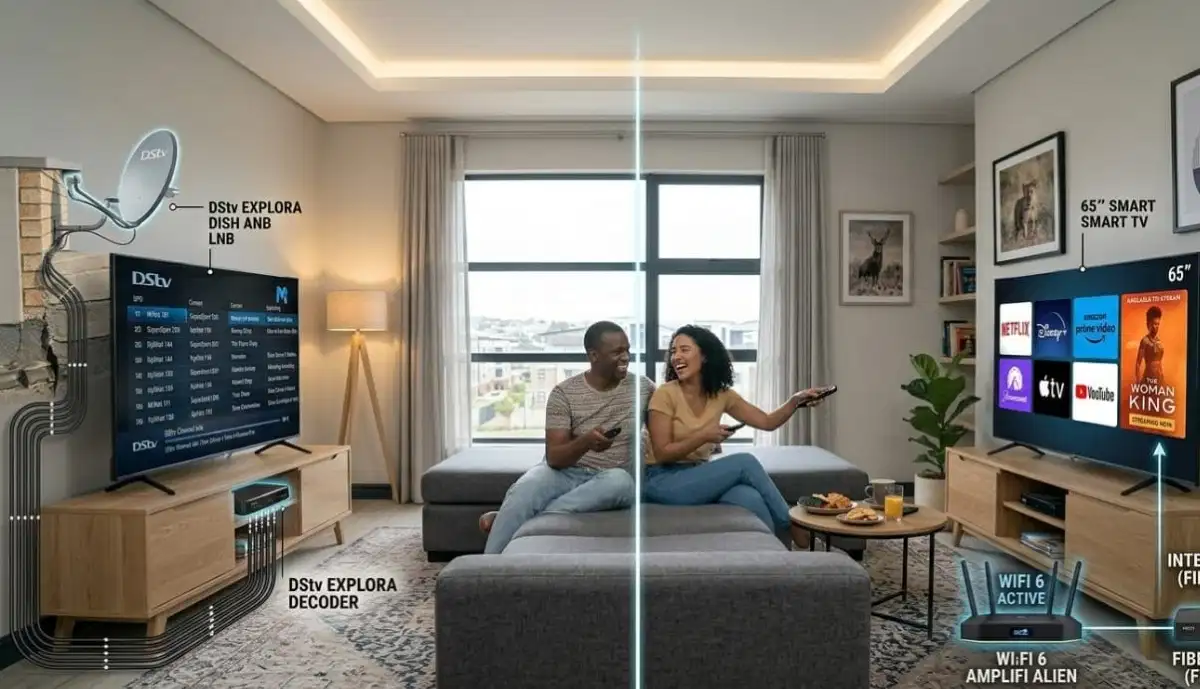
📡 What Is Satellite DSTV (Traditional Decoder)?
Traditional satellite DSTV is the classic service South Africans have used for decades.
A satellite dish on your roof receives signals directly from the Eutelsat satellite.
Key features of satellite DSTV:
- Satellite dish required – installed on your roof or wall
- Decoder required – HD decoder, Explora, or Explora Ultra
- Professional installation required – dish mounting, cabling, alignment
- Works without internet – completely independent of your fibre connection
- Works during load shedding – as long as your TV has power
- Recording capability – Explora models can record shows (PVR)
- No buffering – consistent picture quality regardless of internet congestion
What you need for satellite DSTV:
- Satellite dish (60cm or 80cm depending on location)
- LNB (Single, Quad, or Smart)
- DSTV decoder (HD, Explora, or Explora Ultra)
- Professional installation (R800-R1,500)
- Clear line of sight to the northeastern sky
📊 DSTV Stream vs Satellite Decoder: Quick Comparison
| Feature | DSTV Stream | Satellite Decoder |
|---|---|---|
| Requires satellite dish? | ❌ No | ✅ Yes (R800-R1,500 installation) |
| Requires decoder? | ❌ No (use your device) | ✅ Yes (R600-R3,200) |
| Requires internet? | ✅ Yes (10-25Mbps minimum) | ❌ No (works independently) |
| Works during load shedding? | ⚠️ Only with UPS backup | ✅ Yes (if TV has power) |
| Recording (PVR)? | ❌ No (Catch Up only) | ✅ Yes (Explora models, R75/month) |
| Picture quality | Depends on internet speed (up to 4K) | Consistent HD/4K (no buffering) |
| Upfront cost | R0 (no equipment) | R1,400-R4,700 (dish + decoder + installation) |
| Monthly cost (package only) | R150-R979 (same as satellite) | R150-R979 + R75 PVR fee (Explora) |
| Internet cost | R399-R1,200/month (fibre) | R0 (not required) |
Still Not Sure Which Is Right for You?
Get a free consultation from a verified, accredited DSTV installer near you.
We’ll help you decide between Stream and satellite.
Free quotes. Verified installers. No obligation.
💰 Cost Comparison: DSTV Stream vs Satellite Decoder
When comparing streaming vs satellite dstv, cost is often the deciding factor.
Let’s look at the real numbers.
Upfront costs:
- DSTV Stream: R0 – no equipment needed
- Satellite: R1,400-R4,700 (dish R400-R600, decoder R600-R3,200, installation R800-R1,500)
Monthly costs (for a family with Compact package, R479/month):
- DSTV Stream: R479 + fibre internet (R399-R1,200) = R878-R1,679/month
- Satellite: R479 + R75 PVR fee (if Explora) = R554/month + R0 for internet
5-year total cost (Compact package):
- DSTV Stream: R0 upfront + (R479 + R699 fibre) × 60 = R70,680
- Satellite: R2,500 upfront + (R554) × 60 = R35,740
- Difference: Satellite saves ~R35,000 over 5 years
💰 Key Insight:
If you already have fibre for work and other purposes, DSTV Stream adds only the package cost.
If you need to add fibre specifically for streaming, satellite is significantly cheaper over time.
Dstv stream vs explora cost comparison heavily favours satellite if you don’t already have fibre.
📺 Picture Quality: DSTV Stream vs Satellite
Satellite: Consistent HD/4K regardless of internet congestion. No buffering, no quality drops.
Once your dish is aligned, picture quality is always perfect.
DSTV Stream: Picture quality depends entirely on your internet speed and network congestion.
During peak times, you may experience buffering or quality drops. Requires minimum 10Mbps for HD, 25Mbps for 4K.
Winner: Satellite – consistent, reliable picture quality every time.
⚡ Load Shedding: The Critical Difference
In South Africa, load shedding is a reality. This single factor can completely change the
which is better dstv stream or satellite calculation.
During load shedding:
- Satellite: Works perfectly as long as your TV has power. The satellite signal is independent of Eskom.
- DSTV Stream: Completely dead unless you have a UPS/inverter powering your fibre router and TV.
Winner: Satellite – hands down. This is the #1 reason many South Africans stick with traditional satellite.
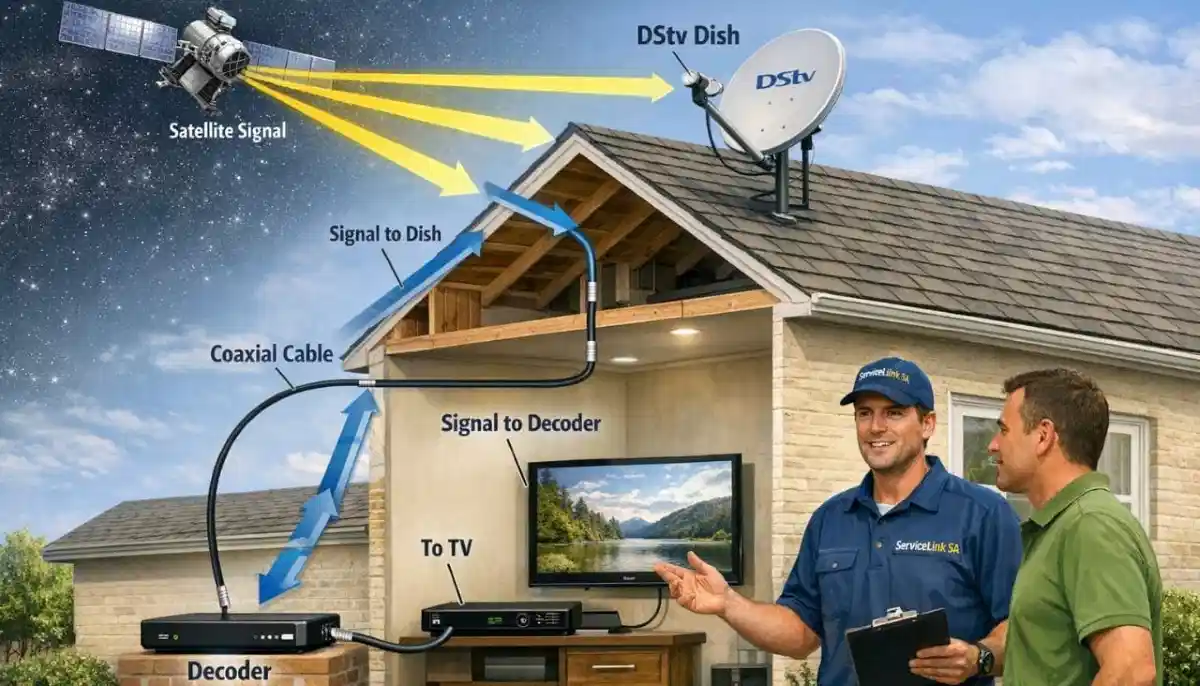
⚽ Sports Coverage: Identical Content, Different Experience
Both DSTV Stream and satellite offer the same channels and sports coverage.
However, there’s a catch: streaming has a 30-60 second delay compared to live satellite.
Satellite: True live broadcast – you’re watching as it happens.
DSTV Stream: 30-60 second delay. You’ll hear neighbours cheering before you see the try.
Winner: Satellite for true live sports experience.
🏠 Multi-Room & Multiple Devices
Satellite: Requires Extra View – additional decoders, cabling, and R105/month per extra decoder.
Can be expensive for multiple rooms but offers independent channel selection.
DSTV Stream: Watch on multiple devices simultaneously (2 streams on Premium, 1-2 on lower packages).
No extra cost for additional devices, but all streams share the same internet connection.
Winner: Stream for device flexibility (phone, tablet, laptop); Satellite for multiple TVs in different rooms.
🔧 Installation & Setup
DSTV Stream: Download the app, create an account, subscribe. Done in 5 minutes. No professional help needed.
Satellite: Requires professional installation (R800-R1,500). Dish mounting, cabling, alignment, decoder setup.
Takes 2-3 hours. Not a DIY job for most homeowners.
Winner: Stream – instant, no installation required.
✅❌ DSTV Stream vs Satellite Decoder: Pros and Cons
✅ DSTV Stream Pros
- No dish or decoder needed
- No installation costs
- Watch on any device (phone, tablet, laptop, TV)
- No contract – month-to-month
- Instant setup – start watching immediately
- No TV licence required
- Good for renters or temporary setups
❌ DSTV Stream Cons
- Requires good, uncapped fibre (R399-R1,200/month)
- Vulnerable to load shedding
- 30-60 second delay for live sports
- Picture quality depends on internet speed
- No recording (PVR) capability
- Buffering during peak times
✅ Satellite Pros
- Works during load shedding
- True live broadcast (no delay)
- Consistent picture quality (no buffering)
- Recording capability (Explora models)
- No internet required
- More reliable in bad weather
❌ Satellite Cons
- High upfront cost (R1,400-R4,700)
- Professional installation required
- Dish on roof (aesthetics, body corporate rules)
- Monthly PVR fee (R75 for Explora)
- TV licence required (R265/year)
- Can’t watch on mobile devices without extra setup
✅ Which Should You Choose? Decision Guide
Choose DSTV Stream if:
- You already have good, uncapped fibre internet
- You have power backup for load shedding (or don’t mind missing content during outages)
- You’re a renter or move frequently (no dish installation)
- You want to watch on multiple devices (phone, tablet, laptop)
- You don’t need recording (PVR)
- You’re on a tight budget upfront (no equipment costs)
- The 30-60 second sports delay doesn’t bother you
Choose Satellite Decoder if:
- You don’t have fibre internet (or have unreliable internet)
- Load shedding is frequent and you don’t have power backup
- You’re a serious sports fan who wants true live broadcast (no delay)
- You want to record shows (PVR)
- You own your home and can install a dish
- You want the most reliable, consistent picture quality
- You’re willing to pay upfront for long-term savings
✅ Our Verdict:
For most South African homeowners with fibre, DSTV Stream is a great option – especially if you have UPS backup.
However, for serious sports fans, those without reliable fibre, or anyone frustrated by load shedding,
traditional satellite remains the superior choice. The dstv stream vs satellite decoder decision
ultimately comes down to your internet and power situation.
🔄 The Hybrid Approach: Best of Both Worlds
Many South Africans are discovering the hybrid approach: keep a basic satellite package for sports and reliability,
and use DSTV Stream on mobile devices for convenience.
Example hybrid setup:
- Satellite DSTV Family (R339) on main TV – for sports and reliable viewing
- DSTV Stream (same account) on phones/tablets – for watching in bed or on the go
- Total monthly cost: R339 (one subscription covers both)
With one DSTV subscription, you can watch on your satellite decoder AND on the DSTV Stream app
(depending on your package’s anywhere stream allowance). This gives you the best of both worlds.
❓ Frequently Asked Questions About DSTV Stream vs Satellite
What is the difference between DSTV Stream and satellite?
Dstv stream vs satellite decoder – DSTV Stream delivers channels via the internet (no dish),
while satellite uses a dish on your roof. Stream requires good fibre (10-25Mbps) and is vulnerable to load shedding.
Satellite works without internet, survives load shedding, and has no buffering, but requires professional installation.
Is DSTV Stream cheaper than satellite?
The monthly package costs are identical. However, streaming vs satellite dstv cost comparison:
Stream has no upfront equipment costs but requires fibre internet (R399-R1,200/month).
Satellite has higher upfront costs (R1,400-R4,700) but no internet requirement.
Over 5 years, satellite is cheaper if you don’t already have fibre.
Can I watch DSTV Stream on my TV?
Yes. You can watch DSTV Stream on any smart TV with the DSTV app installed.
You can also use streaming devices like Apple TV, Chromecast, or Amazon Fire Stick.
No satellite dish or decoder required.
Does DSTV Stream have the same channels as satellite?
Yes. DSTV Stream offers the same packages and channel lineups as satellite.
Access, Family, Compact, Compact Plus, and Premium are all available.
The only difference is delivery method – internet vs satellite.
Can I record shows on DSTV Stream?
No. Dstv stream vs explora – Explora decoders offer recording (PVR) for R75/month.
DSTV Stream has Catch Up (watch shows from the last 7 days) but no ability to record live TV.
If recording is important to you, choose satellite with an Explora decoder.
Why is there a delay on DSTV Stream for live sports?
Streaming always has a delay because the signal must be encoded, transmitted over the internet,
and decoded by your device. Satellite is true live broadcast – there’s a 30-60 second delay on Stream.
For serious sports fans, satellite is better.
Does DSTV Stream work during load shedding?
Only if you have UPS backup for your fibre router and TV. Without backup, Stream stops working during outages.
Satellite works during load shedding as long as your TV has power – the signal comes from space, not Eskom.
This is a major advantage of satellite.
Can I use DSTV Stream and satellite with the same subscription?
Yes. Your DSTV subscription gives you access to both. You can watch on your satellite decoder
AND on the DSTV Stream app (depending on your package’s anywhere stream allowance).
This is the hybrid approach – best of both worlds.
Which has better picture quality – Stream or satellite?
Satellite offers consistent HD/4K regardless of internet congestion. Stream’s quality depends on your internet speed.
With good fibre, Stream can match satellite quality. However, during peak times or network congestion,
Stream may buffer or drop quality. Satellite is more reliable for consistent picture quality.
What internet speed do I need for DSTV Stream?
For HD streaming: minimum 10Mbps. For 4K streaming: minimum 25Mbps.
For a household with multiple simultaneous streams, 50Mbps fibre is recommended.
Most importantly, you need truly uncapped data with no throttling – shaped or capped fibre will cause buffering.
✅ Final Thoughts: Choose What Works for Your Home
The dstv stream vs satellite decoder decision isn’t about which is objectively “better” –
it’s about which is better for YOUR specific situation.
If you have good fibre, power backup, and don’t mind a sports delay, DSTV Stream is convenient and cost-effective.
If you want reliability during load shedding, true live sports, and consistent picture quality, satellite is the winner.
And remember: you don’t have to choose just one. With a single DSTV subscription, you can watch on satellite
AND on the Stream app – giving you the best of both worlds.
Ready to get satellite installed? Request a free quote from ServiceLink SA.
We’ll connect you with verified, accredited installers who will get your dish set up perfectly.
Ready to Get Satellite DSTV Installed?
Get a free quote from a verified, accredited DSTV installer near you.
Professional installation ensures perfect signal and reliability.
📞 Call us: 073 138 4726 for immediate advice.
Free site inspection •
How to choose an installer •
Beat Your Quote guarantee
📚 Official resources & standards referenced:
- DSTV Stream – Official DSTV streaming service information.
- Official DSTV decoder packages – Satellite package information.
- Netflix South Africa – For streaming comparison context.
Information provided for general guidance. DSTV is a registered trademark of MultiChoice.
Internet speeds required may vary by content and device. Always check current requirements with your ISP.
Written by: Innocent T Hanyani
Satellite & Home Entertainment Specialist | 21+ Years Experience
Innocent T Hanyani has over two decades of experience in satellite television and home entertainment across South Africa.
He has helped thousands of households navigate the choice between streaming and satellite,
weighing costs, reliability, and viewing habits to find the best solution for each family’s needs.
For more help comparing DSTV Stream and satellite, explore our related resources:
DSTV vs streaming guide,
satellite vs streaming comparison,
decoder types explained,
best decoder guide,
package price list.
See our service areas page for coverage in your region.