
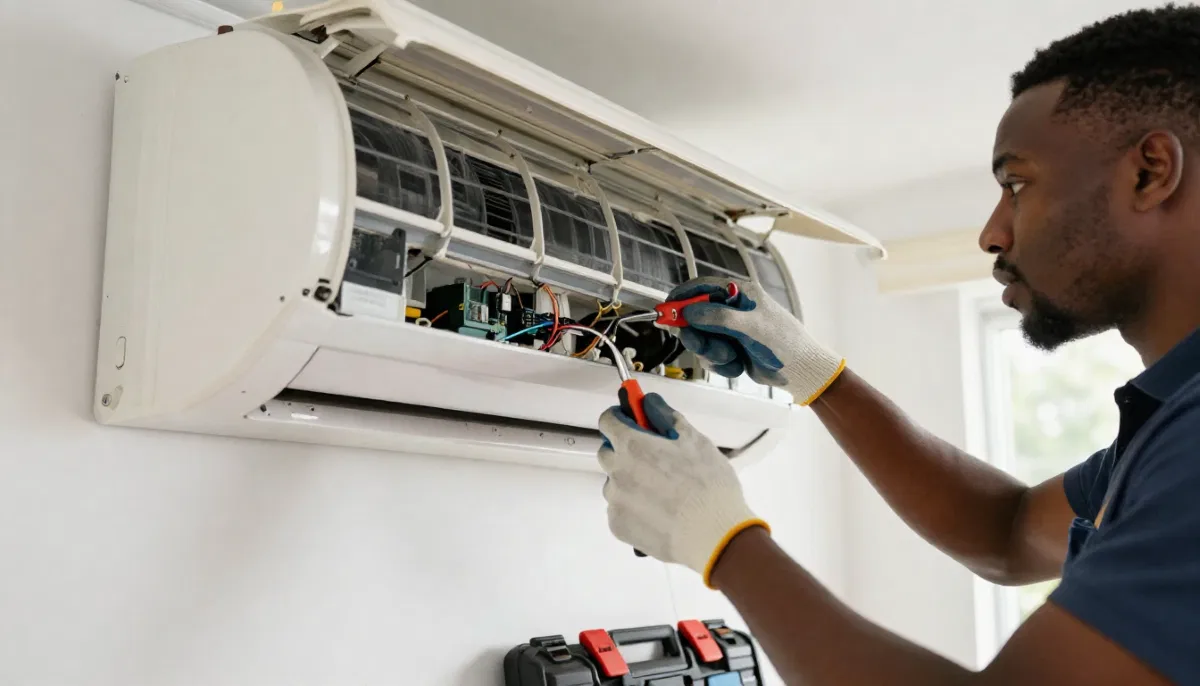
Aircon Won’t Start? It Might Be a Capacitor
Get free quotes from verified local technicians for capacitor diagnosis and replacement.
Find Aircon Repair Technicians Near Me
Servicing Johannesburg, Pretoria, Cape Town, Durban, and across South Africa
Aircon Capacitor Failure: The #1 Reason Your AC Won’t Start
⚡🔧 From humming sounds to no-start—recognise the signs and save thousands on unnecessary repairs
You turn on your aircon. Nothing happens. Or maybe you hear a humming sound, but the fan doesn’t spin. The compressor doesn’t start. Your aircon just sits there, silent and useless.
Before you panic and assume your compressor is dead (R5,000-R12,000 repair), know this: the #1 reason air conditioners won’t start is a failed capacitor. And capacitor replacement costs R500-R1,000.
I’ve seen too many homeowners assume the worst, call for emergency service, and pay for expensive diagnostics—only to learn the fix was a simple capacitor. I’ve also seen homeowners ignore the signs, let the problem worsen, and end up with compressor damage because they kept trying to start a failing system.
The capacitor is the most common air conditioner capacitor problem. It’s also one of the cheapest and easiest fixes. But it’s not a DIY job for most people—capacitors store lethal voltage even when the power is off.
In this guide, I’ll show you the symptoms of aircon capacitor failure, explain what capacitors do, what replacement costs, and when you need a professional.
For more troubleshooting, check aircon not turning on guide and same-day repair services. Ready to diagnose your capacitor? Let’s go.
📋 Table of Contents
⚡ What Is a Capacitor and What Does It Do?
Understanding the electrical component called a capacitor helps you recognise when it fails.
What is a capacitor? A capacitor is a small cylindrical component (looks like a battery) that stores electrical energy. It provides a high-voltage “kick” to start motors (compressor and fan motors) and helps them run efficiently.
Where is it located? Inside the outdoor unit (compressor compartment). Sometimes also inside the indoor unit for the fan motor.
Why do capacitors fail? They are the most stressed electrical component in your aircon. They handle high voltage and temperature cycles. Most last 5-10 years. Heat shortens their life—capacitors fail more often in summer.
Signs of a bad capacitor: Aircon won’t start. Humming sound from outdoor unit. Fan won’t spin (or spins slowly). Intermittent operation. Bulging or leaking top.
Good news: Capacitors are cheap (R150-R400 for the part) and easy to replace (for a professional). Most capacitor failures are not compressor failures.
✅ The Good News:
Capacitor failure symptoms (humming, not starting) are often mistaken for compressor failure. But capacitor replacement costs R500-R1,000, while compressor replacement costs R5,000-R12,000. Always check the capacitor first.
Read our compressor problems guide.
🔊 Symptom #1: Humming Sound But No Start
This is the most common sign of aircon capacitor failure. The unit receives power but can’t start.
What you’ll hear: A loud humming or buzzing sound from the outdoor unit. The indoor fan may run normally. But the outdoor compressor and fan don’t start.
What’s happening: The capacitor has lost its ability to store enough energy to start the motor. The motor receives power (hence the hum) but doesn’t have the “kick” needed to start spinning.
What to do: Turn off the aircon immediately. Don’t keep trying to start it—this can damage the compressor. Call a technician for capacitor testing.
Pro tip: If you gently push the fan blade with a long insulated stick (never your hand), it may start spinning. This confirms the capacitor is bad (the motor works, it just can’t start on its own).
🔘 Symptom #2: Clicking Sound Every Few Minutes
A rhythmic clicking sound indicates the compressor is trying to start but failing repeatedly.
What you’ll hear: Humming for 2-5 seconds, then a distinct “click.” Silence for 30-60 seconds. Then the cycle repeats: humming, click, silence.
What’s happening: The compressor tries to start but can’t (bad capacitor). The thermal overload switch senses the strain and shuts down the compressor to protect it (the click). After cooling, it tries again. Repeat.
What to do: Turn off the aircon at the breaker. Call a technician. Don’t let this continue—repeated starting attempts damage the compressor.
Read our compressor problems guide.
Aircon Humming But Not Starting?
Get free quotes from verified local technicians for capacitor diagnosis and replacement.
Get Free Quotes From Local Technicians
Capacitor replacement from R500-R1,000.
🌀 Symptom #3: Fan Won’t Spin (But Humming)
A failing capacitor affects fan motors as well as the compressor.
What you’ll notice: The outdoor fan doesn’t spin, but you hear a humming sound. The indoor fan may run normally. The compressor may also not start.
What’s happening: The same capacitor that starts the compressor often also starts the fan motor (or there’s a separate fan capacitor). When it fails, neither motor starts.
What to do: Turn off the aircon immediately. Running with a non-spinning fan will overheat the compressor. Call a technician.
Read our fan not working guide.
🔄 Symptom #4: Intermittent Operation (Works Sometimes)
A failing capacitor can work sometimes and fail other times, especially as temperatures change.
What you’ll notice: The aircon works fine sometimes. Other times, it won’t start at all. The problem may be worse on hot days. You might hear humming on the days it fails.
What’s happening: Capacitors lose capacity as they age. They may still have enough stored energy to start the motor on cool days (when motors need less starting torque) but not on hot days. The capacitor is failing and will eventually fail completely.
What to do: Don’t wait for complete failure. Have a technician test the capacitor now. A failing capacitor stresses your compressor.
🔴 Symptom #5: Bulging or Leaking Capacitor (Visual)
A visual inspection can confirm air conditioner capacitor problem without any testing.
What you’ll see: The top of the capacitor is bulging outward (should be flat or slightly concave). Rust or corrosion on the terminals. Oily residue or brown/black substance leaking from the capacitor. Melted or burnt appearance.
What’s happening: Internal pressure has built up due to electrical stress. The capacitor has failed and needs immediate replacement.
Safety warning: Do not touch a bulging or leaking capacitor. It can explode or give a severe electric shock. Call a technician.
🌡️ Symptom #6: Problems Worse on Hot Days
Capacitors are sensitive to heat. If your aircon struggles more on hot days, suspect a failing capacitor.
What you’ll notice: The aircon works fine on mild days (25°C) but won’t start on hot days (35°C+). Or it starts but the fan runs slowly. The problem disappears when temperatures cool.
What’s happening: Capacitors lose capacity as temperature increases. A capacitor that’s borderline on a cool day may fail completely on a hot day when starting torque demands are higher.
What to do: Have the capacitor tested before the next heatwave. Replace it proactively.
🔋 Types of Capacitors (Start vs Run)
Understanding capacitor types helps you understand what replacement costs:
Start capacitor: Provides a high-voltage “kick” to start the motor. Only engaged for 1-2 seconds. When it fails, the motor won’t start (humming). Most common failure. Cost: R150-R300 for part.
Run capacitor: Stays engaged while the motor runs. Improves motor efficiency. When it fails, the motor may run but inefficiently (overheating, higher electricity use). Cost: R150-R400 for part.
Dual run capacitor: Combines start and run functions for both compressor and fan in one unit. Common in modern aircons. Cost: R250-R500 for part.
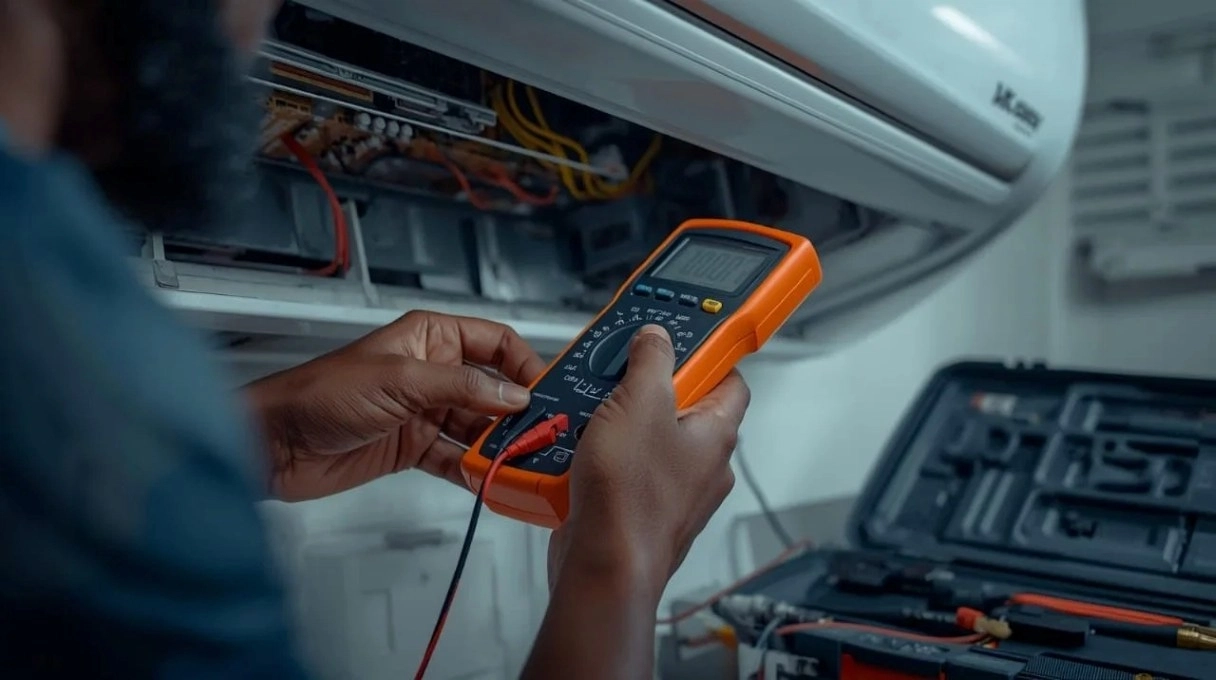
How to tell which failed: A technician tests microfarad (µF) rating with a multimeter. If reading is outside 5-10% of rated value, replace.
Read our PCB board problems guide.
🔧 Professional Repair Process
Here’s what a technician does to fix an ac capacitor replacement:
Step 1: Safety first – Turn off power at the breaker AND isolator switch. Discharge the capacitor (it holds lethal charge even when power is off).
Step 2: Access the capacitor – Remove the outdoor unit’s access panel. Locate the capacitor (small cylinder).
Step 3: Test the capacitor – Use a multimeter to measure microfarads. Compare to rated value (printed on the capacitor).
Step 4: Remove the old capacitor – Note wire positions (take a photo). Disconnect wires. Remove mounting bracket.
Step 5: Install the new capacitor – Match the microfarad rating EXACTLY (e.g., 35µF + 5µF). Match the voltage rating (must be equal or higher). Connect wires exactly as before.
Step 6: Test operation – Restore power. Start the aircon. Verify compressor and fan start normally. Check for unusual noises.
Time: 20-30 minutes for a technician.
💰 Cost Breakdown: What You’ll Pay
Here’s what signs of bad capacitor in air conditioner repair costs in South Africa:
Capacitor part only: R150 – R500 depending on type and brand.
Technician call-out fee: R300 – R600 (often waived if you proceed with repair).
Labour for replacement: R300 – R500.
Total typical cost: R500 – R1,000 including parts and labour.
Emergency/after-hours service: R800 – R1,500 (avoid if possible).
Capacitor + other repairs: If the capacitor failure damaged other components (uncommon), cost increases.
Compare to compressor replacement: R5,000 – R12,000. Capacitor replacement is 90% cheaper.
Read our same-day repair guide.
⚠️ Why DIY Capacitor Replacement Is Dangerous
Capacitors are NOT a DIY component for most homeowners. Here’s why:
Lethal stored charge: Capacitors store electricity even when the power is off. They can hold 300-400 volts for hours or days. Touching the terminals can kill you.
Discharge required: Professionals use a resistor or insulated tool to safely discharge capacitors. Most homeowners don’t have the tools or knowledge.
Incorrect replacement: Using the wrong microfarad rating can damage your compressor. Using the wrong voltage rating can cause the capacitor to explode.
Wiring mistakes: Connecting wires incorrectly can destroy the compressor, fan motor, or control board.
What you CAN do: Turn off power and inspect for bulging/leaking (visually, without touching). Take a photo of the capacitor label (shows ratings). Call a professional with the photo for an accurate quote.
🚨 DANGER: Capacitors Can Kill
Capacitors store lethal voltage even when the power is off. They can hold a charge for days. Do NOT attempt DIY capacitor replacement unless you are a qualified electrician with proper safety training and tools. The R500-R1,000 professional cost is cheap insurance against electrocution.
Read our electrical safety guide.
❓ Frequently Asked Questions
What are the signs of a bad aircon capacitor?
Signs of bad capacitor in air conditioner include: humming sound but unit won’t start, clicking sound every few minutes, fan won’t spin (but hums), intermittent operation (works sometimes), bulging or leaking capacitor, and problems worse on hot days. If you notice any of these, call a technician.
How much does it cost to replace an aircon capacitor?
Ac capacitor replacement costs R500-R1,000 including parts and labour. The capacitor part costs R150-R500. Technician labour adds R300-R500. Compare to compressor replacement (R5,000-R12,000). Capacitor replacement is one of the cheapest aircon repairs.
Can I replace an aircon capacitor myself?
NO. Capacitors store lethal voltage even when power is off (300-400 volts). Touching the terminals can kill you. Professional discharge tools and safety training are required. The R500-R1,000 professional cost is cheap insurance. Leave this to qualified technicians.
Why does my aircon hum but the fan doesn’t spin?
This is classic aircon capacitor failure. The motor receives power (hence the hum) but doesn’t have the electrical “kick” to start spinning. The capacitor stores the energy needed for starting. When it fails, the motor can’t start. Turn off the unit and call a technician.
How long do aircon capacitors last?
Capacitors typically last 5-10 years. Heat shortens their life—they fail more often in summer. Poor power quality (voltage fluctuations) also accelerates failure. Annual professional service includes capacitor testing.
Can a bad capacitor damage my compressor?
Yes. A failing capacitor stresses the compressor. The compressor tries to start but can’t, drawing high current. Repeated attempts overheat the compressor and can damage the internal windings. If you notice capacitor failure symptoms, turn off the unit and call a technician immediately.
What’s the difference between a start capacitor and a run capacitor?
A compressor start capacitor provides a high-voltage “kick” to start the motor (engaged for 1-2 seconds). A run capacitor stays engaged while the motor runs, improving efficiency. Some units have separate capacitors; others have a dual run capacitor that does both. Your technician can identify which failed.
Why does my aircon work sometimes but not other times?
This indicates a failing capacitor that still has some capacity but not enough for all conditions. It may work on cool days (when starting torque is lower) but fail on hot days. It may work after cooling down but fail when hot. Don’t wait for complete failure—have the capacitor tested now.
Can a power surge damage my aircon capacitor?
Yes. Power surges from lightning or load-shedding can damage capacitors. Surges can cause the dielectric inside the capacitor to break down, leading to failure. Install a surge protector (R500-R1,500) to protect your aircon. Read our load-shedding guide.
How do I know if my capacitor is bulging?
Visually inspect the capacitor (DO NOT TOUCH). The top should be flat or slightly concave. If the top is bulging outward (convex), rounded, or swollen, the capacitor has failed. Also look for rust, corrosion, or oily residue. If you see any of these, call a technician. Do not touch a bulging capacitor.
✅ Final Thoughts: The Most Common Fix Is Also the Cheapest
Aircon capacitor failure is the #1 reason air conditioners won’t start. It’s also one of the cheapest fixes. Don’t assume your compressor is dead—a R500-R1,000 capacitor could be the solution.
Key takeaways for capacitor failure:
- Humming but not starting = likely capacitor failure – not compressor failure.
- Capacitor replacement costs R500-R1,000 – 90% cheaper than compressor replacement.
- Don’t ignore the signs – a failing capacitor stresses your compressor.
- Turn off the unit if you hear humming or clicking – repeated starting attempts damage the compressor.
- Capacitors are NOT DIY – they hold lethal voltage even when power is off. Call a professional.
- Annual service includes capacitor testing – prevent failure before it happens.
- Hot days make capacitor problems worse – if your aircon struggles in heat, have the capacitor checked.
Your action plan: First, if your aircon hums but won’t start, turn it off at the breaker. Second, call a technician for capacitor testing. Third, get a quote for replacement (should be R500-R1,000). Fourth, if the technician recommends compressor replacement, get a second opinion—many “compressor failures” are actually capacitors. Fifth, request quotes from local technicians for capacitor diagnosis.
Aircon Humming But Not Starting?
Get free quotes from verified local technicians for capacitor diagnosis and replacement.
📞 Call us: 073 138 4726 for immediate help finding aircon repair technicians near you.
📚 Official resources & standards referenced:
- ECASA – Electrical component standards and safety requirements
- SABS – Capacitor safety standards and electrical installation requirements
- Department of Energy – Electrical efficiency guidelines
Information provided for general guidance based on South African market conditions. Capacitor replacement should only be performed by qualified technicians. Never attempt DIY replacement—capacitors hold lethal charge.
Written by: Innocent T Hanyani
Construction & Home Services Industry Specialist | 21+ Years Experience
Innocent T Hanyani has over two decades of experience working across South Africa’s construction, maintenance, and home services sectors. Throughout his career, he has worked closely with contractors, service providers, and property owners, gaining practical insight into how projects are quoted, managed, and completed. His work focuses on helping homeowners understand how to find reliable contractors, compare quotes, and avoid common industry pitfalls when hiring service professionals. His insights are based on practical industry experience as well as ongoing research into contractor platforms, service marketplaces, and hiring trends across South Africa.