
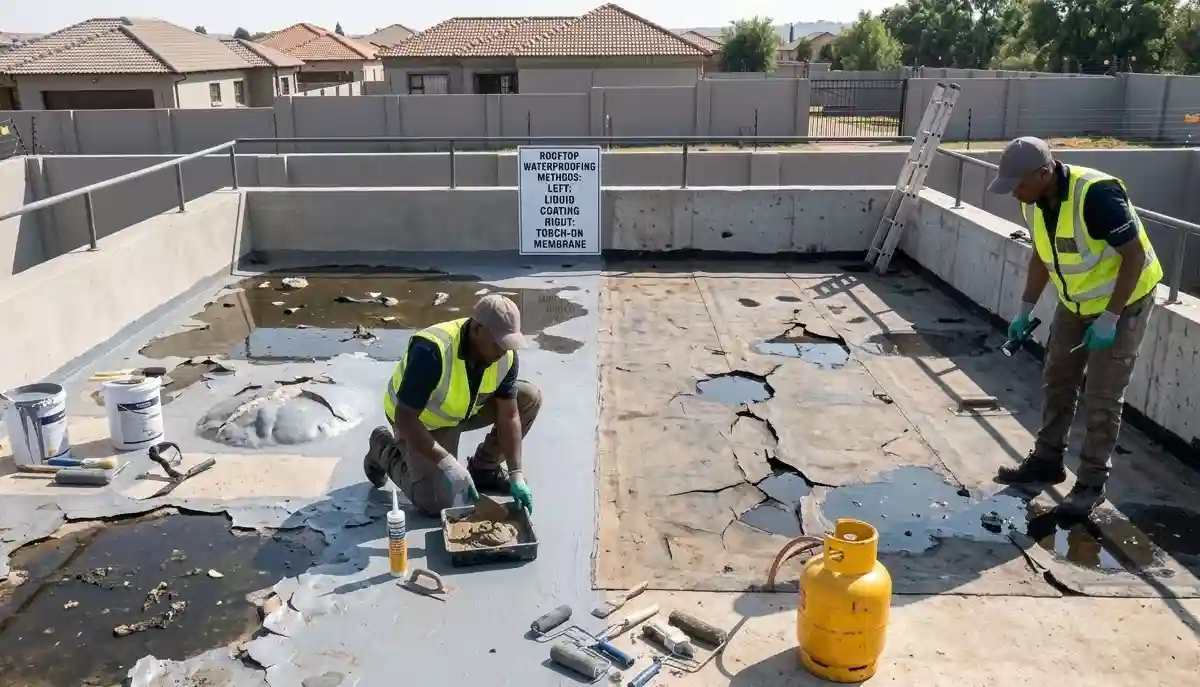
Flat Roof Waterproofing Problems and Fixes – Complete South African Guide
🏢 Leaking flat roof in Johannesburg? Ponding water on your Sandton townhouse? Bubbling membrane in Durban? Here’s how to diagnose and fix every flat roof problem.
Your flat roof in Midrand has developed bubbles. Water ponds after every rain in Centurion. The membrane in your Umhlanga home is cracking. Flat roofs are notorious for problems – but most are fixable when you understand the root cause.
Flat roof waterproofing problems and fixes require proper diagnosis. A blister needs different treatment than a crack. Ponding water requires drainage solutions, not just patching. Flashing failures need detailed attention. This guide covers every common flat roof issue, why it happens, and exactly how to fix it – permanently.
Whether you need emergency repairs or planned maintenance, you’ll learn what to look for, what questions to ask contractors, and how to avoid recurring problems.
If you need urgent help, our emergency services connect you with vetted contractors. For more information, explore our Services Overview or visit our Waterproofing Services page.
📋 INDUSTRY STANDARDS: Flat roof construction must comply with Corobrik substrate standards. The Corporation of Waterproofing Professionals provides defect identification guides, and Safeguard offers maintenance guidelines.
Urgent Flat Roof Leak?
Don’t wait for more damage. Get free, no-obligation quotes from vetted waterproofing specialists who can diagnose and fix your flat roof problems.
Find Flat Roof Experts Near Me
Emergency services available in Johannesburg, Pretoria, Cape Town, Durban, and nationwide
📋 Table of Contents – Flat Roof Problems & Fixes
🔍 Why Flat Roofs Leak – Understanding Root Causes
Why flat roofs leak is the first question to answer. Unlike pitched roofs that shed water quickly, flat roofs allow water to sit – and sitting water finds any weakness.
Primary Causes of Flat Roof Leaks
- Ponding water: Water that doesn’t drain puts constant pressure on the membrane
- Age-related degradation: UV exposure, thermal cycling, and weathering
- Poor installation: Inadequate falls, wrong materials, poor detailing
- Flashing failures: Leaks at edges, parapets, pipes, and penetrations
- Mechanical damage: Foot traffic, equipment installation, storms
- Membrane defects: Blistering, cracking, fishmouths, shrinkage
- Blocked drainage: Scuppers, drains, or gutters clogged with debris
Learn more about our approach on our About Us page or read why clients choose us on our Benefits page.
💧 Ponding Water on Flat Roof – The #1 Problem
Ponding water on flat roof is water that remains 48 hours after rain. It’s a major cause of leaks and membrane degradation.
Causes of Ponding
- Insufficient slope (should be minimum 1:80, ideally 1:40)
- Structural deflection (roof sags over time)
- Settled insulation or substrate
- Blocked drains or scuppers
- Improperly positioned drains (not at lowest points)
Why Ponding is Bad
- Hydrostatic pressure forces water into membrane
- Accelerates UV degradation (water magnifies sun)
- Freeze-thaw damage in cold areas
- Algae and moss growth
- Adds weight load to structure
Fixes for Ponding Water
- Minor ponding: Improve drainage with tapered insulation or lightweight screed
- Add drains: Install additional roof drains at low points
- Scupper modification: Lower scupper openings to improve drainage
- Crickets: Build small pyramids to divert water around obstacles
- Major ponding: May require re-roofing with proper falls
For flat roofs in Durban with high rainfall, proper drainage is essential.
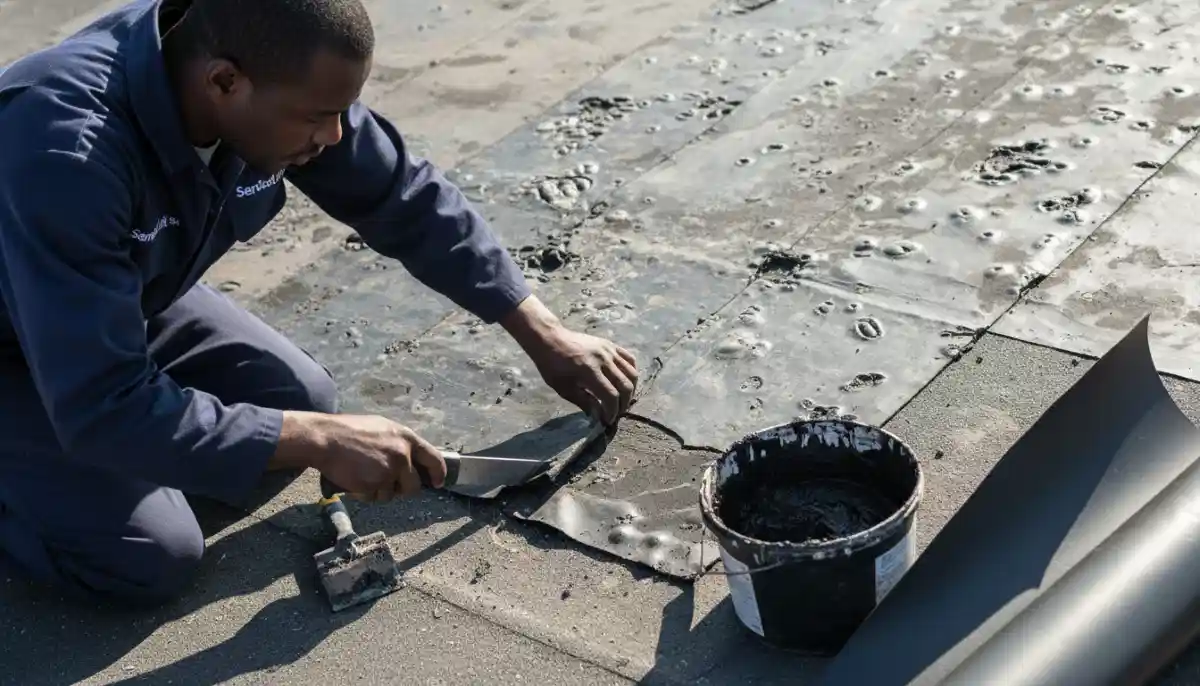
🫧 Blistering – Bubbles in Waterproofing
Blistering appears as bubbles or blisters in the membrane, especially common in torch-on bitumen systems.
Causes of Blistering
- Moisture trapped during installation (wet substrate, dew, rain)
- Air pockets between layers
- Solvent entrapment in liquid systems
- Heat expansion of trapped moisture
- Poor adhesion to substrate
Why Blisters Matter
- Weaken the membrane
- Can rupture, creating leak points
- Indicate poor installation
- Spread over time
How to Fix Blisters
- Small blisters: Cut open with knife, allow to dry, patch with compatible material
- Large blistered areas: May need to be cut out and replaced
- Extensive blistering: Indicates systemic installation problem – may need replacement
- Liquid systems: Grind down, reapply with proper primer
For guidance on proper installation, see our torch-on vs liquid guide.
🐊 Cracking & Alligatoring – Membrane Failure
Cracking and alligatoring (a pattern of cracks resembling alligator skin) indicate advanced membrane degradation.
Causes of Cracking
- UV degradation over time
- Thermal cycling (expansion and contraction)
- Loss of plasticizers (membrane becomes brittle)
- Structural movement
- Low-quality materials
- Insufficient membrane thickness
Fixes for Cracking
- Hairline cracks: Can be sealed with compatible liquid coating
- Small cracks: Clean, prime, apply patch or reinforcing fabric with liquid
- Extensive alligatoring: Membrane is at end of life – replacement recommended
- Structural cracks: May need substrate repair before waterproofing
Prevention: Regular maintenance coatings (reflective/UV protection) extend membrane life significantly.
🐟 Fishmouth – Lifted Seams and Edges
Fishmouth describes open, raised edges at membrane laps – shaped like a fish’s mouth. Common in torch-on systems.
Causes of Fishmouth
- Sheets not properly rolled/flattened during installation
- Sheets laid too cold (bitumen not soft enough)
- Insufficient heat at laps
- Poor workmanship
- Sheet shrinkage over time
Why Fishmouth is Serious
- Creates direct path for water entry
- Water gets under membrane
- Can cause widespread failure
How to Fix Fishmouth
- Small fishmouth: Cut open, clean, reheat and reseal, patch over
- Large fishmouth: May need to cut out section and replace
- Multiple fishmouths: Indicates poor installation – consider replacement
🏗️ Flashing Failure – Leaks at Edges and Penetrations
Flashing failure is one of the most common leak sources. Flashing details at parapets, pipes, vents, and edges are vulnerable.
Common Flashing Problems
- Flashing pulled away from wall
- Sealant dried and cracked
- Missing counter-flashing
- Inadequate upstand height (should be 150mm minimum)
- No mechanical fixing at top edge
- Pipe penetrations not sealed
Fixes for Flashing Failures
- Reattach flashing: Clean, prime, re-bond with appropriate adhesive
- Replace sealant: Remove old, apply new polyurethane or silicone sealant
- Add counter-flashing: Install metal or proprietary flashing over membrane
- Pipe penetrations: Use pipe seals or boots, seal with compatible mastic
- Inadequate upstand: May need to extend membrane up wall
Proper detailing is critical – see our roof waterproofing guide for best practices.
🚰 Scupper Blockage – When Drains Fail
Scupper blockage prevents water from draining, leading to ponding and eventual leaks.
Causes of Blockage
- Leaves and debris accumulation
- Birds nests
- Ice in winter (high altitude areas)
- Improper scupper size (too small)
- Scupper opening too high above roof
Fixes
- Clear blockage: Remove debris, flush with water
- Install scupper guards: Mesh or domes to prevent debris entry
- Resize scuppers: May need larger openings for roof area
- Add overflow scuppers: Secondary drainage for heavy rain
- Regular maintenance: Inspect and clean scuppers seasonally
In Pretoria and Centurion, seasonal leaf drop is a major cause of scupper blockage.
🔪 Puncture Damage – Accidental Holes
Puncture damage from foot traffic, equipment installation, or storms creates direct leak paths.
Common Causes
- Workers walking on roof
- AC installation or maintenance
- Satellite dish installation
- Falling branches or debris
- Animals (birds, rodents)
How to Fix Punctures
- Small puncture: Clean area, apply compatible patch (torch-on patch for bitumen, liquid for membranes)
- Multiple punctures: May indicate need for walkway pads or protection
- Install walkway pads: In high-traffic areas to prevent future damage
Consider regular roof inspections to catch damage early.
📐 Shrinkage & Movement Cracks
Membranes can shrink over time, pulling away from edges or creating stress cracks. Structural movement can also tear membranes.
Causes
- Thermal contraction
- Age-related shrinkage
- Building settlement
- Expansion joints not provided
- Substrate movement
Fixes
- Small shrinkage cracks: Fill with elastic sealant, reinforce with fabric
- Movement at expansion joints: Need proper expansion joint detail – consult specialist
- Widespread shrinkage: Membrane at end of life – replacement indicated
⚖️ Repair vs Replace – Decision Guide
How do you know when to repair and when to replace the entire roof?
Repair is Appropriate When
- Isolated damage (single leak, small area of blistering)
- Membrane is otherwise sound (less than 10-15 years old)
- No widespread degradation
- Ponding is minor and correctable
- Flashing failures only
- Budget is limited (temporary solution)
Replace is Necessary When
- Membrane is near end of life (15-20+ years for torch-on)
- Widespread blistering, cracking, or alligatoring
- Multiple leaks in different areas
- Ponding is severe and structural
- Substrate is damaged or deteriorated
- Repair costs exceed 50% of replacement cost
- You plan to stay in the property long-term
For flat roof replacement costs, see our waterproofing cost guide.
⚠️ Temporary Emergency Fixes
When you have an active leak, you need immediate temporary measures before permanent repair.
Emergency Temporary Fixes
- Tarp/roofing sheet: Cover large area, weight down, ensure water runs off
- Roof sealant tape: Butyl tape can temporarily seal small cracks
- Roof patch compound: Quick-setting cement or patch for small holes
- Plastic sheeting and mastic: For temporary flashing repairs
- Clear silicone: For small cracks (temporary only)
Important Notes
- Temporary fixes are just that – temporary
- They may void warranties if not done properly
- Always follow up with professional permanent repair
- Document temporary work for contractor
For urgent situations, our emergency services connect you with contractors who can provide both temporary and permanent solutions.
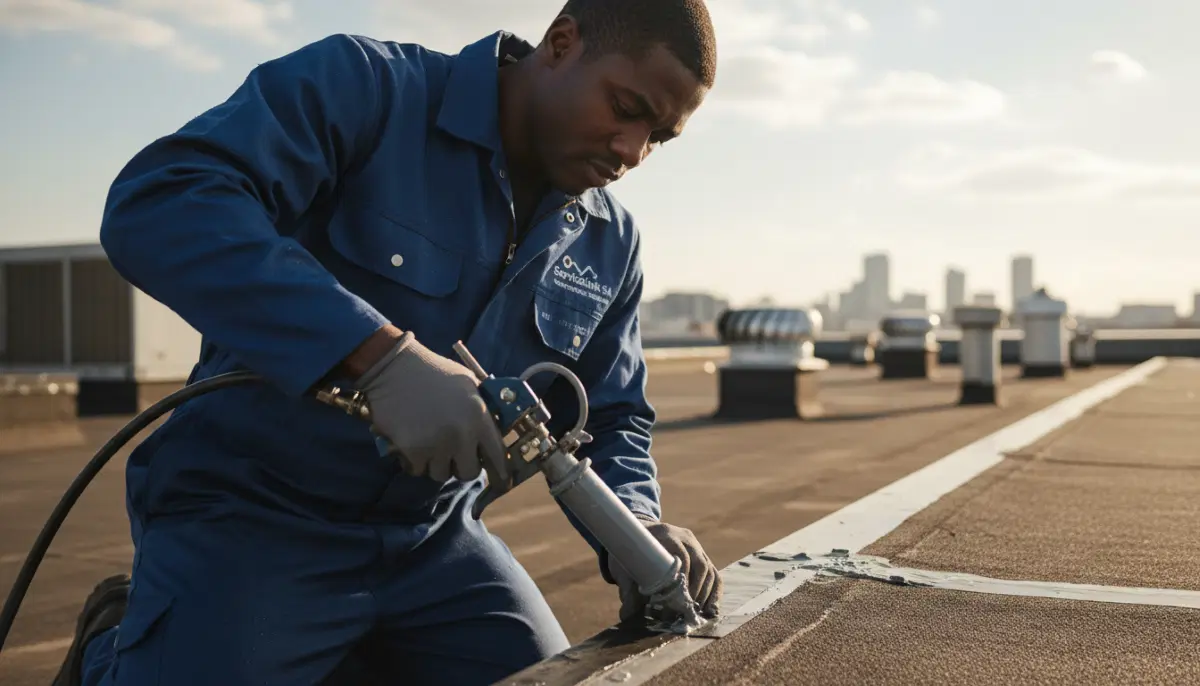
🔧 Permanent Repair Methods
Professional permanent repairs depend on the problem and membrane type.
For Torch-on Bitumen
- Patches: Cut new membrane larger than damaged area, torch on
- Re-melting: For fishmouths, reheat and press down
- Liquid over torch-on: Can apply liquid polyurethane over torch-on for seamless repair
For Liquid Polyurethane
- Recoat: Clean, prime, apply new liquid coat over entire area
- Reinforced patches: Embed fabric in liquid for extra strength
- Spot repairs: Grind, clean, prime, apply fresh material
For PVC/EPDM Membranes
- Patch kits: Use manufacturer-specific adhesives and patches
- Heat welding (PVC): Weld new material over damaged area
- Liquid flashings: For details and penetrations
Always ensure materials are compatible. Mixing systems can cause failure.
💰 Flat Roof Repair Cost South Africa
Flat roof repair cost South Africa varies by problem and repair type.
| Repair Type | Typical Cost Range | Notes |
|---|---|---|
| Small patch repair (per patch) | R800 – R2,000 | Includes labour, materials for small area |
| Flashing repair (per metre) | R400 – R1,200 | Depends on complexity |
| Pipe penetration seal | R600 – R1,500 | Per penetration |
| Blisters repair (each) | R500 – R1,500 | Cut and patch |
| Crack sealing (linear metre) | R300 – R800 | With compatible sealant |
| Add drains or scuppers | R2,500 – R5,000 each | Plus roofing work |
| Partial re-covering | R400 – R800 per m² | For larger areas |
| Full replacement | R180 – R500 per m² | Depending on system |
Example: A typical 100m² flat roof with multiple leaks and ponding issues might cost R15,000-R30,000 for repairs or R25,000-R50,000 for full replacement.
For detailed pricing, see our waterproofing cost guide.
🛡️ Preventive Maintenance – Avoiding Problems
Regular maintenance extends flat roof life significantly. According to Safeguard guidelines, a maintenance program should include:
Twice-Yearly Inspections (Spring and Autumn)
- Check for ponding water after rain
- Inspect flashings and edges
- Look for blisters, cracks, fishmouths
- Check drains and scuppers for blockage
- Inspect pipe penetrations
- Look for signs of movement or damage
Maintenance Tasks
- Clear debris from drains and scuppers
- Trim overhanging branches
- Reapply UV protection coating as needed (every 3-5 years)
- Reseal minor cracks promptly
- Ensure walkway pads protect high-traffic areas
- Check sealants at flashings – replace if cracked
Consider our roof inspection and maintenance service for professional assessments.
📍 Regional Flat Roof Considerations
📌 Johannesburg & Pretoria
In Johannesburg and Pretoria, high UV and hailstorms are concerns. UV protection coatings are essential. Hail can puncture membranes – thicker membranes recommended. Thermal cycling causes expansion/contraction stress.
📌 Durban & Umhlanga
In Durban and Umhlanga, high rainfall and humidity make ponding a critical issue. Drains must be adequate. Moss and algae growth require regular cleaning. Good ventilation prevents condensation under membranes.
📌 Cape Town & Bellville
In Cape Town and Bellville, winter rain tests every detail. Flashing failures are common. Wind can lift edges – ensure proper mechanical fixing. Heritage areas may have restrictions on visible alterations.
📌 Centurion & Midrand
In Centurion and Midrand, new developments often have flat roofs. Quality of installation varies widely. Get professional inspections before purchase.
❌ 8 Common Flat Roof Repair Mistakes
Avoid these errors that lead to recurring leaks:
- Mistake #1: Not fixing the root cause. Patching a leak without fixing ponding or flashing failure means it will leak elsewhere.
- Mistake #2: Using incompatible materials. Mixing different membrane types or using wrong patching materials causes adhesion failure.
- Mistake #3: Poor surface preparation. Patches on dirty, wet, or poorly primed surfaces fail quickly.
- Mistake #4: Ignoring surrounding damage. One blister often indicates wider issues – inspect the whole area.
- Mistake #5: Temporary fixes becoming permanent. Tarps and tape are temporary – schedule proper repair.
- Mistake #6: Walking on damaged areas. Can worsen damage – use walkway pads or stay off roof.
- Mistake #7: Not checking for hidden damage. Water can travel – leak location may not be entry point.
- Mistake #8: DIY when professional needed. Flat roof repairs require expertise – mistakes are expensive.
For more guidance, see our contractor selection guide.
❓ Frequently Asked Questions
Why does my flat roof keep leaking?
Why flat roofs leak repeatedly is often because the root cause wasn’t fixed. Ponding water, flashing failures, or widespread membrane degradation need addressing, not just patching. A proper diagnosis by a waterproofing specialist, following CWP guidelines, is essential.
How do I fix ponding water on my flat roof?
Ponding water on flat roof needs drainage solutions. For minor ponding, add drains or scuppers. For structural issues, tapered insulation or re-sloping may be needed. The repair guide above details options. Always ensure drains are clear first.
How much does flat roof repair cost in South Africa?
Flat roof repair cost South Africa ranges from R800-R2,000 for small patches, R400-R1,200 per metre for flashing repairs, and R15,000-R30,000 for major repairs on a typical 100m² roof. Full replacement costs R25,000-R50,000+. Get multiple quotes from vetted contractors.
What causes bubbles in flat roof membrane?
Blisters are caused by trapped moisture or air expanding with heat. They indicate poor installation or moisture in substrate. Fix by cutting open, drying, and patching. If widespread, replacement may be needed. See our torch-on vs liquid guide for system comparisons.
Can I repair a flat roof myself?
Small emergency patches may be DIY, but permanent repairs are best left to professionals. Flat roof repair requires correct diagnosis, compatible materials, and proper techniques. Mistakes lead to more damage. Use our quote system to find qualified contractors.
How often should I inspect my flat roof?
Inspect your flat roof twice yearly (spring and autumn) and after major storms. Look for ponding, blisters, cracks, and flashing issues. Regular professional inspections catch problems early, extending roof life.
When should I replace my flat roof instead of repair?
Replace when the membrane is near end of life (15-20+ years), when repairs exceed 50% of replacement cost, or when widespread blistering/cracking indicates systemic failure. Our roof waterproofing guide helps compare systems.
What is the best waterproofing for flat roofs?
Torch-on bitumen is excellent for value and performance. Liquid polyurethane is best for complex shapes and details. PVC membranes offer long life. The choice depends on your specific roof. See our comparison guide for help deciding.
✅ Final Thoughts – Your Flat Roof Action Plan
Flat roofs require different care than pitched roofs. Understanding common problems and their fixes helps you make informed decisions and avoid recurring leaks.
Key takeaways:
- Diagnose correctly: Identify the root cause before repairing
- Address drainage first: Fix ponding before patching leaks
- Use compatible materials: Match repairs to existing system
- Don’t delay repairs: Small problems become big leaks
- Maintain regularly: Inspections and coatings extend life
- Know when to replace: Sometimes replacement is more economical
🏢 The Bottom Line:
R800 – R30,000+
is the range for flat roof repairs – far less than the cost of water damage to your home’s interior.
Your 5-Step Action Plan
- Inspect your roof – identify visible problems
- Check drainage – ensure water can flow
- Get professional diagnosis – use our free inspection service
- Compare repair quotes – get multiple opinions
- Schedule repairs promptly – don’t wait for more damage
Need Your Flat Roof Fixed?
Get free, no-obligation quotes from vetted waterproofing specialists who understand flat roof problems and how to fix them permanently.
📞 Call us: 073 138 4726 for urgent assistance
Free site inspections •
Beat-your-quote guarantee •
Our guarantees
📚 Official resources & standards:
- Corobrik – Flat roof substrate standards and specifications
- Safeguard – Waterproofing maintenance guidelines
- Corporation of Waterproofing Professionals – Flat roof defect identification
Information accurate as of publication. Prices are indicative and may vary by location and contractor. This guide is for informational purposes.
Written by: Innocent T Hanyani
21+ years construction and digital industry experience, ServiceLink SA
Innocent has diagnosed and repaired thousands of flat roof problems across South Africa, from minor leaks to complete system failures. His expertise ensures this guide reflects real-world solutions and best practices.
For more detailed information, explore our roof waterproofing guide to understand different systems, our torch-on vs liquid comparison to choose the right system, our cost guide for pricing, and our roof leak prevention guide for broader advice. These resources work together to give you complete knowledge about flat roof care.