Planning a Communal DSTV System for Your Estate?
Get a free consultation from a verified, accredited DSTV installer specialising in communal systems.
Perfect for body corporates and estate managers.
Servicing Gauteng, Western Cape, KwaZulu-Natal, Johannesburg, Cape Town, Durban, and across South Africa
How DSTV Communal Systems Work in Estates: A Complete Guide for Body Corporates
🏘️ One dish, hundreds of homes – communal DSTV systems are the smart solution for estates, complexes, and body corporates.
You’re a body corporate trustee. Every month, residents complain about dishes on roofs, dishes on balconies,
dishes falling off walls, and unsightly cabling. The roof looks like a satellite dish graveyard.
New residents want DSTV but don’t want to add to the clutter.
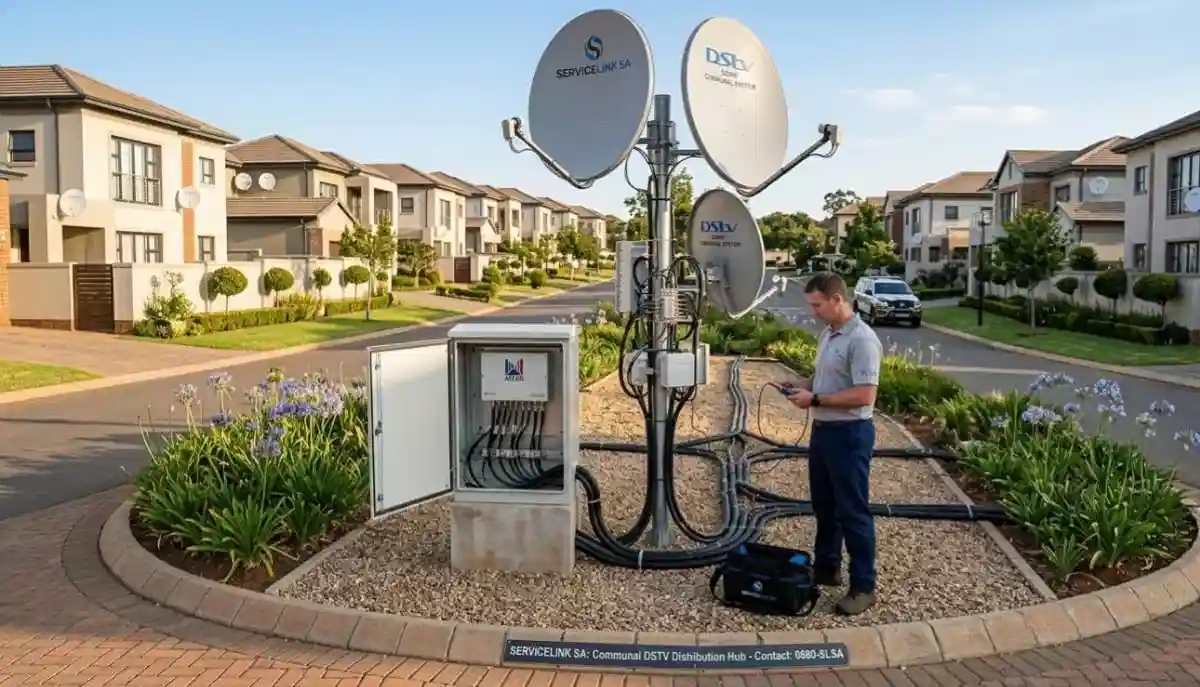
There’s a better way. Dstv communal systems allow a single professional-grade dish to serve
every unit in your estate or complex. One dish. One roof penetration. One maintenance point.
Hundreds of happy residents with perfect signal.
In this guide, I’ll explain everything about communal dstv installation for estates:
how these systems work, the benefits for body corporates, installation process, costs, and legal considerations.
If you’re asking “how does communal dstv work in complexes”, you’ve come to the right place.
For installation guidance, read our
communal installation guide.
For technical details, see multiswitch guide.
And for fibre solutions, read optical LNB guide.
📋 Table of Contents – Communal DSTV Systems Guide
🏘️ What Is a Communal DSTV System?
A dstv communal system (also called a MATV system – Master Antenna Television)
is a centralised satellite distribution system where one professional-grade dish serves all units in a complex or estate.
Key characteristics:
- Single central dish: One large dish (1.2m-2.4m) installed on a common roof or ground location
- Distribution network: Cables run from the dish to every unit in the complex
- Individual subscriptions: Each resident still needs their own DSTV subscription and decoder
- Independent viewing: Each unit can watch different channels independently
Where communal systems are used:
- Security estates and gated communities
- Sectional title complexes (townhouses, cluster developments)
- Apartment buildings
- Retirement villages
- Hotels and resorts
✅ Key Takeaway:
Think of a communal system like a central water supply. One source (the dish) feeds many houses
through a network of pipes (cables). Each house has its own tap (wall outlet) and pays for
what they use (subscription). It’s more efficient than every house drilling their own well.
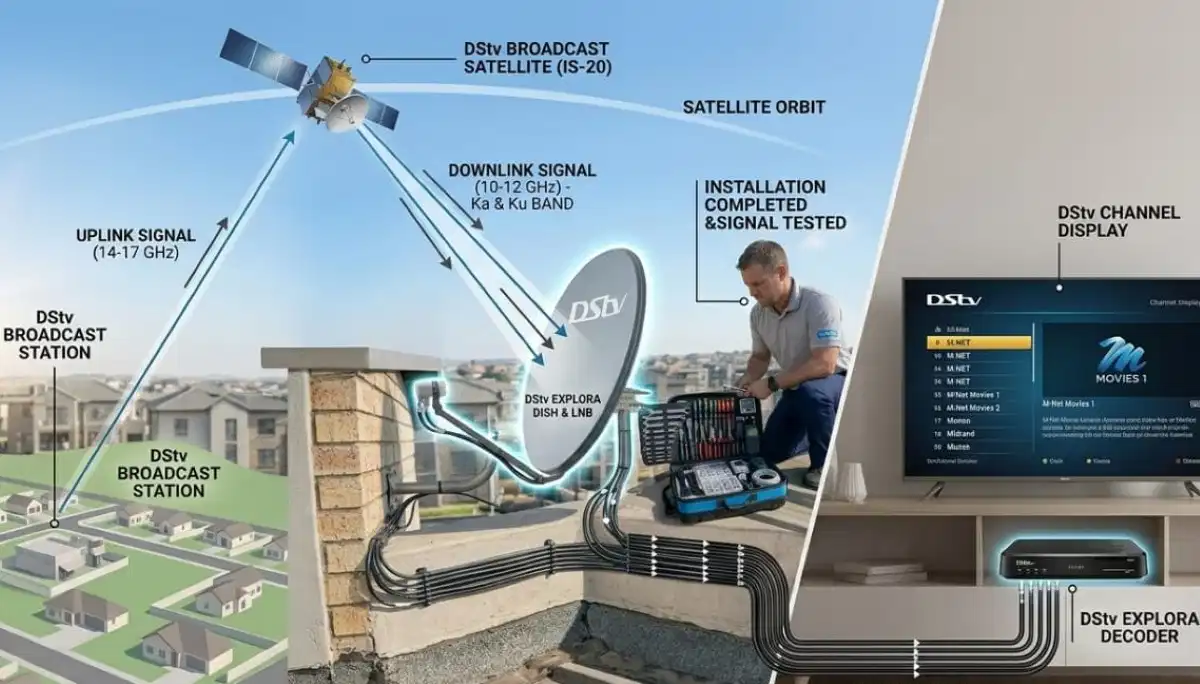
🔧 How DSTV Communal Systems Work (Technical Overview)
Understanding how does communal dstv work in complexes helps body corporates make informed decisions.
The signal path from satellite to resident:
- Satellite transmission: Signal travels 36,000km from Eutelsat satellite to your dish
- Central dish reception: Large professional-grade dish captures the signal
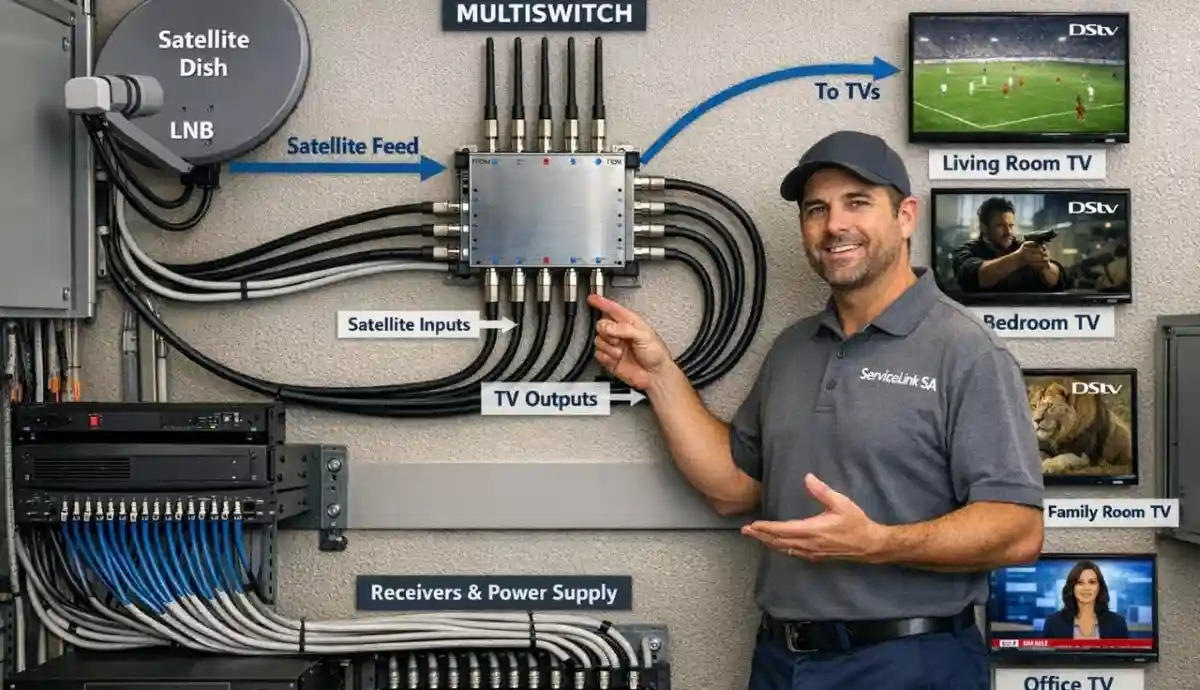
- Quattro LNB: Special LNB outputs all four satellite bands (Horizontal High, Horizontal Low, Vertical High, Vertical Low)
- Head-end equipment: Amplifiers and filters prepare the signal for distribution
- Multiswitch network: Distributes the four bands to many outputs (8, 16, 32, or 64-way)
- Riser cables: Vertical cables running through building shafts to each floor
- Horizontal runs: Cables from risers to each unit
- Wall outlets: Professional wall plates in each unit
- Resident’s decoder: Resident connects their decoder to the wall outlet
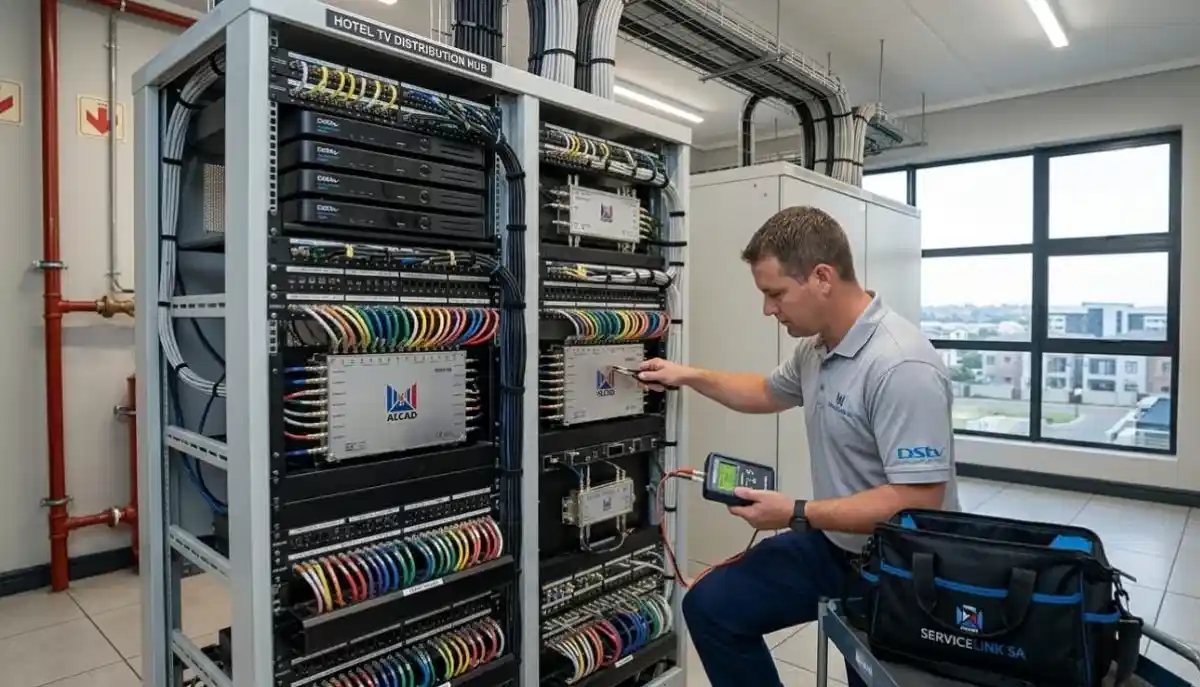
For large estates (fibre optic distribution):
- Optical LNB converts signal to light for fibre optic transmission
- Fibre backbone runs between buildings or clusters
- Optical receivers convert back to RF at each building
- Local multiswitches distribute to units within each building
- Read our optical LNB guide
📦 Components of a Communal DSTV System
A professional estate dstv distribution system requires several key components.
| Component | Description | Typical Spec |
|---|---|---|
| Satellite dish | Large central dish | 1.2m – 2.4m diameter |
| Quattro LNB | 4 outputs (H-H, H-L, V-H, V-L) | Required for multiswitch |
| Head-end amplifiers | Boost signal for distribution | 15-30dB gain |
| Multiswitch | Distributes signal to outputs | 8, 16, 32, or 64-way |
| Riser cables | Vertical distribution | RG11 or RG6 quad-shield |
| Horizontal cables | From riser to each unit | RG6 quad-shield |
| Wall outlets | In each unit | F-type connector |
| Lightning protection | Grounding and surge protection | SABS approved |
Ready to Explore a Communal System for Your Estate?
Get a free consultation from a verified, accredited DSTV installer specialising in communal systems.
We’ll design a solution that works for your property.
Free quotes. Verified installers. No obligation.
✅ Benefits of Communal DSTV Systems for Body Corporates & Residents
For body corporates / estate management:
- Aesthetics: One dish instead of hundreds – clean roof lines, no dishes on balconies
- Reduced roof damage: One roof penetration instead of hundreds – fewer leaks, lower maintenance costs
- Simplified compliance: One system to manage, not hundreds of individual installations
- Higher property values: Cleaner appearance increases property appeal
- Resident satisfaction: No more “my dish doesn’t work” complaints about individual installations
- Future-proof: Fibre-ready systems support future upgrades
For residents:
- Lower cost: No individual dish installation (saves R800-R1,500)
- No body corporate approval needed: The system is already installed
- Better signal: Professional-grade dish and maintenance
- No line of sight issues: The communal dish is placed in the optimal location
- Works during load shedding: If estate has backup power for the system
- Still choose own package: Residents still select their own DSTV package and decoder
⚖️ Communal Systems vs Individual Dishes: A Body Corporate Comparison
| Factor | Individual Dishes | Communal System |
|---|---|---|
| Number of dishes on roof | 100+ (unsightly) | 1 (clean) |
| Roof penetrations | 100+ (leak risk) | 1 (sealed) |
| Maintenance responsibility | Each resident (body corporate can’t control) | Body corporate (single point) |
| Signal quality | Variable (depends on individual alignment) | Consistent (professionally maintained) |
| Cost to resident | R800-R1,500 installation | R0-R500 connection fee |
| Body corporate oversight | Difficult (many approvals) | Simple (one system) |
| Aesthetic impact | High (dish forest) | Low (one dish) |
🔧 Communal DSTV Installation Process for Estates
A professional communal dstv installation follows a structured process.
Phase 1: Planning & Design (2-4 weeks)
- Site survey and signal testing
- Determine optimal dish location (clear line of sight to northeast)
- Design distribution network (cable routes, multiswitch locations)
- Prepare detailed quote and timeline
- Present to body corporate for approval
Phase 2: Infrastructure Installation (2-6 weeks depending on size)
- Install central dish (1.2m-2.4m) with professional mounting
- Install Quattro LNB and head-end equipment
- Install multiswitch network in distribution room(s)
- Run riser cables through building shafts
- Run horizontal cables to each unit
- Install wall outlets in each unit
Phase 3: Testing & Commissioning (1 week)
- Test signal at every wall outlet
- Balance signal levels across all outputs
- Document system configuration
- Hand over to body corporate
Phase 4: Resident Connection (ongoing)
- Residents connect decoders to wall outlets
- Residents activate their DSTV subscriptions
- Individual dishes (if any) are removed from roofs and balconies
💰 Communal DSTV System Cost Breakdown
| System Size | Typical Cost | Cost per Unit | Notes |
|---|---|---|---|
| Small complex (10-20 units) | R15,000-R30,000 | R750-R3,000 | Traditional coaxial distribution |
| Medium complex (20-50 units) | R30,000-R60,000 | R600-R3,000 | Multiple multiswitches |
| Large complex (50-200 units) | R60,000-R150,000 | R300-R3,000 | Fibre backbone or large multiswitch |
| Large estate (200+ units) | R150,000-R500,000+ | R200-R2,500 | Optical LNB + fibre distribution |
💡 Cost Recovery:
Most body corporates recover installation costs through connection fees (R500-R1,500 per unit).
A 100-unit complex paying R1,000 per unit recovers R100,000 – enough to cover most systems.
Costs can also be added to levies over 12-24 months.
💰 Funding Models for Body Corporates
Body corporates have several options for funding MATV system installation.
- Special levy: One-time charge to all owners – fastest recovery, but may face resistance
- Connection fee: Residents pay when they connect to the system – pay-as-you-go model
- Levy increase: Spread cost over monthly levies (e.g., R50-R100 per unit for 24 months)
- Loan financing: Body corporate borrows funds, repays over time from connection fees
- Developer contribution: For new developments, include in building costs
Recommended approach for existing complexes:
Combination of connection fee (R500-R1,000) plus small levy increase (R50/month for 12 months).
This makes the system affordable for residents while ensuring the body corporate recovers costs.
📋 Legal & Compliance Requirements for Communal Systems
Body corporates must follow legal requirements when installing dstv communal systems.
- Special resolution required: Sectional Titles Act requires 75% owner approval for significant alterations to common property
- Update conduct rules: Rules should be updated to require connection to communal system and prohibit individual dishes
- Compliance with SABS standards: MATV systems must meet SABS installation standards
- Building regulations: Dish mounting must comply with municipal building regulations
- Heritage considerations: Additional approvals may be needed for heritage buildings
- ICASA compliance: System must comply with ICACA regulations for signal distribution
⚠️ Critical Note:
Do NOT install a communal system without proper body corporate approval.
Unauthorised alterations to common property can be challenged by owners.
Always follow the Sectional Titles Act and your scheme’s conduct rules.
Consult your body corporate attorney before proceeding.
🔌 How Residents Connect to a Communal DSTV System
Once the communal system is installed, connecting is simple for residents.
- Find the wall outlet: Each unit has a DSTV wall outlet (usually in the living room)
- Connect decoder: Use a coaxial cable to connect decoder to wall outlet
- Activate subscription: Call DSTV or use MyDSTV app to activate subscription
- Tell DSTV it’s a communal system: So they know you don’t need a dish
- Enjoy DSTV: That’s it – no dish installation needed
What residents need to provide:
- Their own DSTV decoder (HD or Explora)
- Their own DSTV subscription
- A coaxial cable (short length from wall outlet to decoder)
- Their own TV
What residents DON’T need:
- A satellite dish
- LNB
- Individual dish installation
- Body corporate approval (already provided)
🔧 Maintenance & Ongoing Costs for Communal Systems
Like any infrastructure, communal systems require regular maintenance.
Annual maintenance checklist:
- Inspect dish for physical damage, corrosion, or movement
- Check and tighten all cable connections at head-end
- Test signal levels at multiple points in the system
- Verify amplifier and multiswitch operation
- Inspect lightning protection and grounding
- Document signal readings for trend analysis
Annual maintenance cost:
- Small complex (10-50 units): R2,000-R5,000 per year
- Medium complex (50-200 units): R5,000-R10,000 per year
- Large estate (200+ units): R10,000-R20,000 per year
Who pays for maintenance?
Maintenance is typically funded from the body corporate’s administrative levy.
This is a standard operating expense, like maintaining the garden or security system.
⚠️ Common Communal System Issues & Solutions
Problem: One unit has poor signal while others work fine
- Likely cause: Cable issue to that specific unit, or faulty wall outlet
- Solution: Check cable connections at the unit and at the multiswitch
Problem: Many units have poor signal
- Likely cause: Dish misalignment, LNB failure, or amplifier problem
- Solution: Professional system diagnosis – may need realignment or component replacement
Problem: No signal in any unit
- Likely cause: Complete system failure (power supply, LNB, or multiswitch)
- Solution: Emergency professional repair needed
Problem: Residents report interference on certain channels
- Likely cause: Amplifier or filter issue, or electrical interference
- Solution: Professional signal analysis and adjustment
❓ Frequently Asked Questions About Communal DSTV Systems
How does a communal DSTV system work in a complex?
How does communal dstv work in complexes is simple: one central dish feeds signal
through a distribution network (multiswitches and cables) to wall outlets in every unit.
Residents connect their decoders to the wall outlet – no individual dish needed.
Each resident still needs their own DSTV subscription and decoder.
What are the benefits of a communal DSTV system for an estate?
Dstv communal systems benefits include: cleaner aesthetics (one dish instead of hundreds),
reduced roof damage (one penetration vs hundreds), lower cost for residents (no individual dish installation),
consistent signal quality, and simplified body corporate oversight.
Residents save R800-R1,500 on installation.
How much does a communal DSTV system cost for a complex?
Estate dstv distribution costs vary by size: small complex (10-20 units) R15,000-R30,000,
medium (20-50 units) R30,000-R60,000, large (50-200 units) R60,000-R150,000.
Cost per unit typically R300-R3,000 depending on scale.
Get a free quote for your specific property.
Can residents still choose their own DSTV package?
Yes. Each resident still needs their own decoder and DSTV subscription.
They can choose any package (Access, Family, Compact, Compact Plus, or Premium)
just like any other DSTV customer. The communal system only provides the signal –
the subscription determines which channels they can watch.
Does a communal system work during load shedding?
The communal system’s head-end equipment needs power. If the body corporate installs UPS backup
for the system, signal continues during outages. Individual units still need power for their decoders and TVs.
Many estates are installing UPS backup for communal systems as a resident amenity.
What is the difference between a communal system and individual dishes?
A MATV system uses one central dish serving all units.
Individual dishes mean each resident installs their own dish.
Communal systems are cheaper for residents (no installation cost),
better for aesthetics (no dish clutter), and easier for body corporates
(one system to manage instead of hundreds).
Do we need body corporate approval for a communal system?
Yes. Installing a communal system on common property requires body corporate approval,
typically a special resolution (75% of owners). You’ll also need to update conduct rules
to require connection to the communal system and prohibit individual dishes.
Consult your body corporate attorney for the legal process.
How many units can one communal dish serve?
A properly designed communal dstv installation can serve hundreds of units.
With a 1.8m dish and professional multiswitch network, you can feed 200+ units.
With fibre optic distribution (optical LNB), you can feed 1,000+ units across a large estate.
The limit is the distribution equipment, not the dish itself.
What maintenance does a communal system need?
Annual professional maintenance is recommended: dish inspection, signal testing,
amplifier and multiswitch checks, and lightning protection verification.
Budget R2,000-R20,000 per year depending on system size.
Without maintenance, signal degradation occurs gradually and may go unnoticed until many residents complain.
Can existing individual dishes be replaced with a communal system?
Yes. This is a common upgrade for complexes tired of dish clutter.
The process: install communal system, connect willing residents, remove old individual dishes.
Body corporate typically funds the communal system and charges a connection fee.
The property looks cleaner and signal reliability improves dramatically.
✅ Final Thoughts: Communal Systems Are the Future for Estates
Dstv communal systems are the smartest solution for estates, complexes, and body corporates.
One dish serves everyone – cleaner aesthetics, lower costs for residents, and simpler management for body corporates.
Residents save R800-R1,500 on installation. The property looks better without dish clutter.
Signal quality is consistent and professionally maintained. And with fibre optic technology,
communal systems can serve estates of any size.
Ready to explore a communal system for your estate? Request a free consultation
from ServiceLink SA. We’ll connect you with verified, accredited installers specialising in communal systems.
Ready to Install a Communal DSTV System?
Get a free consultation from a verified, accredited DSTV installer specialising in communal systems.
Perfect for estates, complexes, and body corporates.
📞 Call us: 073 138 4726 for immediate communal system advice.
Free site inspection •
How to choose an installer •
Beat Your Quote guarantee
📚 Official resources & standards referenced:
- Official DSTV communal installation guidelines – Official communal system information.
- SABS – South African Bureau of Standards MATV system standards.
Information provided for general guidance. DSTV is a registered trademark of MultiChoice.
Communal system requirements vary by property. Always consult with a professional installer and your body corporate attorney.
Written by: Innocent T Hanyani
Communal Satellite Systems Specialist | 21+ Years Experience
Innocent T Hanyani has over two decades of experience designing and installing communal satellite systems
for estates, complexes, and body corporates across South Africa. He has helped hundreds of properties
transition from individual dishes to professional communal systems, improving aesthetics and reducing costs.
For more information about communal DSTV systems, explore our related resources:
communal installation guide,
optical LNB guide,
apartment installation,
townhouse installation,
multi-TV distribution.
See our service areas page for coverage in your region.