

Planning a Large-Scale DSTV System?
Get a free consultation from a verified, accredited DSTV installer specialising in optical LNB systems.
Perfect for estates, hotels, and large complexes.
Servicing Gauteng, Johannesburg, Sandton, Midrand, Centurion, Fourways, and across South Africa
Optical LNB Installation Guide: The Ultimate Solution for Large Buildings & Estates
📡 Fibre optic technology has revolutionised satellite distribution – no more signal loss over long distances.
You’re managing a 40-story apartment building. Residents on the top floors want DSTV, but the dish is on the roof.
By the time the signal travels down 40 floors of coaxial cable, it’s too weak to use. Amplifiers help, but they’re expensive and can introduce noise.
Or you’re developing a new estate with hundreds of homes spread over kilometres. Coaxial cable isn’t practical – the signal loss would be catastrophic.
What’s the solution?
The answer is optical lnb installation – using fibre optic cables instead of traditional coaxial cable.
An optical LNB converts the satellite signal to light, which can travel for kilometres with almost no signal loss.
It’s the ultimate solution for large buildings, estates, and hotels.
In this guide, I’ll explain everything about fibre lnb for dstv technology:
how it works, when you need it, installation requirements, costs, and benefits.
If you’re asking “what is an optical lnb for dstv”, you’ve come to the right place.
For traditional communal systems, read our
communal installation guide.
For signal distribution, see multiswitch guide.
And for hotels, read hotel installation guide.
📋 Table of Contents – Optical LNB Guide
📡 What Is an Optical LNB?
An optical lnb is a specialised LNB that converts satellite signals from radio frequency to light,
allowing distribution via fibre optic cables instead of traditional coaxial cable.
How it differs from a standard LNB:
- Standard LNB: Outputs radio frequency signals (950-2150 MHz) via coaxial cable
- Optical LNB: Outputs light signals via fibre optic cable
- Result: Near-zero signal loss over long distances (kilometres vs 50-100 metres)
What’s in the name?
“Optical” refers to fibre optics – the use of light to transmit signals.
These are sometimes called “fibre LNBs” or “fibre optic LNBs.”
✅ Key Takeaway:
Think of an optical LNB as a translator – it converts the satellite signal from “radio language” to “light language”
so it can travel through fibre optic cables. At the other end, another device converts it back to radio frequency
for your decoder. This allows signal distribution over much longer distances.
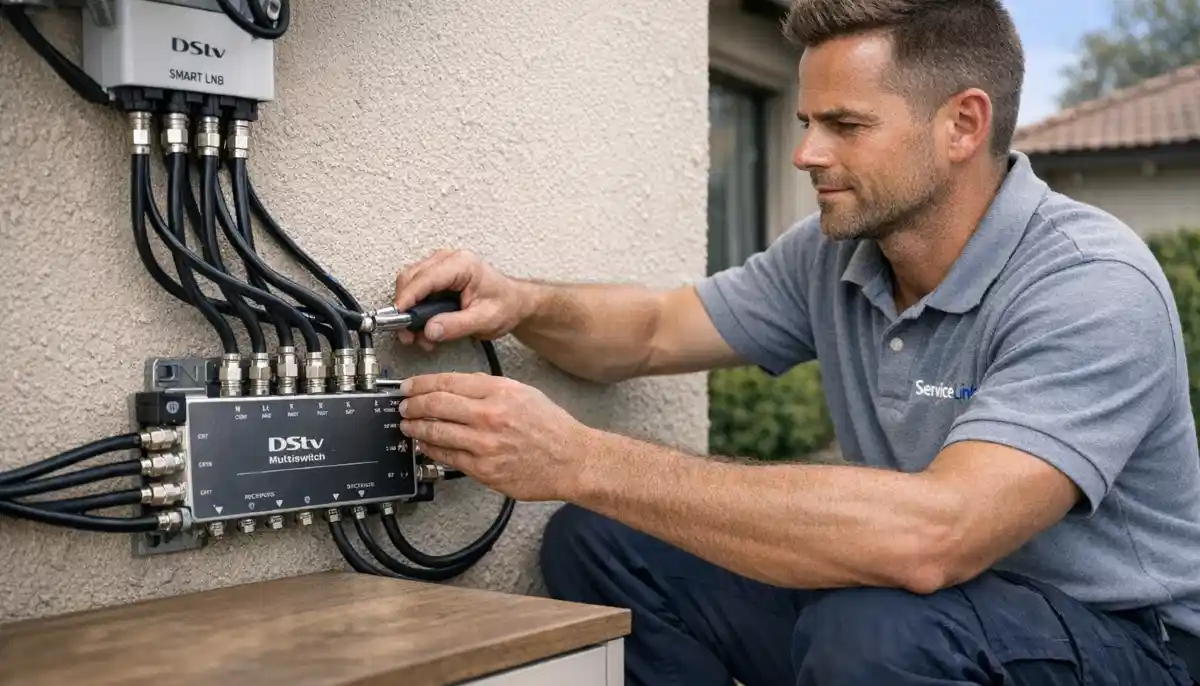
🔧 How Optical LNB Technology Works
Understanding optical satellite distribution helps you appreciate why it’s so powerful.
The signal path:
- Satellite dish captures the signal from space
- Optical LNB converts the RF signal to light (optical signal)
- Fibre optic cable carries the light signal over long distances (up to several kilometres)
- Optical receiver / media converter converts the light signal back to RF
- Multiswitch or direct connection distributes RF signal to decoders
- Decoders decode the signal as normal
Why fibre optic is superior for long distances:
- Coaxial cable loses signal at about 3-4dB per 30 metres
- Fibre optic loses signal at about 0.2-0.5dB per KILOMETRE
- Fibre is immune to electrical interference
- Fibre is lighter, thinner, and easier to pull through conduits
- No grounding or lightning protection issues (fibre is non-conductive)
⚖️ Optical LNB vs Traditional Coaxial: Key Differences
| Feature | Coaxial (Traditional) | Optical LNB (Fibre) |
|---|---|---|
| Maximum distance without amplification | 50-100 metres | 10+ kilometres |
| Signal loss per 100m | 10-15dB (significant) | <0.1dB (negligible) |
| Susceptibility to interference | High (electrical interference) | None (immune) |
| Lightning protection | Required (conductive) | Not required (non-conductive) |
| Cable diameter | ~7mm | ~3mm |
| Installation complexity | Moderate | Higher (specialist equipment) |
| Equipment cost | Lower | Higher |
| Best for | Small to medium systems | Large buildings, estates, long distances |
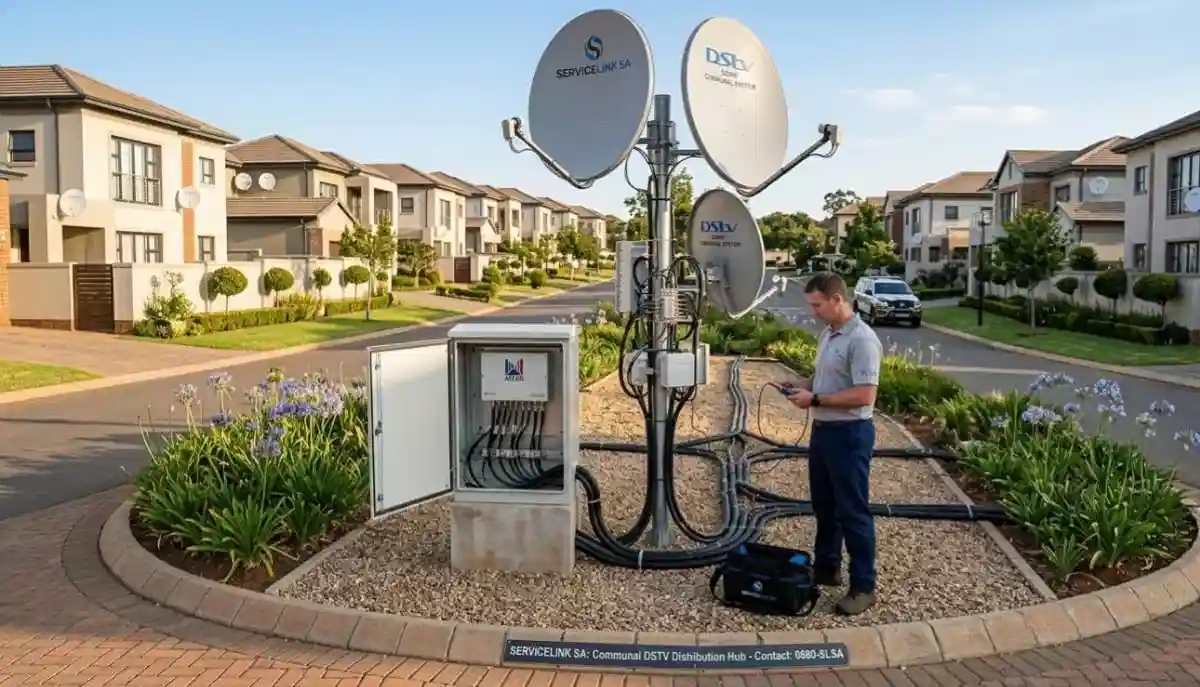
Planning a Large-Scale Fibre DSTV System?
Get a free consultation from a verified, accredited DSTV installer specialising in optical LNB technology.
We design systems for estates, high-rises, and hotels.
Free quotes. Verified installers. No obligation.
🏢 When Do You Need an Optical LNB?
Fibre lnb for dstv is not for everyone. Here’s when it’s the right solution.
You DON’T need an optical LNB if:
- You have a standard home with dish-to-decoder distance under 50 metres
- You have a small complex with short cable runs
- You’re on a tight budget (optical systems cost more)
You NEED an optical LNB if:
- High-rise buildings: Signal must travel 100+ metres from roof to ground floor
- Large estates: Homes are spread over hundreds of metres or kilometres
- Hotels with long cable runs: Signal must reach rooms on multiple floors
- Properties with severe interference: Fibre is immune to electrical noise
- Future-proofing: Fibre infrastructure supports future upgrades (e.g., IPTV, higher bandwidth)
- Multiple buildings on one property: One dish can feed several buildings via fibre
📦 Optical LNB System Components
A complete optical lnb installation requires several specialised components.
- Satellite dish: Standard dish (size depends on number of users)
- Optical LNB: Converts RF to optical signal – the heart of the system
- Fibre optic cable: Single-mode or multi-mode fibre (single-mode for longer distances)
- Optical receiver / media converter: Converts optical signal back to RF (installed at the distribution point)
- Multiswitch (optional): For distributing RF signal to multiple decoders after conversion
- Fibre connectors: SC, LC, or other types depending on equipment
- Fibre termination equipment: Fusion splicer or mechanical connectors (professional installation only)
💡 Note:
Optical LNB systems require specialised installation equipment (fibre fusion splicers, OTDR testers).
This is NOT a DIY project – professional installation is essential.
Contact a specialist installer.
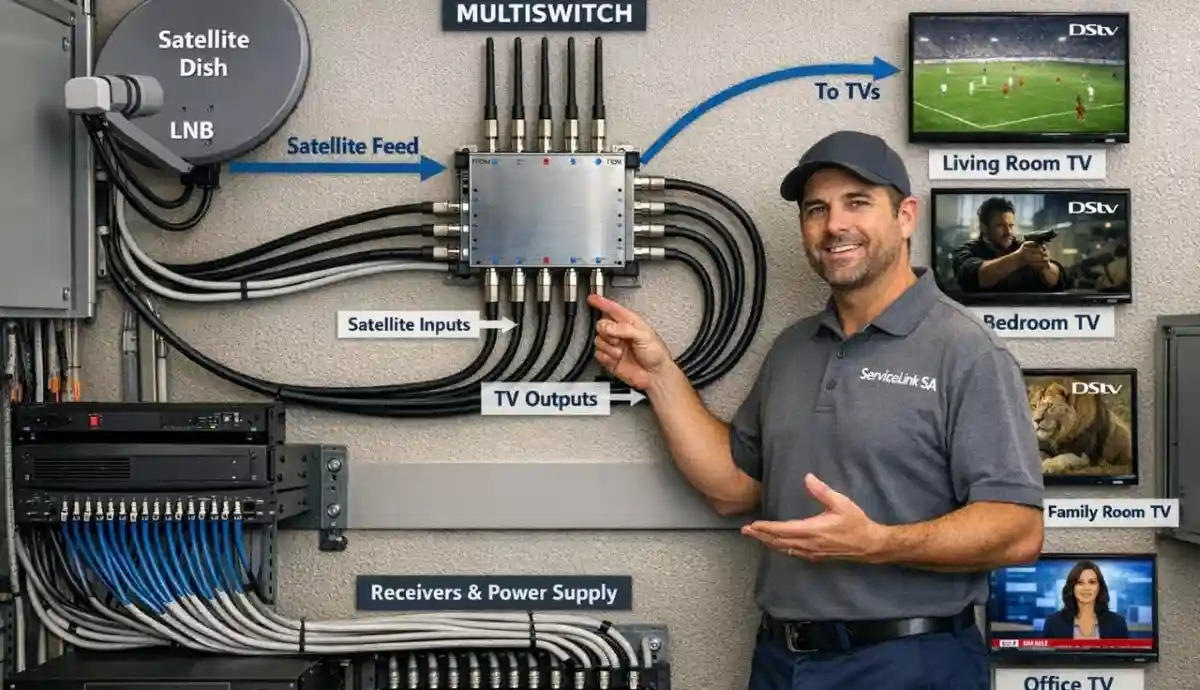
✅ Key Benefits of Optical LNB Systems
Optical satellite distribution offers compelling advantages for large installations.
- Virtually unlimited distance: Fibre can run for kilometres without signal loss
- No signal degradation: Signal quality remains perfect regardless of distance
- Immune to interference: Fibre isn’t affected by electrical noise, lightning, or radio interference
- No grounding required: Fibre is non-conductive – no lightning protection needed
- Future-proof: Fibre infrastructure supports future upgrades (4K, 8K, IPTV)
- Thinner, lighter cable: Easier to pull through conduits, less space in risers
- One cable per building: Single fibre can carry signal for hundreds of users
- Scalable: Easy to add more users by adding optical receivers
🔧 Optical LNB Installation Process
Professional optical lnb installation follows a structured process.
Step 1: Site survey and design
- Assess dish location and line of sight
- Plan fibre routes through the building or estate
- Calculate fibre length and determine splice points
- Design the head-end and distribution system
Step 2: Dish and optical LNB installation
- Install dish with clear line of sight to the northeast
- Mount optical LNB on the dish arm
- Connect fibre pigtail to LNB (professional splicing required)
Step 3: Fibre cable installation
- Pull fibre through conduits or risers
- Leave service loops at each end
- Terminate fibre ends with appropriate connectors (fusion splicing)
Step 4: Head-end installation
- Install optical receivers / media converters
- Connect to multiswitch (if multiple outputs needed)
- Power and test all equipment
Step 5: Distribution to users
- Run coaxial cable from multiswitch to each user
- Install wall outlets in each unit
- Test signal at each outlet
⚖️ Optical LNB vs Traditional Multiswitch: Which to Choose?
| Factor | Traditional Multiswitch | Optical LNB System |
|---|---|---|
| Maximum distance | 50-100 metres | 10+ kilometres |
| Signal quality over distance | Degrades | Perfect |
| Interference susceptibility | High | None |
| Equipment cost | Lower | Higher |
| Installation complexity | Moderate | High (specialist) |
| Cable cost (per metre) | R10-R25 | R15-R30 (fibre) |
| Best for | Small to medium buildings (<100m runs) | Large buildings, estates, long distances |
💰 Optical LNB System Cost Guide
| Component | Cost Range | Notes |
|---|---|---|
| Optical LNB | R1,500-R3,500 | Higher than standard LNB |
| Optical receiver (per location) | R1,000-R2,500 | One per fibre run |
| Fibre optic cable (per metre) | R15-R30 | Single-mode recommended |
| Fibre termination / splicing | R500-R1,500 per splice | Professional only |
| Multiswitch (if needed) | R900-R5,000 | Depends on number of outputs |
| Professional installation | R5,000-R20,000+ | Depends on system size |
| Typical total (small system) | R8,000-R15,000 | For one building with fibre run |
| Typical total (large estate) | R30,000-R100,000+ | Multiple buildings, long distances |
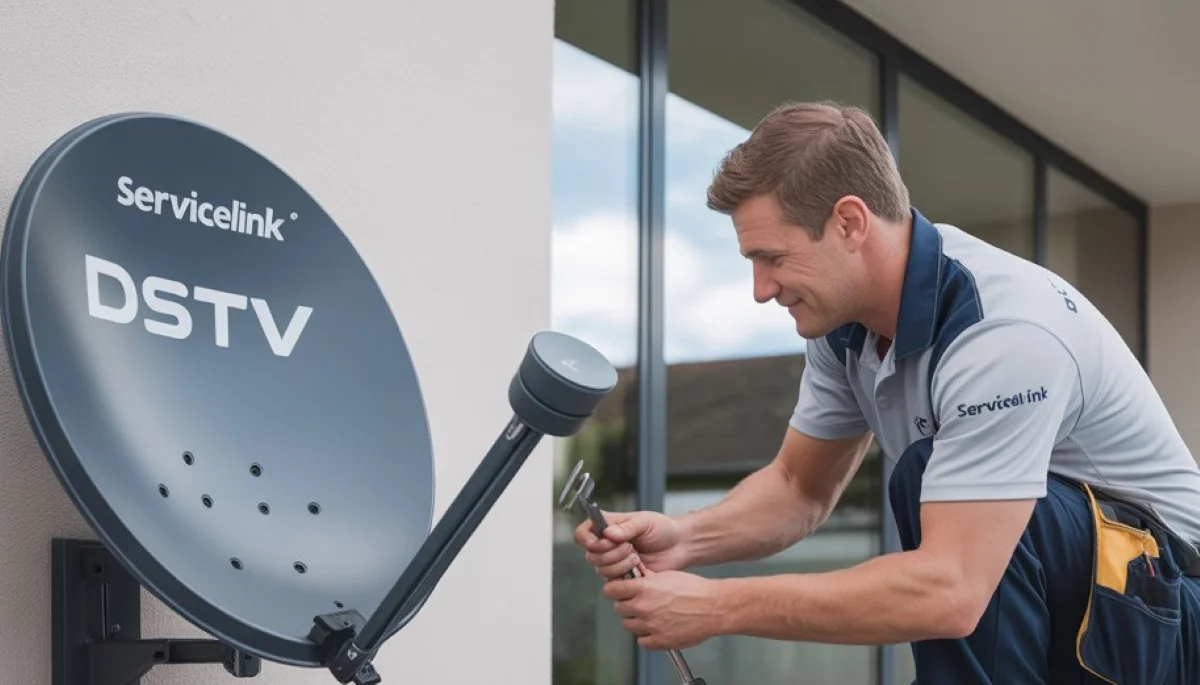
🏗️ Typical Applications for Optical LNB Systems
High-rise apartment buildings:
- Dish on roof, fibre runs down the building riser
- Optical receiver on each floor feeds a small multiswitch
- Each floor serves 10-20 apartments
- No signal degradation from top to bottom floors
Large residential estates:
- Single central dish at estate entrance
- Fibre runs to each cluster or building
- Local multiswitch in each building distributes to units
- Future-proof for estate expansion
Hotels and resorts:
- Single dish feeding all rooms via fibre backbone
- Eliminates signal loss over long distances
- Easy to add new buildings to the system
- Read our hotel guide
Campus environments:
- Universities, hospitals, corporate campuses
- One dish serves multiple buildings
- Fibre runs between buildings in underground conduits
📋 Real-World Case Studies
Case Study 1: 40-Story Apartment Building, Sandton
Challenge: 40 floors, 240 apartments. Traditional coaxial would require amplifiers every 5-6 floors,
introducing noise and signal degradation. Top floors would have poor signal.
Solution: Optical LNB on roof, fibre down the building riser, optical receiver in the basement,
then multiswitch distribution to each floor.
Result: Perfect signal on all 40 floors. No amplifiers needed. Future-proof fibre infrastructure.
Case Study 2: Golf Estate, Gauteng
Challenge: 500 homes spread over 5km. Traditional coaxial impossible due to distance.
Multiple dishes would be unsightly and expensive.
Solution: Central dish at estate entrance, optical LNB, fibre backbone to each cluster,
local multiswitches in each cluster distribution box.
Result: One dish serves entire estate. Fibre can be expanded for future developments.
No signal loss to furthest homes.
❓ Frequently Asked Questions About Optical LNB
What is an optical LNB and how does it work?
An optical lnb converts satellite signals from radio frequency to light,
allowing distribution via fibre optic cable. The light signal can travel for kilometres
with almost no loss. At the destination, an optical receiver converts it back to RF
for your decoder. This enables large-scale satellite distribution over long distances.
When should I use an optical LNB instead of a traditional multiswitch?
Fibre lnb for dstv is needed when coaxial cable runs exceed 50-100 metres,
or when you need to distribute signal to multiple buildings over long distances.
For standard homes and small complexes, traditional multiswitches are fine.
For high-rises, large estates, or campus environments, optical LNB is the superior solution.
How much does an optical LNB system cost?
Optical lnb installation costs: optical LNB R1,500-R3,500,
optical receiver R1,000-R2,500, fibre cable R15-R30/m, professional installation R5,000-R20,000+.
A small system for one building costs R8,000-R15,000.
A large estate system costs R30,000-R100,000+.
Get a free quote for your specific project.
Can I install an optical LNB myself?
No. Optical satellite distribution requires specialist equipment
(fibre fusion splicers, OTDR testers) and expertise. Fibre termination is delicate
and must be done precisely. Always use a professional installer certified in fibre optics.
Contact a specialist.
What’s the maximum distance for an optical LNB system?
With single-mode fibre, an optical LNB system can transmit signal up to 10-20 kilometres
without significant loss. For practical purposes, there’s virtually no distance limit
for buildings and estates. This is the key advantage over coaxial systems,
which are limited to 50-100 metres.
Does an optical LNB require power?
Yes. The optical LNB itself requires power (usually from the decoder via the coaxial cable,
similar to standard LNBs). Optical receivers also require local power.
Unlike standard LNBs, optical LNBs may have higher power requirements.
Professional installers will ensure adequate power supply.
Is fibre optic cable better than coaxial for DSTV?
For what is an optical lnb for dstv applications, fibre is superior for long distances.
It has near-zero signal loss, is immune to interference, and requires no grounding.
However, for short runs (under 50 metres), coaxial is simpler and more cost-effective.
The choice depends on your specific distance and application.
Can I use existing fibre infrastructure for DSTV?
Yes, if you have existing fibre in your building or estate, it can often be used for DSTV distribution.
You’ll need optical LNB at the dish and optical receivers at distribution points.
A professional installer can assess your existing fibre and design the system accordingly.
What’s the difference between single-mode and multi-mode fibre for DSTV?
For fibre lnb for dstv, single-mode fibre is recommended.
It supports longer distances (kilometres) and higher bandwidth.
Multi-mode fibre is limited to shorter distances (300-500 metres) and is typically used within buildings.
Your installer will recommend the appropriate fibre type for your application.
How many users can one optical LNB support?
One optical LNB can support hundreds or even thousands of users.
The signal is converted to light, then distributed via fibre to multiple optical receivers.
Each receiver can feed a multiswitch, which then feeds up to 64 decoders.
By cascading, systems can support thousands of users from a single dish.
✅ Final Thoughts: Optical LNB – The Future of Large-Scale DSTV Distribution
Optical lnb installation represents the cutting edge of satellite distribution technology.
By converting signals to light and using fibre optic cable, it eliminates the distance limitations
that plague traditional coaxial systems.
For high-rise buildings, large estates, hotels, and campus environments, optical LNB is the ultimate solution.
Yes, it costs more upfront – but the benefits of perfect signal quality over any distance,
immunity to interference, and future-proof fibre infrastructure make it the smart choice for large-scale projects.
Ready to explore an optical LNB system for your property? Request a free consultation
from ServiceLink SA. We’ll connect you with verified, accredited installers specialising in fibre optic satellite distribution.
Ready to Install an Optical LNB System?
Get a free consultation from a verified, accredited DSTV installer specialising in fibre optic technology.
Perfect for high-rises, estates, hotels, and large complexes.
📞 Call us: 073 138 4726 for immediate optical LNB advice.
Free site inspection •
How to choose an installer •
Beat Your Quote guarantee
📚 Official resources & standards referenced:
- Official DSTV optical LNB specifications – Official optical LNB information.
- SABS – South African Bureau of Standards fibre optic standards.
Information provided for general guidance. DSTV is a registered trademark of MultiChoice.
Optical LNB systems require professional design and installation – consult a certified fibre optic specialist.
Written by: Innocent T Hanyani
Satellite & Fibre Optic Distribution Specialist | 21+ Years Experience
Innocent T Hanyani has over two decades of experience in satellite television and fibre optic distribution systems across South Africa.
He has designed and installed optical LNB systems for high-rise buildings, large estates, and hotels,
helping property owners overcome the distance limitations of traditional coaxial distribution.
For more information about optical LNB and large-scale DSTV distribution, explore our related resources:
how communal systems work,
communal installation guide,
multiswitch guide,
hotel installation guide,
multi-TV distribution.
See our service areas page for coverage in your region.