
Ice on Your Aircon? Don’t Let It Destroy Your Compressor
Get free quotes from verified local aircon repair technicians. Fast diagnosis of airflow and refrigerant problems.
Find Aircon Repair Technicians Near Me
Servicing Johannesburg, Pretoria, Cape Town, Durban, and across South Africa
Frozen Aircon Coils? Don’t Scrape! Here’s How to Fix Ice Build Up Safely
🧊❄️ From dirty filters to low refrigerant—diagnose why your air conditioner is freezing up before the compressor fails
You walk past your indoor aircon unit and notice something strange. Water dripping. You open the front panel and your heart sinks. Ice. Thick layers of ice covering the copper pipes and the metal coils. Your aircon is freezing up in the middle of summer.
“How can my aircon be freezing when it’s 35°C outside?” you wonder. “Isn’t ice a good thing? It means it’s cold, right?”
Wrong. Aircon ice build up is NEVER normal. It means something is seriously wrong. And running your aircon while iced up can destroy your compressor—a R5,000-R12,000 repair.
I’ve seen this too many times. Homeowners see ice and think, “It’s still cooling, so I’ll let it run.” Hours later, the ice melts, floods their floor, and the compressor burns out. All because they didn’t act quickly.
In this guide, I’ll explain why aircon coils freeze, the 5 most common causes, how to safely thaw your unit, and how to fix the underlying problem—from simple DIY cleaning to professional refrigerant repair.
For more troubleshooting help, check same-day aircon repair services and aircon not cooling guide. Ready to stop the ice? Let’s go.
📋 Table of Contents – Aircon Ice Build Up Guide
🧊 Why Ice Forms on Air Conditioners (The Science)
To understand why aircon ice build up happens, you need to understand how your aircon works.
Normal operation: Warm air from your room is blown across freezing-cold evaporator coils (typically 4-10°C). The refrigerant inside the coils absorbs heat from the air, causing the air to cool. Moisture in the air condenses on the coils (like water on a cold glass) and drips into the drain pan. This is normal and good.
What causes ice: When something goes wrong, the evaporator coils get TOO cold—below freezing (0°C or lower). Moisture in the air freezes on the coils instead of condensing and dripping away. Ice builds up layer by layer, eventually blocking airflow completely.
The vicious cycle: Ice blocks airflow → less warm air reaches the coils → coils get even colder → more ice forms → even less airflow. This cycle continues until the entire coil is a block of ice.
⚠️ NEVER CHIP OR SCRAPE ICE OFF YOUR AIRCON!
The coils are made of delicate aluminum fins. Scraping ice off will bend and crush the fins, permanently damaging your aircon. Only allow natural melting (turn off cooling and run fan only). Patience saves your unit.
🔍 Quick Diagnostic: Identify the Cause of Ice
Use this checklist to narrow down why your frozen aircon coil is icing up:
| Symptom | Likely Cause | DIY Fix? | Urgency |
|---|---|---|---|
| Ice on indoor unit, haven’t cleaned filter in months | Dirty air filter (blocked airflow) | ✅ Yes | Moderate (thaw then clean) |
| Ice on indoor unit, supply vents blocked by furniture | Blocked vents or closed doors | ✅ Yes | Moderate (thaw then clear) |
| Ice on indoor unit, ice returns quickly after thawing | Low refrigerant (gas leak) | ❌ No (illegal) | High (compressor damage risk) |
| Ice on indoor unit, fan not spinning or airflow weak | Fan motor problem | ❌ No | High (compressor damage risk) |
| Ice on outdoor unit pipes (not indoor coils) | Low refrigerant (gas leak) | ❌ No (illegal) | High (compressor damage risk) |
💡 The 30-Minute Test:
After thawing your unit completely (see instructions below), run it in Cool mode for 30 minutes. If ice returns within 30 minutes, you almost certainly have low refrigerant or a fan problem. Call a professional immediately.
🧹 Cause #1: Dirty Air Filter (The #1 Culprit!)
This is the most common reason for why aircon coils freeze. And it’s the easiest fix.
How to diagnose:
- You haven’t cleaned your filter in months (or ever)
- The filter looks grey, black, or clogged with dust/hair when you remove it
- Airflow from the indoor unit feels very weak
- Ice is forming on the indoor coils and pipes
Why this causes ice: A blocked air filter restricts airflow across the evaporator coils. Without enough warm room air flowing over the coils, the coils get too cold—below freezing. Moisture in the air freezes on the coils instead of condensing and draining away. Ice builds up.
DIY fix (5 minutes + thaw time):
- Turn off the aircon (remote and isolator switch)
- Open the front panel and remove the filter(s)
- If there’s ice on the coils, you must thaw first (see “How to Thaw” section below)
- Vacuum the filter with a brush attachment
- Wash with warm soapy water (not hot—can warp plastic)
- Rinse thoroughly and let dry completely (don’t install wet)
- Once fully thawed, reinstall the clean filter
- Restart the aircon—ice should not return
✅ Pro Tip:
Clean your aircon filters every 2-4 weeks during summer. A clean filter prevents ice build up, improves cooling, saves electricity (15-30%), and extends the life of your unit. Read our complete filter cleaning guide.
🚪 Cause #2: Blocked Vents or Closed Doors
Restricted airflow doesn’t only come from dirty filters—physical obstructions can also cause ice.
How to diagnose:
- Furniture, curtains, or boxes are blocking the air supply or return vents
- Doors to the room are closed, restricting airflow from the rest of the house
- The room is very small and the door is kept closed
- Ice forms even with a clean filter
Why this causes ice: Same principle as a dirty filter—restricted airflow means the coils get too cold and freeze. If the room door is closed and the room is small, the aircon quickly cools the limited air, then the coils have no warm air to absorb heat from, so they freeze.
DIY fix (2 minutes):
- Ensure all supply vents (where cold air comes out) are fully open and unobstructed
- Ensure the return air intake (usually the grille on top of the indoor unit) is unobstructed
- Leave the room door slightly open (at least 10-20mm) to allow airflow circulation
- Move furniture away from vents
- Thaw the unit (see instructions below) and restart
🧼 Cause #3: Dirty Evaporator Coils
If your filter is clean but ice still forms, the evaporator coils themselves may be dirty.
How to diagnose:
- You clean your filter regularly, but ice still forms
- You can see visible dirt, dust, or grease on the metal fins when you open the panel
- The aircon is several years old and has never had a professional deep clean
Why this causes ice: Dirt on the coils acts as an insulator. It prevents heat transfer between the air and the refrigerant. The coils get colder than they should (trying to compensate), and ice forms.
DIY fix (cautious approach):
- Turn off the aircon and thaw completely
- Remove the filter and front panel (if possible)
- Use a soft brush to gently remove loose debris from the coils
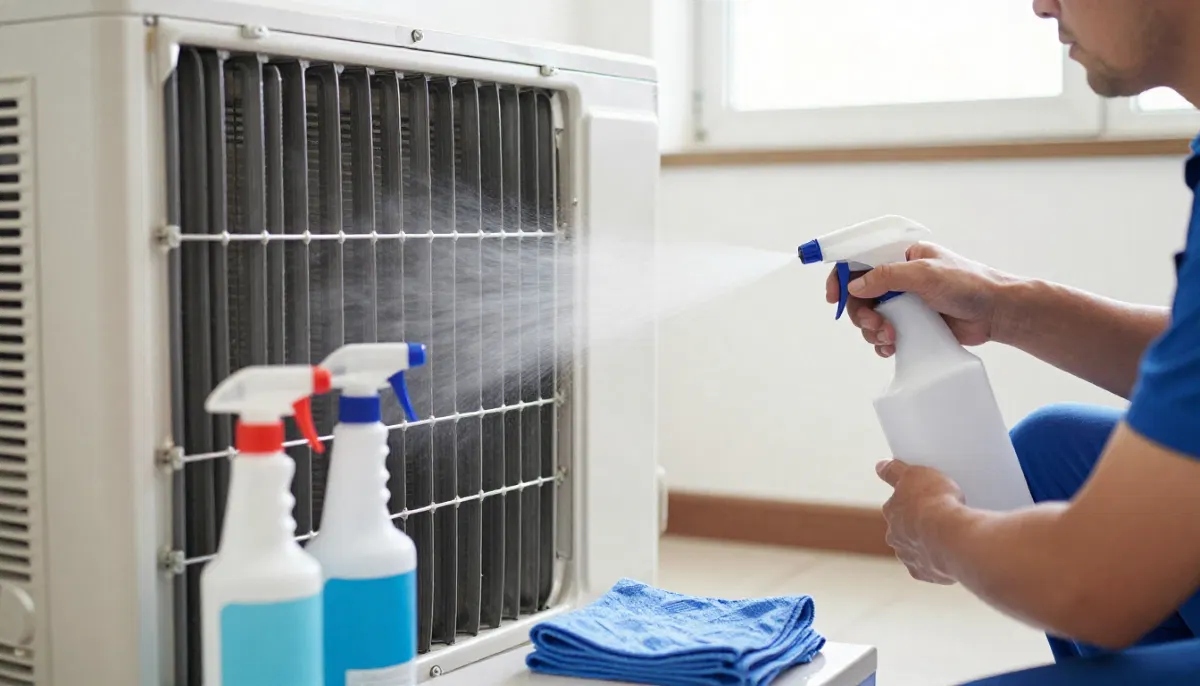
- Spray a specialized evaporator coil cleaner (available at hardware stores, R150-R300) onto the coils
- Wait as directed, then rinse gently with a spray bottle of water (not pressure washer)
- Wait for coils to dry completely before reassembling and restarting
⚠️ Caution:
Coil fins are extremely delicate—easily bent by pressure, brushes, or fingers. Bent fins restrict airflow and reduce cooling. If you’re not confident, hire a professional. A professional deep clean costs R500-R1,000 and is worth every rand. Read our complete coil cleaning guide.
Ice Returns Quickly After Thawing? That’s a Red Flag
Ice that returns within 30 minutes usually means low refrigerant or a fan problem. Get free quotes from certified technicians.
Get Free Quotes From Local Technicians
Same-day service available for urgent ice problems.
💨 Cause #4: Low Refrigerant (Gas Leak)
If you’ve cleaned your filter, cleared vents, and cleaned the coils—but ice still forms—you almost certainly have low refrigerant (a gas leak).
How to diagnose:
- Ice returns quickly (within 30 minutes) after thawing
- Ice forms on the outdoor unit’s copper pipes (not just indoor coils)
- The aircon is not cooling properly (or blowing warm air)
- You hear a hissing sound (refrigerant leak)
- Your electricity bill has increased (compressor running longer)
Why this causes ice: Low refrigerant pressure causes the evaporator coils to become TOO cold (below freezing). The refrigerant is expanding too much because there’s not enough of it. Ice forms on the coils and pipes.
Important myth busting: Refrigerant doesn’t get “used up.” It circulates in a sealed system. If you’re low on gas, you have a LEAK. Just adding gas without fixing the leak is a waste of money—the gas will leak out again.
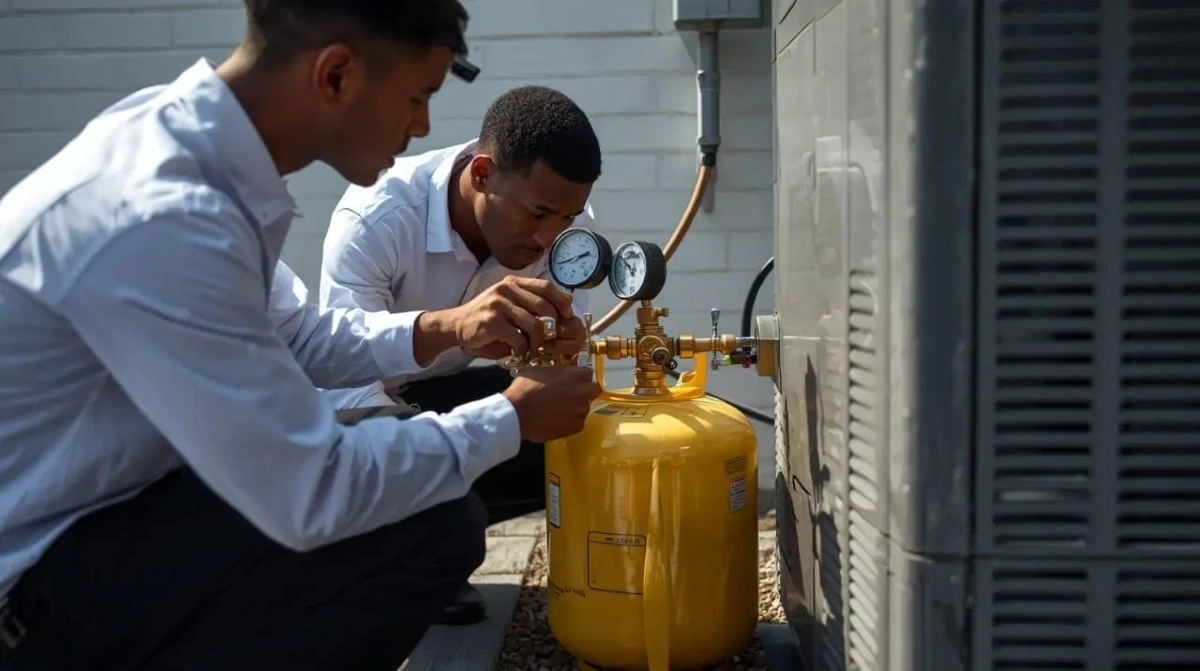
Is this DIY? NO. Refrigerant handling requires SAQCA certification. It’s illegal to handle refrigerants without a license. Refrigerants (R32, R410A, R22) are also harmful to the environment and dangerous to handle.
Professional fix: A certified technician will:
- Locate the leak using electronic leak detector or UV dye
- Repair the leak (braze/solder copper pipes or replace damaged components)
- Vacuum the system to remove moisture and air
- Recharge with the correct amount of refrigerant
- Test the system for proper operation
Typical cost: R800-R1,500 for leak detection + R800-R2,500 for gas refill.
Read our refrigerant leak guide and gas refill cost guide. Read DEFF refrigerant handling regulations.

🌀 Cause #5: Fan Motor Not Working Properly
If the indoor fan isn’t moving enough air across the coils, ice will form—even with a clean filter.
How to diagnose:
- The indoor fan spins very slowly or makes unusual noises
- Airflow from the vents is very weak (even with a clean filter)
- The fan stops and starts erratically
- You’ve ruled out dirty filter and blocked vents
Why this causes ice: The fan is responsible for pulling warm room air across the evaporator coils. If the fan isn’t moving enough air, the coils get too cold and freeze—same as a dirty filter.
Is this DIY? NO. Fan motor diagnosis and replacement requires electrical knowledge and tools.
Professional fix: A technician will test the fan motor, capacitor, and control board. Fan motor replacement: R1,500-R3,500.
Read our fan motor problems guide and fan not working guide.
🧊 How to Safely Thaw Your Aircon (Step by Step)
Before you can fix the underlying problem, you must thaw the ice completely. NEVER run an iced-up aircon.
Method 1: Fan Only (Recommended – 2-4 hours)
- Turn off the aircon using the remote
- Change the mode to FAN ONLY (no cooling, no heat, just the fan)
- Set the fan speed to HIGH (this moves the most air across the coils)
- Run the fan for 2-4 hours until all ice has melted
- Place towels under the unit to catch melting water
- Once completely thawed, turn off the unit and address the underlying cause
Method 2: Turn Off Completely (Slower – 4-8 hours)
- Turn off the aircon at the remote AND the isolator switch
- Wait 4-8 hours for natural thawing
- Place towels under the unit to catch water
- Once completely thawed, address the underlying cause
🚨 NEVER DO THESE:
- NEVER scrape or chip ice off the coils (you’ll destroy the fins)
- NEVER use a hairdryer or heat gun (thermal shock can crack pipes)
- NEVER run the aircon in Cool mode while iced up (compressor damage)
- NEVER ignore ice and hope it goes away (it won’t)
💀 What Happens If You Run an Iced-Up Aircon
Running your air conditioner with ice on the coils is dangerous. Here’s what happens:
The cascade of failure:
- Ice blocks airflow across the evaporator coils
- Liquid refrigerant returns to the compressor instead of gas (liquid slugging)
- Liquid refrigerant cannot be compressed—it’s like trying to compress water
- The compressor’s internal valves and pistons are damaged or destroyed
- The compressor fails—either immediately or within weeks/months
💰 The Cost Comparison:
Cleaning a dirty filter: R0. Professional coil cleaning: R500-R1,000. Fixing low refrigerant: R1,500-R4,000. Compressor replacement: R5,000-R12,000 (often more than a new unit). Turn off an iced-up aircon immediately. Thaw it. Fix the cause. Don’t be the person who ignored ice and paid thousands.
💰 Repair Cost Guide by Cause (What You’ll Actually Pay)
Here’s what you can expect to pay to fix aircon ice build up problems in South Africa:
| Cause | Typical Repair Cost | DIY Possible? | Notes |
|---|---|---|---|
| Dirty air filter | R0 | ✅ Yes | Clean monthly—free and easy |
| Blocked vents or closed doors | R0 | ✅ Yes | Clear obstructions, open doors |
| Dirty evaporator coils (DIY) | R150 – R300 (coil cleaner) | ⚠️ Risky DIY | Fins bend easily—be careful |
| Dirty evaporator coils (professional) | R500 – R1,000 | ❌ No | Worth it for deep clean |
| Low refrigerant (leak repair + refill) | R1,500 – R4,000 | ❌ No (illegal) | Requires certified technician |
| Fan motor replacement | R1,500 – R3,500 | ❌ No | Indoor or outdoor fan |
| Compressor replacement (if you ignored ice) | R5,000 – R12,000 | ❌ No | Preventable by fixing ice early! |
For accurate quotes, request quotes from local technicians.
🛡️ Prevention: Stop Ice Before It Forms
Preventing why aircon coils freeze emergencies is easier than fixing the damage. Here’s a simple prevention schedule:
| Frequency | Task | Time | Prevents |
|---|---|---|---|
| Every 2-4 weeks (summer) | Clean air filters | 5 minutes | #1 cause of ice (blocked airflow) |
| Every month | Check that vents are unobstructed | 1 minute | Blocked vents causing ice |
| Every 3 months | Ensure room doors aren’t kept fully closed | 30 seconds | Poor airflow circulation |
| Annually (before summer) | Professional service including coil cleaning | 1 hour (technician) | Dirty coils, low refrigerant detection |
| As needed | If you see ANY ice, act immediately | Thaw then fix | Compressor damage from ignored ice |
Read our complete aircon maintenance checklist and service frequency guide. Schedule professional servicing through free inspections and maintenance services.
❓ Frequently Asked Questions About Aircon Ice Build Up
Why is my air conditioner icing up in summer?
Aircon ice build up in summer is a sign of a problem, not normal operation. The most common causes are: dirty air filter (restricted airflow), blocked vents or closed doors, dirty evaporator coils, low refrigerant (gas leak), or a failing fan motor. Ice means your coils are getting too cold because not enough warm air is flowing over them. Turn off the unit, thaw it, and diagnose the cause.
Can a dirty filter cause ice on my aircon?
Yes, absolutely. A dirty filter is the #1 cause of why aircon coils freeze. When the filter is clogged, airflow across the evaporator coils is restricted. Without enough warm room air flowing over the coils, they get too cold—below freezing. Moisture in the air freezes on the coils instead of condensing and draining away. Clean your filter monthly to prevent ice. Read our filter cleaning guide.
How do I defrost my air conditioner quickly?
The fastest safe method is to switch to FAN ONLY mode (no cooling) at high speed. Run the fan for 2-4 hours. This moves room-temperature air across the frozen coils, melting the ice. NEVER scrape ice off or use a hairdryer—you’ll damage the delicate fins. Place towels under the unit to catch melting water. Once fully thawed, diagnose and fix the underlying cause before running in Cool mode again.
Why does my aircon keep freezing up after I cleaned the filter?
If ice returns after cleaning the filter and ensuring good airflow, the cause is likely low refrigerant (a gas leak) or a failing fan motor. Low refrigerant causes the coils to get too cold. A failing fan motor doesn’t move enough air. Both require professional diagnosis. Call a certified technician—do not keep running the unit. Read our refrigerant leak guide.
Can low refrigerant cause ice on an air conditioner?
Yes, low refrigerant is a common cause of ice. When the system is low on gas, the pressure drops, and the refrigerant expands too much in the evaporator coils. This makes the coils extremely cold—below freezing. Ice forms on the coils and pipes. Low refrigerant always means you have a leak. Only a certified technician can repair the leak and recharge the system. Read our refrigerant leak guide.
Is it safe to run my aircon with ice on it?
NO. Running an air conditioner with ice on the coils is dangerous. Liquid refrigerant can return to the compressor (liquid slugging), which destroys the compressor’s internal valves and pistons. Compressor replacement costs R5,000-R12,000—often more than a new unit. Turn off the unit immediately, thaw it completely, and fix the underlying cause before running again.
Why is there ice on the outdoor unit pipes but not inside?
Ice on the outdoor unit’s copper pipes (the thick insulated pipe) almost always indicates low refrigerant. The low pressure causes the refrigerant to get extremely cold, freezing moisture on the pipes outside. This is a serious problem—the system is losing gas. Call a certified technician immediately. Do not keep running the unit. Read our refrigerant leak guide.
How long does it take for an aircon to defrost?
Using FAN ONLY mode at high speed: 2-4 hours depending on the amount of ice. Turning the unit off completely (no fan): 4-8 hours. The fan method is faster. Never try to speed up defrosting with heat (hairdryer, heat gun) or physical scraping—you’ll damage the coils. Be patient. Place towels under the unit to catch water.
Can a closed door cause my aircon to freeze up?
Yes. If you keep the door to a small room closed, the aircon quickly cools the limited air volume. Then there’s no warm air left to flow across the coils. The coils get too cold and freeze. Always leave the door slightly open (at least 10-20mm) to allow airflow circulation from adjacent rooms. This is a common cause of ice in bedrooms and home offices.
How much does it cost to fix a frozen air conditioner?
Cost depends on the cause: dirty filter (R0), blocked vents (R0), dirty coils DIY (R150-R300 for cleaner), professional coil cleaning (R500-R1,000), low refrigerant repair (R1,500-R4,000), fan motor replacement (R1,500-R3,500). Ignoring ice can lead to compressor replacement (R5,000-R12,000). Get free quotes from local technicians for accurate diagnosis and pricing.
✅ Final Thoughts: Ice Is NEVER Normal
Ice on your air conditioner is NOT a sign that it’s working well. It’s a cry for help. Something is wrong—and ignoring it will cost you thousands.
Key takeaways for aircon ice build up:
- Ice is NEVER normal. If you see ice, something is wrong. Turn off the unit immediately.
- Dirty filters are the #1 cause. Clean your filter monthly—it’s free and prevents most ice problems.
- Check airflow first: Clean filter, clear vents, leave doors slightly open. These are free fixes.
- Ice that returns quickly = low refrigerant. If ice returns within 30 minutes after thawing, call a professional. You have a gas leak.
- NEVER run an iced-up aircon. It will destroy your compressor. Thaw first (fan only, 2-4 hours).
- NEVER scrape ice off coils. You’ll destroy the delicate fins. Only natural melting (fan only).
- Annual professional maintenance prevents ice. A technician can catch dirty coils and low refrigerant before they cause freezing.
Your action plan: First, turn off the aircon if you see ice. Second, thaw using FAN ONLY mode (2-4 hours). Third, clean your filter and check for blocked vents. Fourth, if ice returns quickly, request quotes from certified technicians for refrigerant leak diagnosis. For emergencies, use our emergency services.
Ice on Your Aircon? Don’t Risk Compressor Failure
Get free quotes from verified local technicians for fast diagnosis of airflow and refrigerant problems.
📞 Call us: 073 138 4726 for immediate help finding aircon repair technicians near you.
📚 Official resources & standards referenced:
- Department of Energy – Low refrigerant efficiency and energy consumption guidelines
- Department of Environment, Forestry and Fisheries – Refrigerant leak reporting and F-Gas regulations
- SABS – Air conditioning installation and safety standards
Information provided for general guidance based on South African market conditions and common air conditioning systems. Always consult a certified professional for diagnosis and repair of refrigerant and electrical systems. Refrigerant handling without a license is illegal in South Africa.
Written by: Innocent T Hanyani
Construction & Home Services Industry Specialist | 21+ Years Experience
Innocent T Hanyani has over two decades of experience working across South Africa’s construction, maintenance, and home services sectors. Throughout his career, he has worked closely with contractors, service providers, and property owners, gaining practical insight into how projects are quoted, managed, and completed. His work focuses on helping homeowners understand how to find reliable contractors, compare quotes, and avoid common industry pitfalls when hiring service professionals. His insights are based on practical industry experience as well as ongoing research into contractor platforms, service marketplaces, and hiring trends across South Africa.