
Aircon Still Not Cooling After Trying These Fixes?
Get free quotes from verified local aircon repair technicians. Same-day service available in most areas.
Find Aircon Repair Technicians Near Me
Servicing Johannesburg, Pretoria, Cape Town, Durban, and across South Africa
Aircon Not Cooling? 9 Causes & Fixes (DIY Guide Before You Call a Technician)
❄️🔧 From dirty filters to low refrigerant—diagnose and fix your air conditioner’s cooling problems yourself
It’s a sweltering December afternoon in Johannesburg. The temperature outside is 34°C. You’ve just come home from work, sweating through your shirt. You grab the remote, point it at your aircon, and press the power button. The unit hums to life. The fan spins. But the air coming out… is warm. Not cool. Definitely not cold.
Your heart sinks. “Not now,” you think. “Not during a heatwave.”
I’ve been there. And here’s what I’ve learned after helping hundreds of homeowners troubleshoot their aircons: most cooling problems have simple fixes. Dirty filters. Incorrect settings. A tripped breaker. These are things you can fix yourself in minutes—without paying a R600-R1,000 call-out fee.
In this guide, I’ll walk you through 9 common reasons why your aircon is not cooling. For each cause, I’ll explain how to diagnose it and how to fix it—step by step. And when you’ve tried everything and still have aircon blowing warm air, I’ll tell you exactly when to call a professional.
For more troubleshooting help, check same-day aircon repair services and our maintenance checklist. Ready to diagnose your aircon? Let’s go.
📋 Table of Contents – Aircon Not Cooling Troubleshooting Guide
🔍 Quick Diagnostic: Is This a DIY Fix or Professional Job?
Before diving into each cause, use this quick flowchart to decide if you should keep reading (DIY) or call a technician immediately.
✅ Likely DIY Fix (Keep Reading)
- Aircon turns on but blows warm air
- Airflow feels weak
- Unit makes normal sounds
- Remote control works
- No error codes on display
⚠️ Call a Professional Immediately
- Burning smell from unit
- Loud grinding or screeching noises
- Water leaking from indoor unit
- Circuit breaker trips repeatedly
- Visible refrigerant leak (oily residue)
- Compressor won’t start
💡 Before You Start:
Turn off your aircon at the remote and at the isolator switch (near the outdoor unit) before attempting any DIY fixes that involve touching the unit. Safety first!
🧹 Cause #1: Dirty or Blocked Air Filter (Most Common!)
This is the #1 reason why aircon is not cooling properly. And it’s the easiest fix.
How to diagnose: Remove the air filter (usually behind the front panel of the indoor unit). Hold it up to light. Can you see through it? If not, it’s clogged with dust, pet hair, and debris.
Why this causes poor cooling: A blocked air filter restricts airflow across the evaporator coils. Without adequate airflow, the coils get too cold, ice up, and the unit can’t absorb heat from your room. The air coming out feels weak and barely cool.
DIY fix (5 minutes):
- Turn off the aircon and unplug it (or turn off the isolator switch)
- Open the front panel and remove the filter(s)
- Vacuum the filter with a brush attachment
- Wash with warm soapy water (not hot—can warp plastic)
- Rinse thoroughly and let dry completely (don’t install wet)
- Reinstall filter and close panel
- Restart aircon—cooling should improve within 10-15 minutes
📌 Pro Tip:
Clean your aircon filters every 2-4 weeks during heavy use (summer). Dirty filters increase electricity consumption by 15-30% and reduce cooling capacity by up to 40%. Read our complete filter cleaning guide for detailed instructions.
Prevention: Set a monthly reminder on your phone. Filter cleaning takes 5 minutes and saves you hundreds in electricity and repairs.
🎮 Cause #2: Wrong Remote Settings (Embarrassingly Common!)
I can’t tell you how many service calls I’ve seen where the “broken” aircon was just on the wrong setting. Don’t be embarrassed—it happens to everyone.
How to diagnose: Check your remote control display. Look for these mode indicators:
- ❄️ Cool mode (snowflake icon): This is what you want for cooling
- 💨 Fan mode (fan icon): Only runs the fan—no cooling at all
- 💧 Dry mode (water droplet icon): Dehumidifies but cools very little
- ☀️ Heat mode (sun icon): Blows hot air (winter mode)
- 🔄 Auto mode: May switch between modes unpredictably
Why this causes “aircon blowing warm air”: If your unit is in Fan mode, it’s just circulating room air—no cooling. If it’s in Heat mode, it’s actively warming your room. If it’s in Dry mode, cooling is minimal.
DIY fix (10 seconds): Press the “Mode” button on your remote until the ❄️ snowflake icon appears. Set temperature to 22-24°C (not 16°C—that won’t cool faster, it’ll just make the unit run longer). Wait 5-10 minutes. Your ac not cooling properly problem just disappeared.
✅ Quick Check:
Also check the temperature setting. If it’s set higher than the current room temperature, the aircon won’t turn on the compressor. Lower the temperature below the room temp and ensure the fan speed is set to Auto or High, not Low.
⚡ Cause #3: Tripped Circuit Breaker or Blown Fuse
Sometimes the outdoor unit (compressor) loses power while the indoor fan still runs. This results in room-temperature air blowing from your vents.
How to diagnose: Go to your electrical distribution board (fuse box). Look for a breaker labeled “Aircon,” “HVAC,” or “Outdoor Unit.” Is it in the “off” position or halfway between on and off? If yes, it’s tripped. Also check if the outdoor unit’s isolator switch (near the unit) is turned on.
Why this causes poor cooling: The indoor fan runs, making you think the aircon is working. But the outdoor compressor (which does the actual cooling) has no power. So you get fan-only air—warm and useless for cooling.
DIY fix (1 minute):
- Turn the breaker fully to “off” position
- Wait 10 seconds
- Flip it back to “on” position
- Check if the outdoor unit’s fan starts spinning
- If it trips again immediately, call a professional (there’s an electrical fault)
When to call a pro: If the breaker trips repeatedly, don’t keep resetting it. This indicates a serious electrical problem—short circuit, faulty compressor, or overloaded circuit. Call a licensed electrician or aircon technician.
Read our electrical safety tips for homeowners for more guidance.
🧊 Cause #4: Frozen Coils (Ice Build-Up)
If you see ice forming on the indoor unit’s coils or refrigerant pipes, your aircon is not cooling because the coils are frozen solid.
How to diagnose: Turn off the aircon and open the front panel. Look at the metal fins (evaporator coils). Do you see ice or frost? Also check the thick refrigerant pipe (the one with insulation)—if it’s frozen or sweating excessively, you have a problem.
Why this happens: Ice build-up is usually caused by:
- Dirty air filter (restricted airflow)
- Low refrigerant (gas leak)
- Dirty evaporator coils
- Fan motor not running properly
DIY fix (2-4 hours, mostly waiting):
- Turn off the aircon completely (remote and isolator switch)
- Turn on the fan mode only (no cooling)—this helps melt ice faster
- Wait 2-4 hours for all ice to melt completely
- Clean or replace the air filter
- Restart in cool mode
- If ice returns within an hour, call a professional (likely low refrigerant)
⚠️ Warning:
Never scrape or chip ice off the coils—you’ll damage the delicate fins. Only allow natural melting. Running the aircon while iced up can damage the compressor. Read our complete ice build-up guide for more details.
Related reading: Aircon refrigerant leak signs and maintenance checklist.
Tried These Fixes and Still Not Cooling?
Don’t suffer through another hot day. Get free quotes from verified local aircon repair technicians. Same-day service available.
Get Free Quotes From Local Technicians
No call-out fee hidden charges. Compare prices before hiring.
💨 Cause #5: Low Refrigerant (Gas Leak)
If your aircon is low on refrigerant (gas), it can’t absorb enough heat from your room. This is a common cause of aircon blowing warm air—and it requires professional repair.
How to diagnose (professional tools needed):
- The aircon runs but cooling is very poor or non-existent
- The suction pipe (thick insulated pipe) is not cold to the touch
- Ice forms on the indoor unit or outdoor unit connections
- You hear a hissing sound (refrigerant leak)
- Your electricity bill has increased significantly (compressor running longer)
Why this happens: Refrigerant doesn’t get “used up”—it circulates in a sealed system. If you’re low on gas, you have a leak. Leaks can occur at pipe connections, through pinholes in copper pipes, or from damaged valves.
Is this DIY? NO. Refrigerant handling requires SAQCA certification (legal requirement). It’s illegal to handle refrigerants without a license. Refrigerants (R32, R410A) are also environmentally harmful if released.
Professional fix: A certified technician will:
- Locate the leak using electronic leak detector or UV dye
- Repair the leak (braze/solder or replace damaged pipe)
- Vacuum the system to remove moisture and air
- Recharge with the correct amount of refrigerant
- Test the system for proper operation
Typical cost: R800-R1,500 for leak detection + R800-R2,500 for gas refill (depending on unit size and refrigerant type). Read our complete gas refill cost guide.
Related reading: Aircon refrigerant leak signs and repair and R32 vs R410A guide.
🔧 Cause #6: Compressor Issue (The Heart of Your Aircon)
The compressor is the heart of your air conditioner. If it fails, your aircon is not cooling at all—and you’ll hear unusual sounds or nothing at all from the outdoor unit.
How to diagnose:
- Go outside to the outdoor unit while the aircon is set to Cool mode
- Is the fan on the outdoor unit spinning? (Listen for the hum)
- Is the compressor making a loud humming or buzzing sound but not starting?
- Do you hear a clicking sound every few minutes (compressor trying to start)?
- Is the outdoor unit vibrating excessively?
Common compressor issue problems:
- Failed start capacitor: The compressor tries to start but can’t (clicking sound). This is repairable.
- Burnt out compressor: The compressor is dead—needs replacement (R4,000-R8,000+ for parts).
- Compressor thermal overload: The compressor has overheated and shut down (resets after cooling, 30-60 minutes).
- Electrical fault: No power reaching the compressor (tripped breaker, faulty contactor, damaged wiring).
Is this DIY? NO. Compressor diagnosis and repair requires specialized electrical knowledge, refrigerant handling, and proper tools. Attempting DIY compressor repair is dangerous and will void warranties.
Professional fix: A technician will test the compressor windings, check the capacitor, measure voltage, and diagnose the exact failure. Compressor replacement is expensive (often R5,000-R12,000) and sometimes costs more than a new aircon for older units.
The 50% Rule: If repair costs exceed 50% of a new unit’s price, replace the aircon. Read our aircon repair vs replacement guide.
Related reading: Aircon compressor problems explained and capacitor failure symptoms.
🌿 Cause #7: Dirty Outdoor Unit Coils
The outdoor unit (condenser) needs to dump heat from your home into the outside air. If its coils are clogged with dust, leaves, or debris, it can’t release heat efficiently—and your indoor cooling suffers.
How to diagnose: Go outside to your outdoor compressor unit. Look at the metal fins on all sides. Are they covered in dust, grass clippings, leaves, or cottonwood fluff? Can you see light through them? If not, they’re clogged.
Why this causes poor cooling: The outdoor unit rejects heat from your home. Clogged coils block airflow, reducing heat rejection by 30-50%. The compressor works harder, runs longer, and cooling capacity drops.
DIY fix (15-20 minutes, with caution):
- Turn off the aircon at the isolator switch (near outdoor unit)
- Remove large debris (leaves, grass) by hand
- Use a soft brush or vacuum with brush attachment to remove surface dust
- Spray a gentle stream of water from a garden hose through the coils from inside out (don’t use pressure washer—it bends fins)
- Let the unit dry completely (30 minutes)
- Restart and check cooling performance
⚠️ Caution:
Don’t use a pressure washer on your outdoor coils—the high pressure will bend the delicate aluminum fins, permanently reducing efficiency. Also, never stick objects between the fins to clean them (same reason). Gentle water spray only.
Prevention: Keep the area around your outdoor unit clear of vegetation (at least 300mm clearance on all sides). Trim bushes and trees regularly. Cover the unit during autumn if leaves are falling, but remove the cover before running.
Read our complete coil cleaning guide for detailed instructions.
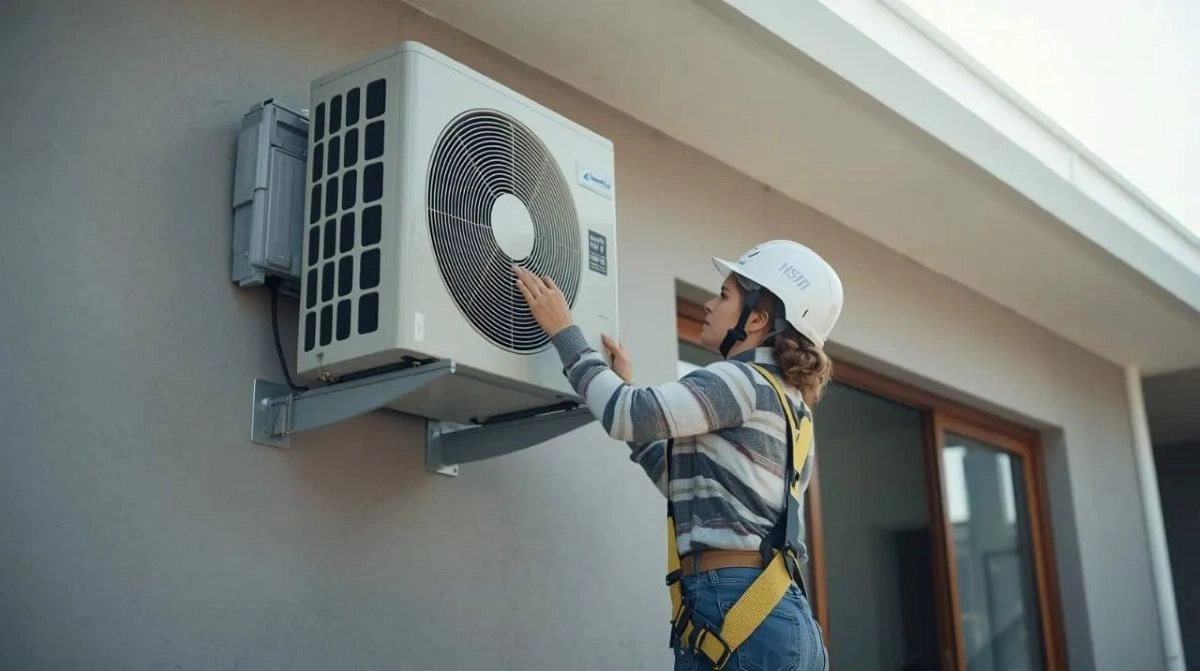
🌀 Cause #8: Fan Motor Problems (Indoor or Outdoor)
If either the indoor fan or outdoor fan isn’t running properly, your ac not cooling properly problem is likely fan-related.
How to diagnose indoor fan issues:
- Turn on the aircon in Fan mode (no cooling)
- Do you feel air coming from the indoor unit vents?
- Is the airflow very weak compared to normal?
- Do you hear unusual noises (clicking, rattling, screeching) from the indoor unit?
How to diagnose outdoor fan issues:
- Go outside while the aircon is set to Cool mode
- Is the outdoor fan spinning? (Look through the grille)
- If the compressor is running but the fan isn’t, the outdoor unit will feel very hot
Why this causes poor cooling:
- Indoor fan not working: No air circulates over the cold coils. The unit gets icy cold but can’t transfer that cold to your room.
- Outdoor fan not working: The outdoor unit can’t dump heat. The compressor overheats and may shut down. Cooling capacity drops to near zero.
Is this DIY? Maybe (simple fixes only).
- DIY if: The fan is obstructed by debris, or the filter is so clogged that airflow is blocked (clean filter first).
- Call a pro if: The fan motor is making grinding/screeching noises, won’t start, or spins very slowly. This indicates a failed motor bearing, dead capacitor, or electrical fault.
Professional fix: Fan motor replacement costs R800-R2,500 for parts plus labour. Capacitor replacement costs R300-R600 plus labour.
Related reading: Aircon fan not working guide and fan motor problems explained.
📏 Cause #9: Undersized Unit for Your Room
Sometimes the aircon isn’t broken—it’s just too small for the space you’re trying to cool. This is a design/installation problem, not a repair issue.
How to diagnose:
- The aircon runs continuously (never cycles off)
- The room never reaches the set temperature on hot days
- The air coming out of the vents is cold, but the room stays warm
- You’ve added insulation, sealed windows, or closed doors—still not cooling
- Your room has large windows, high ceilings, or poor insulation
Why this happens: You need approximately 600 BTU per square meter of room space. A 9,000 BTU unit can cool about 15m². If your room is 25m² with afternoon sun, you need 15,000+ BTU. The small unit runs 24/7 but can’t overcome the heat load.
DIY fix? Not really—you need a larger unit or additional unit.
Solutions:
- Add a second unit: Install another aircon in the same space (two smaller units working together)
- Replace with larger unit: Install a properly sized aircon (R8,000-R15,000+ depending on size)
- Reduce heat load: Add ceiling insulation (R5,000-R15,000), install blinds/curtains, seal gaps around windows
Use our BTU size calculator to determine the correct size for your room. Read best aircon for small rooms or best aircon for large homes for buying guidance.
📞 When to Call a Professional (Don’t DIY These)
After trying the DIY fixes above, if your aircon is not cooling, it’s time to call a professional. Also call immediately if you experience any of these:
| Symptom | Likely Cause | DIY Possible? |
|---|---|---|
| Burning smell from indoor or outdoor unit | Electrical short, burnt motor, failed capacitor | ❌ No (fire risk) |
| Loud grinding, screeching, or metal-on-metal noises | Failed compressor, destroyed fan bearing, loose components | ❌ No (major mechanical failure) |
| Circuit breaker trips repeatedly after reset | Short circuit, faulty compressor, overloaded circuit | ❌ No (electrical fire risk) |
| Ice returns immediately after melting | Low refrigerant (leak) or serious airflow problem | ⚠️ Diagnose only—repair needs pro |
| Compressor won’t start (humming then clicking) | Failed capacitor or dead compressor | ⚠️ Capacitor can be DIY if you’re experienced—but risky |
| Water leaking from indoor unit (excessive) | Blocked drain line, cracked drain pan | ⚠️ Drain cleaning is DIY; cracked pan needs pro |
| Remote control not working (new batteries) | Faulty receiver on indoor unit | ⚠️ Clean receiver lens; if not, call pro |
How to find a reliable technician: Use our installer selection guide and contractor selection guide. Request quotes from local repair technicians and compare prices. Emergency services available for urgent issues.
🛡️ Prevention: Keep Your Aircon Cooling Properly
The best way to avoid why is my aircon not cooling panic is regular maintenance. Here’s a simple prevention schedule:
| Frequency | Task | Time | Why It Matters |
|---|---|---|---|
| Every 2-4 weeks (summer) | Clean or vacuum air filters | 5 minutes | Prevents 80% of cooling problems, saves 15-30% electricity |
| Every 3 months | Check outdoor unit for debris, ensure 300mm clearance | 5 minutes | Maintains airflow, prevents compressor overheating |
| Every 6 months | Clean outdoor coils (gentle water spray) | 15 minutes | Maintains heat rejection efficiency |
| Annually (before summer) | Professional service including refrigerant check | 1 hour (technician) | Catches leaks early, ensures peak efficiency |
| Every 2-3 years | Professional deep clean of indoor coils and blower wheel | 2-3 hours | Restores cooling capacity, removes mould, improves air quality |
Read our complete aircon maintenance checklist and service frequency guide. Schedule professional servicing through free inspections and maintenance services.
❓ Frequently Asked Questions About Aircon Not Cooling
Why is my aircon not cooling but the fan is running?
This is a common symptom of several problems: dirty filter (restricting airflow), low refrigerant (gas leak), tripped breaker to outdoor unit (compressor has no power), or a failed compressor. Start by checking your remote settings (ensure it’s in Cool mode, not Fan), then clean the filter. If that doesn’t work, check if the outdoor unit’s fan is spinning. Read our load-shedding troubleshooting guide for power-related issues.
Can a dirty filter cause an aircon to stop cooling?
Yes, absolutely. A blocked air filter is the #1 cause of poor cooling. When the filter is clogged, airflow across the evaporator coils is restricted. The coils get too cold, freeze up, and the unit can’t absorb heat from your room. Cleaning your filter takes 5 minutes and fixes most cooling problems. Read our filter cleaning guide for step-by-step instructions.
How do I know if my aircon needs gas (refrigerant)?
Signs of low refrigerant include: the aircon runs but blows barely cool air, ice forms on the copper pipes or indoor unit, the thick insulated pipe isn’t cold to the touch, your electricity bill has increased (compressor runs longer), or you hear a hissing sound (leak). Only a certified technician can diagnose and fix refrigerant leaks. Read our refrigerant leak guide for more signs.
Why is my aircon blowing hot air when set to cool?
Aircon blowing warm air usually means one of three things: 1) Your remote is in Heat mode (sun icon) instead of Cool mode (snowflake icon)—check this first. 2) The outdoor unit has lost power (tripped breaker or faulty isolator switch)—the indoor fan runs but compressor doesn’t. 3) The compressor has failed or the refrigerant is low. Start by checking your remote settings, then check your breaker box.
How much does it cost to fix an aircon that’s not cooling?
Cost depends on the cause: dirty filter (free—DIY), tripped breaker (free—DIY), wrong settings (free), dirty outdoor coils (free—DIY), refrigerant leak (R1,500-R4,000 for leak repair + gas refill), capacitor failure (R500-R1,000 including labour), fan motor replacement (R1,500-R3,500), compressor replacement (R5,000-R12,000). Get free quotes from local technicians to compare prices.
Can a power surge or load-shedding damage my aircon?
Yes. Power surges (from lightning or grid switching) and frequent load-shedding cycles can damage the compressor, control board (PCB), and capacitors. The repeated on-off cycling during load-shedding is particularly hard on compressors. Read our load-shedding troubleshooting guide and backup power guide for protection strategies.
How often should I service my aircon to prevent cooling problems?
Professional servicing should be done annually, ideally before summer. In between, clean your filters every 2-4 weeks (DIY, 5 minutes) and check the outdoor unit for debris monthly. Annual professional service includes refrigerant check, electrical testing, coil cleaning, and drain line clearing. Read our service frequency guide and what to expect from professional servicing.
Why does my aircon cool but not remove humidity?
This usually means your aircon is oversized for the room (short cycling) or the fan speed is too high. Air conditioners need to run for 15-20 minutes continuously to remove humidity effectively. If the unit is too powerful, it cools the room quickly (5-10 minutes) then shuts off—never running long enough to dehumidify. Try lowering the fan speed or consult our BTU calculator to check if your unit is oversized.
My aircon is making a clicking sound and not cooling—what’s wrong?
A clicking sound every few minutes (often from the outdoor unit) usually indicates the compressor is trying to start but can’t. The most common cause is a failed start capacitor. Other possibilities include a faulty contactor or compressor thermal overload (wait 30-60 minutes to reset). This requires professional diagnosis. Read our capacitor failure guide for symptoms and solutions.
When should I replace my aircon instead of repairing it?
Use the 50% Rule: if the repair cost exceeds 50% of a new unit’s price, replace it. Also replace if: your unit is over 10-12 years old (split system) or 7-8 years old (window unit), it uses R22 refrigerant (obsolete, expensive), you’ve had multiple major repairs in 2-3 years, or efficiency has dropped significantly. Read our repair vs replacement guide for detailed decision factors.
✅ Final Thoughts: Don’t Panic—Diagnose First
When your aircon is not cooling, it’s easy to panic and immediately call a technician. But 80% of cooling problems have simple DIY fixes that cost nothing but a few minutes of your time.
Key takeaways for troubleshooting aircon cooling problems:
- Start with the simple stuff: Check remote settings (Cool mode, temperature below room temp), clean the filter, check the breaker. These fix most problems.
- Dirty filters cause 80% of cooling issues: Clean them monthly during summer. It’s free and takes 5 minutes.
- Listen and look for clues: Is the outdoor unit running? Is there ice? Is the airflow weak? These tell you what’s wrong.
- Don’t ignore warning signs: Burning smells, grinding noises, or repeated breaker trips need immediate professional attention.
- Low refrigerant always means a leak: Refrigerant doesn’t get “used up.” If you need gas, you have a leak that must be repaired.
- Regular prevention saves money: Monthly filter cleaning and annual professional servicing prevent 90% of cooling problems.
Your action plan: First, check your remote settings (mode and temperature). Second, clean your filter. Third, check your breaker box. Fourth, inspect the outdoor unit for debris and fan operation. Fifth, if still not cooling after these steps, request quotes from local repair technicians. For emergencies, use our emergency services.
Still Having Trouble With Your Aircon?
Don’t suffer through another hot day. Get free quotes from verified local aircon repair technicians. Same-day service available.
📞 Call us: 073 138 4726 for immediate help finding aircon repair technicians near you.
📚 Official resources & standards referenced:
- Department of Energy – Cooling efficiency diagnostics and energy saving tips
- SABS – Refrigerant handling safety standards and electrical safety requirements
- Eskom – Load-shedding impact on appliances and surge protection guidelines
Information provided for general guidance based on South African market conditions and common air conditioning systems. Always consult a certified professional for diagnosis and repair of electrical and refrigerant systems.
Written by: Innocent T Hanyani
Construction & Home Services Industry Specialist | 21+ Years Experience
Innocent T Hanyani has over two decades of experience working across South Africa’s construction, maintenance, and home services sectors. Throughout his career, he has worked closely with contractors, service providers, and property owners, gaining practical insight into how projects are quoted, managed, and completed. His work focuses on helping homeowners understand how to find reliable contractors, compare quotes, and avoid common industry pitfalls when hiring service professionals. His insights are based on practical industry experience as well as ongoing research into contractor platforms, service marketplaces, and hiring trends across South Africa.