
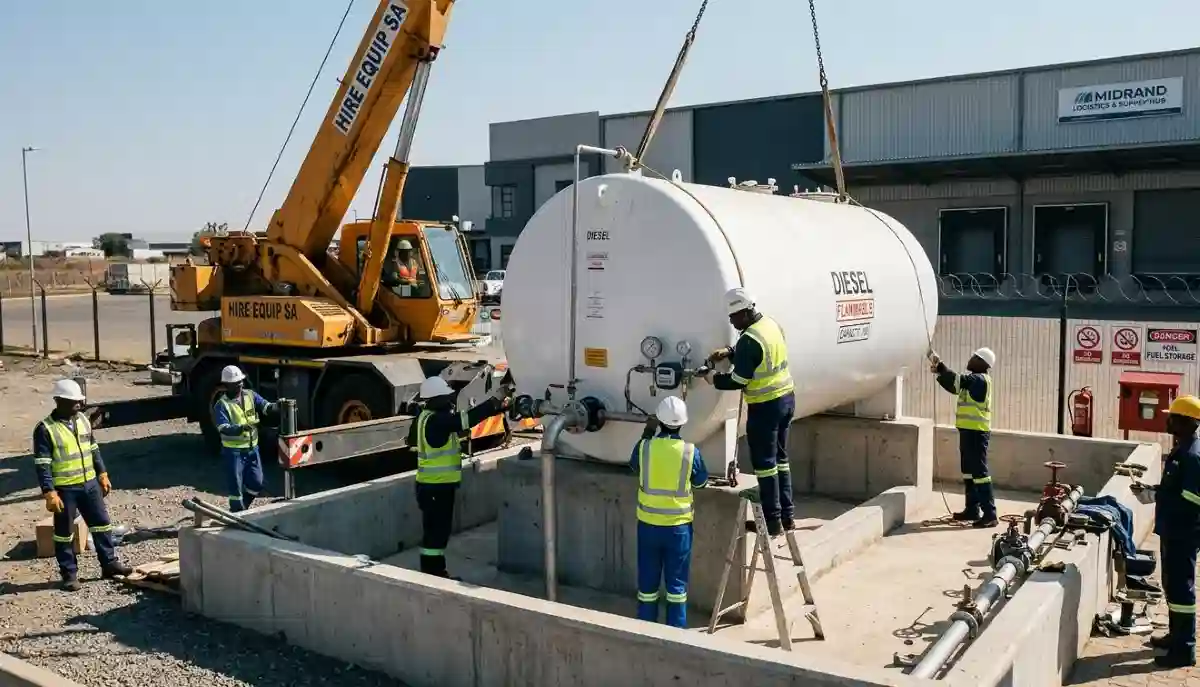
Fuel Tank Installation & Setup South Africa: Complete Guide to Compliance & Cost
🛢️ From SANS 10089-3 compliance to bunding requirements—everything you need to know about installing diesel storage tanks.
Whether you’re a logistics company in Germiston looking to reduce fuel costs, a mine in Secunda needing on-site storage, or a farmer in the Free State securing your own supply, a proper fuel tank installation setup South Africa is a significant capital investment. But it’s not just about buying a tank and putting it on the ground. The regulatory landscape is complex, and mistakes can be costly—and dangerous.
This comprehensive guide covers everything you need to know about installing fuel storage tanks. We’ll walk you through the differences between above ground fuel tank installation and underground fuel tank installation, explain critical safety requirements like fuel tank bunding requirements and double skinned tank regulations, and help you understand the compliance certificates you’ll need. We’ll also provide realistic cost of installing 5000L diesel tank examples and explain technical requirements like cathodic protection, flame arrestors, and emergency vent systems. For ongoing maintenance, see our fuel tank cleaning maintenance guide.
Ready to invest in your own fuel storage? Explore our Services Overview or visit our main Bulk Fuel Supply page. For more on our approach, see How It Works.
Get Quotes for Professional Tank Installation
Compare vetted, certified installers for your fuel tank project. SANS-compliant, insured, and experienced.
Find Tank Installation Experts
Servicing Johannesburg, Pretoria, Durban, Cape Town, Secunda, Richards Bay, and nationwide
📋 Table of Contents – Tank Installation Guide
💰 Why Invest in Your Own Fuel Tank Installation?
For businesses with significant, predictable fuel consumption, installing your own storage tank is a strategic move with multiple benefits.
- Cost Savings: Buying fuel in bulk and storing it on-site allows you to purchase at wholesale prices, avoiding retail markups. You can also buy when prices are low and store for future use—a form of fuel hedging.
- Supply Security: During fuel shortages, strikes, or high-demand periods, having your own reserve ensures your operations continue uninterrupted.
- Convenience: No more coordinating deliveries for every small order. You schedule bulk deliveries on your terms.
- Fleet Efficiency: For companies with return-to-base fleets, on-site fueling with fleet fueling solutions saves driver time and improves productivity.
- Control: You control fuel quality, monitor usage, and prevent theft with proper fuel management systems.
The key is doing it right—with proper compliance, safety, and professional installation. Read more about our commitment to quality on our About Us page and see why clients trust us on Benefits of Choosing Us.
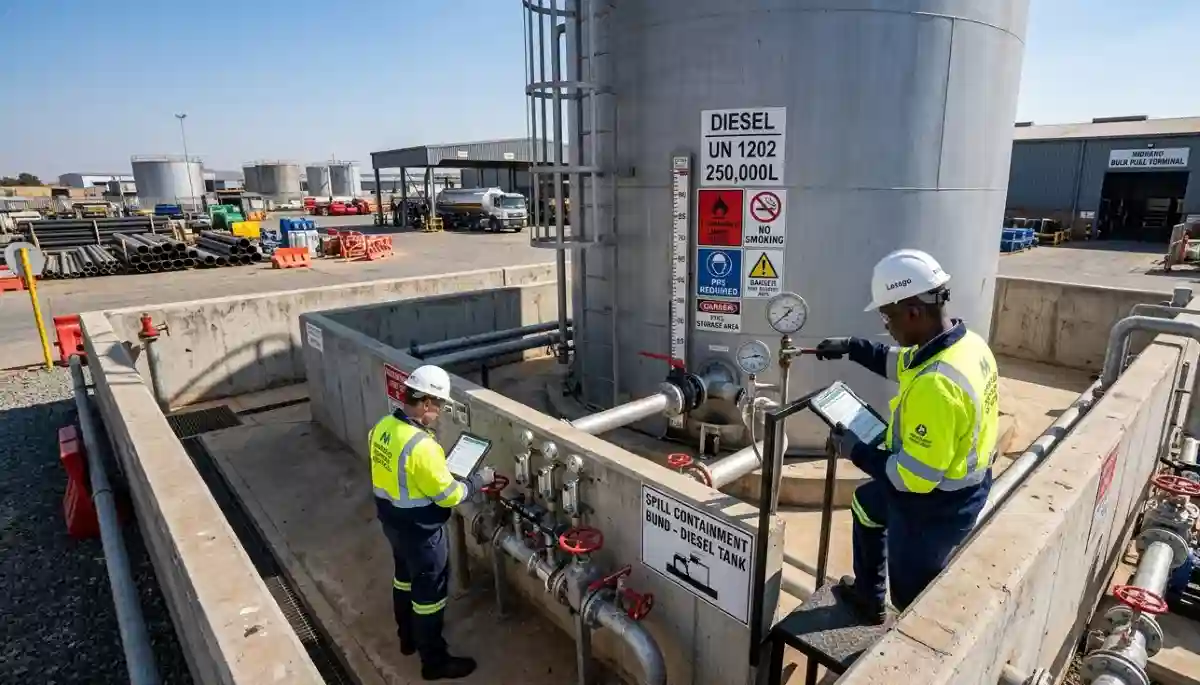
🏗️ Above Ground vs Underground Fuel Tank Installation
One of the first decisions you’ll face is whether to install an above-ground storage tank (AST) or an underground storage tank (UST). Each has advantages and specific regulatory requirements.
| Factor | Above Ground Tank (AST) | Underground Tank (UST) |
|---|---|---|
| Installation Cost | Lower—simpler excavation, accessible for maintenance | Higher—requires excavation, backfill, and specialized installation |
| Maintenance Access | Easy—tanks visible, leaks detectable, cleaning straightforward | Difficult—requires excavation for major work, leak detection relies on monitoring systems |
| Space Requirements | Requires dedicated above-ground space, needs safety distances from buildings | Saves surface space, can be placed under parking lots or landscaping |
| Aesthetics | Visible—may require screening or enclosures | Invisible—preserves site appearance |
| Regulatory Standard | SANS 10089-1 and -2 | SANS 10089-3 compliant tank installation is mandatory |
| Typical Applications | Farms, construction sites, industrial yards, depots | Service stations, urban sites, where space is at a premium |
For most commercial and industrial applications in South Africa, above-ground tanks are more common due to lower cost and easier maintenance. However, sites with space constraints or aesthetic requirements may opt for underground installation.
📜 Navigating the Regulatory Maze: SANS, NEMA & DMRE
Fuel storage in South Africa is heavily regulated. Ignorance is not an excuse, and non-compliance can result in fines, shutdowns, and even criminal liability. Here are the key authorities and standards.
- SABS (South African Bureau of Standards): The core technical standards are the SANS 10089 series:
- SANS 10089-1: Above-ground storage tanks for petroleum products.
- SANS 10089-3: Underground storage tanks for petroleum products. If you’re installing a UST, this is your bible.
- SANS 10089-2: Installation and maintenance of tanks.
- DMRE (Department of Mineral Resources and Energy): Under the Petroleum Products Act, you may need a licence to store fuel, depending on volume. The DMRE also regulates the industry and licensing of suppliers.
- NEMA (National Environmental Management Act): Fuel storage can have significant environmental impacts. You may need an environmental authorisation or to comply with specific pollution prevention requirements. This is especially critical for underground tanks near water sources.
- Local Authorities: Municipal bylaws, fire department approvals, and town planning permissions may also be required. Always check with your local municipality before starting.
Ensuring your installation meets all these requirements is why you need professional installers. Our contractor selection guide helps you vet the right team.
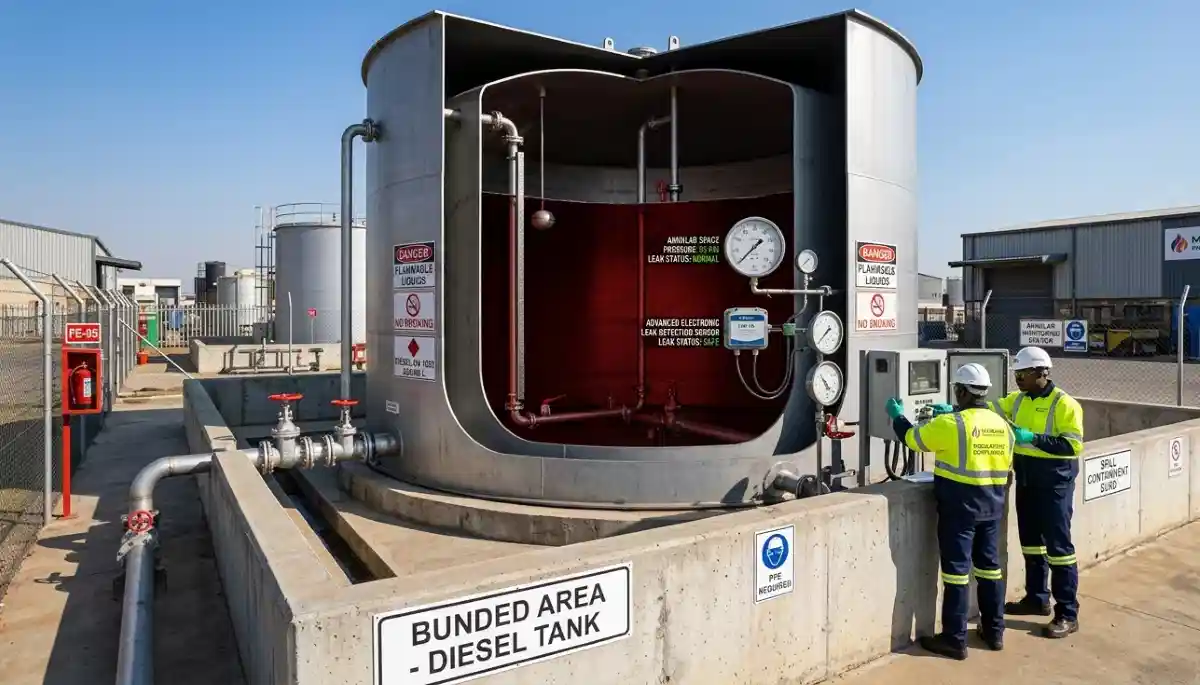
🛡️ Fuel Tank Bunding Requirements & Secondary Containment
One of the most critical safety requirements for any fuel storage installation is secondary containment—a system to catch any leaks or spills before they reach the environment. This is typically achieved through bunding.
Fuel tank bunding requirements under SANS standards include:
- Capacity: The bund must be able to hold at least 110% of the volume of the largest tank within it. If you have multiple tanks, the bund must hold 110% of the largest tank OR 25% of the total volume, whichever is greater.
- Impermeability: The bund floor and walls must be impermeable to fuel—typically constructed of reinforced concrete or lined with an impermeable membrane.
- Structural Integrity: The bund must be able to withstand the hydrostatic pressure of a full tank failure.
- Drainage: No drains through the bund wall. Any rainwater that accumulates must be removed manually or via a locked valve, after checking for contamination.
- Compatibility: Materials must be compatible with diesel/petrol to prevent degradation.
Alternatively, you can use double skinned tank regulations compliant tanks. These have an inner tank and an outer shell, with the interstitial space monitored for leaks. This built-in secondary containment can eliminate the need for external bunding, though site-specific requirements may still apply. Our bunding solutions page has more details.
⚠️ Essential Safety Features: Leak Detection, Overfill Prevention & More
A compliant tank installation includes multiple safety features to prevent accidents and protect the environment.
- Leak Detection: For single-skinned tanks, this means regular visual inspection and dip tests. For double-skinned tanks, interstitial monitoring (vacuum or pressure) provides continuous leak detection. Electronic leak detection systems can alert you immediately to any breach.
- Overfill Prevention: During delivery, there’s a risk of overfilling the tank, leading to spills. Overfill prevention devices include:
- High-level alarms that alert the delivery driver.
- Automatic shut-off valves that stop the flow when the tank reaches a preset level.
- Overfill protection valves that prevent the tank from being filled beyond its safe capacity.
- Flame Arrestor: Installed on tank vents, a flame arrestor prevents external flames from entering the tank and igniting vapours.
- Emergency Vent: In the event of a fire, pressure can build up inside the tank. An emergency vent opens to relieve pressure safely, preventing tank rupture.
- Cathodic Protection: For underground steel tanks, cathodic protection is required to prevent corrosion. This involves sacrificial anodes or impressed current systems that protect the tank metal from electrochemical degradation.
- Earth Bonding: During fuel transfer, static electricity can build up. Fuel tank earth bonding requirements mandate that the tank and delivery vehicle are electrically bonded to prevent sparks that could ignite vapours.
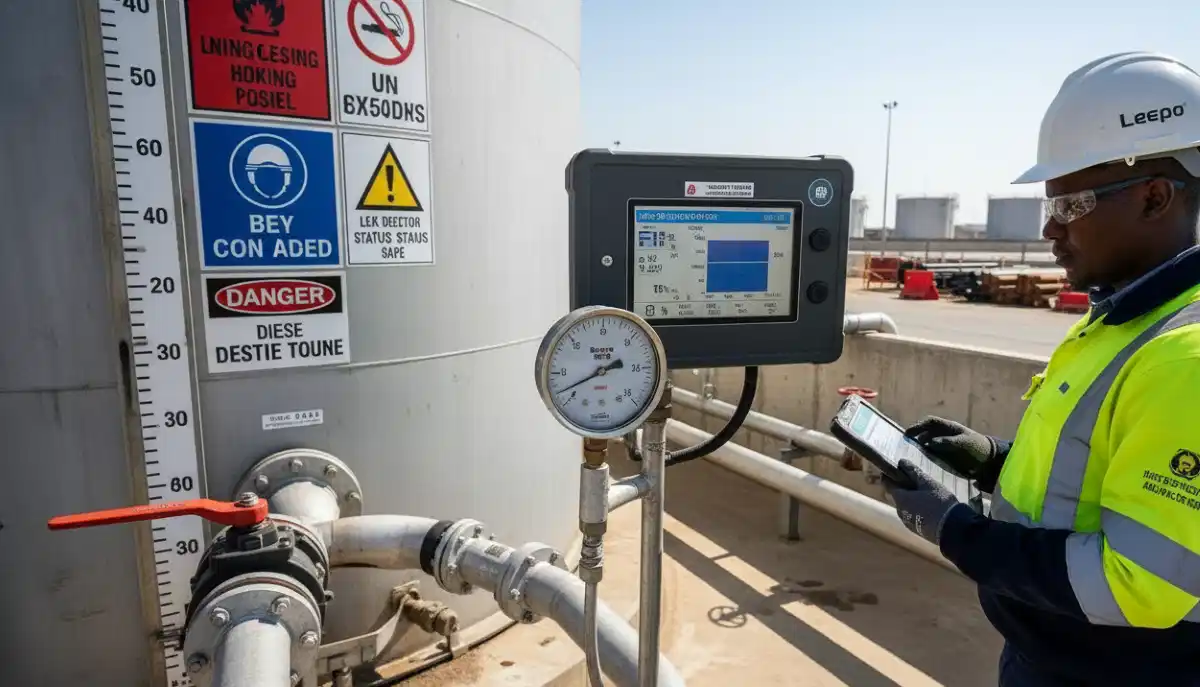
Ready to Install Your Fuel Tank?
Get free quotes from certified, SANS-compliant tank installers. We’ll connect you with vetted professionals who understand the regulations.
Take advantage of our free site inspection to assess your location and requirements.
🚫 7 Common Fuel Tank Installation Mistakes
These mistakes are surprisingly common and can be extremely costly to rectify.
- Mistake #1: Skipping the Regulatory Approvals. Installing a tank without the necessary DMRE licence or municipal approval is illegal. You risk fines, forced removal, and even criminal charges. Always check requirements first.
- Mistake #2: Incorrect Bunding Capacity. A bund that’s too small is useless. If a tank fails, the spill will escape into the environment, leading to massive cleanup costs and environmental fines.
- Mistake #3: Ignoring Soil Conditions for Underground Tanks. Corrosive soil, high water tables, or unstable ground can destroy an underground tank. Proper geotechnical surveys are essential before underground fuel tank installation.
- Mistake #4: Poor Foundation for Above Ground Tanks. Tanks need a stable, level, load-bearing foundation. Settling can stress pipework and cause leaks.
- Mistake #5: Forgetting about Tank Calibration. After installation, your tank needs tank calibration so that dip readings accurately reflect volume. Without it, you can’t manage inventory effectively.
- Mistake #6: Inadequate Lightning Protection. In thunderstorm-prone areas, tanks (especially above ground) need lightning protection to prevent ignition.
- Mistake #7: Using Unqualified Installers. This is the biggest mistake. Always verify that your installer is experienced, insured, and familiar with SANS standards. Our contractor’s liability insurance page explains why insurance matters.
💰 Realistic Cost of Installing Fuel Tanks
Costs vary significantly based on tank type, site conditions, and regulatory requirements. Here are estimated ranges for typical installations. Always get multiple quotes for your specific site.
| Tank Size & Type | Typical Application | Estimated Cost Range (Installed) | Notes |
|---|---|---|---|
| 5,000L Above Ground (Single Skin) | Small farm, small workshop | R45,000 – R65,000 | Requires external bunding |
| 5,000L Above Ground (Double Skin) | Commercial site, small fleet | R65,000 – R90,000 | Built-in secondary containment |
| Cost of installing 5000L diesel tank (typical) | General commercial | R55,000 – R80,000 | Depends on site access and foundation |
| 10,000L Above Ground (Double Skin) | Medium fleet, construction yard | R95,000 – R130,000 | Includes pump and basic dispenser often |
| 20,000L Above Ground (Double Skin) | Large fleet, depot | R150,000 – R200,000+ | May require significant civils work |
| 10,000L Underground (Double Skin) | Service station, urban site | R120,000 – R180,000+ | Excavation, backfill, cathodic protection |
*Costs are estimates only and exclude VAT, long pipe runs, complex civils, or environmental studies. Always get a detailed quote.
For a full breakdown of fuel pricing once your tank is installed, see our bulk fuel supply cost guide.
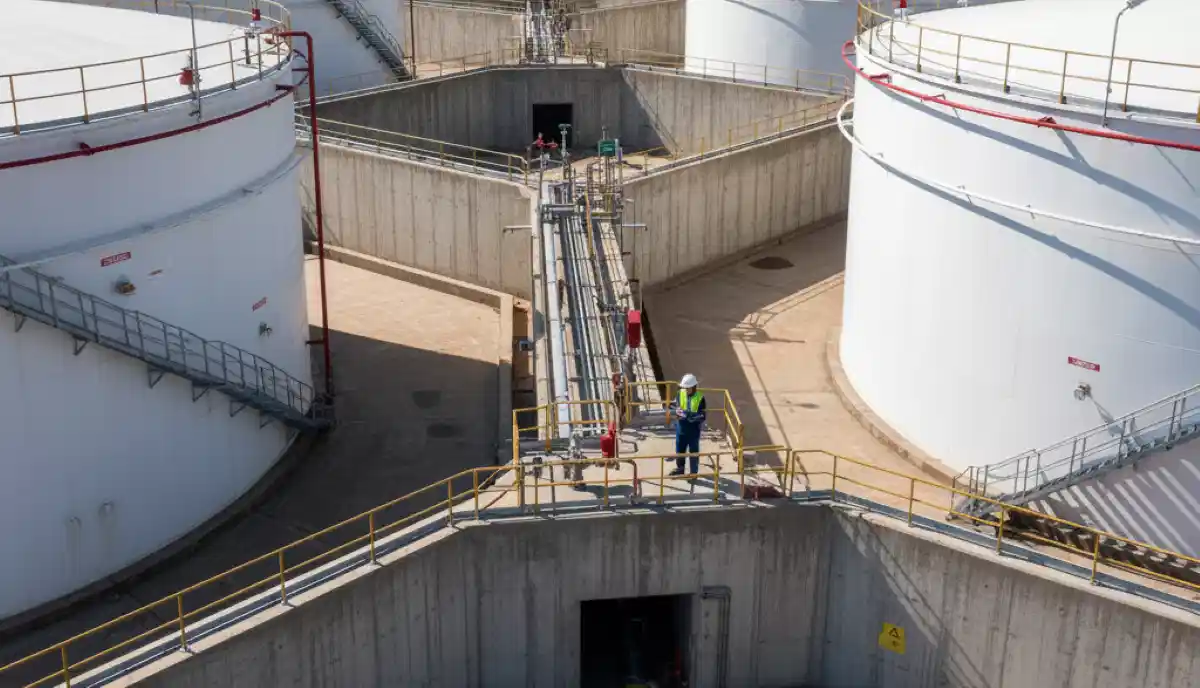
📋 The Fuel Tank Installation Process: What to Expect
A professional installation follows a structured process to ensure compliance and safety.
- Site Assessment & Feasibility: A professional installer visits your site to assess access, ground conditions, distances from buildings and boundaries, and existing infrastructure. They’ll identify any potential obstacles.
- Regulatory Check: They’ll advise on necessary permits—DMRE licence, municipal approval, environmental authorisation. For larger tanks, this step can take several weeks.
- Design & Quotation: Based on the assessment, they’ll design the system, specifying tank type, bunding, pipework, pump, and safety features. You’ll receive a detailed quotation.
- Civils & Foundation: For above-ground tanks, this means preparing a level, reinforced concrete plinth. For underground tanks, excavation, preparing the bed, and installing groundwater monitoring wells if required.
- Tank Placement: The tank is delivered and carefully placed on its foundation or into the excavation. For above-ground tanks, this often requires a crane.
- Pipework & Fittings: Connecting the tank to dispensers, installing vent pipes with flame arrestors, fitting gauges and overfill prevention devices.
- Bunding Construction: For single-skinned tanks, the bund wall is constructed. For double-skinned tanks, this step may be simplified.
- Electrical & Bonding: Installing fuel tank earth bonding requirements, any pumps, and telemetry systems. For steel underground tanks, installing cathodic protection.
- Testing & Certification: The system is tested for leaks, the bund is water-tested, and all safety features are verified. You receive a fuel tank installation compliance certificate.
- Commissioning & Training: Your staff are trained on safe operation, and you’re ready to start receiving fuel.
❓ Frequently Asked Questions About Fuel Tank Installation
Do I need a licence to install a diesel tank on my property?
It depends on the volume. Under the Petroleum Products Act, storage above certain thresholds requires a licence from the DMRE. Additionally, local municipalities and fire departments may have their own requirements. Always check before installing—your installer should guide you through this process.
What is the difference between single-skin and double-skin tanks?
A single-skin tank has one layer of steel. It requires an external bund for secondary containment. A double-skin tank has an inner and outer wall, with the space between monitored for leaks. It provides built-in secondary containment and is often required by double skinned tank regulations for certain applications.
What are the bunding requirements for fuel tanks?
Fuel tank bunding requirements under SANS standards specify that the bund must hold at least 110% of the largest tank’s volume. It must be impermeable, structurally sound, and have no drains. This ensures that any leak or spill is contained and does not reach the environment.
How much does it cost to install a 5000L diesel tank?
The cost of installing 5000L diesel tank typically ranges from R55,000 to R80,000, depending on whether it’s single or double-skinned, site access, foundation requirements, and included equipment. Always get multiple itemised quotes for comparison.
What is a fuel tank installation compliance certificate?
A fuel tank installation compliance certificate is a document issued by a qualified installer confirming that the installation meets all relevant SANS standards and regulatory requirements. It’s your proof of compliance and is essential for insurance purposes and future inspections.
What is cathodic protection and when is it needed?
Cathodic protection is a technique to prevent corrosion of steel underground tanks and pipes. Sacrificial anodes or impressed currents protect the metal. It’s required for all steel underground installations under SANS standards to prevent leaks from corrosion over time.
Can I install a fuel tank myself?
We strongly advise against DIY installation. Fuel storage is heavily regulated, and mistakes can be catastrophic—environmental damage, fire risk, legal liability. Professional installers understand SANS standards, have the right equipment, and can provide the necessary compliance certificates.
What is SANS 10089-3 compliance?
SANS 10089-3 compliant tank installation refers to the South African national standard for underground storage tanks for petroleum products. It covers design, installation, testing, and maintenance. Compliance is mandatory for any legal underground fuel storage installation.
What is a flame arrestor and why is it needed?
A flame arrestor is a device fitted to tank vents. It allows air to pass in and out during filling and emptying but prevents an external flame from entering the tank and igniting flammable vapours. It’s a critical safety component required by SANS standards.
✅ Your Fuel Tank Installation Action Plan
Installing your own fuel storage is a smart investment, but it must be done right. Compliance with SANS standards, NEMA requirements, and DMRE licensing is not optional—it’s the law, and it protects you, your business, and the environment.
Key takeaways:
- Choose the right tank type for your needs—above ground vs underground, single vs double skin.
- Understand and comply with all regulations—SANS 10089, NEMA, DMRE, local bylaws.
- Never compromise on safety features—bunding, leak detection, overfill prevention, flame arrestors.
- Budget realistically. The cost of installing 5000L diesel tank is an investment that pays back through fuel savings.
- Always use certified, insured, experienced installers. Verify their credentials and ask for proof of insurance. Our contractor’s liability insurance page explains what to look for.
Your 5-Step Tank Installation Action Plan
- Define Your Needs: What volume do you need? What fuel type? What’s your budget? Will you need a pump and dispenser?
- Check Regulations: Contact your local municipality and research DMRE requirements. Your installer should assist, but it helps to be informed.
- Get Multiple Quotes: Use our quote request system to connect with vetted installers. Compare their experience, proposed solutions, and pricing.
- Verify Credentials: Ask for proof of SANS knowledge, insurance, and past project references. Book a free inspection to get expert advice on your site.
- Plan for the Long Term: Once installed, you’ll need ongoing tank cleaning and maintenance and a fuel management system to protect your investment.
Invest in Your Fuel Independence
Get free, no-obligation quotes from certified, SANS-compliant tank installers. Start saving on fuel costs today.
📞 Call us: 073 138 4726 for expert advice on your tank project.
Free site inspections •
Beat-your-quote guarantee •
Our guarantees
📚 Official resources & standards referenced:
- SABS – SANS 10089-3: The standard for underground tank installation.
- NEMA – Environmental authorisation requirements for fuel storage.
- DMRE – Petroleum Products Act licensing and fuel regulations.
Information is for general guidance. For specific advice, consult a qualified professional.
Written by: Innocent T Hanyani
21+ years construction, infrastructure, and digital industry experience, ServiceLink SA
Innocent has overseen numerous fuel storage installations across South Africa, from small farm tanks to large industrial depots. He understands the regulatory landscape and the practical challenges of getting installations right.
For more detailed information, explore our related guides: fuel tank cleaning maintenance for ongoing care, bulk diesel storage regulations for deeper compliance insights, and how to choose a bulk fuel supplier for once your tank is ready. Our generator fuel services and fleet fueling solutions pages show how storage integrates with operations. See our service areas page for coverage in your region, including Gauteng, Durban, and Cape Town.