🔥 No Hot Water? Burnt Element?
Get quotes from verified geyser repair specialists for element replacement. Same-day service available. Free inspections.
Get Geyser Element Replacement Quotes Near You
Servicing Gauteng, Johannesburg, Pretoria, Sandton, Midrand, Centurion, and across South Africa
Geyser Element Replacement Guide: How to Replace a Burnt Element (Step-by-Step)
🔥 From no hot water to restored heat—complete guide to diagnosing, testing, and replacing a burnt geyser element
You turn on the tap. Cold water. You wait. Still cold. Your geyser is humming, but no heat. The circuit breaker is fine. The thermostat seems to be working. What’s wrong? The heating element—the part that actually heats the water—has likely burnt out.
The heating element is the workhorse of your geyser. It’s submerged in the water and converts electricity into heat. Over time, sediment buildup, hard water, or simple age causes it to fail. A burnt element means no hot water—and a cold shower.
I’ve replaced hundreds of geyser elements over the years. The good news? A geyser element replacement is one of the most common—and most affordable—geyser repairs. A new element costs R500-R1,200, and a plumber can replace it in 1-2 hours.
This guide will teach you how to diagnose a burnt geyser element, test it with a multimeter, and decide whether to replace it yourself or call a professional. Whether you’re in Gauteng, Johannesburg, or Pretoria, this replace geyser element guide will help you restore hot water.
For related information, read our geyser not heating guide, geyser thermostat guide, pressure valve guide, and geyser leaking guide. Let’s get your hot water back.
📋 Table of Contents – Geyser Element Replacement Guide
🔧 How a Geyser Heating Element Works
Understanding how a heating element works helps you diagnose problems:
⚡ What It Does
The heating element is a metal rod (usually copper or stainless steel) containing a resistance wire. When electricity flows through the wire, it generates heat, which transfers to the surrounding water. The element is submerged directly in the water for efficient heat transfer.
🔧 Where It’s Located
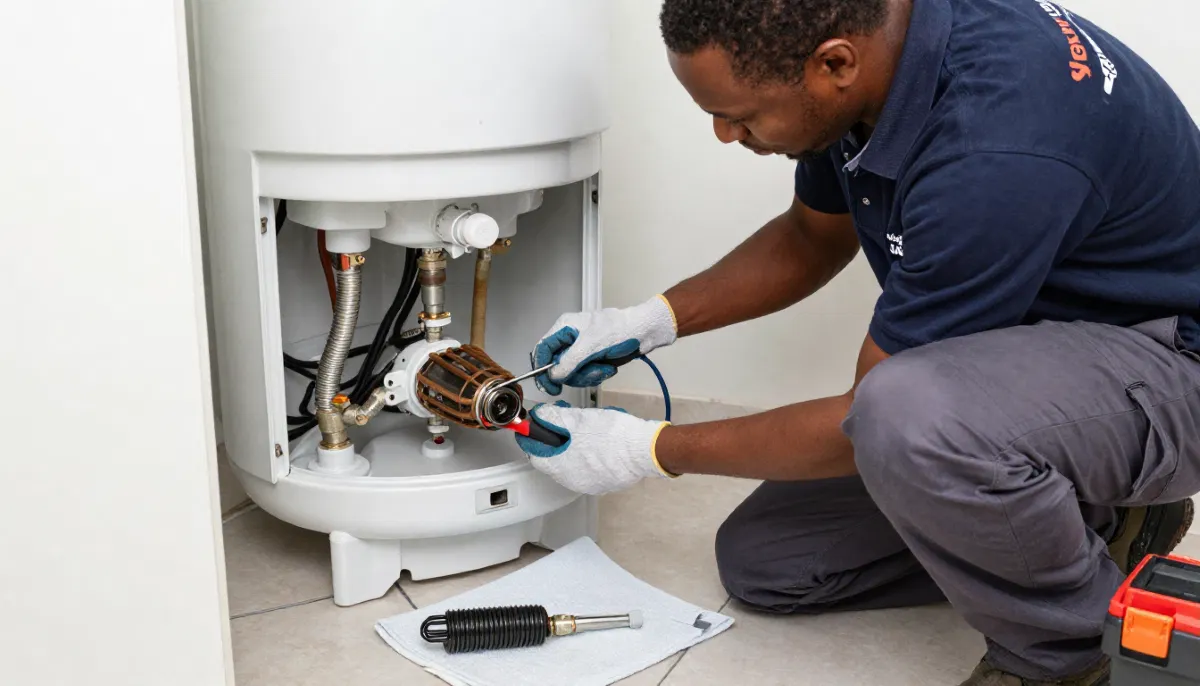
The element screws into the side of the geyser tank through a threaded opening. It’s accessed by removing the access panel and insulation. Most geysers have one element (smaller units) or two elements (upper and lower in larger units).
Element specifications:
- Wattage: Typically 2kW, 3kW, or 4kW (higher wattage = faster heating)
- Voltage: 230V (standard South African supply)
- Resistance: Approximately 10-30 ohms depending on wattage (measured with multimeter)
- Lifespan: 3-8 years depending on water quality and usage
📋 Key Point:
A burnt geyser element either fails open (infinite resistance = no heat) or shorts to ground (very low resistance = tripping breaker). Both result in no hot water.
⚠️ 5 Symptoms of a Burnt Geyser Element
Here are the most common signs of a burnt geyser element:
❄️ 1. No Hot Water (Geyser Humming)
Geyser is humming (power is on), but water never gets hot. The element has failed open—electricity flows but no heat is generated.
🔌 2. Circuit Breaker Trips Repeatedly
The geyser’s circuit breaker trips soon after resetting. A shorted element (element touching the tank) causes this.
💥 3. Popping or Rumbling Sounds
Sediment buildup around the element causes popping sounds. This leads to premature element failure.
🐌 4. Water Takes Forever to Heat
A partially failed element (still working but inefficient) or heavy sediment buildup slows heating dramatically.
📈 5. High Electricity Bills
A failing element may run longer to heat water, increasing consumption. A shorted element may run constantly.
❄️ Symptom #1: No Hot Water (But Geyser Humming)
This is the most common sign of a burnt geyser element—the element has failed “open,” meaning electricity flows but the heating wire is broken.
Symptoms:
- Water never gets hot—ice cold or barely lukewarm
- Geyser hums (power is reaching the element)
- Circuit breaker is fine (not tripped)
- Thermostat appears to be working (clicks when turned)
Diagnosis: Test the element with a multimeter (see Section 8). A burnt element will show infinite resistance (open circuit).
Solution: Replace the element. Also check the thermostat—a faulty thermostat may have caused the element to overheat and fail.
🔌 Symptom #2: Circuit Breaker Trips Repeatedly
A shorted element (where the heating wire touches the outer metal sheath) will trip the circuit breaker.
Symptoms:
- Geyser breaker trips soon after resetting (immediately or within minutes)
- May hear a pop or see a flash when resetting (dangerous—stand back)
- Water may have been very hot before failure (element shorted due to overheating)
Diagnosis: Test the element for continuity to ground (see Section 8). A shorted element will show continuity between the terminals and the element’s metal base.
⚠️ Critical Warning:
If your breaker trips repeatedly, DO NOT keep resetting it. Each reset stresses the breaker and could cause a fire. Call a professional immediately.
Solution: Replace the element immediately.
🔥 No Hot Water? Burnt Element?
Get quotes from verified geyser repair specialists for element replacement. Same-day service available. Free inspections.
Get Element Replacement Quotes
Free quotes • Same-day service • Verified specialists
💥 Symptom #3: Popping or Rumbling Sounds
Popping sounds indicate sediment buildup around the element, which will eventually cause it to fail.
Symptoms:
- Loud popping, crackling, or rumbling from the geyser
- Water may still be hot, but heating takes longer
- Higher electricity bills
Cause: Minerals in hard water settle at the bottom of the tank, coating the element. This insulation reduces heat transfer, causing the element to overheat and eventually burn out.
Solution: Flush the geyser to remove sediment. If the element is already damaged, replace it.
🐌 Symptom #4: Water Takes Forever to Heat
A partially failed element or heavy sediment buildup slows heating dramatically.
Symptoms:
- After using hot water, it takes hours to recover (reheat)
- Water eventually gets hot, but very slowly
- Element may test as partially functional (higher-than-normal resistance)
Solution: Replace the element. Also flush the geyser to remove sediment.
📈 Symptom #5: High Electricity Bills
A failing element runs longer to heat water, increasing consumption.
Symptoms:
- Electricity bill has increased by 20-40%
- Geyser seems to run constantly
- Water temperature may be normal or slightly low
Solution: Test and replace the element if faulty. Also check the thermostat and flush sediment.
📋 How to Test a Geyser Element (Multimeter)
How to replace a geyser element starts with confirming it’s faulty. Here’s how to test:
⚠️ Safety First:
Before testing, turn off the circuit breaker to the geyser. Confirm power is off with a voltage tester. If you’re not comfortable with electrical testing, call a professional.
Tools needed: Multimeter (set to resistance/ohms), screwdriver, torch.
Step-by-step:
- Turn off circuit breaker to geyser
- Remove geyser access panel and insulation
- Locate the element terminals (usually two or three terminals)
- Disconnect wires from element terminals (take a photo first)
- Test 1 – Resistance across terminals: Set multimeter to lowest ohms range. Touch probes to the two element terminals. Should read 10-30 ohms (2kW element ~26 ohms, 3kW ~18 ohms, 4kW ~13 ohms). Infinite reading (OL) = burnt element (open circuit).
- Test 2 – Continuity to ground: Touch one probe to an element terminal, the other to the element’s metal base (or geyser tank). Should read infinite resistance (no continuity). Any reading = shorted element (replace immediately).
What the results mean:
- Normal element: 10-30 ohms across terminals, infinite to ground
- Burnt element (open): Infinite reading across terminals
- Shorted element: Continuity from terminal to ground (low resistance)
- Partially failed element: Resistance higher than normal (e.g., 50+ ohms)
Read our geyser thermostat guide for testing the thermostat.

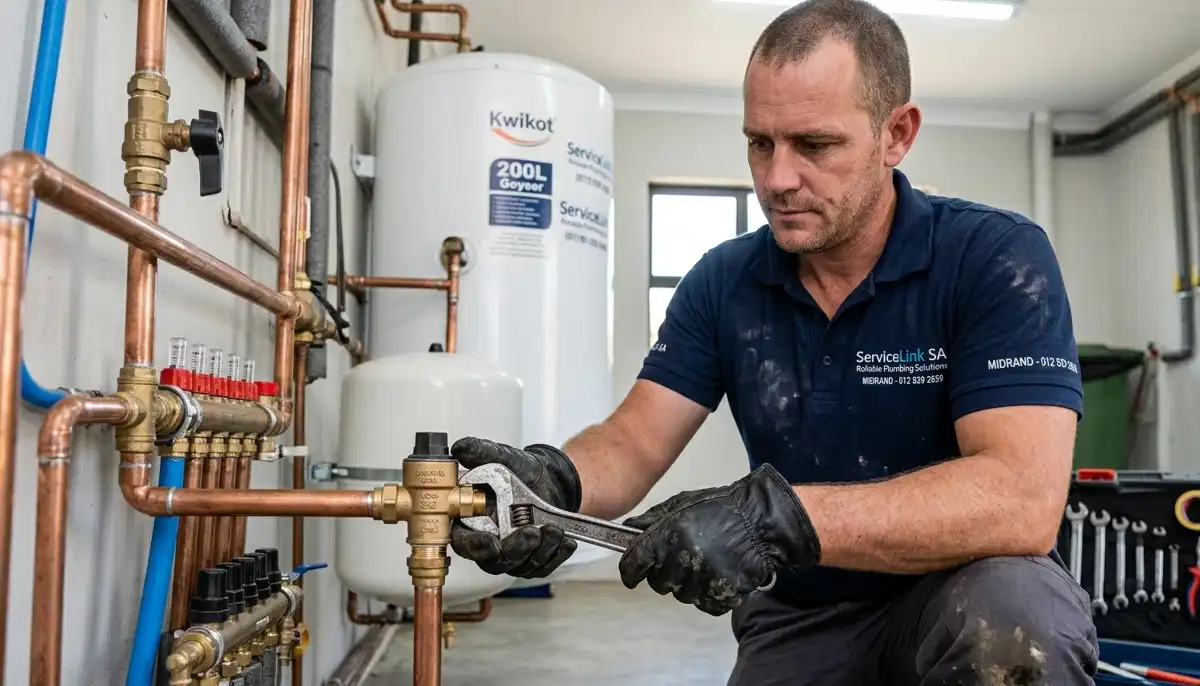
🔧 How to Replace a Geyser Element (Step-by-Step)
If you’ve confirmed a burnt geyser element, here’s how to replace geyser element:
Tools needed: New element (exact match to your geyser), element spanner or large socket (special tool), screwdrivers, multimeter, bucket, towels.
Step-by-step:
- Turn off circuit breaker to geyser (confirm power is off)
- Turn off water supply to geyser (isolation valve)
- Open a hot tap to relieve pressure and drain the geyser (connect hose to drain valve or place bucket under element opening)
- Remove access panel, insulation, and plastic cover
- Disconnect wires from element terminals (take a photo)
- Using an element spanner, unscrew the old element (counter-clockwise)
- Remove old element—water will drain out (have bucket ready)
- Clean the threaded opening—remove old sealant or gasket
- Apply new sealant or install new gasket on the new element
- Screw in new element (clockwise) and tighten firmly (but not overtightened)
- Reconnect wires exactly as per your photo
- Close drain valve, turn water supply back on
- Open a hot tap and wait for water to flow steadily (geyser is now full)
- Check for leaks around the new element
- Replace insulation, cover, and access panel
- Turn circuit breaker back on
- Test after 30-60 minutes
⚠️ Critical Warning:
Never turn the power on until the geyser is completely full of water. Running the element without water destroys it in seconds. Always open a hot tap and confirm water flow before restoring power.
🛠️ DIY vs Professional: Should You Replace It Yourself?
Consider these factors before attempting DIY geyser element replacement:
✅ DIY MAY BE RIGHT IF:
- You have experience with electrical and plumbing work
- You own a multimeter and element spanner
- You’re comfortable working with 220V electricity
- You have the correct replacement element
- You understand the importance of proper sealing
❌ CALL A PROFESSIONAL IF:
- You’re uncomfortable with electrical work
- You don’t own a multimeter or element spanner
- Your geyser has dual elements (more complex)
- You’re unsure about the correct replacement
- You want a warranty on the repair
- You need a COC for insurance purposes
Professional cost: R1,800-R3,500 including parts and labour. This includes diagnosis, parts, installation, testing, and COC.
💰 Geyser Element Replacement Cost Guide
Here’s what to budget for geyser element replacement:
| Service | Cost Range (ZAR) | What’s Included |
|---|---|---|
| Heating Element (2kW/3kW) | R300 – R600 | Replacement element only |
| Heating Element (4kW) | R500 – R1,200 | Higher wattage, more expensive |
| Professional Labour (single-element) | R1,000 – R2,000 | Diagnosis, replacement, testing |
| Professional Labour (dual-element) | R1,500 – R2,500 | More complex system |
| Total Professional Replacement | R1,800 – R3,500 | Parts + labour + COC |
| DIY Replacement | R300 – R1,200 | Part only (if you have tools) |
| Geyser Flush (add-on) | R500 – R1,000 | Recommended when replacing element |
| Call-Out Fee (if diagnosis only) | R450 – R650 | Often waived if repair proceeds |
🛡️ Preventing Premature Element Failure
Extend the life of your heating element with these maintenance tips:
- Flush the geyser every 2-3 years – Removes sediment that insulates and overheats the element
- Set thermostat to 55-60°C – Higher temperatures cause scale buildup and stress the element
- Install a geyser timer – Reduces the number of heating cycles
- Check water pressure – High pressure stresses all geyser components
- Replace sacrificial anode every 3-5 years – Prevents tank corrosion that can damage the element
- Annual professional inspection – Catches sediment buildup before it damages the element
Read our home plumbing maintenance checklist for a complete schedule.
❌ 5 Costly Mistakes When Replacing a Geyser Element
Mistake #1: Buying the Wrong Element
Geyser elements are not universal. Match wattage (2kW, 3kW, 4kW), length, and thread size. Take your old element to the hardware store or note the specifications. Wrong element may not fit or may draw incorrect current.
Mistake #2: Not Draining the Geyser First
Attempting to remove an element without draining the geyser will flood your ceiling. Always turn off water, open a hot tap to relieve pressure, and drain the geyser before removing the element.
Mistake #3: Overtightening the New Element
Overtightening can crack the element housing or geyser fitting. Tighten firmly but not with excessive force. Use the correct sealant or gasket to prevent leaks.
Mistake #4: Restoring Power Before the Geyser Is Full
Running the element without water destroys it in seconds. Always open a hot tap and confirm steady water flow before restoring power. This mistake costs you a new element.
Mistake #5: Replacing the Element Without Fixing the Cause
If your element burnt out due to sediment buildup or a faulty thermostat, replacing just the element won’t solve the problem—the new element will fail prematurely. Flush the geyser and test the thermostat.
📋 Real-World Element Replacement Case Studies
🔥 Case 1: The Burnt Element in Johannesburg
Location: Johannesburg | Homeowner: The Patel Family
Problem: No hot water for 2 days. Geyser humming but water cold. Circuit breaker fine.
Diagnosis: Multimeter test showed infinite resistance across element terminals—burnt element.
Solution: Element replacement (R2,200) + geyser flush (R800) = R3,000 total.
Outcome: Hot water restored. Flushing removed sediment that caused the failure.
Lesson: Replacing the element alone would have failed again soon—flushing was essential.
⚡ Case 2: The Tripping Breaker in Pretoria
Location: Pretoria | Homeowner: Mrs. du Plessis
Problem: Geyser circuit breaker tripped repeatedly. Couldn’t reset.
Diagnosis: Shorted element—continuity from terminal to ground.
Solution: Emergency element replacement (R2,500 including after-hours call-out).
Outcome: Breaker held after replacement. No further issues.
Lesson: A tripping breaker is often a shorted element—don’t ignore it.
❓ Frequently Asked Questions About Geyser Element Replacement
How to replace a geyser element myself?
How to replace a geyser element yourself: 1) Turn off power and water, 2) Drain the geyser, 3) Remove access panel, 4) Disconnect wires (photo first), 5) Unscrew old element with element spanner, 6) Clean threads, 7) Install new element with sealant, 8) Reconnect wires, 9) Fill geyser (open hot tap until water flows), 10) Restore power. If unsure, call a professional.
How much does geyser element replacement cost?
Geyser element replacement professionally costs R1,800-R3,500 including parts and labour. DIY cost is R300-R1,200 for the part only. The element itself is affordable (R300-R1,200); labour is the main cost. Most homeowners choose professional installation for safety and warranty.
How do I know if my geyser element is burnt?
Signs of a burnt geyser element: no hot water (but geyser humming), circuit breaker tripping repeatedly, popping sounds, slow heating, or high electricity bills. To confirm, test with a multimeter—a burnt element shows infinite resistance (open circuit) across the terminals.
Can I replace a geyser element without draining the geyser?
No—you MUST drain the geyser before removing the element. Attempting to remove an element from a full geyser will flood your ceiling with 150+ litres of water. Always turn off the water supply, open a hot tap to relieve pressure, and drain the geyser before starting.
How long do geyser elements last?
Geyser elements typically last 3-8 years, depending on water quality and usage. Hard water (high mineral content) causes sediment buildup that insulates and overheats the element, shortening its life. Regular flushing (every 2-3 years) extends element life significantly.
What causes a geyser element to burn out?
Common causes of a burnt geyser element: sediment buildup (insulates the element, causing overheating), faulty thermostat (keeps element on constantly), old age (normal wear), high water pressure, or manufacturing defect. Regular flushing and thermostat checks prevent premature failure.
Do I need a COC after replacing a geyser element?
Yes—any electrical work on a geyser, including element replacement, requires a Certificate of Compliance (COC) from a PIRB-registered plumber or electrician. Without a COC, your insurance may deny claims and you cannot legally sell your property. Professional installation includes a COC.
What size element do I need for my geyser?
Element size is determined by your geyser’s wattage and physical dimensions. Common sizes: 2kW (100L geysers), 3kW (150L geysers), 4kW (200L+ geysers). Check your geyser’s specification plate or take the old element to the hardware store. Matching wattage is essential for proper circuit protection.
✅ Final Thoughts: Restore Hot Water Affordably
A burnt geyser element is one of the most common causes of no hot water—but it’s also one of the most affordable to fix. A R300-R1,200 part and an hour of a plumber’s time can restore your hot water and save you from replacing an otherwise perfectly good geyser.
Key takeaways for South African homeowners:
- Symptoms: No hot water (geyser humming), tripping breaker, popping sounds, slow heating, high bills
- Test with multimeter: 10-30 ohms = good, infinite = burnt, continuity to ground = shorted
- Replacement cost: R1,800-R3,500 professionally – DIY part cost R300-R1,200
- Always drain the geyser first – never remove an element from a full geyser
- Never restore power until geyser is full – running an element without water destroys it
- Flush the geyser when replacing element – sediment causes failure
- Check the thermostat too – a faulty thermostat may have caused the element to fail
Your action plan: If you have no hot water and your geyser is humming, test the element with a multimeter. If it’s burnt, decide whether to DIY (if you have electrical experience) or call a professional. Use ServiceLink SA to find verified geyser repair specialists for geyser element replacement.
🔥 No Hot Water? Burnt Element?
Get quotes from verified geyser repair specialists for element replacement. Same-day service available. Free inspections.
📞 Call us: 073 138 4726 for immediate help finding a geyser specialist near you.
No hot water? •
Thermostat guide •
Pressure valve guide •
Leaking geyser •
Beat Your Quote guarantee
📚 Official resources & standards referenced:
- SANS 10400 – Element standards and geyser installation requirements.
- South African Bureau of Standards (SABS) – Electrical safety and component standards.
- Plumbing Industry Registration Board (PIRB) – Find registered geyser repair specialists.
Information provided for general guidance based on industry research and SANS/SABS standards. For geyser element replacement, professional assistance is recommended if you’re unsure about electrical work.
Written by: ServiceLink SA Research Team
Geyser Element & Hot Water System Specialists
The ServiceLink SA Research Team comprises geyser element specialists, electrical component experts, and plumbing industry professionals with decades of experience diagnosing and replacing burnt geyser element issues across South Africa. Our team works directly with PIRB-registered plumbers, element manufacturers, and electrical safety authorities to bring you accurate, actionable information about how to replace a geyser element, testing procedures, and prevention strategies. We continuously update our guides to reflect current safety standards, manufacturer specifications, and real-world best practices for heating element replacement.
For more information about geyser elements and hot water systems, explore our related resources:
geyser not heating guide,
geyser thermostat guide,
geyser pressure valve guide,
geyser leaking guide,
and geyser costs guide.
Our what is ServiceLink SA and
how ServiceLink SA works pages explain our verification process.
See our service areas page for geyser repair coverage in your region.