

🌡️ Geyser Temperature Problems?
Get quotes from verified geyser repair specialists. Thermostat replacement, diagnosis, and repair. Free inspections.
Get Geyser Thermostat Repair Quotes Near You
Servicing Gauteng, Western Cape, Cape Town, Bellville, Stellenbosch, Paarl, and across South Africa
Geyser Thermostat Problems: Symptoms, Diagnosis & Fix (DIY Guide)
🌡️ From no hot water to scalding temperatures—complete guide to diagnosing and fixing faulty geyser thermostats
You turn on the tap expecting a warm shower. Instead, you get freezing cold water. Or worse—scalding hot water that forces you to jump back. Your geyser is misbehaving, and the culprit is likely the thermostat.
The thermostat is the brain of your geyser. It monitors water temperature and tells the heating element when to turn on and off. When it fails, your temperature control goes haywire—too hot, too cold, or wildly inconsistent.
I’ve diagnosed hundreds of geyser thermostat problems over the years. The good news? A faulty geyser thermostat is one of the most common—and most affordable—geyser repairs. A replacement thermostat costs R300-R600, and a plumber can install it in under an hour.
This guide will teach you how to recognize the symptoms of a bad thermostat, diagnose the problem (DIY with a multimeter), and decide whether to repair it yourself or call a professional. Whether you’re in Gauteng, Western Cape, or Cape Town, this guide will help you restore proper temperature control to your geyser.
For related information, read our geyser not heating guide, geyser element replacement guide, pressure valve guide, and geyser leaking guide. Let’s fix your temperature troubles.
📋 Table of Contents – Geyser Thermostat Problems Guide
🔧 How a Geyser Thermostat Works
Understanding how a thermostat works helps you diagnose geyser thermostat problems:
🌡️ What It Does
The thermostat monitors water temperature inside the geyser tank. When the water cools below your set temperature (typically 55-60°C), it closes an electrical switch, sending power to the heating element. When the water reaches the set temperature, it opens the switch, turning off the element.
🔧 Where It’s Located
The thermostat is mounted against the side of the geyser tank, usually under a metal access panel. It has a temperature dial (adjustable) and electrical terminals connected to the element and power supply.
Types of geyser thermostats:
- Single-element thermostat: Controls one heating element. Common in smaller geysers (100-150L).
- Dual-element thermostat: Controls two elements (upper and lower). Common in larger geysers (150-200L+). More efficient but more complex.
- Electronic thermostat: Digital control with precise temperature settings. Found in newer, higher-end geysers.
📋 Key Point:
A faulty geyser thermostat either fails “open” (no power to element = no hot water) or “closed” (constant power to element = scalding water). Both are dangerous—one leaves you cold, the other risks burns and geyser damage.
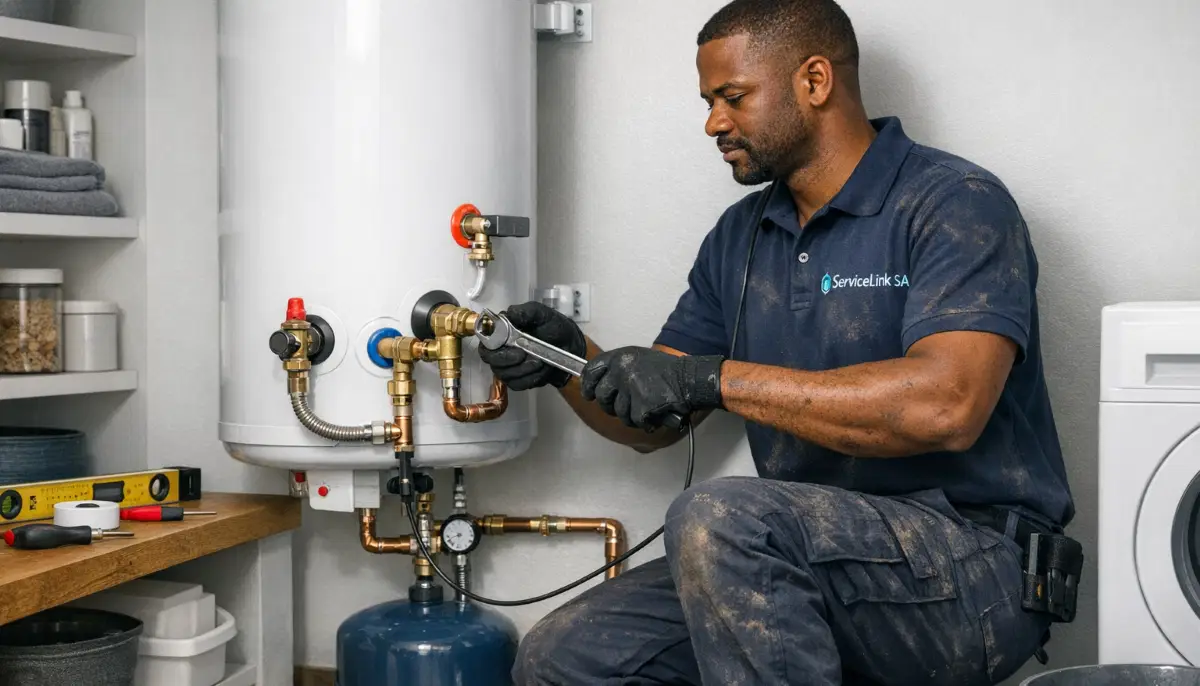
⚠️ 5 Symptoms of a Bad Geyser Thermostat
Here are the most common signs of geyser thermostat problems:
❄️ 1. No Hot Water (or Lukewarm)
Water never gets hot, or gets slightly warm then cools. The thermostat may be stuck in the “open” position, never sending power to the element.
🔥 2. Scalding Hot Water
Water is dangerously hot, even when the thermostat is set to a normal temperature. The thermostat may be stuck “closed,” keeping the element on constantly.
📊 3. Fluctuating Water Temperature
Water temperature changes randomly during use—hot, then cold, then hot again. The thermostat is failing to maintain consistent temperature.
⚡ 4. Geyser Runs Constantly
You can hear the geyser running continuously, and your electricity bill has spiked. The thermostat may be stuck closed, running the element constantly.
🔌 5. Circuit Breaker Trips Repeatedly
The geyser’s circuit breaker trips soon after resetting. A shorted thermostat can cause this (though a bad element is also possible).
❄️ Symptom #1: No Hot Water (Thermostat Stuck Open)
This is the most common geyser thermostat problem—the thermostat fails in the “open” position, meaning it never sends power to the heating element.
Symptoms:
- Water never gets hot—ice cold or barely lukewarm
- Geyser is silent (no humming sound)
- Circuit breaker is fine (not tripped)
- Other electrical items in the house work normally
Diagnosis: The thermostat is likely faulty and needs replacement. However, also check:
- Is the circuit breaker tripped? (Reset and test)
- Is the isolator switch turned off? (Check wall switch)
- Could it be a burnt-out element instead? (Element failure also causes no hot water)
Solution: Replace the faulty thermostat. Cost R300-R600 for part + labour.
🔥 Symptom #2: Scalding Hot Water (Thermostat Stuck Closed)
A thermostat stuck in the “closed” position is dangerous—it keeps the element running constantly, overheating the water.
Symptoms:
- Water is dangerously hot (well above 60°C, possibly 80-90°C+)
- Geyser runs continuously (you can hear it humming even when no hot water is being used)
- Electricity bill has spiked significantly
- Pressure relief valve may be dripping (overheating increases pressure)
- Popping or rumbling sounds (water boiling inside tank)
Dangers:
- Risk of scalding burns, especially to children and elderly
- Geyser can over-pressurise and burst
- Element will burn out prematurely
- Thermal cutout may trip (safety device)
⚠️ Critical Warning:
If your water is scalding hot, turn off the geyser’s circuit breaker immediately. A stuck-closed thermostat can cause the geyser to overheat, over-pressurise, and potentially explode. Call a plumber immediately.
Solution: Replace the faulty thermostat immediately. Also check if the thermal cutout has tripped (safety device).
🌡️ Geyser Temperature Problems?
Get quotes from verified geyser repair specialists. Thermostat replacement, diagnosis, and repair. Free inspections.
Free quotes • Same-day service • Verified specialists
📊 Symptom #3: Fluctuating Water Temperature
A failing thermostat may work intermittently, causing temperature swings during use.
Symptoms:
- Water temperature changes during shower—hot, then cold, then hot again
- Inconsistent hot water supply
- Geyser cycles on and off more frequently than normal
Cause: The thermostat’s internal contacts are worn or damaged, causing intermittent connection. It may work sometimes but not others.
Solution: Replace the thermostat. A fluctuating thermostat will only get worse.
⚡ Symptom #4: Geyser Runs Constantly (High Electricity Bill)
If your geyser never seems to turn off, the thermostat may be failing to sense the correct temperature.
Symptoms:
- You hear the geyser humming continuously
- Electricity bill has increased by 30-50%
- Water may be normal temperature or slightly hot
Cause: The thermostat’s temperature sensor is inaccurate, or the contacts are stuck closed.
Solution: Replace the thermostat. Also check the element—a scaled element can also cause longer run times.
🔌 Symptom #5: Circuit Breaker Trips Repeatedly
A shorted thermostat can cause the circuit breaker to trip.
Symptoms:
- Geyser circuit breaker trips soon after resetting
- May trip immediately or after a few minutes
Possible causes:
- Shorted thermostat (electrical fault)
- Burnt-out element (shorted to ground)
- Water in electrical compartment
- Faulty circuit breaker (less common)
Diagnosis: A plumber or electrician needs to test both the thermostat and element for shorts.
📋 How to Test a Geyser Thermostat (Multimeter)
How to tell if geyser thermostat is bad using a multimeter:
⚠️ Safety First:
Before testing, turn off the circuit breaker to the geyser. Confirm power is off with a voltage tester. If you’re not comfortable with electrical testing, call a professional.
Tools needed: Multimeter (set to resistance/ohms), screwdriver, torch.
Step-by-step:
- Turn off circuit breaker to geyser
- Remove geyser access panel (usually held by screws)
- Remove insulation and plastic cover over thermostat
- Set multimeter to resistance (ohms) – lowest range
- Test 1 – Thermostat in “off” position: Turn thermostat dial to lowest setting (usually marked “off” or minimum). Test between terminals 1 and 2 (or L and T). Should read infinite resistance (open circuit – no continuity).
- Test 2 – Thermostat in “on” position: Turn dial to a medium setting (around 50°C). Test between terminals 1 and 2 again. Should read near-zero resistance (closed circuit – continuity).
- If either test fails (continuity when should be open, or open when should be closed), the thermostat is faulty.
What the results mean:
- Normal: Open circuit when dial is off/low, closed circuit when dial is in heating range
- Faulty (stuck open): Always open—no continuity even when dial is turned up
- Faulty (stuck closed): Always closed—continuity even when dial is off
- Faulty (intermittent): Inconsistent readings when you tap the thermostat
Read our geyser element replacement guide for testing the element.
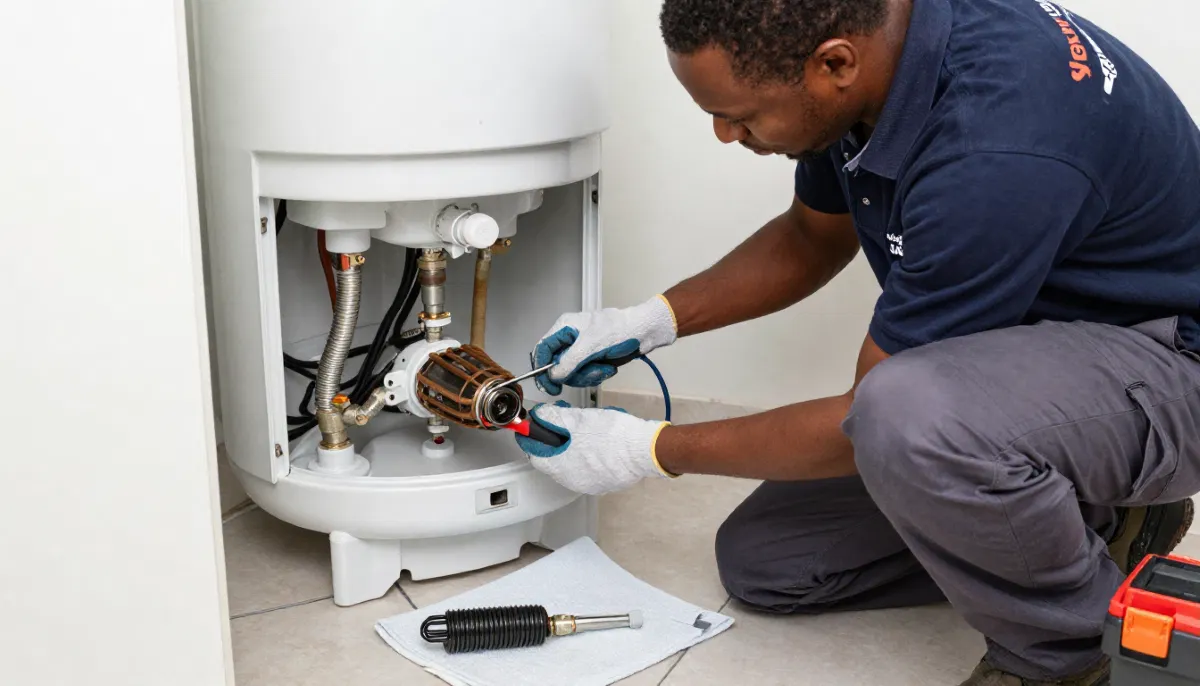
🔧 How to Replace a Faulty Geyser Thermostat
If you’ve confirmed a faulty geyser thermostat, here’s how to replace geyser thermostat:
Tools needed: New thermostat (exact match to your geyser model), screwdrivers, multimeter, torch.
Step-by-step:
- Turn off circuit breaker to geyser (confirm power is off)
- Turn off water supply to geyser (isolation valve)
- Remove access panel, insulation, and plastic cover
- Take a photo of the wiring connections (critical for correct reassembly)
- Disconnect wires from thermostat terminals (label them if needed)
- Remove thermostat from its mounting bracket (may have clips or screws)
- Install new thermostat in the same position
- Ensure the thermostat is pressed firmly against the geyser tank (temperature sensor needs good contact)
- Reconnect wires exactly as per your photo
- Set the temperature dial to 55-60°C
- Replace plastic cover, insulation, and access panel
- Turn water supply back on
- Ensure geyser is full of water before restoring power (open a hot tap until water flows)
- Turn circuit breaker back on
- Test after 30-60 minutes
⚠️ Critical Warning:
Never turn the power on until the geyser is completely full of water. Running the element without water destroys it in seconds. Always open a hot tap to confirm water flow before restoring power.
🛠️ DIY vs Professional: Should You Replace It Yourself?
Consider these factors before attempting DIY replace geyser thermostat:
✅ DIY MAY BE RIGHT IF:
- You have experience with electrical work
- You own a multimeter and know how to use it
- You’re comfortable working with 220V electricity
- You can identify the correct replacement thermostat
- You understand the importance of proper reassembly
❌ CALL A PROFESSIONAL IF:
- You’re uncomfortable with electrical work
- You don’t own or know how to use a multimeter
- Your geyser has a dual-element system (more complex)
- You’re unsure about the correct replacement part
- You want a warranty on the repair
- You need a COC for insurance purposes
Professional cost: R1,500-R2,800 including parts and labour. This includes diagnosis, parts, installation, testing, and COC.
💰 Geyser Thermostat Replacement Cost Guide
Here’s what to budget for geyser thermostat problems repairs:
| Service | Cost Range (ZAR) | What’s Included |
|---|---|---|
| Thermostat Part (single-element) | R200 – R400 | Replacement thermostat only |
| Thermostat Part (dual-element) | R400 – R800 | Replacement thermostat only |
| Professional Labour (single-element) | R800 – R1,500 | Diagnosis, replacement, testing |
| Professional Labour (dual-element) | R1,200 – R2,000 | More complex wiring |
| Total Professional Replacement | R1,500 – R2,800 | Parts + labour + COC |
| DIY Replacement | R200 – R800 | Part only (if you have tools) |
| Call-Out Fee (if diagnosis only) | R450 – R650 | Often waived if repair proceeds |
🛡️ Preventing Thermostat Failure
While thermostats eventually wear out, you can extend their life:
- Set temperature to 55-60°C – Higher temperatures stress the thermostat and cause scale buildup
- Install a geyser timer – Reduces the number of heating cycles
- Flush the geyser every 2-3 years – Sediment buildup affects temperature sensing
- Check water pressure – High pressure stresses all geyser components
- Annual professional inspection – Catches issues before failure
Read our home plumbing maintenance checklist for a complete schedule.
❌ 5 Costly Mistakes When Dealing With Thermostat Problems
Mistake #1: Replacing the Thermostat Without Testing
Assuming the thermostat is faulty without testing can waste money. The problem could be a burnt element, tripped breaker, or thermal cutout. Always test first.
Mistake #2: Buying the Wrong Replacement Thermostat
Geyser thermostats are not universal. Take your old thermostat to the hardware store or note the model number. Wrong thermostat may not fit or function correctly.
Mistake #3: Not Ensuring Good Tank Contact
The thermostat must be pressed firmly against the geyser tank. Poor contact causes inaccurate temperature sensing—the thermostat will read the air temperature, not the water temperature.
Mistake #4: Restoring Power Before the Geyser Is Full
If you drained the geyser for any reason, ensure it’s completely full before restoring power. Running the element without water destroys it in seconds.
Mistake #5: Ignoring Scalding Water
“We just turn the tap carefully” is dangerous, especially if you have children or elderly family members. A stuck-closed thermostat is an emergency—fix it immediately.
📋 Real-World Thermostat Problem Case Studies
🌡️ Case 1: The Lukewarm Geyser in Cape Town
Location: Cape Town | Homeowner: The Williams Family
Problem: Water was lukewarm at best. Never hot enough for a comfortable shower.
Diagnosis: Multimeter test showed thermostat stuck open—no continuity even when turned up.
Solution: Thermostat replacement (R1,800). Element tested fine.
Outcome: Hot water restored. Cost far less than a new geyser.
Lesson: A simple thermostat replacement fixed the problem—no need for a new geyser.
🔥 Case 2: The Scalding Water Emergency
Location: Gauteng | Homeowner: Mrs. van Zyl
Problem: Water suddenly became scalding hot. Pressure valve dripping. Elderly mother at home.
Diagnosis: Thermostat stuck closed—continuity even when turned to off position.
Solution: Emergency thermostat replacement (R2,200 including after-hours call-out).
Outcome: Temperature normalised. Thermal cutout had also tripped (reset). No burns, no geyser damage.
Lesson: Scalding water is an emergency—don’t wait.
❓ Frequently Asked Questions About Geyser Thermostat Problems
How to tell if geyser thermostat is bad?
How to tell if geyser thermostat is bad: Symptoms include no hot water (stuck open), scalding water (stuck closed), fluctuating temperatures, geyser running constantly, or tripping breaker. To confirm, use a multimeter to test continuity—open circuit when dial is off, closed circuit when dial is turned up. If readings are wrong, the thermostat is faulty.
Can I replace a geyser thermostat myself?
Yes, if you have electrical experience, a multimeter, and understand 220V safety. However, if you’re unsure, call a professional. A mistake could cause electrocution, fire, or geyser damage. Professional cost is R1,500-R2,800—worth it for peace of mind and a COC.
How much does it cost to replace a geyser thermostat?
A replace geyser thermostat professionally costs R1,500-R2,800 including parts and labour. DIY cost is R200-R800 for the part only. The part itself is inexpensive (R200-R800); labour is the main cost. Most homeowners choose professional installation for safety and warranty.
What temperature should my geyser thermostat be set to?
Set your geyser thermostat to 55-60°C. This is hot enough for comfortable showers and kills bacteria (legionella), but not so hot that it wastes energy or creates scalding risk. Temperatures above 65°C increase electricity consumption by 5-8% per degree and accelerate scale buildup.
Can a faulty thermostat cause high electricity bills?
Yes—a thermostat stuck in the “closed” position keeps the element running constantly, dramatically increasing electricity consumption. A constantly running geyser can add R300-R800 to your monthly bill. If you notice your geyser never turns off and your bill has spiked, the thermostat is likely faulty.
How long do geyser thermostats last?
Geyser thermostats typically last 5-10 years, similar to heating elements. Factors affecting lifespan: water quality (hard water reduces life), temperature setting (higher settings stress components), and frequency of heating cycles. Regular maintenance (flushing, annual inspection) extends thermostat life.
What’s the difference between a single-element and dual-element thermostat?
A single-element thermostat controls one heating element—common in smaller geysers (100-150L). A dual-element thermostat controls two elements (upper and lower)—common in larger geysers (150-200L+). Dual-element systems are more efficient but more complex to diagnose and replace. Know which type your geyser has before buying a replacement.
Can a bad thermostat trip the circuit breaker?
Yes—a shorted thermostat can cause the circuit breaker to trip repeatedly. However, a burnt-out element is a more common cause of tripping breakers. A plumber or electrician can test both components to identify the culprit. Never repeatedly reset a tripping breaker—it indicates a fault that needs professional diagnosis.
✅ Final Thoughts: Small Part, Big Impact
The geyser thermostat is a small, inexpensive component that plays a critical role in your home’s hot water system. When it fails, you’ll notice immediately—no hot water, scalding water, or wildly fluctuating temperatures.
The good news? Geyser thermostat problems are among the most affordable and straightforward geyser repairs. A R300-R600 part and an hour of a plumber’s time can restore proper temperature control and save you from replacing an otherwise perfectly good geyser.
Key takeaways for South African homeowners:
- Symptoms: No hot water, scalding water, fluctuating temps, constant running, tripping breaker
- Stuck open = no hot water – Stuck closed = scalding water (emergency)
- Test with a multimeter – open when off, closed when on = good
- Replacement cost: R1,500-R2,800 professionally – DIY part cost R200-R800
- Set thermostat to 55-60°C – optimal for comfort, safety, and efficiency
- Never ignore scalding water – dangerous for children and elderly
- Annual maintenance extends life – flushing, pressure valve testing
Your action plan: If you’re experiencing temperature problems, start by checking your circuit breaker and isolator switch. Then note the symptoms—no hot water vs scalding vs fluctuating. If you have a multimeter and electrical knowledge, test the thermostat. Otherwise, call a professional. Use ServiceLink SA to find verified geyser repair specialists who can diagnose and fix your faulty geyser thermostat quickly.
🌡️ Geyser Temperature Problems?
Get quotes from verified geyser repair specialists. Thermostat replacement, diagnosis, and repair. Free inspections.
📞 Call us: 073 138 4726 for immediate help finding a geyser specialist near you.
No hot water? •
Element replacement •
Pressure valve guide •
Leaking geyser •
Beat Your Quote guarantee
📚 Official resources & standards referenced:
- SANS 10400 – Thermostat standards and geyser installation requirements.
- South African Bureau of Standards (SABS) – Electrical component safety and geyser standards.
- Plumbing Industry Registration Board (PIRB) – Find registered geyser repair specialists.
Information provided for general guidance based on industry research and SANS/SABS standards. For geyser thermostat problems, professional diagnosis is recommended if you’re unsure about electrical testing.
Written by: ServiceLink SA Research Team
Geyser & Electrical Component Specialists
The ServiceLink SA Research Team comprises geyser repair specialists, electrical component experts, and plumbing industry professionals with decades of experience diagnosing and fixing geyser thermostat problems across South Africa. Our team works directly with PIRB-registered plumbers, thermostat manufacturers, and electrical safety authorities to bring you accurate, actionable information about faulty geyser thermostat diagnosis, replacement, and prevention. We continuously update our guides to reflect current safety standards, manufacturer specifications, and real-world best practices for temperature control in hot water systems.
For more information about geyser thermostats and hot water systems, explore our related resources:
geyser not heating guide,
geyser element replacement guide,
geyser pressure valve guide,
geyser leaking guide,
and geyser costs guide.
Our what is ServiceLink SA and
contractor verification process pages explain how we connect you with trusted professionals.
See our service areas page for geyser repair coverage in your region.