Not Sure Which Installer to Trust?
Let ServiceLink SA connect you with verified, accredited DSTV installers.
We’ve already asked the questions for you. Free quotes. No obligation.
Servicing Gauteng, Western Cape, Cape Town, Bellville, Stellenbosch, Paarl, and across South Africa
15 Questions to Ask Before Hiring a DSTV Installer (Don’t Get Ripped Off)
🔧 One wrong hire can cost you thousands in roof damage, poor signal, and frustration. Ask these 15 questions first.
You need a DSTV installer. You find one online. The price seems fair. You hire them.
Two weeks later, your signal is pixelating. Water is leaking through your roof where they didn’t seal a penetration.
You call them back – the phone is disconnected. You’ve been ripped off.
This happens more often than you’d think. The difference between a professional installer and a cowboy
is often just a few questions. But if you don’t know what questions to ask a dstv installer,
you can’t separate the experts from the scammers.
In this guide, I’ll give you 15 essential questions to ask dstv installer professionals.
You’ll learn how to verify credentials, spot red flags, and protect yourself from costly mistakes.
If you’re hiring dstv installer services, this installer checklist is your best defence.
For a complete guide to choosing an installer, read our
how to choose the right DSTV installer guide.
For scam prevention, see how to avoid contractor scams.
And for verification, read how we verify contractors.
📋 Table of Contents – Questions to Ask a DSTV Installer
⚠️ Why These Questions Matter (The Cost of Not Asking)
Before we dive into the questions to ask dstv installer professionals,
understand what’s at stake. Hiring the wrong installer can cost you:
- Roof damage and leaks: R2,000-R10,000+ to repair
- Voided equipment warranty: R600-R3,000 for replacement decoder
- Ongoing signal problems: Constant pixelation, freezing, and frustration
- No recourse: Unaccredited installers disappear when problems arise
- Double payment: Paying twice – once for bad installation, again for professional fix
⚠️ Real Example:
A homeowner in Cape Town hired an unaccredited installer who quoted R500 less than competitors.
The installer didn’t seal roof penetrations, causing a leak that cost R8,000 to repair.
The signal was poor, requiring a professional realignment (R700). Total cost: R9,200.
Professional installation would have been R1,200. Don’t make this mistake.
✅ Q1: “Are you MultiChoice-accredited? Can I see your certificate?”
This is the most important what to ask satellite installer question.
Accreditation proves the installer has completed MultiChoice’s official training.
Why it matters:
- Ensures proper training on latest equipment
- Access to genuine DSTV parts
- Warranty protection on workmanship
- Official recourse through MultiChoice if problems arise
What to look for:
- Current accreditation certificate (not expired)
- Name on certificate matches installer’s name/business
- Verify through official DSTV Accredited Installer Directory
Red flag: “I’m accredited but I don’t have my certificate with me” or “It’s expired but I’m renewing.”
🛡️ Q2: “Do you have public liability insurance? Can I see proof?”
Insurance protects you if the installer damages your property.
Why it matters:
- Covers roof damage, broken tiles, water leaks
- Covers damage to your home during installation
- Covers injury to the installer (so you’re not liable)
What to look for:
- Valid insurance certificate (not expired)
- Minimum R1 million coverage (R2 million preferred)
- Call the insurer to verify it’s active
Red flag: “I’m insured” but can’t provide proof, or “I don’t need insurance for this job.”
Read our contractors liability insurance guide.
📅 Q3: “How many years of DSTV installation experience do you have?”
Experience matters. A seasoned installer has seen every type of installation challenge.
What to look for:
- Minimum 3 years of continuous DSTV installation experience
- Experience with your specific decoder type (HD, Explora, Ultra)
- Experience with your property type (house, complex, apartment)
Red flag: Vague answers like “I’ve been doing this for a while” or less than 1 year experience.
📞 Q4: “Can you provide 2-3 recent references from customers in my area?”
References let you verify quality and reliability with past customers.
What to ask references:
- “Was the installer punctual?”
- “Did they clean up after themselves?”
- “Is your signal still good?”
- “Would you hire them again?”
Red flag: Can’t provide references, or references sound scripted or won’t answer specific questions.
Don’t Have Time to Interview Installers?
ServiceLink SA pre-vets all installers for accreditation, insurance, experience, and reviews.
Get free quotes from verified professionals – we’ve already asked the questions for you.
Free quotes. Verified installers. No obligation.
📝 Q5: “Will you provide a detailed written quote before any work begins?”
A written quote protects you from unexpected charges and disputes.
What a good written quote includes:
- Itemised list of equipment (dish size, LNB type, cable type)
- Labour cost
- Cable length included (and cost per extra metre)
- Warranty terms
- Total price (including VAT)
- Validity period (usually 30 days)
Red flag: “I’ll give you a verbal estimate” or refuses to put anything in writing.
🛡️ Q6: “What warranty do you offer on your workmanship and parts?”
A warranty protects you if something goes wrong after installation.
What to look for:
- Labour warranty: Minimum 6 months (12 months preferred)
- Parts warranty: 12 months on dish and LNB
- Written warranty documentation: Not verbal
Red flag: “I guarantee my work” but won’t put it in writing, or offers only 30 days.
Read our guarantees page for what we require from our installers.
📦 Q7: “What equipment will you use? (Dish size, LNB type, cable brand)?”
Quality equipment is essential for reliable signal.
Acceptable answers:
- Dish size: 60cm minimum (80cm for coastal areas)
- LNB type: Single, Quad, or Smart – matching your decoder
- Cable: RG6 quad-shield (not RG59)
- Connectors: Compression F-connectors (not screw-on)
Red flag: “Standard dish” (could be 45cm), “RG59 is fine,” or “screw-on connectors are fine.”
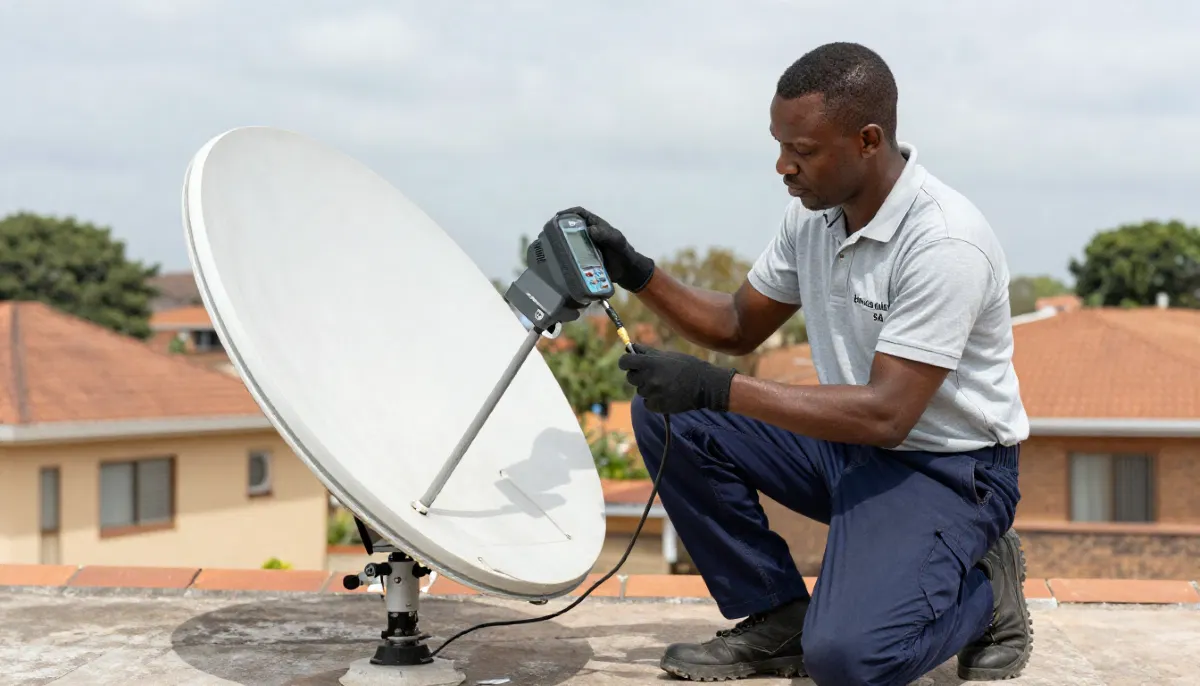
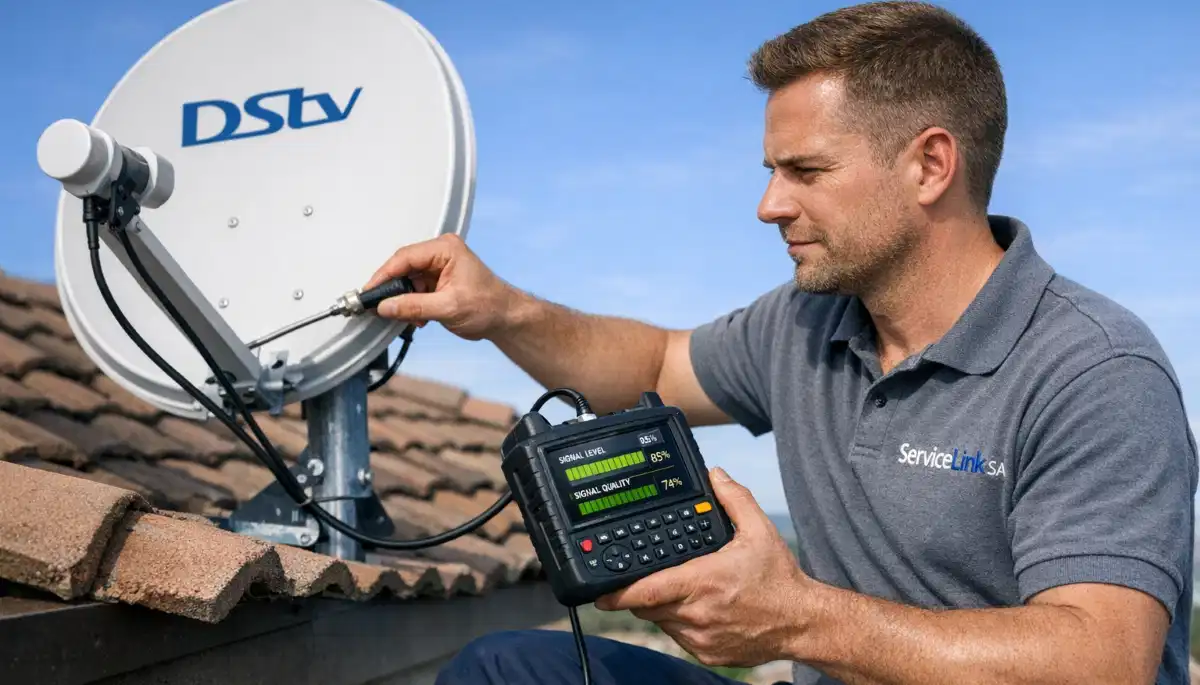
📡 Q8: “Do you use a satellite signal meter for alignment?”
This is a deal-breaker question. Professional alignment requires a signal meter.
Acceptable answer: “Yes, I use a professional signal meter.”
Red flag: “I can do it by eye” or “The decoder’s meter is good enough” (decoder meter updates slowly).
📞 Q9: “What is your process if I have signal problems after installation?”
A good installer stands behind their work.
Acceptable answer: “Call me, and I’ll come back to fix it under warranty at no charge.”
Red flag: “That’s unlikely to happen” or “You’ll need to pay another call-out fee.”
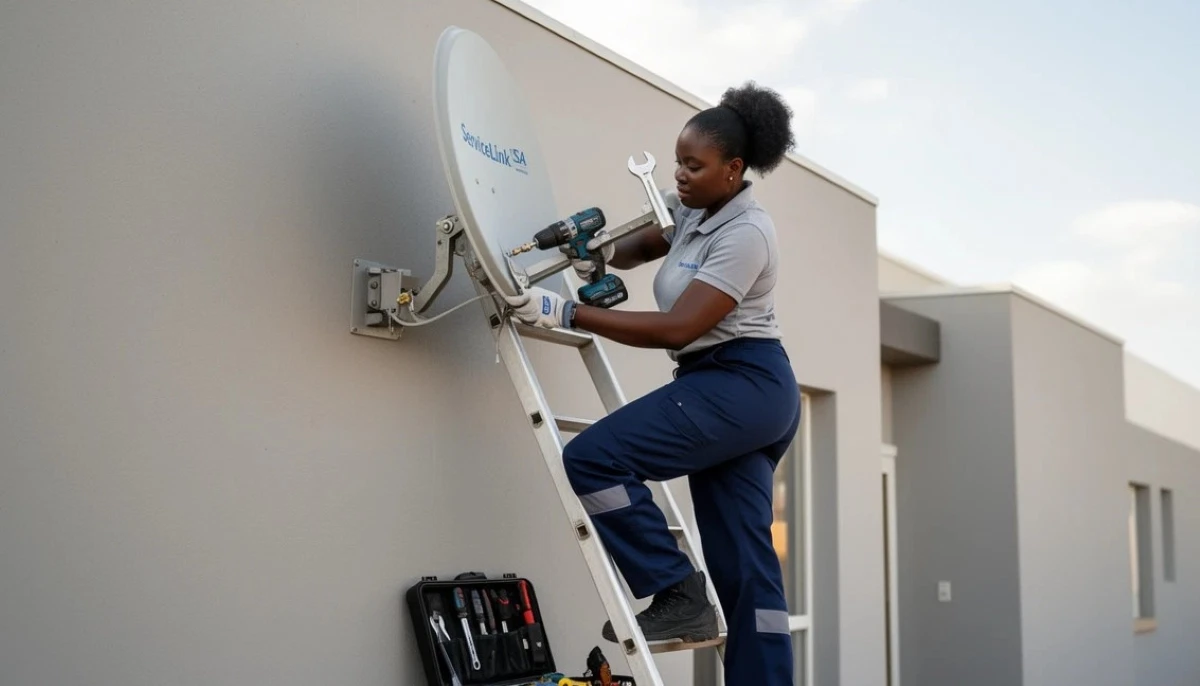
🌧️ Q10: “Do you weatherproof all outdoor connections?”
Weatherproofing prevents water damage and signal loss.
Acceptable answer: “Yes, I use self-amalgamating tape on all outdoor F-connectors and silicone on wall penetrations.”
Red flag: “That’s not necessary” or “Electrical tape is fine” (electrical tape fails in sunlight).
🔌 Q11: “What type of cable do you use?”
Acceptable answer: “RG6 quad-shield with solid copper core.”
Red flag: “RG59” or “copper-clad steel” – these have higher signal loss and cause pixelation.
For cable quality guidance, read our
best coaxial cable guide.
📏 Q12: “How much cable is included in your quote?”
Acceptable answer: “15-20 metres included. Extra cable is R20-R45 per metre.”
Red flag: “Cable included” but no length specified – they may use only 5 metres.
💰 Q13: “What are your payment terms?”
Acceptable answer: “30-50% deposit, balance on completion” or “payment on completion.”
Red flag: “Full payment upfront before any work begins” – this is a common scam.
⚠️ Q14: “What is NOT included in your quoted price?”
This is the most important question to avoid surprises.
Common exclusions to ask about:
- Extra cable beyond included length
- Wall-mounting brackets (if not standard)
- Travel fees (for remote areas)
- After-hours surcharges
- VAT (if quoting excluding VAT)
- LNB upgrade (Quad or Smart vs Single)
🏢 Q15: “Do you have a physical business address?”
Acceptable answer: Provides a verifiable physical address (not just a cellphone number).
Red flag: Only a cellphone number, no physical address – scammers often operate this way.
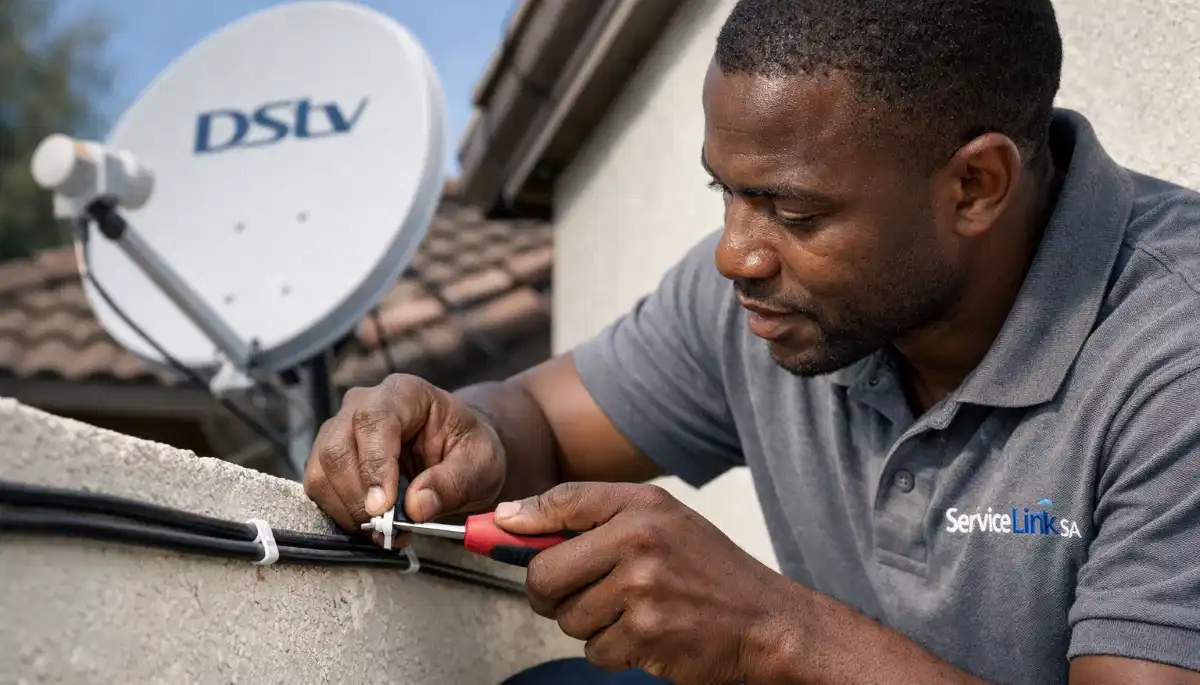
🚩 10 Red Flags of a Bad DSTV Installer (Walk Away!)
⚠️ If You See Any of These, Find Someone Else
- Demands full payment upfront – Deposit is fine (30-50%). Full payment before work is a scam.
- Cannot provide proof of MultiChoice accreditation – Or provides a number that doesn’t verify.
- No physical business address – Only a cellphone number is a major risk.
- Pressures you to skip proper installation steps – “We don’t need to waterproof that” – run.
- Uses substandard materials – RG59 cable, screw-on connectors, no-name LNBs.
- No written quote or refuses to provide one – Verbal estimates only are a red flag.
- No written warranty – If they won’t put it in writing, they won’t honour it.
- “Too good to be true” pricing – R300 for a full installation? Something is missing or substandard.
- Reluctant to provide references – Or provides references who sound scripted.
- “Alignment by eye” – Professionals use signal meters – “by eye” means poor signal.
🔍 How to Verify Their Answers (Don’t Just Take Their Word)
Verify MultiChoice accreditation:
- Ask for their accreditation number
- Visit the official DSTV Accredited Installer Directory
- Search for the installer’s name or number
- Confirm the accreditation is current (not expired)
Verify insurance:
- Ask for a copy of their public liability insurance certificate
- Call the insurance company to verify it’s active
- Confirm the coverage amount (minimum R1 million)
Verify qualifications (SAQA):
- For electronic or satellite qualifications, check via SAQA
- Ask for copies of trade certificates or training completion documents
Verify reviews and references:
- Check HelloPeter, Google Reviews, and Facebook reviews
- Look for patterns – not just overall rating
- Call provided references and ask specific questions
ServiceLink SA does all this verification for you. Read
how ServiceLink SA verifies contractors
and is ServiceLink SA legit.
❓ Frequently Asked Questions About Hiring a DSTV Installer
What questions should I ask before hiring a DSTV installer?
What questions should i ask a dstv installer include: accreditation (see proof),
insurance (see certificate), experience (3+ years), references (call them), written quote,
warranty terms, equipment used, signal meter usage, callback policy, and hidden costs.
See our complete 15-question list above for everything you need to ask.
How do I verify if a DSTV installer is accredited?
To verify hiring dstv installer credentials, ask for their accreditation number,
then verify it through the official DSTV Accredited Installer Directory.
If the number doesn’t appear or the name doesn’t match, they are not legitimate.
ServiceLink SA also verifies accreditation for all installers on our platform.
What are the red flags of a bad DSTV installer?
Red flags when what to ask satellite installer include: demands full payment upfront,
cannot provide accreditation proof, no physical business address, pressures you to skip steps,
uses substandard materials (RG59 cable, screw-on connectors), no written quote,
no written warranty, “too good to be true” pricing, or “alignment by eye.”
See our complete red flags list above.
Do DSTV installers need to be insured?
Yes. Professional installer checklist includes public liability insurance.
This protects you if the installer damages your property (roof, walls, ceiling).
Minimum coverage should be R1 million. Always ask for proof and verify with the insurer.
Read our insurance guide.
What warranty should a DSTV installer provide?
A professional questions to ask dstv installer about warranty:
minimum 6 months labour warranty (12 months preferred) and 12 months parts warranty
on the dish and LNB. Get warranty terms in writing before work begins.
Read our guarantees page.
Should I pay a deposit for DSTV installation?
A deposit of 30-50% is reasonable for materials. Full payment upfront before any work begins
is a major red flag and common scam tactic. Reputable installers may ask for a deposit
to cover equipment costs, with balance due on completion.
How can I find a reliable DSTV installer near me?
To find a reliable installer, use ServiceLink SA’s free quote service.
We connect you with verified, accredited installers who have been pre-screened
for accreditation, insurance, experience, and reviews.
Request free quotes and compare.
What is the difference between accredited and independent installers?
Accredited installers have completed MultiChoice training, use genuine parts, and offer warranty protection.
Independent installers may be excellent but lack official certification, which can void your equipment warranty.
Read our accredited vs independent guide.
Can I negotiate the price with a DSTV installer?
Yes. Get multiple quotes and use them as leverage.
Bundle services (installation + TV mounting) for discounts.
Use ServiceLink SA’s Beat Your Quote guarantee to ensure competitive pricing.
Many installers are willing to negotiate, especially during slow periods.
How does ServiceLink SA verify installers?
ServiceLink SA uses a 5-step verification process: MultiChoice accreditation verification,
public liability insurance confirmation, trade license checks, live reference checks,
and ongoing monitoring. Read how we verify contractors
and what makes a reliable contractor.
✅ Final Thoughts: Ask First, Hire Second
Questions to ask dstv installer professionals are your best defence against poor workmanship,
hidden costs, and scams. Never hire an installer without asking these 15 questions first.
Remember: a legitimate professional will be happy to answer your questions.
They’ll provide proof of accreditation and insurance. They’ll give written quotes and warranties.
They’ll use signal meters and quality materials.
If an installer is evasive, can’t provide proof, or pressures you to skip steps – walk away.
There are plenty of reputable installers who will do the job right.
Not sure which installer to trust? Request free quotes from ServiceLink SA.
We’ve already verified all our installers. You get free quotes from professionals you can trust.
Ready to Find a Trusted DSTV Installer?
Get free quotes from verified, accredited DSTV installers near you.
We’ve already asked the tough questions – so you don’t have to.
📞 Call us: 073 138 4726 for immediate installer recommendations.
How to choose a contractor •
Free site inspections •
Our guarantees •
Dispute resolution
📚 Official resources & standards referenced:
- Official DSTV Accredited Installer Directory – Verify installer accreditation.
- SAQA – South African Qualifications Authority – Verify technician qualifications.
Information provided for general guidance. DSTV is a registered trademark of MultiChoice.
Always verify installer credentials independently before hiring.
Written by: Innocent T Hanyani
Satellite & Home Entertainment Installation Specialist | 21+ Years Experience
Innocent T Hanyani has over two decades of experience in satellite television installations across South Africa.
He has helped thousands of homeowners avoid scams and find reliable, accredited installers.
His practical question guides help South Africans protect themselves from poor workmanship and hidden costs.
For more help choosing a DSTV installer, explore our related resources:
how to choose an installer,
DIY vs professional,
accredited vs independent,
find installers near me,
free installation quote.
See our service areas page for coverage in your region.