
Not Sure Which Glass Is Right for You?
Get free quotes from verified aluminium fabricators. Compare window glass types and find the best option for your home.
Servicing Gauteng, Johannesburg, Pretoria, Cape Town, and Durban
Tempered Glass vs Laminated Glass for Aluminium Windows: Which Is Safer?
🪟 The complete guide to choosing between two safety glass options for your home
Let me tell you about a call I received last year. A homeowner in Johannesburg had a break-in. The burglar smashed a ground floor window – standard annealed glass – and was inside in seconds. The glass shattered into large, sharp shards. Dangerous for the intruder, yes, but also dangerous for the family who had to clean it up.
That homeowner asked me: “What glass should I have used?” The answer wasn’t simple. Two types of safety glass dominate the market: tempered glass and laminated glass. Both are safer than standard annealed glass, but they work very differently. And the right choice depends on your priorities – security, impact resistance, noise reduction, or cost.
In this complete glass safety comparison, I’ll explain tempered vs laminated glass in detail, compare their strengths and weaknesses, help you understand which is better tempered or laminated glass, and provide cost estimates. By the end, you’ll know exactly which window glass types to specify for each application.
For more glass guidance, read our single vs double glaze guide, Low-E glass guide, or security features guide. Ready to compare? Let’s dive in.
📋 Table of Contents – Glass Safety Guide
🔨 What Is Tempered Glass?
Tempered glass (also called toughened glass) is the most common safety glass in South Africa.
How it’s made: Standard annealed glass is heated to approximately 650°C, then rapidly cooled with high-pressure air jets. This process creates compressive stress on the surface and tensile stress inside. The result is glass that is 4-5x stronger than standard glass.
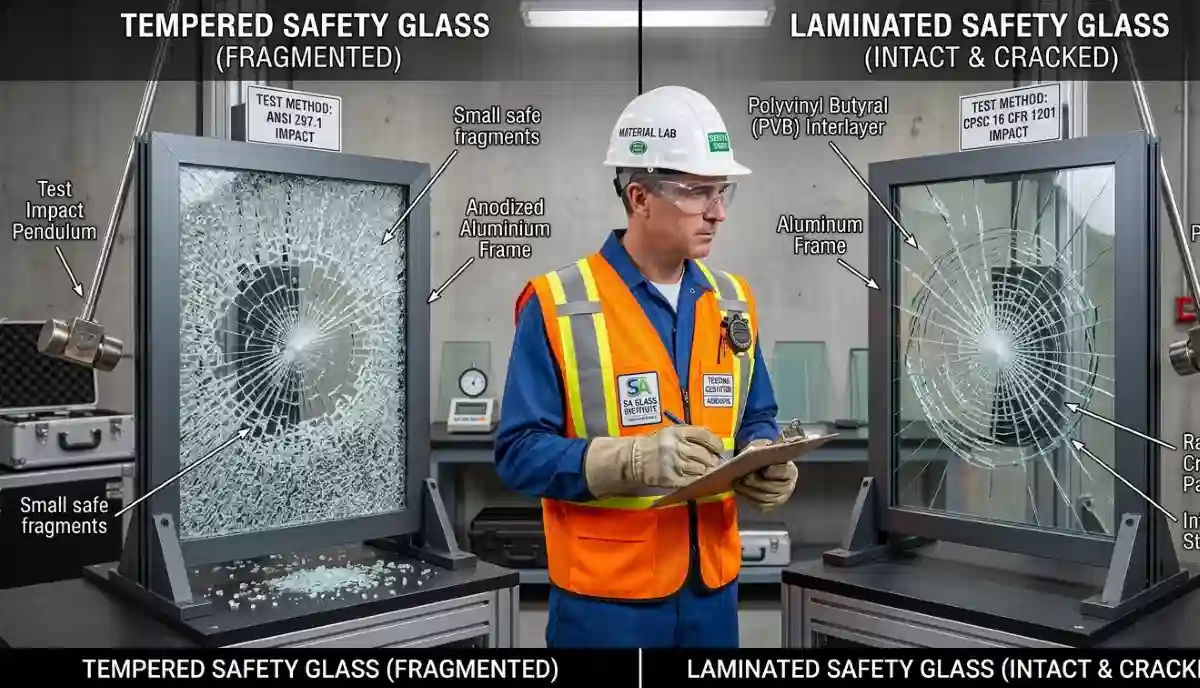
How it breaks: When tempered glass breaks, it shatters into hundreds of small, relatively harmless cubes (about the size of a corn kernel). It doesn’t form large, sharp shards.
Key characteristics:
- 4-5x stronger than standard annealed glass
- Breaks into small, dull cubes (safer than sharp shards)
- Cannot be cut or modified after tempering (must be cut to size first)
- Required by building codes for certain applications (shower doors, near floors)
- Cost: +R150-300 per m² over standard glass
Common uses in homes:
- Shower doors and enclosures (legally required)
- Windows near floors or doors (safety glazing locations)
- Sliding doors (standard glass often tempered)
- Table tops, shelves, balustrades
According to SABS glass safety standards and SANS 10400 building glass regulations, tempered glass is required in specific safety glazing locations.
🔗 What Is Laminated Glass?
Laminated glass is the premium choice for security and noise reduction.
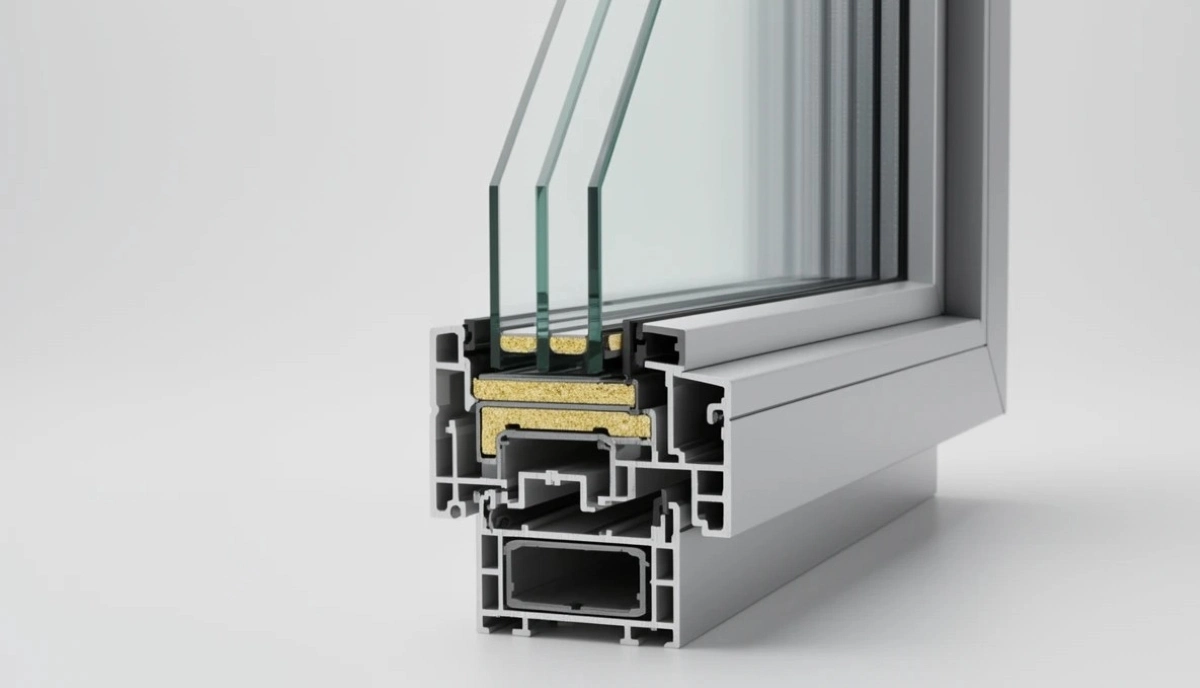
How it’s made: Two or more glass panes are bonded together with a plastic interlayer (typically PVB – polyvinyl butyral). The interlayer is sandwiched between the glass layers using heat and pressure.
How it breaks: When laminated glass breaks, the glass cracks but the fragments stick to the plastic interlayer. The glass remains in place – it doesn’t shatter or fall out.
Key characteristics:
- Holds together when broken – remains intact as a single cracked sheet
- Excellent security – very difficult to penetrate (smash-and-grab resistant)
- Superior noise reduction – the plastic interlayer dampens sound
- Blocks 99% of UV radiation – protects furniture from fading
- Can be cut and modified after manufacturing (unlike tempered)
- Cost: +R400-800 per m² over standard glass (double tempered)
Common uses in homes:
- Ground floor windows (security against break-ins)
- Homes on busy streets (noise reduction)
- Skylights (if broken, glass doesn’t fall on occupants)
- Balustrades and railings (safety if glass breaks)
- Hurricane/storm-prone areas (impact resistance)
Laminated + tempered (best of both): You can have laminated glass where one or both panes are tempered. This gives the strength of tempered and the security of laminated – but at a premium cost (+R600-1,200 per m²).
📊 Quick Comparison – Tempered vs Laminated Glass
A snapshot of tempered vs laminated glass for quick reference.
| Feature | Tempered Glass | Laminated Glass |
|---|---|---|
| Strength (impact resistance) | 4-5x stronger than standard | Similar to standard (but holds together) |
| How it breaks | Shatters into small cubes | Cracks but holds together |
| Security (smash & grab) | Poor – shatters completely | Excellent – very hard to penetrate |
| Noise reduction | Poor (same as standard) | Excellent (dampens sound) |
| UV protection | Poor | 99% UV block |
| Cost premium (vs standard) | +R150 – R300 per m² | +R400 – R800 per m² |
| Can be cut after manufacturing | No | Yes |
🛡️ Safety & Breakage Behavior – Which Is Safer?
Both are safety glass types, but they protect in different ways.
Tempered glass safety: When tempered glass breaks, it shatters into small, relatively harmless cubes. There are no large, sharp shards that could cause severe cuts. This makes tempered glass safer than standard glass for human impact. However, the entire window collapses – there’s no barrier left.
Laminated glass safety: When laminated glass breaks, the glass cracks but stays attached to the plastic interlayer. The window remains intact – no falling glass. This prevents injury from falling shards (especially important for skylights or upper floors). However, the cracked glass edges may still be sharp.
Which is safer for human impact? Both are safer than standard glass. Tempered glass eliminates large sharp shards. Laminated glass prevents glass from falling. For areas where people might fall into glass (shower doors, balustrades), tempered is often required by code. For areas where falling glass is a concern (skylights, high windows), laminated is better.
For children: Both are safer than standard glass. Tempered eliminates sharp shards; laminated keeps the window intact, preventing falls through broken glass.
Read our child safety guide for more on protecting little ones.
🔒 Security – Smash & Grab Protection
This is where tempered vs laminated glass shows the biggest difference.
Tempered glass security (poor): When a tempered glass window is struck, it shatters completely. The entire window collapses, leaving an open hole. An intruder can enter immediately. Tempered glass offers no security advantage over standard glass – it just breaks into smaller pieces.
Laminated glass security (excellent): When struck, laminated glass cracks but the plastic interlayer holds everything together. The intruder must strike repeatedly to create a hole – typically requiring 10-20 blows. This takes time (30-90 seconds), makes noise, and often deters the intruder. Even after penetration, the hole is small – a person cannot climb through easily.
Real-world test: A single strike with a hammer shatters tempered glass completely. The same strike on laminated glass creates a star-shaped crack but no hole. Laminated glass can withstand 10-20 strikes before a small hole appears.
For ground floor windows: Laminated glass is strongly recommended. It’s one of the most effective glass safety comparison upgrades for security. For upper floors where access is difficult, tempered glass may be sufficient.
Read our security features guide for more on protecting your home.
🌪️ Impact Resistance – Hail, Storms, Accidents
Which glass handles impacts better?
Tempered glass impact resistance (excellent): Tempered glass is 4-5x stronger than standard glass. It resists impacts from hail, flying debris (storms), and accidental bumps. This is why tempered is used in sports facilities, shower doors, and areas prone to impact.
Laminated glass impact resistance (moderate): Laminated glass has similar strength to standard annealed glass. The plastic interlayer doesn’t increase strength – it holds broken pieces together. However, if laminated glass is used with tempered panes (tempered-laminated), it gains the strength of tempered.
For hail-prone areas (Gauteng, Free State): Tempered glass is excellent for hail resistance. It can withstand larger hailstones without breaking. Standard glass can be shattered by severe hail.
For storm-prone areas: Both have advantages. Tempered resists breakage; laminated holds together if broken. For ultimate protection, use tempered-laminated (both strength and retention).
🔇 Noise Reduction Comparison
If you live on a busy street, noise reduction matters.
Tempered glass noise reduction (poor): Tempered glass has the same acoustic performance as standard glass – no improvement. Single glazing (tempered or not) reduces noise by only 25-28 dB.
Laminated glass noise reduction (excellent): The plastic interlayer dampens sound vibrations. Laminated glass reduces noise by 35-40 dB – a significant improvement. For homes near highways, under flight paths, or on busy streets, laminated glass makes a noticeable difference.
Double glazing + laminated: For maximum noise reduction, combine double glazing with laminated glass (one or both panes). This can achieve 45-50 dB reduction – approaching soundproof.
Example: With standard single glazing, traffic at 70 dB sounds like 45 dB inside (loud conversation). With laminated glass, the same traffic sounds like 30-35 dB inside (quiet library).
Read our soundproof windows guide for more.
☀️ UV Protection & Fading Prevention
UV radiation fades furniture, carpets, and curtains. Here’s how each glass type performs.
Tempered glass UV protection (poor): Tempered glass blocks only about 30-50% of UV radiation. Significant UV still passes through, causing fading over time.
Laminated glass UV protection (excellent): The PVB interlayer blocks 99% of UV radiation. Laminated glass is the best choice for homes with valuable furniture, art, or flooring that you want to protect from fading.
UV comparison summary:
- Standard glass: blocks 30-40% UV
- Tempered glass: blocks 30-50% UV
- Low-E glass: blocks 60-70% UV
- Laminated glass: blocks 99% UV
For art, antiques, or expensive furniture: Laminated glass is the best choice. Your furnishings will last years longer without fading.
💰 Cost Comparison – Tempered vs Laminated
Here’s what different window glass types cost in South Africa.
| Glass Type | Cost per m² (Glass Only) | Premium vs Standard | Best For |
|---|---|---|---|
| Standard annealed glass | R150 – R250 | Base | Budget, non-safety locations |
| Tempered glass | R300 – R550 | +R150 – R300 | Safety glazing locations, impact resistance |
| Laminated glass (PVB) | R550 – R1,050 | +R400 – R800 | Security, noise reduction, UV protection |
| Tempered-laminated (best of both) | R750 – R1,450 | +R600 – R1,200 | Maximum security + impact resistance |
For a typical house (12m² of windows):
- Tempered glass upgrade: R1,800 – R3,600 extra
- Laminated glass upgrade: R4,800 – R9,600 extra
- Tempered-laminated upgrade: R7,200 – R14,400 extra
Use our Beat Your Quote guarantee for competitive pricing.
✅ Which Should You Choose? Decision Guide
Based on this which is better tempered or laminated glass analysis, here’s my practical advice.
Choose tempered glass if:
- You need to meet building code safety requirements (shower doors, near floors)
- Your priority is impact resistance (hail, storms, accidental bumps)
- Budget is a concern (tempered is cheaper than laminated)
- You’re on a tight budget but need safety glass
- Security is not a major concern (upper floors, gated community)
Choose laminated glass if:
- Security is a priority (ground floor windows, smash-and-grab prevention)
- You live on a busy street and want noise reduction
- You want to protect furniture from UV fading
- You have skylights or high windows (falling glass hazard)
- You’re in a hurricane or storm-prone area (glass retention)
Choose tempered-laminated (best of both) if:
- You need impact resistance AND security (ground floor, hail-prone area)
- Budget allows for the premium (this is the best safety glass available)
- You’re building new or doing major renovation
Our recommendation for most homes: Use tempered glass for upper floor windows (code requirement + impact resistance). Use laminated glass for ground floor windows (security priority). For the best protection, use tempered-laminated on ground floor.
Read our security features guide for complementary measures.
📜 South African Safety Regulations for Glass
Understanding building codes helps you stay compliant.
SANS 10400 (National Building Regulations): Specifies where safety glazing must be used. Locations include:
- Glass within 900mm of the floor
- Glass in doors (including sliding doors)
- Glass in shower enclosures and bathrooms
- Glass in balustrades and railings
- Glass in skylights and rooflights
Safety glass requirements: In these locations, glass must be either tempered or laminated. Standard annealed glass is not permitted.
Markings on safety glass: Safety glass must be permanently marked to show compliance. Tempered glass has a “tempered” mark or logo. Laminated glass has a “laminated” mark. Always verify before installation.
Enforcement: Building inspections check for safety glass compliance. Non-compliant glass may require replacement at your cost.
Read our buying checklist for more on compliance.
❓ Frequently Asked Questions About Tempered vs Laminated Glass
Which is stronger – tempered or laminated glass?
Tempered glass is stronger – it’s 4-5x stronger than standard glass. Laminated glass has similar strength to standard glass. However, when broken, laminated glass holds together while tempered shatters completely. For which is better tempered or laminated glass in terms of impact resistance, tempered wins. For security (holding together), laminated wins.
Is laminated glass burglar proof?
No glass is completely burglar proof, but laminated glass is highly resistant to smash-and-grab. It requires 10-20 strikes to penetrate, makes significant noise, and often deters intruders. For security applications, laminated glass is the best choice among window glass types. For maximum security, combine laminated glass with security bars or multi-point locks. Read our security guide.
Can you see the difference between tempered and laminated glass?
Visually, tempered and laminated glass look similar when installed. However, you can identify them by: 1) Look at the edge – laminated glass has a visible plastic interlayer (thin line), tempered does not. 2) Look for safety markings – safety glass is permanently marked with “tempered” or “laminated”. 3) Break test – if you can, but that’s destructive. Ask your supplier for certification.
Which glass is better for noise reduction?
Laminated glass is significantly better for noise reduction. The plastic interlayer dampens sound vibrations, reducing noise by 35-40 dB vs 25-28 dB for tempered/standard glass. For homes on busy streets, near highways, or under flight paths, laminated glass is the best choice for glass safety comparison involving noise. Read our soundproof windows guide.
Which glass is required by law in South Africa?
SANS 10400 requires safety glazing (tempered OR laminated) in specific locations: within 900mm of the floor, in doors, in shower enclosures, in balustrades, and in skylights. Standard annealed glass is not permitted in these locations. Both tempered and laminated meet the legal requirement – choose based on your priorities (cost vs security vs noise).
Can laminated glass be used in double glazing?
Yes – laminated glass works perfectly in double glazing. For maximum performance, specify double glazing where one or both panes are laminated. This gives you security + noise reduction + insulation. For homes on busy streets, double glazing + laminated is the ultimate solution for tempered vs laminated glass decisions. Read our double glazing guide.
How much does laminated glass cost compared to tempered?
Laminated glass costs approximately 40-60% more than tempered glass. Tempered glass premium: +R150-300 per m² over standard. Laminated glass premium: +R400-800 per m² over standard. For a typical window (1.44m²), the difference is R360-720 per window. For many homeowners, the security and noise benefits of laminated justify the extra cost.
How do I find a supplier of safety glass windows?
Use ServiceLink SA’s free quote service to find verified aluminium fabricators who supply safety glass. Ask potential suppliers: Do you offer both tempered and laminated glass? Can you provide SABS certification? What are the costs for each option? For Gauteng, Johannesburg, Pretoria, Cape Town, or Durban, ask for references from homes with safety glass.
✅ Final Thoughts: Choose Based on Your Priorities
After reading this tempered vs laminated glass guide, you understand the trade-offs.
Tempered glass is stronger and cheaper – excellent for impact resistance and compliance with building codes. Laminated glass is more expensive but offers security, noise reduction, and UV protection – benefits that many homeowners value highly.
For most homes, the smartest approach is layered: tempered glass on upper floors (cost-effective, code-compliant), laminated glass on ground floors (security priority). For the ultimate protection, use tempered-laminated (both strength and retention).
Don’t use standard annealed glass in safety glazing locations – it’s dangerous and likely illegal. Upgrade to tempered or laminated. Your family’s safety is worth the investment.
Key takeaways for glass safety:
- Tempered glass: 4-5x stronger, shatters into small cubes, cheaper (+R150-300 per m²)
- Laminated glass: holds together when broken, excellent security, noise reduction, UV protection (+R400-800 per m²)
- Tempered-laminated: best of both – strongest + secure (+R600-1,200 per m²)
- For ground floor windows: laminated glass (security priority)
- For upper floors: tempered glass (impact resistance, cost-effective)
- Building codes require safety glass near floors, in doors, in showers
- Laminated glass provides smash-and-grab protection – deters intruders
- Laminated glass significantly reduces outside noise
- Use ServiceLink SA to find verified safety glass suppliers
Your next step: Identify the safety glass locations in your home. Upgrade any standard glass to tempered or laminated. Get free quotes from verified aluminium fabricators.
Ready to Upgrade Your Glass?
Get free, no-obligation quotes from verified aluminium fabricators. Compare tempered vs laminated glass options and find the best value for your home.
📞 Call us: 073 138 4726 for glass safety advice.
Free safety assessments •
Hiring tips •
Beat Your Quote •
Our guarantees
📚 Official resources & standards referenced:
- SABS – South African Bureau of Standards for glass safety standards and product certification.
- SANS 10400 – South African National Standard for building glass regulations and safety glazing requirements.
Information provided for general guidance. Building regulations vary by municipality. Always verify safety glass requirements with your local authority and use certified installers.
Written by: ServiceLink SA Research Team
Specialist Glass Safety & Aluminium Window Experts
The ServiceLink SA Research Team has extensive experience with safety glass specifications across thousands of South African homes. Our team has worked closely with SABS-certified glass manufacturers, building inspectors, and homeowners to develop this comprehensive glass safety comparison guide. This guide is based on real safety data, building code requirements, and feedback from across Gauteng, Johannesburg, Pretoria, Cape Town, Durban, Sandton, and nationwide. We update our information regularly to reflect current safety standards and building regulations.
For more information about glass and windows, explore our related resources: single vs double glaze, double glazing cost guide, soundproof windows guide, Low-E glass guide, and security features guide. Learn about our process on what is ServiceLink SA and how we protect homeowners. Find fabricators in your area: Gauteng, Johannesburg, Pretoria, Cape Town, Durban, and Sandton. For related services, see our CCTV and building construction guides.