
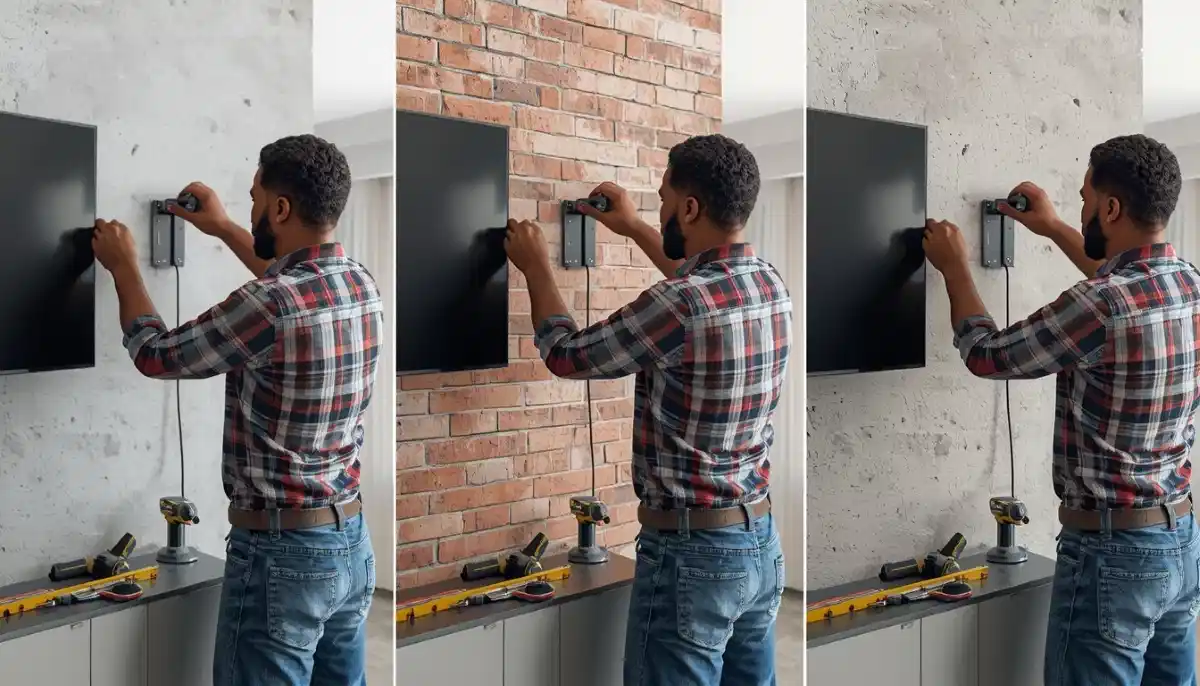
TV Wall Mounting on Drywall vs Brick vs Concrete – The Complete SA Guide
🧱 What you need to know about fixings, tools, and weight limits for every wall type in South African homes.
You’ve found the perfect spot for your new TV in your Fourways home. But what’s behind that wall? Is it solid brick, reinforced concrete, or lightweight drywall? The answer determines everything: the tools you’ll need, the fixings required, and even whether the wall can safely hold your TV. Attempting a brick wall TV bracket installation technique on drywall is a recipe for disaster. Understanding the differences is critical for safety.
This guide is your technical manual for TV wall mounting on drywall vs brick vs concrete. We cover each wall type in detail: how to identify it, the correct fixings to use, and the weight limits you must respect. You’ll learn about hollow wall anchors for plasterboard, masonry screws for brick, and why you need a hammer drill for concrete TV mount. We answer the crucial question: can you mount a TV on drywall without studs? (Spoiler: only with the right anchors and for lighter TVs). We also explain concepts like pull-out force, stud finder use, and when a backing plate is necessary. Whether you’re in Cape Town with its concrete homes or Pretoria with brick, this guide ensures your TV stays safely on the wall.
If you’re ready for professional installation on any wall type, explore our Services Overview or visit our TV Mounting page to find vetted installers near you. For more on how we work, see How It Works.
Not Sure What’s Behind Your Wall?
Get free, no-obligation quotes from local TV mounting experts who can assess your wall type and install your TV safely.
Find TV Mounting Experts Near Me
Servicing Johannesburg, Pretoria, Cape Town, Durban, and nationwide
📋 Table of Contents – Wall Type Installation Guide
🧱 Why Your Wall Type Matters for TV Mounting
The wall is what holds your TV. If the fixings aren’t right for the material, the bracket can pull out, destroying your TV and potentially injuring someone. The key factors are:
- Load-bearing capacity: Different materials have different abilities to hold screws under load (pull-out force).
- Fixing type: Solid walls need masonry screws or plugs. Hollow walls need anchors that spread the load.
- Tools: Masonry requires a hammer drill; drywall can be done with a normal drill.
- Safety: A failure on drywall is more likely if the wrong anchor is used or weight limits are exceeded.
Understanding your wall type is the first step to a safe installation. Read more about our approach on our About Us page or see why clients choose us on our Benefits page.
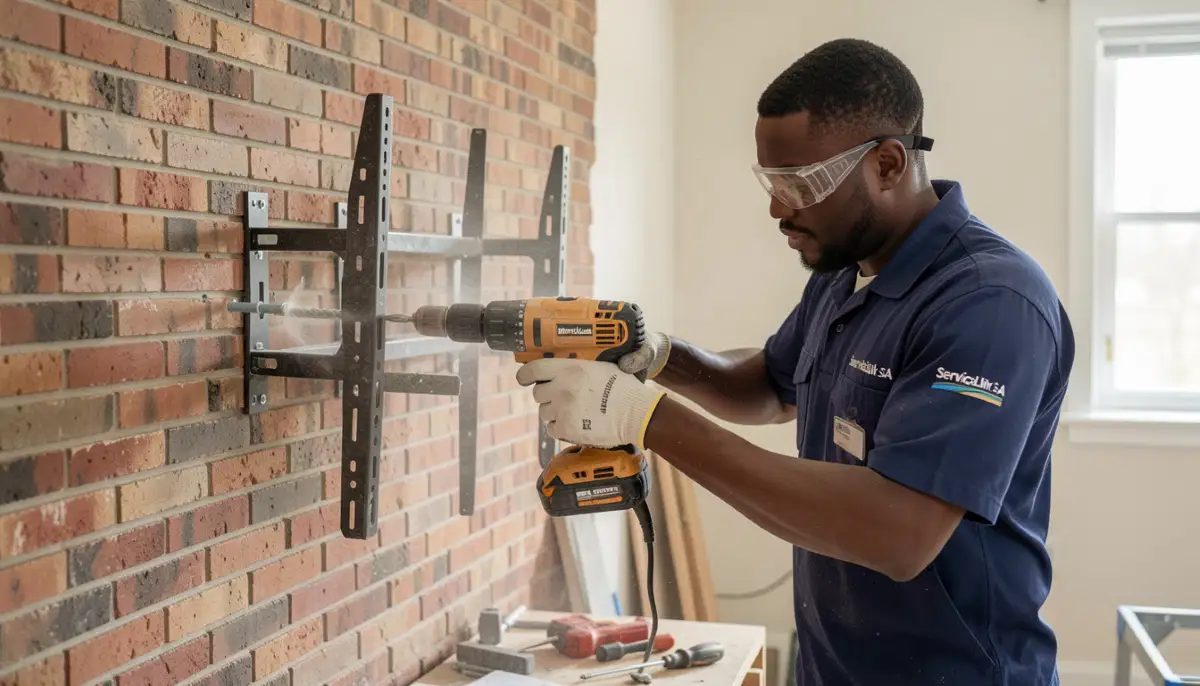
🧱 Brick Walls: The Gold Standard for TV Mounting
Most South African homes, especially in areas like Randburg and Bryanston, have brick walls (often plastered). This is the ideal surface.
- Fixings: Standard expanding wall plugs (masonry anchors) and masonry screws. The plug expands against the brick, creating a very strong hold.
- Weight capacity: Very high. A single M8 screw in a good brick wall can hold over 50kg in pull-out force. A TV bracket with 4 such screws is incredibly secure.
- Installation: Requires a hammer drill and masonry bit. Drill a hole, insert the plug, then screw in the bracket screw.
- Tip: Always drill into the brick, not the mortar between bricks. Mortar is softer and less reliable.
For most homes, brick is the safest and easiest option. See our cost guide for pricing on standard installations.
🏗️ Concrete Walls: Strong but Require More Effort
Concrete walls are common in newer buildings, apartments in Sandton, and some commercial spaces. They are extremely strong but harder to drill.
- Fixings: Similar to brick – expanding wall plugs designed for concrete, or sometimes concrete screws (which tap directly into a pre-drilled hole). Heavy-duty sleeve anchors may be needed for very heavy TVs.
- Weight capacity: Excellent. Concrete has very high pull-out resistance.
- Installation: Definitely requires a powerful hammer drill with a sharp masonry bit. Drilling into concrete is slower and more physically demanding than brick. You may hit aggregate (small stones) which can deflect the bit.
- Tip: Use a vacuum to clean dust from the hole before inserting the plug for maximum grip.
While concrete is strong, the difficulty of drilling means many DIYers prefer to hire a pro. Our TV mounting service includes concrete wall installations.
📄 Drywall / Plasterboard: The Challenge
Drywall (also called plasterboard or gypsum board) is common in modern internal walls, especially in Fourways estates and home renovations. It is not solid – it’s a thin layer of gypsum between paper faces, with a hollow cavity behind.
- The problem: Drywall itself is weak. You cannot simply screw into it – the screw will pull out.
- The solution: You must use special hollow wall anchors that spread the load across a wider area, or ideally, find the wooden studs behind the drywall.
- Weight limits: Even with the best anchors, drywall has limits. A standard toggle bolt might hold 20-30kg, but this depends on the drywall thickness and condition. For TVs over 15kg, it’s always better to mount into studs.
- Professional assessment: A professional will use a stud finder to locate studs. If none are in the right place, they may install a backing plate (a piece of plywood attached to studs, then the TV mounts to the plywood).
Drywall mounting requires expertise. See our safety tips for more.
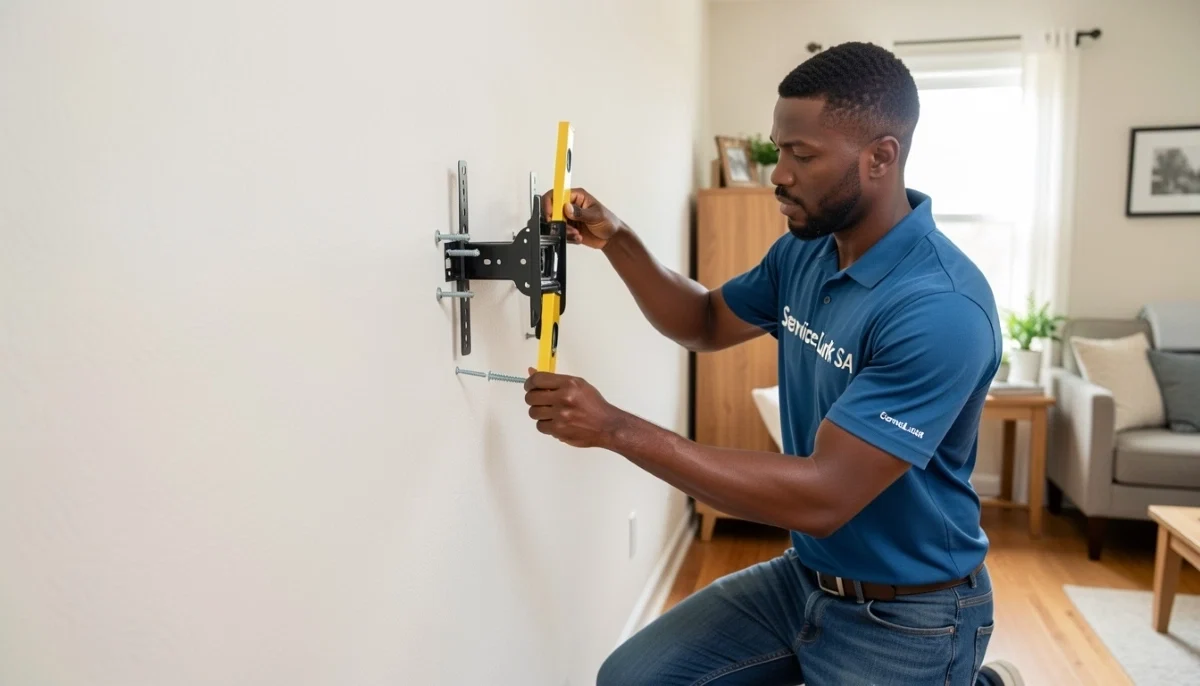
❓ Can You Mount a TV on Drywall Without Studs?
This is the most common question. The answer is: Yes, but only for lighter TVs and with the right anchors.
- When it’s possible: For small TVs (32″ or less, under 15kg), high-quality hollow wall anchors like snap toggles or metal self-drilling anchors can be sufficient. The toggle bolt weight limit for a single anchor might be 20kg, but you need to multiply by the number of anchors (usually 4). Always check the anchor’s rating.
- When it’s NOT recommended: For any TV over 15kg, or for a tilting or full-motion bracket (which puts more leverage on the wall), you MUST mount into studs. The leverage from an articulating arm can exert many times the TV’s weight on the fixings.
- The risk: A TV pulling out of drywall can cause serious injury and damage. Don’t take risks with heavy TVs.
If you’re unsure, a professional from our network can assess and advise.
📏 Using a Stud Finder Correctly
If you have drywall, finding studs is the safest approach. Here’s how to do it right.
- Choose a good stud finder: Electronic stud finders are best. They detect changes in density behind the wall. Some also detect live wires, which is a safety bonus.
- Calibrate: Place the finder on the wall where there’s no stud, hold down the button, and wait for calibration. Then move it slowly horizontally.
- Mark the edges: When it indicates a stud, mark the left and right edges. The centre is usually 19-25mm wide (standard stud).
- Verify: You can verify by tapping the wall – a solid sound indicates a stud, a hollow sound is empty cavity. Or drill a tiny pilot hole to confirm.
- Spacing: Studs are typically spaced 400mm or 600mm apart in South African construction. If you find one, measure 400mm to find the next.
Our free inspection includes professional stud finding and assessment.
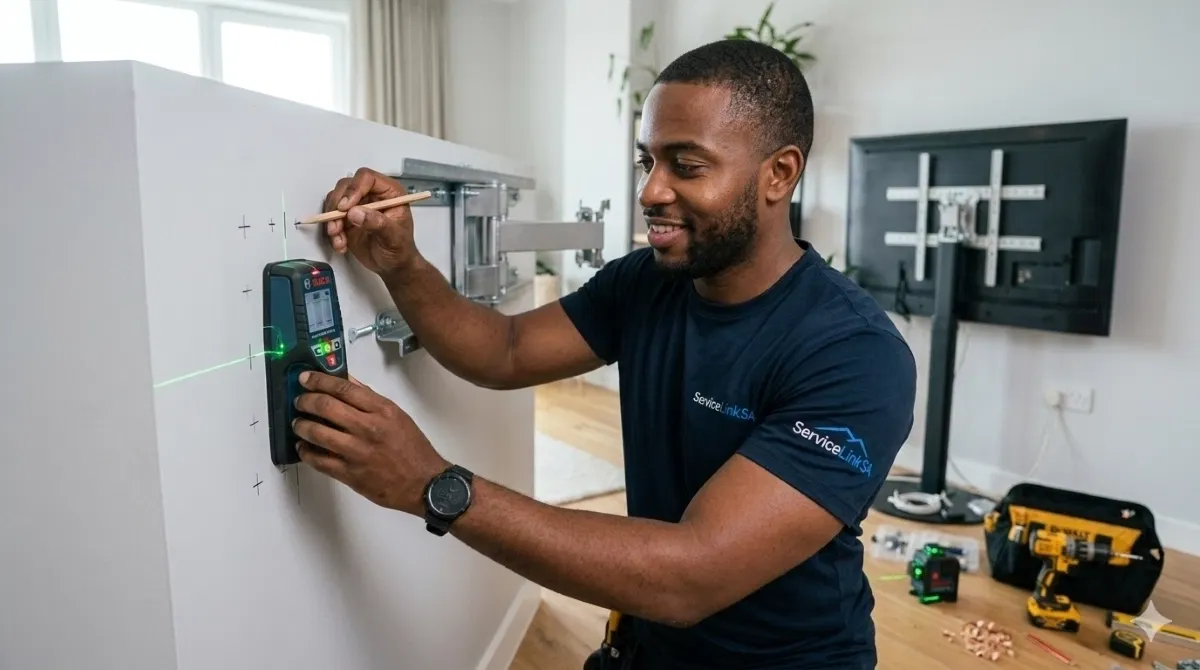
🔩 Hollow Wall Anchor Types & Weight Limits
If you must mount into drywall (and have confirmed it’s safe for your TV weight), here are the main anchor types.
- Toggle Bolts: A screw with spring-loaded wings that open behind the drywall. Very strong. Requires a larger hole. Weight limit per bolt: 10-25kg depending on size. Best for medium loads.
- Metal Self-Drilling Anchors (Molly Bolts): These screw into the drywall without a pre-drilled hole (or with a small pilot). They have sharp threads that cut into the board. Weight limit: 10-20kg. Good for medium loads.
- Plastic Expansion Anchors: The cheap ones that come with flat-pack furniture. These are NOT suitable for TV mounting. They pull out easily.
- Snap Toggles: Similar to toggle bolts but the wings are separate and snap into place. Very high weight ratings (up to 50kg per anchor for the largest size). The best choice for heavy TVs on drywall (if studs aren’t an option).
Always check the manufacturer’s stated pull-out force and ensure the combined rating of all anchors exceeds your TV and bracket weight by a safety factor of at least 4.
⚙️ Masonry Screws & Concrete Fixings
For brick and concrete, the fixings are simpler but must be chosen correctly.
- Wall plugs (Rawl plugs): The standard for brick. Nylon plugs expand when the screw is driven in, gripping the sides of the hole. Size matters – use the plug size recommended for your screw (e.g., M6 screw needs a 6mm plug and 6mm hole).
- Concrete screws (Tapcons): These are hardened screws that cut threads directly into a pre-drilled hole in concrete or brick. No plug needed. Very strong and convenient. Requires a specific drill bit size.
- Sleeve anchors: Heavy-duty metal anchors used for very heavy loads into concrete. Overkill for most TVs but used for commercial installations or very large screens.
- Quality matters: Use reputable brands. Cheap plugs can fail. Safix and similar suppliers offer certified fixings.
🛠️ Tools You’ll Need: Hammer Drill vs Normal Drill
The right tool for the wall type is essential.
- For brick and concrete: You MUST use a hammer drill (impact drill) with a masonry bit. The hammer action pounds the bit into the hard material. A normal drill will struggle and overheat. A corded hammer drill is best for multiple holes.
- For drywall (into studs): A normal drill with a wood bit is fine for pilot holes into the stud. For anchors into drywall only, you may need a drill bit sized for the anchor.
- Other essentials: Spirit level, tape measure, pencil, stud finder, vacuum for dust.
If you don’t own a hammer drill, hiring a professional for concrete walls is often cheaper than buying one.
⚖️ Weight Limits & Pull-Out Force Explained
Understanding these terms helps you choose safe fixings.
- Pull-out force: The amount of force (in kg or Newtons) required to pull the fixing straight out of the wall. This is the key figure for TV mounting, as the TV pulls away from the wall.
- Shear force: The force downwards on the fixing. Less critical for wall mounting as the bracket transfers most weight in shear to the screws.
- Safety factor: A good rule is that the total pull-out capacity of your fixings should be at least 4 times the weight of your TV and bracket. So for a 20kg TV, your fixings should be rated for 80kg total.
- Leverage: Full-motion brackets increase the force on fixings when the arm is extended. For these, an even higher safety factor is needed, and mounting into studs or solid masonry is essential.
🪵 Backing Plates for Problem Walls
Sometimes, the ideal mounting spot on drywall has no studs, and the TV is too heavy for anchors alone. A backing plate is the solution.
- What it is: A piece of 18mm or thicker plywood, cut to size and painted to match the wall. It’s securely screwed into the studs (spanning across the hollow area). The TV bracket is then screwed into the plywood.
- Why it works: The plywood distributes the TV’s weight across the studs, creating a rock-solid mounting point. It also gives you flexibility to position the bracket anywhere on the plate.
- Aesthetics: When painted to match the wall, a backing plate can look like a deliberate design feature, or it can be hidden behind the TV.
- Professional solution: This is a common technique used by professional installers for tricky drywall situations. It’s far safer than relying on anchors for a heavy TV.
❌ 8 Common Wall Fixing Mistakes
- Mistake #1: Using cheap plastic anchors in drywall for a heavy TV. They will fail. Use proper toggle bolts or, better, find studs.
- Mistake #2: Drilling into mortar instead of brick. Mortar is weaker and can crumble over time. Always drill into the brick itself.
- Mistake #3: Not using a hammer drill for concrete. You’ll burn out a normal drill and make little progress.
- Mistake #4: Ignoring the stud finder’s limitations. It can give false readings. Verify with a tiny pilot hole or tapping.
- Mistake #5: Over-tightening screws in drywall anchors. This can strip the anchor or crush the drywall. Tighten until snug, then stop.
- Mistake #6: Not checking what’s behind the wall. Drilling into a wall with electrical cables or pipes can be dangerous. Use a stud finder with wire detection.
- Mistake #7: Assuming all walls are the same. An old house might have lath and plaster, not drywall. A new estate might have lightweight concrete blocks. Identify first.
- Mistake #8: DIY-ing a complex drywall mount without proper knowledge. If in doubt, hire a professional. It’s cheaper than a new TV and a repaired wall. Check our contractor guide.
❓ Frequently Asked Questions
Can you mount a TV on drywall without studs?
Can you mount a TV on drywall without studs? Yes, for lighter TVs (under 15kg) using high-quality hollow wall anchors like toggle bolts. For heavier TVs, you must mount into studs or use a backing plate.
What is the toggle bolt weight limit for TV mounting?
The toggle bolt weight limit varies by size. A typical 3/16″ toggle bolt holds about 10-15kg in drywall. Larger 1/4″ toggles can hold 20-25kg. Always use multiple toggles (at least 4) and calculate total capacity.
Do I need a hammer drill for concrete TV mount?
Yes, a hammer drill for concrete TV mount is essential. Concrete is too hard for a standard drill. A hammer drill with a sharp masonry bit will make the job possible and safe.
What’s the best brick wall TV bracket installation method?
For brick wall TV bracket installation, drill a hole into the brick (not mortar) using a masonry bit, insert an expanding wall plug, then screw the bracket screw into the plug. Use a spirit level to keep the bracket straight.
What are masonry screws and when are they used?
Masonry screws (like Tapcons) are hardened screws that cut threads directly into a pre-drilled hole in brick or concrete. They are very strong and don’t need a wall plug. Ideal for concrete and hard brick.
How do I find studs behind drywall?
Use a good electronic stud finder. Calibrate it on the wall, then move it slowly horizontally. Mark the edges of the stud. You can also tap the wall – a solid sound indicates a stud. Drill a tiny pilot hole to confirm before committing.
What is pull-out force in wall fixings?
Pull-out force is the amount of force required to pull a fixing straight out of the wall. For TV mounting, you need fixings with high pull-out resistance to prevent the TV from falling forward.
Can I mount a TV on a cavity wall?
Yes, but you must use cavity fixing anchors designed for hollow walls, or preferably, find the studs or metal framework within the cavity. For heavy TVs, a backing plate attached to the studs is the safest method.
What’s the difference between a hammer drill and a normal drill?
A hammer drill has a hammering action that pounds the bit forward while it spins, allowing it to break up concrete and brick. A normal drill only spins, and will struggle or burn out on masonry.
Is it safe to mount a TV on a plasterboard wall?
It can be safe for smaller TVs using proper hollow wall anchors, but for larger TVs, you must mount into the wooden studs behind the plasterboard. Always check the weight rating of your anchors and the condition of the wall. See our safety tips.
✅ Final Thoughts – Your Wall Type Action Plan
Mounting a TV is not a one-size-fits-all job. The TV wall mounting on drywall vs brick vs concrete decision dictates your tools, fixings, and approach. A safe installation starts with correctly identifying your wall and using the right hardware for the job.
Key takeaways:
- Brick: The easiest and safest. Use expanding wall plugs into the brick itself.
- Concrete: Very strong but needs a hammer drill and masonry bits.
- Drywall: The most challenging. For heavy TVs, you MUST find studs. For lighter TVs, use high-quality toggle bolts, never cheap plastic anchors.
- Always check weight limits and use a safety factor of 4x.
- When in doubt, hire a professional. It’s cheaper than a broken TV.
Your 5-Step Action Plan
- Identify your wall type: Knock on it. Solid sound? Brick/concrete. Hollow sound? Drywall. Check with a stud finder.
- Weigh your TV: Check the manual for the exact weight, including the bracket.
- Choose the right fixings: Based on wall type and weight.
- Gather the right tools: Hammer drill for masonry, normal drill for drywall into studs.
- Get professional help if needed: For complex walls or heavy TVs, use our quote service to find a vetted installer.
Not Sure About Your Wall Type?
Get free, no-obligation quotes from vetted TV mounting specialists who can assess your wall and install your TV safely, no matter the material.
📞 Call us: 073 138 4726 for personalised assistance
Free site inspections •
Beat-your-quote guarantee •
Our guarantees
📚 Official resources & standards:
- CIDB – Structural fixing standards and contractor guidelines.
- Safix – Anchor and fastener supplier standards and technical data.
Information accurate as of publication. This guide is for informational purposes. For specific advice, consult a professional.
Written by: Innocent T Hanyani
21+ years construction and digital industry experience, ServiceLink SA
Innocent has specified fixings for thousands of installations across every wall type imaginable – from heritage homes with lath and plaster to modern concrete apartments. His expertise ensures this guide reflects real-world best practices for safe, secure TV mounting.
For more detailed information, explore our related guides: TV mounting costs to budget your project, our height guide for optimal positioning, our safety tips for preventing accidents, and our bracket types guide for choosing the right hardware. For help finding the right professional, see our contractor selection guide and ensure they have proper liability insurance. Our free inspection and beat-your-quote services are also available.