
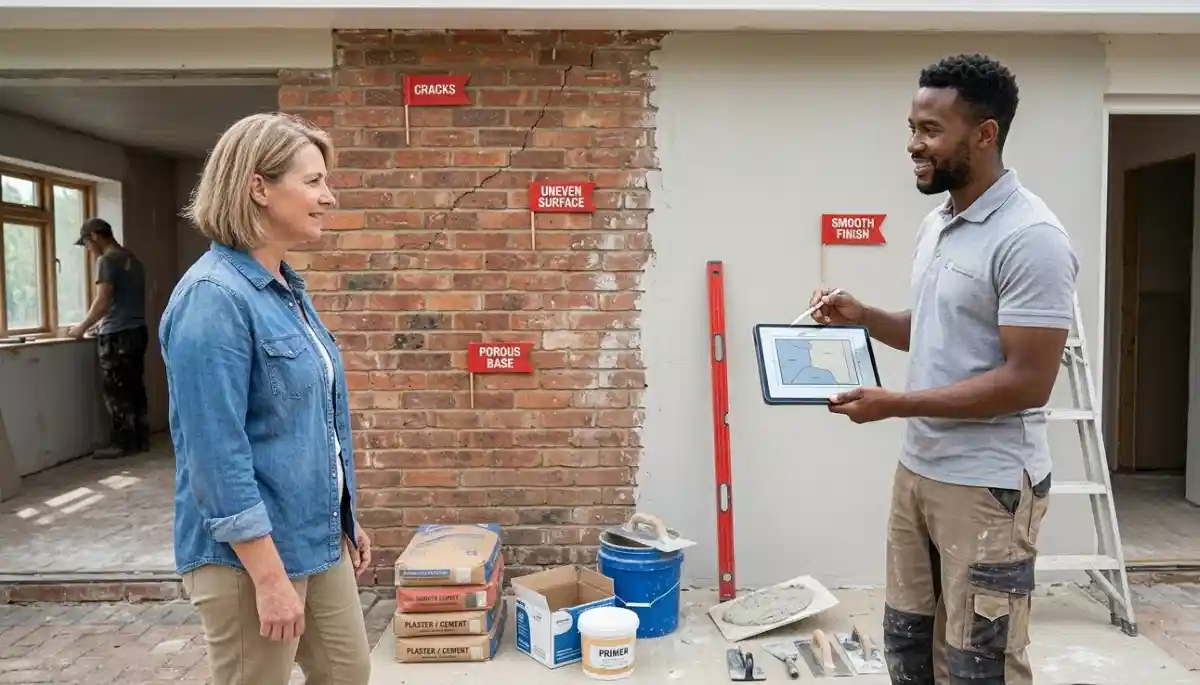
How to Choose a Reliable Plastering Contractor in South Africa – The Complete Guide
🧱 CIDB grading, NHBRC registration, red flags, and the essential questions to ask before you hire.
You’re ready to plaster your new home in Johannesburg or renovate a heritage property in Cape Town. The success of your entire project now rests on one crucial decision: who you hire to do the work. Finding a skilled, reliable, and honest professional can feel like searching for a needle in a haystack. Knowing how to choose reliable plastering contractor South Africa is the most important skill a homeowner can develop.
This guide provides you with a professional’s checklist for vetting plasterers. You’ll learn the essential questions to ask plasterer before hiring, from verifying their credentials to understanding their warranty. We explain the importance of official registrations like CIDB registered plasterers and NHBRC registered builders, and how to verify them. We provide a detailed plasterer qualifications checklist covering insurance, references, and written quotes. You’ll also learn to spot the common red flags when hiring plastering contractor, such as demands for full payment upfront or an inability to provide proof of insurance. We also share the “5 Tips For Hiring A Listed Contractor” from Cemcrete, which emphasise research, quotes, and approving a sample. Whether you’re looking for plastering company reviews in Durban or need to understand plasterer insurance requirements in Pretoria, this guide ensures you hire with confidence.
If you’re ready to connect with vetted, qualified plasterers, explore our Services Overview or visit our Plastering Services page to find trusted professionals near you. For more on how we work, see How It Works.
Find a Vetted Plastering Contractor
Get free, no-obligation quotes from insured, verified plasterers in your area. Compare and hire with confidence.
Find Plastering Experts Near Me
Servicing Johannesburg, Pretoria, Cape Town, Durban, and nationwide
📋 Table of Contents – Contractor Selection Guide
⚠️ Why Your Choice of Plastering Contractor Matters
Plastering is often seen as a finishing trade, but its quality has a massive impact on your home’s appearance, durability, and value. A poor plastering job can lead to a cascade of problems.
- Aesthetics: Uneven walls, visible trowel marks, and poor corners ruin the look of a room, no matter how good the paint job is.
- Durability: Incorrect mix ratios, lack of curing, and poor substrate preparation lead to cracking, delamination, and plaster falling off the wall within months.
- Paint failure: As we’ve covered in our preparation guide, paint over poorly prepared plaster will peel and blister.
- Property value: A shoddy plastering job can significantly reduce the value of your home and make it harder to sell.
- Costly rectification: Fixing bad plastering is expensive and messy. It’s far cheaper to do it right the first time with a skilled contractor.
Read more about our approach on About Us or see why clients choose us on Benefits.
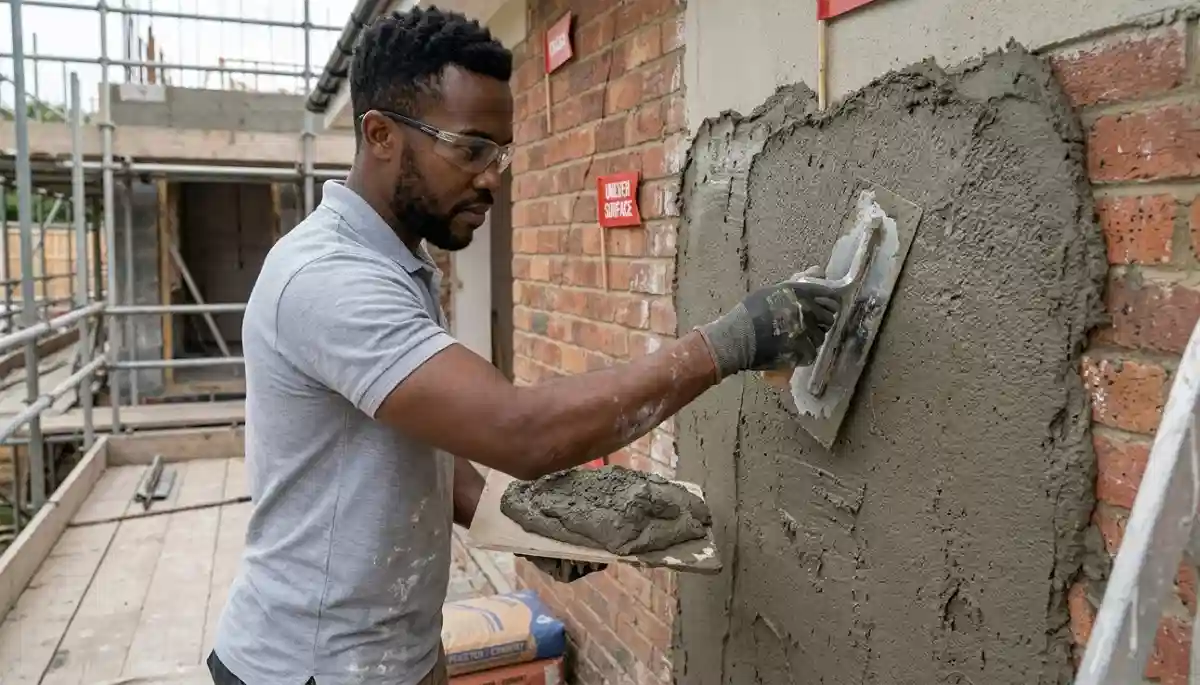
📜 Credentials: CIDB, NHBRC & Accreditations
Legitimate, professional contractors will have verifiable credentials. These are your first line of defence against cowboys.
- CIDB Grading: The Construction Industry Development Board (CIDB) registers contractors and grades them based on their capability and financial status. A CIDB grade (e.g., 1, 2, etc.) is a reliable indicator of a legitimate business. You can verify any contractor’s CIDB registration online for free. This is crucial for CIDB registered plasterers.
- NHBRC Registration: If your project is a new home, the contractor must be registered with the National Home Builders Registration Council (NHBRC). This provides you with consumer protection and ensures the home meets minimum standards. The NHBRC also has specifications for plastering.
- Manufacturer Accreditations: For specialist finishes (like Cemcrete or Weber), using a manufacturer-approved applicator is often required to validate the product warranty. These contractors have been trained in the correct application of those specific materials.
- Master Builders Affiliation: Membership in an association like Master Builders South Africa indicates a commitment to industry standards and ethics.
🛡️ Insurance: Public Liability & COID
This is non-negotiable. Do not let anyone work on your property without proof of these two insurances.
- Public Liability Insurance: This covers damage to your property. If a plasterer accidentally drops a scaffold pole through your window, their insurance pays for it. Ask for a current certificate of insurance. Minimum cover should be R1 million.
- COID (Compensation for Occupational Injuries and Diseases): This is a government fund that compensates workers injured on the job. If a worker is injured on your property and the contractor does not have a valid COID letter, YOU could be held liable for their medical expenses and lost wages. This is a massive financial risk. Always ask for their COID letter.
See our detailed page on contractor’s liability insurance for more.
❓ 10 Essential Questions to Ask Before Hiring
Put these on your list. A reputable plasterer will be happy to answer them.
- Are you registered with the CIDB? Ask for their registration number so you can verify it.
- Can you provide proof of public liability insurance and COID? Ask for certificates.
- Are you an approved applicator for any plaster brands? (e.g., Weber, Cemcrete).
- Can you provide a detailed written quote? Verbal quotes are worthless.
- Will you do a site inspection before quoting? A professional will want to see the job in person.
- Can you provide references from recent, similar projects? Ask for contact details and photos.
- What is your process for preparing the walls? They should mention cleaning, priming, and using bonding agents if needed. See our preparation guide.
- What is included in the price? Materials? Labour? Waste removal? Preparation? Waterproofing?
- What workmanship warranty do you offer? Typically 1-3 years is standard.
- What is your payment schedule? A small deposit (10-20%) is normal, with progress payments and final payment on completion.
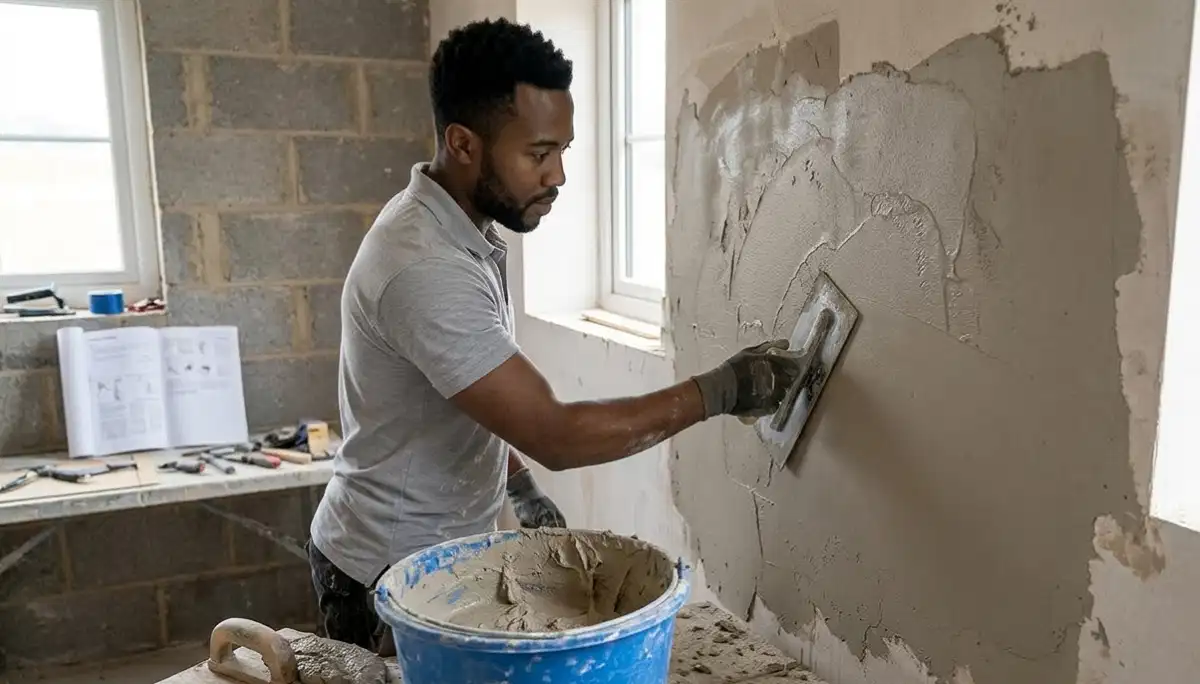
✅ Contractor Selection Checklist
Use this table as your quick reference when evaluating potential plasterers.
| Criteria | What to Check | Why It Matters |
|---|---|---|
| Registration | CIDB grading (1-9); NHBRC registration (for new homes) | Legal requirement; verified competency; consumer protection |
| Accreditation | Manufacturer-approved applicator (Weber, Cemcrete, etc.) | Product warranty validity; trained in correct application |
| Insurance | Public liability; COID (Workman’s Compensation) | You are not liable if worker is injured or property damaged |
| Warranty | Minimum 1-3 years workmanship; manufacturer warranties | Protection against premature failure |
| References | 3 recent clients with similar projects; photo portfolio | Proven track record; quality verification |
| Online Reviews | Google, Facebook, HelloPeter, Trust Pilot | 4+ star rating with minimum 10 reviews; read comments |
| Written Quote | Itemised: labour, materials, prep, waterproofing, VAT | Prevents hidden charges; clear scope |
| Site Visit | Contractor measures BEFORE quoting | Accurate pricing; identifies unknown issues |
| Contract | Payment schedule; start/completion dates; materials spec | Legal protection; project timeline |
| Safety & Security | Permanent employees; reputation; vetting | Protection against theft, hijacking |
🎨 5 Tips For Hiring a Listed Contractor – Cemcrete
Cemcrete, a leading manufacturer of decorative finishes, offers excellent advice for homeowners looking to hire a specialist contractor. Their “5 Tips For Hiring A Listed Contractor” are invaluable.
- FIND A CONTRACTOR: Submit your project details via the manufacturer’s website to receive a list of approved contractors for your area. Alternatively, a sales representative may contact you.
- DO RESEARCH: Use the manufacturer’s website and social media (Facebook, Instagram, Pinterest) to find photographs and get an idea of the desired finish. Contact the manufacturer or visit a showroom for product selection advice.
- GET QUOTES: Always get more than one quote. Compare them thoroughly. Check each contractor’s references and examples of past work.
- SEAL THE DEAL: Sign a contract between yourself and the contractor. No verbal agreements. Remember: each contractor has their own style – this carries through to the final finish.
- APPROVE THE SAMPLE: Request an on-site sample(s) from the contractor for final approval BEFORE commencing work. Ensure you are happy with the colour and sealing method.
🚩 Red Flags When Hiring a Plastering Contractor
Trust your instincts. If you encounter any of these, walk away and find another contractor.
- ❌ Refusal to provide CIDB/NHBRC number: They are either not registered or hiding something. You cannot verify their legitimacy.
- ❌ No physical business address: A cellphone-only operator is a major risk. They can disappear if problems arise.
- ❌ Requests full payment upfront: Industry standard is a small deposit (10-20%) with progress payments and final payment on completion. Full payment upfront is a scam tactic.
- ❌ Cannot provide manufacturer warranty documents: If they claim to be an approved applicator, they should have documentation. If not, they may not be accredited, which could void your product warranty.
- ❌ No demo or portfolio: They cannot show you examples of their work. This hides poor workmanship.
- ❌ Quote significantly lower than competitors: This is a classic sign that corners will be cut on materials, preparation, or labour.
- ❌ Vague about prep work: Preparation is 70% of successful plastering. If they gloss over it, they don’t understand its importance. See our preparation guide.
As one industry source notes: “Many cheaper contractors in the casual sector that you may pick up outside of a Builders Warehouse or similar will tell you they are a ‘jack of all trades’ but in reality, these guys are sadly desperate for work and will try to convince you that they have extensive experience when in truth they are purely desperate for work.”

📝 Plastering Warranty Requirements
Understanding what kind of warranty to expect protects you from latent defects.
- Workmanship Warranty: A reputable contractor should offer a warranty on their workmanship, typically for 1 to 3 years. This covers issues arising from poor installation, such as delamination or excessive cracking.
- Manufacturer’s Warranty: If you use specific products (like Weber or Cemcrete finishes), there may be a separate manufacturer’s warranty. This often requires that the product was applied by an approved applicator. Ask the contractor for these details.
- Latent Defects: The NHBRC provides a 5-year warranty for structural defects in new homes. Plaster cracking caused by structural movement may be covered under this.
- Get it in writing: The warranty terms should be clearly stated in your contract. Don’t rely on verbal promises.
🎨 The Importance of a Sample
For any decorative or coloured finish, a sample is not a luxury – it’s a necessity.
- What Cemcrete advises: “Request on-site sample(s) from contractor for final approval BEFORE commencing work. Ensure you are happy with colour and sealing method.”
- Why it’s crucial: Colours and textures look different on a small sample card than on a large wall. The lighting in your home, the texture of the underlying plaster, and the contractor’s technique all affect the final look.
- The process: Ask the contractor to prepare a sample panel (at least 1m x 1m) on a less visible part of the wall or on a portable board. Approve this sample before they proceed with the rest of the work.
📞 Checking References & Reviews
Don’t skip this step. It’s your best insight into what it’s like to work with the contractor.
- Ask for recent references: Request contact details for clients who had similar work done in the last 6-12 months.
- What to ask references:
- Was the crew punctual and professional?
- Did they clean up thoroughly each day?
- Was the project completed on time and on budget?
- How did they handle any unexpected issues?
- Would you hire them again?
- Check online reviews: Look at Google, Facebook, and HelloPeter. Look for patterns – a few negative reviews among many positive ones are normal, but a string of complaints about the same issue is a red flag.
❌ 8 Common Hiring Mistakes
- Mistake #1: Choosing based on price alone. The cheapest quote is often from an uninsured, unskilled operator. The long-term cost of fixing their mistakes will be far higher.
- Mistake #2: Not checking insurance and COID. This is the most common and costly error. You could be liable for injuries or damages.
- Mistake #3: Accepting a verbal quote. Verbal agreements are impossible to enforce. Get everything in writing.
- Mistake #4: Not getting a site inspection. A quote over the phone is a guess. A professional will always want to see the job.
- Mistake #5: Ignoring red flags. If something feels off (cash only, high pressure), trust your gut.
- Mistake #6: Not checking references. A quick call can save you from a nightmare.
- Mistake #7: Not having a contract. A contract protects both you and the contractor. Never start work without one.
- Mistake #8: Assuming plastering is “low-skill”. Quality plastering requires significant expertise. Poor plastering leads to cracking, delamination, aesthetic defects, and reduced property value. Invest in quality.
❓ Frequently Asked Questions
How do I choose a reliable plastering contractor in South Africa?
To choose reliable plastering contractor South Africa, verify their CIDB registration, check insurance (public liability and COID), ask for references, get multiple written quotes, and watch for red flags like demands for full payment upfront.
What questions should I ask a plasterer before hiring?
Questions to ask plasterer before hiring include: Are you CIDB registered? Can I see proof of insurance? Will you provide a written quote? Can I see examples of your past work? What warranty do you offer?
What is CIDB grading and why is it important?
CIDB registered plasterers are contractors registered with the Construction Industry Development Board. Their grading indicates their capability and financial standing. It’s a mark of a legitimate, professional business.
What insurance should a plastering contractor have?
Plasterer insurance requirements include public liability insurance (to cover damage to your property) and COID (Workman’s Compensation) to cover worker injuries. Ask for certificates for both.
What are the red flags when hiring a plastering contractor?
Red flags when hiring plastering contractor include: no CIDB number, no physical address, demands for full payment upfront, no portfolio, and a quote that’s significantly lower than others.
What is a normal payment schedule for a plastering job?
A normal payment schedule is a small deposit (10-20%) to secure the date and cover materials, followed by progress payments, and the final payment only upon completion and your satisfaction.
How long should a plastering warranty be?
Plastering warranty requirements South Africa – a workmanship warranty of 1-3 years is standard. For new homes, the NHBRC provides a 5-year structural warranty that may cover plaster cracking from structural movement.
How can I verify a plasterer’s credentials in Johannesburg?
To how to verify plasterer credentials in Johannesburg, ask for their CIDB number and verify it online at cidb.org.za. Check for NHBRC registration if it’s a new build. Ask for references and check online reviews.
Why is a sample important before starting work?
For decorative finishes, an on-site sample allows you to approve the colour, texture, and finish before the full job begins. It ensures you are happy with the result and avoids disputes later.
Where can I find plastering company reviews?
Plastering company reviews can be found on Google, Facebook, and HelloPeter. Look for a pattern of positive feedback and see how the company responds to any negative comments.
✅ Final Thoughts – Your Contractor Selection Action Plan
Choosing the right plasterer is not a decision to rush. It’s an investment in your property and your peace of mind. By taking the time to verify credentials, check insurance, ask the right questions, and get everything in writing, you set your project up for success.
Key takeaways:
- Always verify CIDB registration and insurance.
- Get at least three detailed, written quotes based on a site inspection.
- Use our checklist and ask the 10 essential questions.
- Watch for red flags and trust your instincts.
- For specialist finishes, follow the “5 Tips” from Cemcrete: research, get quotes, sign a contract, and approve a sample.
- Remember: quality plastering is not a low-skill trade. Invest in quality.
Your 5-Step Action Plan
- Define your scope: What work needs to be done? New plaster, repair, or a decorative finish?
- Research potential contractors: Use our quote request, manufacturer lists, and personal recommendations.
- Get multiple quotes: Invite at least three contractors for a site inspection and written quote.
- Verify and compare: Use our checklist to vet each contractor’s credentials, insurance, and references. Compare quotes carefully.
- Sign a contract and approve a sample: Once you’ve chosen, get a signed contract and, for decorative work, approve a sample before work begins.
Ready to Hire a Reliable Plasterer?
Get free, no-obligation quotes from vetted, insured, and experienced plastering contractors in your area. Compare and hire with confidence.
📞 Call us: 073 138 4726 for personalised assistance
Free site inspections •
Beat-your-quote guarantee •
Our guarantees
📚 Official resources & standards:
- CIDB – Contractor grading verification and Register of Contractors.
- NHBRC – Home builder registration and consumer protection.
- Master Builders South Africa – Accredited contractor listings.
- Cemcrete – 5 Tips For Hiring A Listed Contractor.
- Construction Safety – Contractor selection, safety, and references.
- LocalPros – Vetted plastering professionals.
- HelloPeter – South African contractor reviews.
Information accurate as of publication. This guide is for informational purposes. For specific advice, consult a professional.
Written by: Innocent T Hanyani
21+ years construction and digital industry experience, ServiceLink SA
Innocent has spent decades vetting contractors and managing construction projects across South Africa. He has seen firsthand the difference between professional, insured plasterers and dangerous cowboys. This guide distills that experience into practical advice for homeowners.
For more detailed information, explore our related guides: plastering costs to understand pricing, our common mistakes guide to know what to look out for, our preparation guide to understand what proper prep involves, and our contractor guide for general advice. Our guarantees and dispute resolution pages are also relevant. Free inspections and beat-your-quote services are available. Pay-later options can help with budgeting. See our service areas page for coverage in your region.