How to Choose a Tree Felling Company in South Africa – The Complete Vetting Guide
🌳 Credentials, insurance, safety, and red flags: everything you need to find a reliable arborist.
You have a large, dangerous tree in your Sandton garden that needs to come down. You’ve seen the ads, and a few guys with a bakkie and a chainsaw have knocked on your door offering a “cash price.” But how do you separate the true professionals from the risky cowboys? Knowing how to choose tree felling company South Africa wisely is the most important step in ensuring the job is done safely, legally, and without leaving you liable for damages or injuries.
This guide is your ultimate resource for vetting tree care companies. We build on our hiring guide with an even deeper dive into the credentials and practices that define a reliable arborist. You’ll learn about formal tree service accreditation, such as certification through the South African Arborist Association (ISAA) and what it means for you. We cover the importance of a documented quote and a clear contract, and we explain the value of a formal arbitration process should something go wrong. We’ll help you spot the red flags when hiring a tree feller – the signs that you should run the other way. We also explain terms like chain of custody for wood disposal and how to verify a company’s safety compliance through bodies like NOSA. Whether you need a tree felling company near me with insurance in Johannesburg, Pretoria, Durban, or Cape Town, this guide ensures you hire the best tree removal company for the job.
If you’re ready to connect with vetted, qualified arborists, explore our Services Overview or visit our Tree Services page to find trusted professionals near you. For more on how we work, see How It Works.
Find a Vetted Tree Felling Company
Get free, no-obligation quotes from insured, accredited arborists in your area. Compare and choose with confidence.
Servicing Johannesburg, Pretoria, Cape Town, Durban, and nationwide
📋 Table of Contents – Choosing a Tree Felling Company
⚠️ Why Your Choice of Tree Felling Company Matters
Tree felling is one of the most dangerous professions. A mistake can lead to property damage, serious injury, or even death. Beyond the immediate danger, an unprofessional company can leave you with legal and financial liabilities.
- Safety: A professional company follows strict safety protocols, uses proper equipment, and has trained staff. This protects your property and everyone on site.
- Liability: If an uninsured worker is injured on your property, you could be held liable for medical costs and lost wages. A reputable company has its own insurance.
- Quality of work: A proper job includes safe felling, thorough clean-up, and leaving your property tidy. Cowboys often leave a mess.
- Legal compliance: Professionals know about permit requirements and will advise you accordingly. They won’t put you at risk of fines.
- Peace of mind: Hiring a vetted, reputable company means you can relax, knowing the job will be done right.
Read more about our approach on our About Us page or see why clients choose us on our Benefits page.
📜 Tree Service Accreditation & Certifications
Formal accreditation is the hallmark of a professional. It shows the company invests in training and adheres to industry standards.
- ISAA Certification: The Institute of South African Arboriculture (ISAA) is the leading body for arboriculture in South Africa. They offer different levels of certification for arborists, recognising competence in tree climbing, pruning, and safety. Look for companies that employ ISAA-certified arborists.
- Why it matters: Certification means the arborist has passed exams and demonstrated practical skills. They are more likely to understand tree biology and proper techniques, especially for complex pruning or removals near structures.
- Other certifications: Some companies may have certifications from international bodies like the International Society of Arboriculture (ISA) or local training providers. Ask about their qualifications.
🛡️ Insurance: Public Liability & COID
This is the absolute non-negotiable. Do not let anyone work on your property without verifying these two documents.
- Public Liability Insurance: This covers damage to your property (e.g., a falling tree damages your roof or a branch breaks a window). Ask for a current certificate of insurance. The minimum cover should be R1 million, but R5 million is becoming standard for reputable companies. See our page on contractor’s liability insurance.
- COID (Compensation for Occupational Injuries and Diseases): This is a South African government fund that provides compensation to workers injured on the job. If a worker is injured on your property and the company does not have a valid COID letter, YOU could be held personally liable for their medical expenses and lost wages. This is a massive financial risk. Always ask for their COID letter.
- Ask for copies: A reputable company will happily provide copies of both certificates. If they hesitate or make excuses, walk away.
🦺 Safety Compliance & NOSA
A commitment to safety is a sign of a professional operation. Look for evidence of a safety culture.
- Safety audits: Some larger companies undergo independent safety audits by bodies like NOSA (National Occupational Safety Association). A NOSKA-rated company has demonstrated a high level of safety management.
- Safe working procedures: Ask about their safety protocols. How do they ensure the safety of their crew and your property? A professional company will have a health and safety plan.
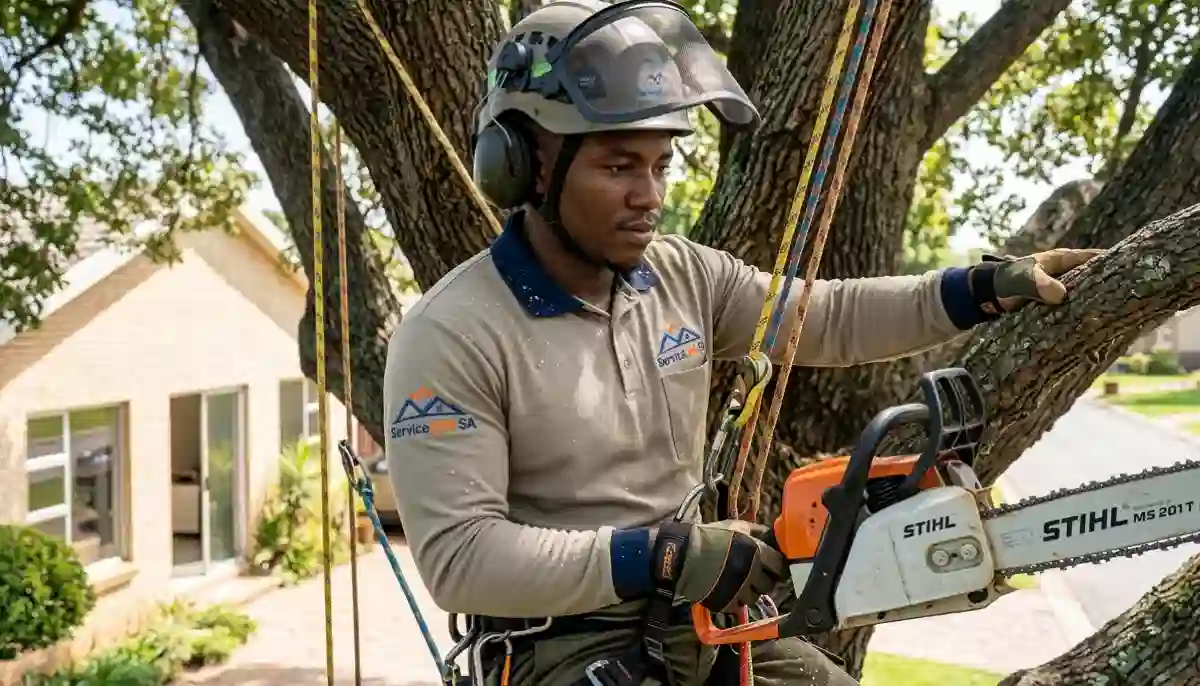
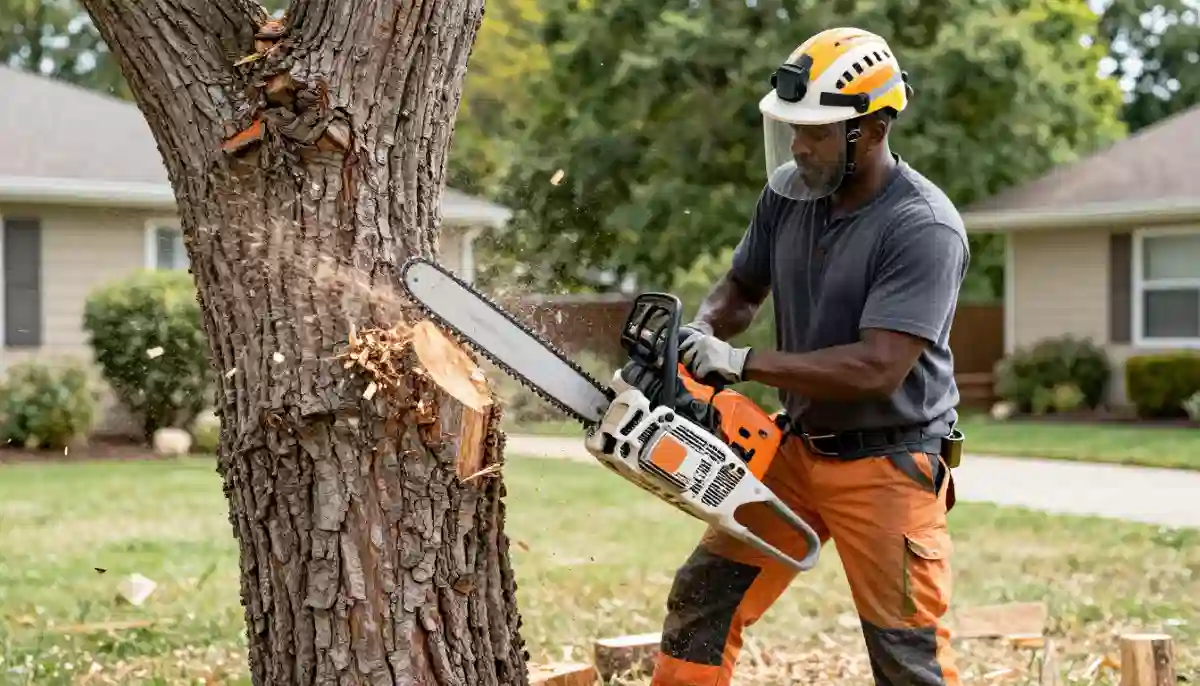
- PPE (Personal Protective Equipment): As shown in our image, all crew members should wear appropriate PPE: helmets, visors, ear defenders, chainsaw-proof trousers, and safety boots. If the crew on site lacks this, it’s a major red flag.
- Tool maintenance: Professional companies keep their equipment in good working order, which is also a safety consideration.
📝 The Importance of a Documented Quote
A verbal agreement is not worth the paper it’s not written on. A detailed, written quote protects both you and the contractor.
- What a documented quote should include:
- Company name, contact details, and physical address.
- A clear description of the work to be done (e.g., “Fell one gum tree, remove all branches and trunk, grind stump to 20cm below ground”).
- The total price, including a breakdown if helpful (labour, equipment, debris removal).
- A list of exclusions (e.g., stump grinding, permit fees).
- Payment terms (deposit required, when final payment is due).
- A validity period for the quote (e.g., “valid for 30 days”).
- Any warranties on workmanship.
- Why it matters: A documented quote prevents misunderstandings and disputes. If a disagreement arises later, you have a written record of what was agreed. It’s also evidence of a professional operation.
📸 References & Portfolio Review
A reputable company will be proud of their past work and happy to provide references.
- Ask for recent references: Request contact details for clients who had similar work done in the last 6-12 months. Call them. Ask about punctuality, cleanliness, communication, and if there were any unexpected costs.
- Check online reviews: Look at Google, HelloPeter, and our own reviews page. Look for patterns, not just one-off complaints.
- Portfolio: Many companies have before-and-after photos on their website or social media. This gives you an idea of the quality of their work and the types of jobs they handle.
🚩 Red Flags When Hiring a Tree Feller
Trust your instincts. If you encounter any of these, find another company.
- Red flag #1: No proof of insurance or COID. This is the biggest one. If they can’t produce it, they don’t have it.
- Red flag #2: “Cash only” and a very low price. They are likely uninsured and unskilled, and you’ll have no recourse if something goes wrong.
- Red flag #3: High-pressure sales tactics. “I can do it today for half price if you pay now.” Genuine professionals don’t pressure you.
- Red flag #4: No site inspection. A quote over the phone is a guess, often leading to extra charges later.
- Red flag #5: Vague or verbal quotes. “Don’t worry, I’ll sort it out.” Get it in writing.
- Red flag #6: Refusal to provide references. They should have happy customers to vouch for them.
- Red flag #7: Unmarked vehicles or no signage. Not a deal-breaker alone, but combined with others, it’s suspicious.
- Red flag #8: Lack of PPE on crew. If they’re not wearing safety gear, they don’t take safety seriously.
- Red flag #9: Asks you to get the permit. A reputable company will advise on permits and may help with the process. A cowboy won’t care.
- Red flag #10: Poor communication. If they’re hard to reach before the job, it will be worse after.
⚖️ Arbitration Process & Dispute Resolution
Even with the best planning, disputes can sometimes arise. A professional company will have a clear process for handling them.
- Contracts: A well-written contract should include a clause on dispute resolution. This might involve mediation or arbitration.
- Arbitration process: Arbitration is a form of dispute resolution outside of court, where an independent third party makes a binding decision. It’s often faster and cheaper than going to court.
- Industry bodies: If the company is a member of an industry body like ISAA, they may have a code of conduct and a dispute resolution mechanism you can access.
- Our approach: We have a clear dispute resolution procedure for any issues arising from work booked through our platform.
🌲 Chain of Custody for Removed Wood
This is a more niche consideration, but it matters, especially for large volumes of wood from protected species or in conservation areas.
- What it is: Chain of custody refers to the documentation that tracks wood from its origin (your property) to its final destination (e.g., a sawmill, firewood processor, or landfill).
- Why it matters: For protected species, you may need to prove that the wood was legally removed and disposed of. For invasive species, proper disposal is required to prevent spread. A professional company will have a system for tracking this.
- Ask about it: If you have a large volume of wood, especially from a protected tree, ask the company how they dispose of it and if they can provide documentation.
🌐 SA Arborist Association (ISAA)
The Institute of South African Arboriculture (ISAA) is the key industry body. Membership or certification through ISAA is a strong indicator of professionalism.
- What ISAA does: ISAA promotes professional standards, provides training and certification, and advocates for the arboriculture industry.
- Benefits of hiring an ISAA-affiliated company:
- Access to certified arborists with proven knowledge and skills.
- Adherence to a code of ethics and professional conduct.
- Commitment to ongoing education and best practices.
- How to find them: The ISAA website (trees.org.za) has a directory of certified arborists and member companies.
🏢 Commercial vs Residential: What’s Different
If you’re hiring a tree service for a business, complex, or large-scale project, the requirements are even higher.
- Higher insurance limits: Commercial projects often require higher public liability cover (e.g., R5 million or R10 million).
- CIDB grading: For large or government contracts, the company may need a specific CIDB (Construction Industry Development Board) grade.
- Health and safety files: Commercial sites usually require a full health and safety plan and file.
- Project management: A commercial tree service should have project management capabilities to handle scheduling, multiple crews, and coordination with other trades.
- Our commercial tree services page has more details.

❌ 7 Common Mistakes When Choosing a Tree Feller
- Mistake #1: Choosing based on price alone. The cheapest quote is often from an uninsured operator. The potential liability cost far outweighs the savings.
- Mistake #2: Not checking insurance and COID. This is the most common and costly error. Always verify both.
- Mistake #3: Accepting a verbal quote. Verbal agreements are impossible to enforce. Get everything in writing.
- Mistake #4: Hiring before checking for permits. Removing a protected tree without a permit can lead to massive fines. A good company will advise you.
- Mistake #5: Not asking about debris removal. You could be left with a massive pile of branches and wood. Clarify what’s included.
- Mistake #6: Ignoring red flags. If something feels off (cash only, high pressure), trust your gut and walk away.
- Mistake #7: Not getting multiple quotes. At least three quotes give you a good idea of the market rate and help you spot outliers. Use our quote request to get multiple easily.
❓ Frequently Asked Questions
How do I choose a tree felling company in South Africa?
To choose tree felling company South Africa, verify their insurance (public liability and COID), check for accreditation (e.g., ISAA), get a detailed written quote, ask for references, and watch for red flags like cash-only deals. See our full guide above.
What insurance should a tree felling company have?
They must have public liability insurance (at least R1 million cover) and be registered with the Compensation Fund (COID compliance). Ask for copies of both certificates.
What is ISAA certification?
ISAA certification is from the Institute of South African Arboriculture. It means the arborist has proven knowledge and skills in tree care. Hiring an ISAA-certified professional is a mark of quality.
What are red flags when hiring a tree feller?
Red flags when hiring a tree feller include: no proof of insurance, cash-only deals, no site inspection, verbal quotes, pressure to decide immediately, no PPE, and inability to provide references.
How can I find a tree felling company near me with insurance?
Use our free quote service to connect with vetted, insured tree services in your area. You can also check the ISAA website for certified arborists near you.
What is a documented quote and why is it important?
A documented quote is a written estimate detailing the scope of work, price, and terms. It’s crucial for preventing misunderstandings and provides a record if a dispute arises.
What is the arbitration process for tree service disputes?
The arbitration process is a formal method of dispute resolution outside of court. A professional tree service may have this outlined in their contract. See our dispute resolution procedure for an example.
What is NOSA safety compliance?
NOSA is an independent safety auditing body. A company with NOSA compliance has demonstrated a high level of safety management. It’s a strong indicator of a professional operation.
What is chain of custody for tree removal?
Chain of custody refers to the documentation tracking removed wood from your property to its final disposal. It’s important for protected species or large volumes to ensure legal disposal.
What is the best tree removal company in my area?
The best tree removal company for you is one that is properly insured, accredited, has good references, and provides a fair, detailed quote. Use our service to compare multiple vetted companies in your area.
✅ Final Thoughts – Your Company Selection Action Plan
Choosing the right tree felling company is an investment in safety, property protection, and peace of mind. By taking the time to vet potential contractors thoroughly – checking their credentials, insurance, and references – you ensure a successful, stress-free outcome.
Key takeaways:
- Always verify public liability insurance and COID compliance. This is non-negotiable.
- Look for tree service accreditation (e.g., ISAA certification) as a mark of professionalism.
- Get a detailed documented quote based on a site inspection.
- Watch for red flags and trust your instincts.
- Check references and online reviews.
- Consider the company’s approach to safety and dispute resolution.
Your 5-Step Action Plan
- Identify your needs: What work needs to be done? Felling, pruning, emergency? See our removal signs guide.
- Research potential companies: Use our service or the ISAA website to find candidates.
- Get multiple quotes: Invite at least three companies for a site inspection and written quote.
- Verify credentials: Check insurance, COID, accreditation, and references before making a decision.
- Get a signed contract: Ensure all details are in writing before work starts.
Ready to Hire a Reliable Tree Felling Company?
Get free, no-obligation quotes from vetted, insured, and accredited arborists in your area. Compare and choose with confidence.
📞 Call us: 073 138 4726 for personalised assistance
Our guarantees •
Beat-your-quote guarantee •
Insurance requirements
📚 Official resources & standards:
- Institute of South African Arboriculture (ISAA) – Find certified arborists and industry standards.
- Forestry Protection Initiative (FPI) – Information on sustainable forestry and tree care.
- NOSA – Safety compliance and auditing standards.
Information accurate as of publication. This guide is for informational purposes. For specific advice, consult a professional.
Written by: Innocent T Hanyani
21+ years construction and digital industry experience, ServiceLink SA
Innocent has spent decades vetting contractors across multiple industries, including tree services. He has seen firsthand the difference between professional, insured arborists and dangerous cowboys. This guide distills that experience into practical advice for homeowners.
For more detailed information, explore our related guides: hiring a tree felling service for a deeper dive into the process, our cost guide to understand pricing, our removal signs guide to know if a tree needs to go, and our permits guide for legal compliance. For urgent situations, see our emergency removal page. Our contractor guide and guarantees pages also provide valuable background. Beat-your-quote and free inspections are also available.