
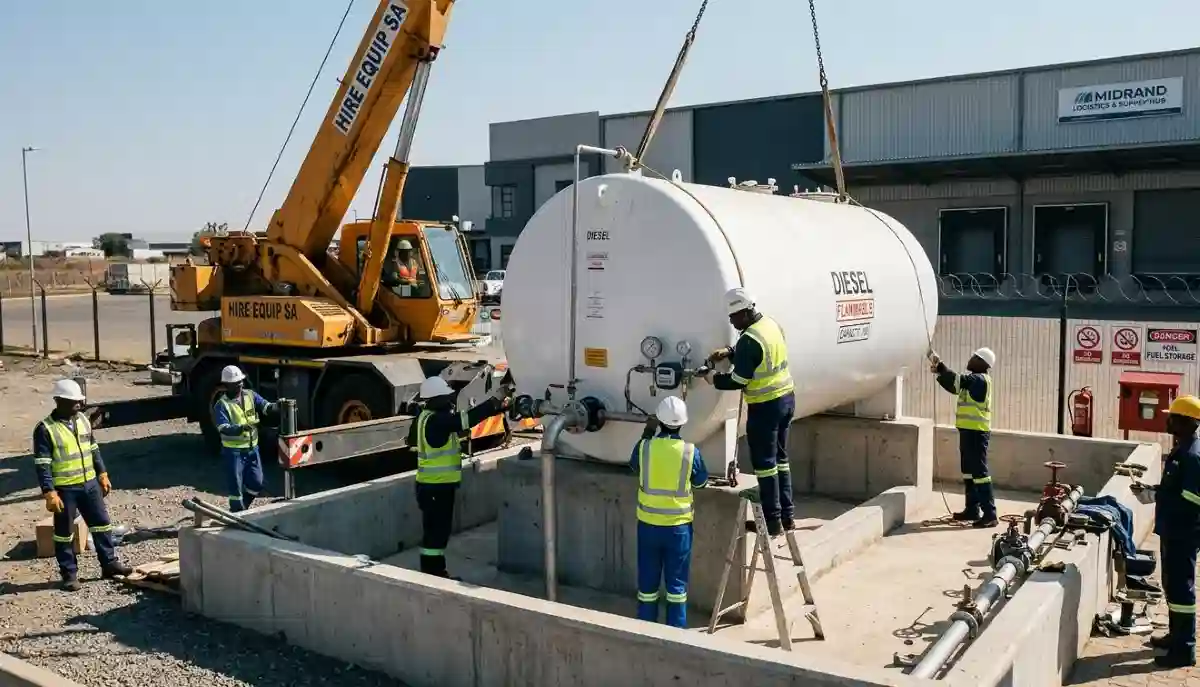
Need a Farm Fuel Storage Solution?
ServiceLink SA connects you with verified tank installers specialising in agricultural diesel storage. Get free quotes today. If we can’t assist directly, we’ll connect you with our trusted partner companies to carry out your fuel storage projects professionally and timeously.
Servicing Mpumalanga, Free State, North West, Western Cape, Gauteng, and across South Africa’s farming regions
Diesel Storage Tanks for Farms: Agricultural Fuel Solutions
🚜 From small single-tank setups to large-scale farm storage—your complete guide to agricultural diesel tanks
I once visited a grain farm in the Free State during harvest season. The farmer had three combines running 18 hours a day, pushing to beat incoming rains. His entire operation depended on a single 5,000-litre diesel tank that was rusted, leaking, and hadn’t been inspected in years. When the tank developed a leak during peak harvest, he lost not only thousands of litres of diesel but also three full days of harvesting while waiting for a replacement.
“I should have invested in proper diesel storage tanks for farms years ago,” he told me. That single failure cost him over R1.5 million in spoiled crops and emergency fuel purchases.
For South African farmers, farm fuel tanks are not optional—they’re essential infrastructure. Without reliable agricultural diesel storage, you risk running out of fuel during critical planting and harvest windows, contaminating expensive equipment, and failing environmental compliance.
This comprehensive equipment guide covers everything you need to know about diesel storage tanks for farms, including above ground diesel tanks for farms, farm storage best practices, agricultural tank selection, compliance with SABS standards, and maintenance requirements. For more on farm fuel supply, read bulk fuel for farms and agriculture.
Ready to secure your farm’s fuel future? Let’s dive in.
📋 Table of Contents – Farm Diesel Tank Guide
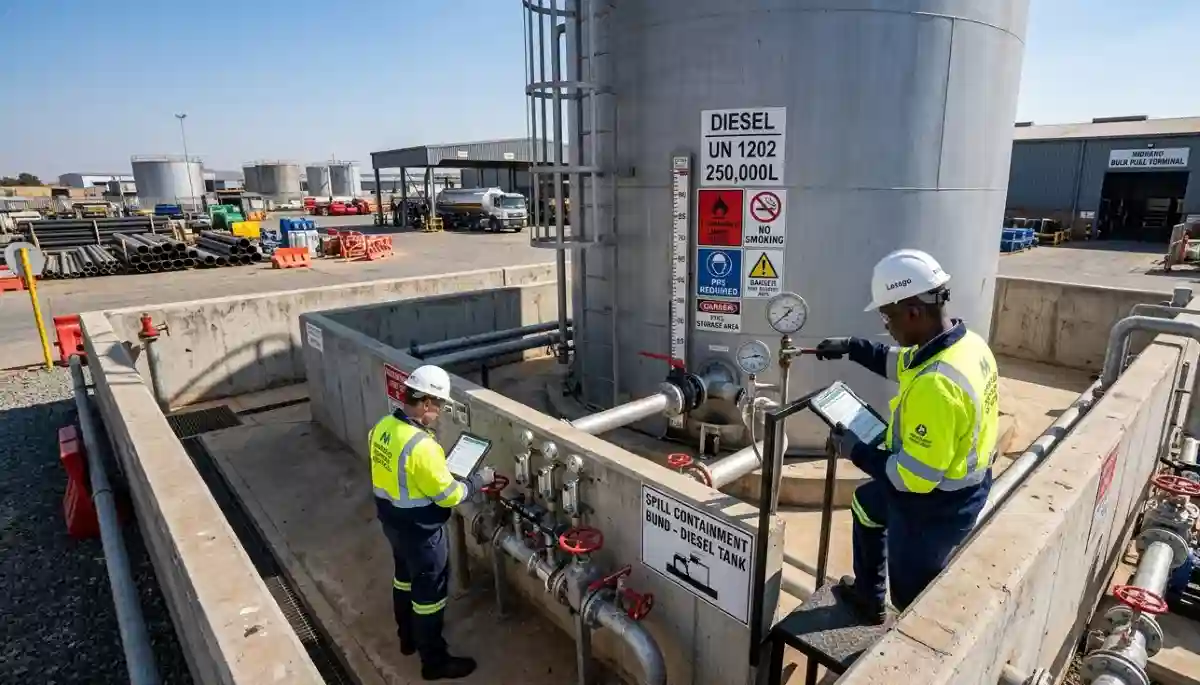
⚠️ Why On-Farm Diesel Storage Matters
For South African farmers, diesel storage tanks for farms are essential infrastructure, not optional extras. Here’s why:
⚠️ The Cost of Inadequate Farm Fuel Storage
A single day without diesel during harvest can cost a medium-sized grain farm R50,000-R200,000+ in spoiled crops. A week without diesel can destroy an entire season’s profit. Proper agricultural diesel storage is insurance against catastrophic downtime.
Why every farm needs dedicated fuel storage:
- No nearby fuel stations: Many rural farms are 50-150km from the nearest town. Driving equipment to town for fuel wastes hours daily.
- Seasonal urgency: Planting and harvest windows are tight. You cannot afford to waste time fetching fuel.
- Volume requirements: Large tractors and combines consume 30-50 L/hour. A single day of harvesting can use 500-1,000L per machine.
- Cost savings: Buying in bulk (5,000-50,000L) saves 15-25% compared to retail fuel station prices.
- Rebate documentation: Proper storage enables accurate record-keeping for diesel rebate claims.
- Emergency preparedness: Load shedding and supply disruptions don’t stop your farm from operating.
Consequences of poor farm fuel storage:
- Water contamination: Condensation in poorly sealed tanks damages injectors (R20,000-R100,000+ repair costs).
- Microbial growth (diesel bug): Clogs filters and damages fuel systems.
- Theft: Unsecured tanks are vulnerable to fuel theft, especially in remote areas.
- Environmental fines: Leaking tanks without bunding violate DFFE regulations.
- Compliance failures: Non-compliant tanks can result in fines and loss of rebate eligibility.
- Supply interruption: Running out of fuel during critical operations causes crop losses.
Typical farm fuel consumption by operation type:
| Farm Type | Peak Season Monthly Consumption | Off-Season Monthly Consumption | Recommended Storage Capacity |
|---|---|---|---|
| Small mixed farm (<100ha) | 5,000-10,000L | 1,000-3,000L | 5,000-10,000L |
| Medium grain farm (100-500ha) | 15,000-30,000L | 3,000-8,000L | 15,000-30,000L |
| Large grain farm (500-2,000ha) | 40,000-80,000L | 8,000-15,000L | 40,000-80,000L |
| Irrigation farm | 20,000-50,000L (dry season) | 5,000-10,000L | 30,000-60,000L |
| Livestock farm | 5,000-15,000L | 3,000-10,000L | 10,000-20,000L |
For more on farm fuel needs, read bulk fuel for farms and agriculture.
🏭 Types of Farm Fuel Tanks
Agricultural diesel storage comes in several configurations:
Single-wall above-ground tanks:
- Capacity: 1,000L – 50,000L
- Material: Steel or polyethylene
- Pros: Lower cost, widely available
- Cons: Requires separate bunding for spill containment
- Best for: Farms with space for bunded area, budget-conscious installations
Double-skinned (bunded) tanks:
- Capacity: 1,000L – 30,000L
- Material: Steel with integrated secondary containment
- Pros: Built-in spill containment (no separate bunding required), complies with SABS standards
- Cons: Higher upfront cost
- Best for: Most farms (recommended)
Polyethylene (plastic) tanks:
- Capacity: 500L – 10,000L
- Material: UV-stabilised polyethylene
- Pros: Lightweight, corrosion-resistant, lower cost
- Cons: Less durable than steel, UV degradation over time
- Best for: Small farms, temporary storage, generator fuel
Mobile farm bowsers:
- Capacity: 500L – 3,000L
- Material: Steel or polyethylene on trailer
- Pros: Portable, can be towed to equipment in fields
- Cons: Smaller capacity, requires towing vehicle
- Best for: Refuelling equipment in distant fields, supplementing main storage
Comparison of farm tank types:
| Tank Type | Capacity Range | Pros | Cons | Typical Cost Range |
|---|---|---|---|---|
| Single-wall steel | 1,000-50,000L | Lower cost, durable | Requires separate bunding | R15,000-R80,000 |
| Double-skinned steel | 1,000-30,000L | Built-in bunding, SABS compliant | Higher upfront cost | R25,000-R120,000 |
| Polyethylene | 500-10,000L | Lightweight, corrosion-resistant | UV degradation, less durable | R5,000-R30,000 |
| Mobile bowser | 500-3,000L | Portable, field refuelling | Small capacity, requires towing | R20,000-R60,000 |
For more on tank selection, read fuel tank installation.
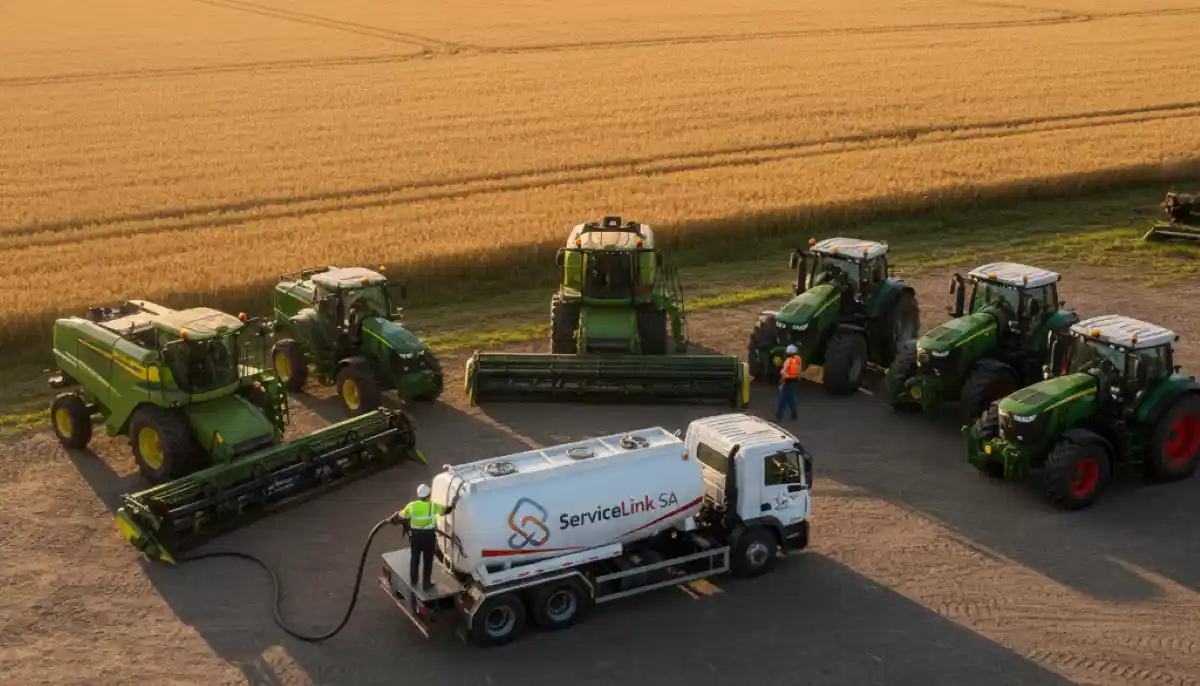
🏗️ Above Ground Diesel Tanks for Farms
Above ground diesel tanks for farms are the most common choice for agricultural storage:
Why above ground tanks are preferred for farms:
- Easy inspection: Visible leaks and damage can be spotted quickly
- Lower installation cost: No excavation required
- Accessible for deliveries: Tanker drivers can easily access and fill
- Mobile if needed: Can be relocated if farm layout changes
- Simpler maintenance: Easy to access for cleaning and repairs
Key features to look for in farm above-ground tanks:
- Double-skinned or bunded: Integrated secondary containment (highly recommended)
- Lockable dispensing system: Prevents theft and unauthorised access
- Level gauge: Easy visual check of fuel level
- Water drain valve: Allows draining condensation from tank bottom
- Vent with flame arrestor: Prevents fire from entering tank
- Overfill protection: Alerts when tank is nearing full
- Hazchem signage: Proper warning labels for safety and compliance
Popular above-ground tank sizes for farms:
- 5,000L: Suitable for small farms or as a secondary tank
- 10,000L: Most popular size for medium farms
- 15,000L: Good for larger operations
- 20,000L: Suitable for large grain or irrigation farms
- 30,000-50,000L: For very large farms or co-operative storage
Positioning above-ground tanks on your farm:
- Place on level, stable, well-drained ground
- Position away from buildings, livestock areas, and water sources (minimum 10-15 metres)
- Ensure clear access for delivery tankers (adequate turning radius)
- Locate in well-lit area with security visibility
- Consider proximity to equipment storage (minimise refuelling travel distance)
- Avoid low-lying areas where water collects (flood risk)
For more on tank positioning, read commercial fuel storage tanks.
📏 Tank Sizing Guide for Farms
Choosing the right size for your diesel storage tanks for farms is critical:
Step 1: Calculate your peak daily consumption
List all diesel-powered equipment and estimate hours of operation during peak season (planting or harvest).
Example calculation for a grain farm during harvest:
- 2 combines @ 40 L/hour × 16 hours = 1,280 L/day
- 2 tractors (grain carts) @ 25 L/hour × 16 hours = 800 L/day
- 2 tractors (hauling) @ 20 L/hour × 16 hours = 640 L/day
- 1 grain dryer @ 15 L/hour × 16 hours = 240 L/day
- Total daily consumption: 2,960 L/day
Step 2: Determine desired days of autonomy
How many days of fuel storage do you need? Recommended minimums:
- Planting season: 7-10 days
- Harvest season: 10-14 days
- Irrigation season: 14-21 days
- Off-season: 30-60 days (can use smaller tank, more frequent deliveries)
Step 3: Calculate required tank size
Required Capacity = Peak Daily Consumption × Desired Days of Autonomy × 1.2 (buffer)
Example for harvest season:
2,960 L/day × 10 days × 1.2 = 35,520 L required capacity → recommend 40,000L tank (or multiple tanks)
Tank sizing recommendations by farm type:
| Farm Type | Peak Daily Consumption | Recommended Tank Size | Notes |
|---|---|---|---|
| Small mixed farm | 500-1,000L | 5,000-10,000L | 5-10 days autonomy |
| Medium grain farm | 1,500-3,000L | 15,000-30,000L | 10-14 days autonomy |
| Large grain farm | 3,000-6,000L | 40,000-80,000L | 10-14 days autonomy, may need multiple tanks |
| Irrigation farm | 2,000-5,000L | 30,000-60,000L | 14-21 days autonomy (critical) |
| Livestock farm | 300-800L | 5,000-15,000L | 10-14 days autonomy |
Multiple tank strategy:
Many farms use multiple smaller tanks rather than one large tank:
- Pros: Redundancy (if one tank fails, others still work), easier to manage, can dedicate tanks to specific equipment types
- Cons: Higher installation cost, more space required
For more on storage planning, read bulk diesel storage regulations.
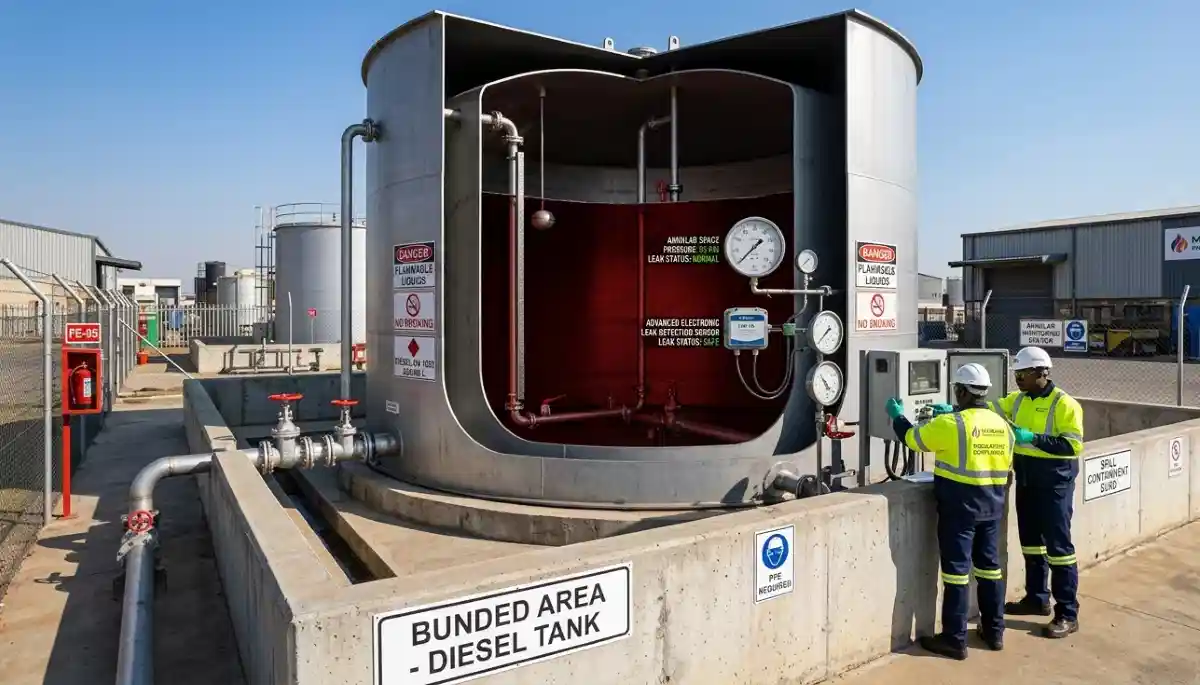
Ready to Install Proper Farm Fuel Storage?
ServiceLink SA connects you with verified tank installers specialising in agricultural diesel storage. Get free quotes today. If we can’t assist directly, we’ll connect you with our trusted partner companies to carry out your fuel storage projects professionally and timeously.
Above ground diesel tanks for farms—find certified installers serving your farming region.
📋 SABS Farm Storage Standards
Farm fuel tanks must comply with SABS standards for safety and legality. See SABS – Farm storage standards.
SANS 10089-3 key requirements:
- Tank construction: Must be designed and manufactured to SABS specifications
- Secondary containment: Bunding or double-skinned construction required
- Capacity requirements: Bunding must hold 110% of tank capacity
- Materials: Suitable for diesel storage (corrosion-resistant)
- Markings: Tank must display capacity, manufacturer, and date of manufacture
- Venting: Proper venting with flame arrestor required
- Access: Safe access for filling and inspection
Compliance checklist for farm tanks:
- ✅ Tank certified to SANS 10089-3
- ✅ Secondary containment (bunding or double-skinned) at 110% capacity
- ✅ Proper venting with flame arrestor
- ✅ Lockable dispensing system
- ✅ Hazchem signage clearly displayed
- ✅ Fire extinguisher within easy access
- ✅ Spill kit available
- ✅ Regular inspections documented
Consequences of non-compliance:
- Fines from DFFE and local authorities
- Invalidated insurance (if tank causes damage)
- Potential loss of diesel rebate eligibility
- Environmental damage liability
- Legal action from neighbours or authorities
For more on standards, read bulk diesel storage regulations.
🌿 Environmental Compliance for Farm Storage
Agricultural fuel storage must comply with DFFE environmental regulations. See DFFE – Environmental compliance.
Key environmental requirements:
- Spill containment: Bunding or double-skinned tank at 110% capacity
- Location restrictions: Tanks must be away from water sources, wetlands, and flood zones
- Spill response plan: Documented procedures for fuel spills
- Spill kit: Equipment to contain and clean up spills
- Regular inspections: Monthly visual inspections, annual professional inspections
- Record keeping: Inspection logs, delivery records, maintenance records
- Reporting: Spills must be reported to DFFE
DALRRD agricultural storage regulations:
The Department of Agriculture, Land Reform and Rural Development also regulates farm fuel storage. See DALRRD – Agricultural storage regulations.
Key DALRRD requirements:
- Registration of storage facilities over certain capacity thresholds
- Compliance with farm safety standards
- Record keeping for agricultural inputs
- Inspections by agricultural officers
Best practices for environmental compliance:
- Install tanks on impervious surface (concrete) within bunded area
- Conduct weekly visual inspections for leaks
- Keep spill kit accessible and staff trained in use
- Test bunding integrity annually (fill with water to check for leaks)
- Document all inspections and maintenance
- Train farm staff on spill response procedures
For more on environmental compliance, read bulk diesel storage regulations.
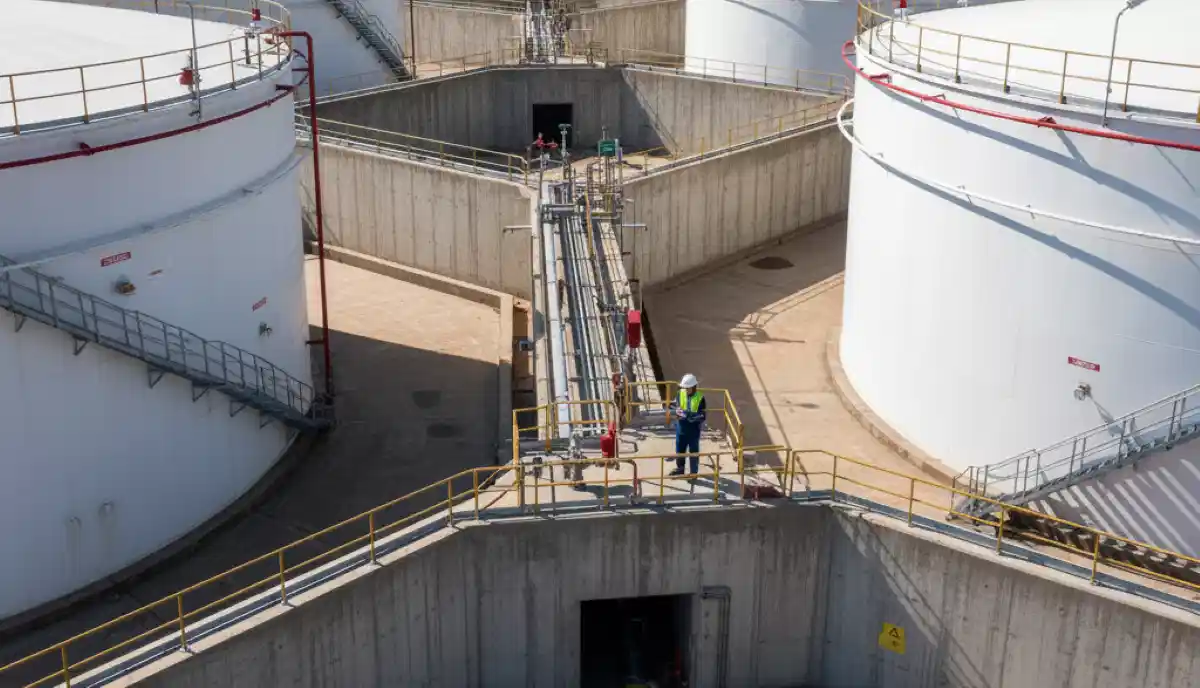
🔧 Installation Best Practices
Professional installation of diesel storage tanks for farms is essential for safety and compliance:
Site preparation:
- Level, stable ground (concrete pad recommended)
- Adequate drainage away from tank area
- Clear access for delivery tankers (minimum 3-4 metres width, adequate turning radius)
- Distance from buildings, livestock, water sources (minimum 10-15 metres)
- Security lighting and visibility
Tank installation steps:
- Prepare concrete foundation or compacted gravel base
- Position tank on foundation (ensure level)
- Install bunding (if separate bunding used)
- Connect dispensing system (pump, hose, nozzle)
- Install level gauge and overfill protection
- Install vent with flame arrestor
- Install lockable dispensing cabinet or lock on pump
- Apply hazchem and safety signage
- Position fire extinguisher and spill kit
- Conduct fill test (check for leaks)
- Schedule first delivery and inspection
Common installation mistakes to avoid:
- ❌ Installing on unstable or uneven ground
- ❌ Forgetting bunding or inadequate bunding capacity
- ❌ No overfill protection (risk of spill during delivery)
- ❌ Inaccessible for delivery tankers (tight turns, low clearance)
- ❌ Poor security (unlocked dispensing, no lighting)
- ❌ No fire extinguisher or spill kit
- ❌ Missing hazchem signage
Do I need a professional installer?
Yes, for tanks over 5,000L or any permanent installation. Professional installers ensure compliance with SABS standards, proper grounding, and correct safety equipment. DIY installation risks leaks, fines, and invalidated insurance.
For more on installation, read fuel tank installation.
🛠️ Maintenance and Fuel Quality
Regular maintenance of agricultural tank systems ensures fuel quality and equipment protection:
Weekly maintenance tasks:
- Visual inspection for leaks, damage, or corrosion
- Check level gauge accuracy
- Inspect hoses and nozzles for cracks or wear
- Check lock functionality
- Verify fire extinguisher pressure
Monthly maintenance tasks:
- Drain water from tank bottom (open drain valve until clear diesel flows)
- Inspect bunding for cracks, holes, or water accumulation
- Check vent and flame arrestor for blockages
- Test spill kit completeness
- Inspect security lighting and cameras
Quarterly maintenance tasks:
- Fuel quality testing (water content, microbial growth, particulate contamination)
- Clean or replace fuel filters
- Inspect tank interior for sludge (if accessible)
- Test pump accuracy (meter calibration check)
Annual maintenance tasks:
- Professional tank inspection (structural integrity)
- Bunding integrity test (fill with water, check for leaks)
- Full fuel quality laboratory analysis
- Professional tank cleaning if sludge present
- Recalibrate meter (if used)
- Update inspection records
Fuel quality preservation tips:
- Use fuel within 6-12 months: Diesel degrades over time
- Rotate stock: Use oldest fuel first (first-in, first-out)
- Add biocides: Prevent microbial growth (diesel bug) in long-term storage
- Keep tanks full: Reduces condensation and water accumulation
- Use filtration: Install filter on dispensing system
- Test regularly: Quarterly fuel quality testing
Signs of fuel contamination:
- Cloudy or hazy appearance
- Bad smell (rancid, sulphur-like)
- Black sludge in filters or tank bottom
- Water droplets in fuel sample
- Engine performance issues (hard starting, smoking, power loss)
- Frequent filter clogs
For more on maintenance, read fuel tank cleaning and maintenance.
💰 Cost Breakdown for Farm Tanks
Understanding the costs of farm fuel tanks helps you budget effectively:
Typical cost components:
| Component | Typical Cost Range | Notes |
|---|---|---|
| 5,000L double-skinned tank | R25,000-R40,000 | Includes bunding, basic fittings |
| 10,000L double-skinned tank | R40,000-R60,000 | Most popular size |
| 20,000L double-skinned tank | R70,000-R100,000 | For larger farms |
| 30,000L double-skinned tank | R100,000-R150,000 | Large-scale storage |
| Concrete foundation | R5,000-R15,000 | Depends on size and ground conditions |
| Professional installation | R5,000-R15,000 | Labour and setup |
| Dispensing pump (electric) | R3,000-R8,000 | High-flow for tractors |
| Dispensing pump (manual) | R1,500-R3,000 | Lower flow, no power needed |
| Lockable dispensing cabinet | R2,000-R5,000 | Theft prevention |
| Hazchem signage | R500-R1,500 | Required for compliance |
| Fire extinguisher (9kg) | R800-R1,500 | Required near tank |
| Spill kit | R1,000-R3,000 | Environmental compliance |
| Total (10,000L tank installed) | R55,000-R95,000 | Fully installed and compliant |
Return on investment calculation:
For a farm using 30,000L monthly:
- Retail price: R23.00/L = R690,000 monthly
- Wholesale price with storage: R18.50/L = R555,000 monthly
- Monthly saving: R135,000
- Tank investment: R80,000
- Payback period: Less than 1 month
For more on cost savings, read bulk diesel vs retail diesel price.
❓ Frequently Asked Questions About Farm Diesel Tanks
What size diesel storage tank do I need for my farm?
Diesel storage tanks for farms should be sized for peak season consumption × desired days of autonomy × 1.2 buffer. Example: 3,000 L/day × 10 days × 1.2 = 36,000L. Most medium farms choose 10,000-20,000L tanks; large farms may need 30,000-80,000L.
What are the SABS requirements for farm fuel tanks?
Farm fuel tanks must comply with SANS 10089-3: secondary containment (bunding at 110% capacity), proper venting with flame arrestor, lockable dispensing, hazchem signage, and regular inspections. Double-skinned (bunded) tanks are recommended for automatic compliance.
What are above ground diesel tanks for farms made of?
Above ground diesel tanks for farms are typically steel (most durable) or polyethylene (lighter, corrosion-resistant). Steel double-skinned tanks are the most popular choice for permanent farm installations due to durability and integrated spill containment.
How much does a farm diesel tank cost?
A 10,000L double-skinned agricultural tank costs R40,000-R60,000. With installation, foundation, pump, signage, fire extinguisher, and spill kit, total installed cost is R55,000-R95,000. Larger tanks (20,000-30,000L) cost R70,000-R150,000 installed.
How do I prevent diesel contamination in farm storage?
Prevent contamination through: weekly water draining (condensation), quarterly fuel testing, biocide additives for long-term storage, filtration on dispensing system, keeping tanks full to reduce condensation, and regular professional tank cleaning (every 3-5 years).
Do I need a permit for a farm fuel tank?
Permit requirements vary by capacity and location. Tanks over 10,000L typically require DFFE environmental authorization and municipal permits. Some municipalities require permits for any tank. Consult your local authority and use a professional installer who knows local requirements.
How often should I clean my farm diesel tank?
Farm storage tanks should be professionally cleaned every 3-5 years or when sludge is detected. Signs cleaning is needed: frequent filter clogs, engine performance issues, visible sludge in tank bottom, or cloudy fuel. Read fuel tank cleaning and maintenance for details.
What environmental regulations apply to farm fuel storage?
Farm fuel storage must comply with DFFE environmental regulations: spill containment (bunding at 110% capacity), spill response plan, spill kit on-site, regular inspections, and spill reporting. See DFFE – Environmental compliance for complete requirements.
✅ Final Thoughts: Invest in Proper Farm Fuel Storage
Diesel storage tanks for farms are essential infrastructure that protects your operations, equipment, and profitability. The right tank ensures you never run out of fuel during critical planting and harvest windows, protects your expensive equipment from contaminated fuel, and keeps you compliant with environmental regulations.
Key takeaways from this guide:
- Diesel storage tanks for farms are essential for reliable fuel supply during peak seasons
- Farm fuel tanks should be sized for peak consumption × desired autonomy days
- Above ground diesel tanks for farms are the most common and practical choice
- Double-skinned (bunded) tanks are recommended for built-in spill containment
- Agricultural diesel storage must comply with SABS standards (SANS 10089-3)
- DFFE environmental regulations require spill containment and response plans
- Regular maintenance prevents fuel contamination and equipment damage
- Professional installation ensures compliance and safety
- Return on investment is rapid (often less than 1 month through fuel savings)
- ServiceLink SA connects you with verified tank installers specialising in agricultural tank solutions
Your action plan: Calculate your peak daily fuel consumption. Determine desired days of autonomy (10-14 days for harvest). Get quotes from multiple verified tank installers. Choose a double-skinned SABS-compliant tank. Ensure professional installation with proper bunding and safety equipment. Implement regular maintenance and fuel quality testing. Enjoy reliable, cost-effective farm fuel storage.
Ready to Install Proper Farm Fuel Storage?
ServiceLink SA connects you with verified tank installers specialising in agricultural diesel storage. Get free quotes today. If we can’t assist directly, we’ll connect you with our trusted partner companies to carry out your fuel storage projects professionally and timeously.
📞 Call us: 073 138 4726 for immediate help finding farm tank installers near you.
Fuel Tank Installation •
Diesel Delivery •
Emergency Fuel Delivery •
Tank Cleaning & Maintenance •
Fuel Management Systems
📚 Official resources & standards referenced:
- SABS – South African Bureau of Standards – Farm storage standards (SANS 10089-3) and tank certification.
- DALRRD – Department of Agriculture, Land Reform and Rural Development – Agricultural storage regulations and farm compliance.
- DFFE – Department of Forestry, Fisheries and the Environment – Environmental compliance for farm fuel storage.
- DMRE – Department of Mineral Resources and Energy – Fuel storage licensing and regulations.
Information provided for general guidance based on independent research and official sources. Storage regulations, compliance requirements, and standards change periodically. Always verify current requirements directly with SABS, DALRRD, and DFFE.
Written by: ServiceLink SA Research Team
Agricultural Fuel Storage & Compliance Specialists
The ServiceLink SA Research Team combines expertise from agricultural engineering, fuel storage compliance, and environmental regulations. Our analysts track SABS farm storage standards (SANS 10089-3), monitor DALRRD agricultural storage regulations, analyse DFFE environmental compliance requirements, and maintain relationships with accredited tank installers serving South Africa’s major farming regions—Mpumalanga, Free State, North West, Western Cape, and KwaZulu-Natal. This guide draws on primary research, official SABS, DALRRD, and DFFE documentation, and direct experience with grain farms, irrigation operations, livestock farms, and mixed agricultural enterprises. Our mission is to help South African farmers select, install, and maintain proper diesel storage tanks for farms that ensure reliable fuel supply, equipment protection, and regulatory compliance. If we can’t assist directly, we’ll connect you with our trusted partner companies who specialise in agricultural fuel storage solutions.
For more information about farm fuel storage, explore our related resources: fuel tank installation and setup, bulk diesel storage regulations, fuel tank cleaning and maintenance, how to choose a bulk fuel supplier, bulk fuel for farms and agriculture, and commercial fuel storage tanks. See our location-specific guides for Bethal, Standerton, Kroonstad, Welkom, and George.