
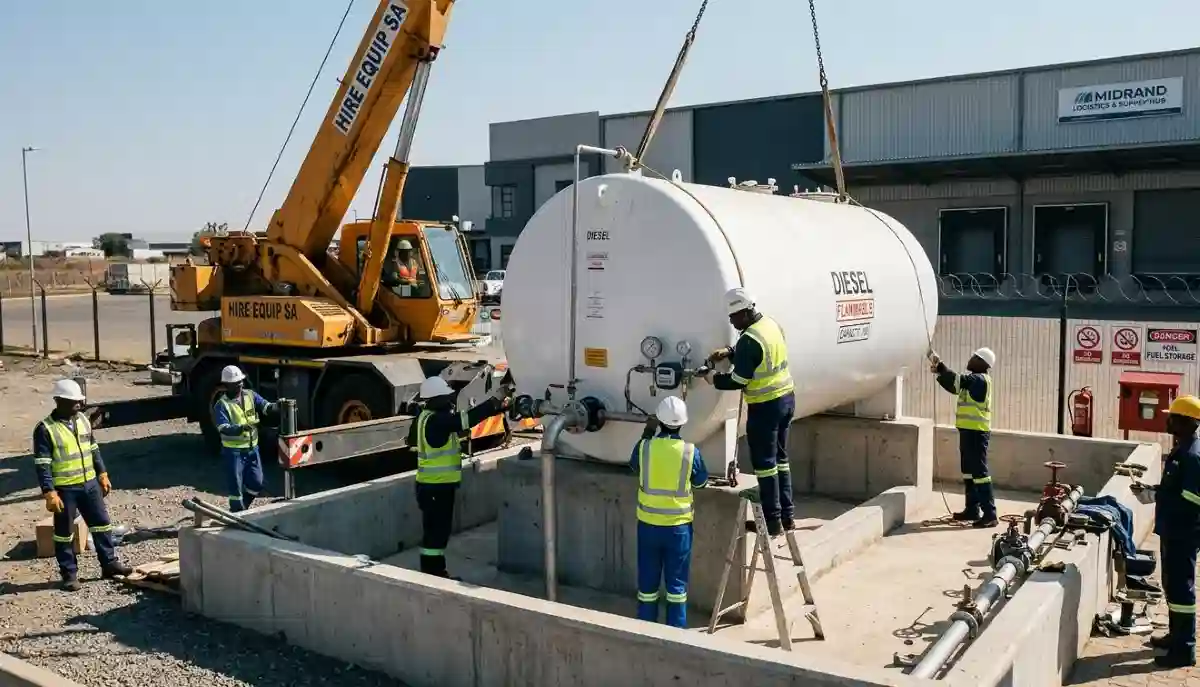
Need Commercial Fuel Storage?
ServiceLink SA connects you with verified tank installers specialising in commercial fuel storage. Get free quotes today. If we can’t assist directly, we’ll connect you with our trusted partner companies to carry out your fuel storage projects professionally and timeously.
Get Free Commercial Tank Quotes
Servicing Johannesburg, Pretoria, Durban, Cape Town, Sandton, and across South Africa
Commercial Fuel Storage Tanks: Bulk Diesel for Business Operations
🏭 From logistics depots to manufacturing plants—your complete guide to business fuel storage
I once worked with a logistics company in Johannesburg that was spending over R2.5 million monthly on diesel—all at retail prices. They had 80 trucks returning to their depot every night, but no on-site fuel storage. Every morning, drivers spent 30 minutes at public fuel stations before starting their routes. The waste was staggering.
I showed them the numbers: installing commercial fuel storage tanks would cost R250,000. The monthly saving from switching to wholesale diesel? Over R400,000. They would recover their investment in less than a month. “Why hasn’t anyone told me this before?” the owner asked.
For any business with a fleet of vehicles, backup generators, or diesel-powered equipment, business fuel tanks are not an expense—they’re an investment that pays for itself in months. Commercial diesel storage enables wholesale purchasing, eliminates retail markups, and ensures you never run out of fuel during critical operations.
This comprehensive equipment guide covers everything you need to know about commercial fuel storage tanks, including commercial fuel storage tanks for logistics companies, fleet storage solutions, depot tank selection, SABS compliance, and installation best practices. For more on fuel supply, read bulk fuel supply services.
Ready to start saving on fuel? Let’s dive in.
📋 Table of Contents – Commercial Fuel Storage Guide
⚠️ Why Commercial Fuel Storage Matters
For businesses with significant diesel consumption, commercial fuel storage tanks are a strategic investment:
⚠️ The Financial Case for Commercial Fuel Storage
Businesses that switch from retail to wholesale diesel through on-site storage typically save 15-25% on fuel costs. For a logistics company using 50,000L monthly, that’s R150,000-R250,000 saved every month. The tank investment pays for itself in 1-3 months.
Why your business needs on-site fuel storage:
- Wholesale pricing: Buy diesel at wholesale (15-25% cheaper than retail)
- Convenience: No more sending drivers or equipment to fuel stations
- Time savings: Drivers save 15-30 minutes daily (not spent refuelling)
- Control: Monitor fuel usage, prevent theft, manage quality
- Emergency preparedness: On-site storage ensures fuel during supply disruptions
- Load shedding protection: Keep generators running during power outages
- Rebate documentation: Proper records for diesel rebate claims (if applicable)
Businesses that benefit from commercial fuel storage:
- Logistics companies: Fleet of delivery trucks returning to depot
- Manufacturing plants: Generators for load shedding, forklifts, equipment
- Construction companies: Heavy machinery, site generators
- Mining operations: Haul trucks, loaders, drills
- Agricultural businesses: Tractors, harvesters, irrigation pumps
- Municipalities: Fleet vehicles, emergency generators
- Hospitality: Backup generators for lodges and resorts
Typical commercial consumption by business type:
| Business Type | Monthly Diesel Consumption | Recommended Storage | Payback Period |
|---|---|---|---|
| Small logistics (10 trucks) | 15,000-25,000L | 10,000-20,000L | 2-3 months |
| Medium logistics (25 trucks) | 40,000-60,000L | 20,000-40,000L | 1-2 months |
| Large logistics (50+ trucks) | 80,000-150,000L | 50,000-100,000L | <1 month |
| Manufacturing plant (generators) | 10,000-30,000L | 10,000-20,000L | 2-4 months |
| Construction company | 20,000-50,000L | 15,000-30,000L | 1-3 months |
For more on cost savings, read bulk diesel vs retail diesel price.
🏭 Types of Commercial Fuel Storage Tanks
Commercial fuel storage tanks come in several configurations:
Single-wall above-ground tanks:
- Capacity: 5,000L – 100,000L
- Material: Steel or polyethylene
- Pros: Lower cost, widely available
- Cons: Requires separate bunding for spill containment
- Best for: Businesses with space for bunded area, budget-conscious installations
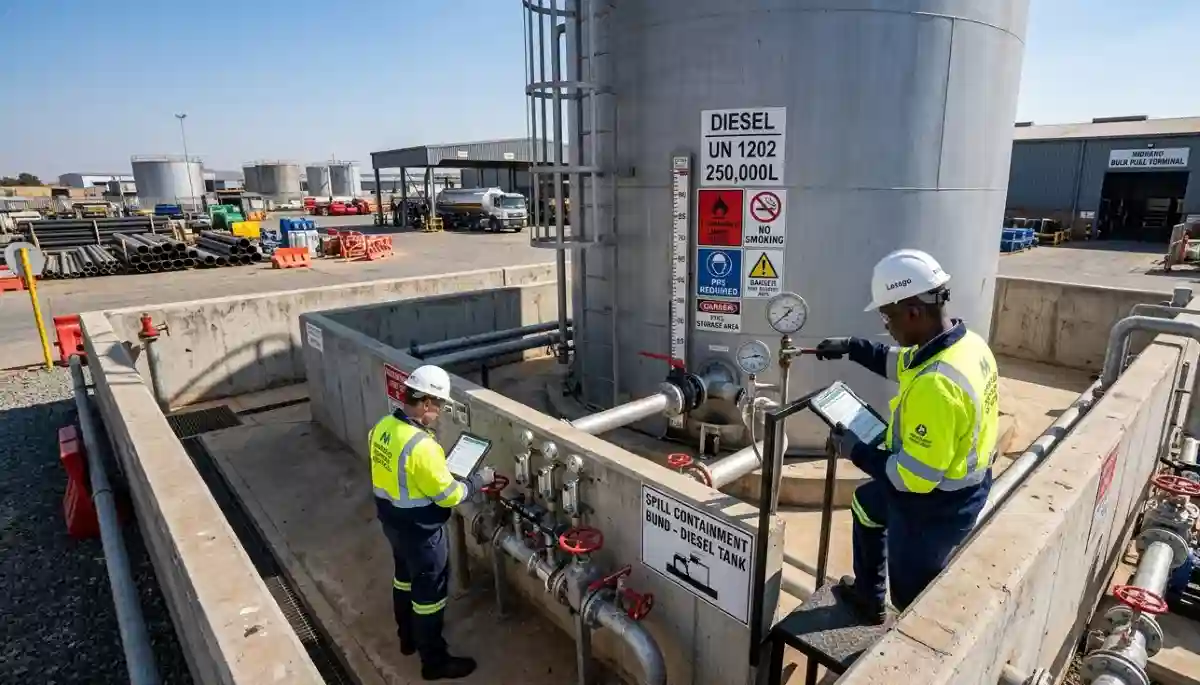
Double-skinned (bunded) tanks (recommended):
- Capacity: 5,000L – 100,000L
- Material: Steel with integrated secondary containment
- Pros: Built-in spill containment, SABS compliant, lower installation cost (no separate bunding)
- Cons: Higher upfront tank cost
- Best for: Most commercial applications (recommended)
Portable fuel tanks (skid/trailer-mounted):
- Capacity: 1,000L – 10,000L
- Material: Steel on skid or trailer
- Pros: Portable, no permanent installation required
- Cons: Smaller capacity, less secure
- Best for: Temporary sites, rental applications, backup generator fuel
Comparison of commercial tank types:
| Tank Type | Capacity Range | Pros | Cons | Typical Cost Range |
|---|---|---|---|---|
| Single-wall steel | 5,000-100,000L | Lower cost, durable | Requires separate bunding | R20,000-R80,000 |
| Double-skinned steel | 5,000-100,000L | Built-in bunding, SABS compliant | Higher upfront cost | R35,000-R120,000 |
| Polyethylene (plastic) | 1,000-20,000L | Lightweight, corrosion-resistant | UV degradation, less durable | R8,000-R30,000 |
| Portable skid/trailer | 1,000-10,000L | Portable, flexible | Smaller capacity | R25,000-R60,000 |
Recommended tank type for most businesses: Double-skinned (bunded) steel tanks. The integrated spill containment simplifies installation, reduces long-term compliance burden, and provides peace of mind. The higher upfront cost is justified by lower installation costs and reduced regulatory risk.
For more on tank selection, read fuel tank installation.
🚛 Fleet Storage Solutions for Logistics Companies
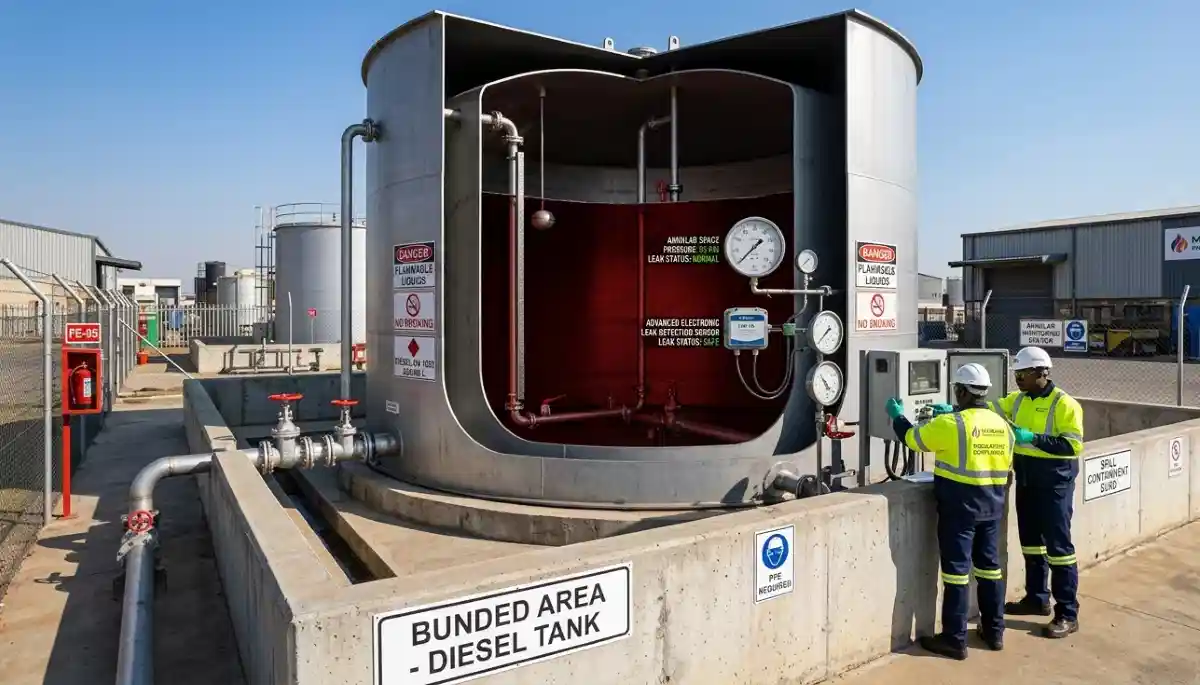
Commercial fuel storage tanks for logistics companies require specific features:
Key features for fleet storage:
- High-flow pump: 80-150 L/min for rapid truck refuelling
- Access control: Card or keypad system to prevent unauthorised use
- Multiple dispensing points: Refuel multiple trucks simultaneously
- Vehicle tracking integration: Link fuel dispensing to specific vehicles
- Overnight fueling capability: Lighting and access for after-hours refuelling
- Large capacity: 20,000-100,000L depending on fleet size
- Quick turnaround: Design for rapid truck movement through fueling area
Fleet storage configurations:
- Single large tank (50,000-100,000L): Simple, lower installation cost
- Multiple smaller tanks (2-3 × 20,000-30,000L): Redundancy, can segregate by fuel grade
- Tank farm with dispensing island: Professional setup for large fleets (50+ trucks)
Fleet storage sizing by fleet size:
| Fleet Size | Daily Consumption | Recommended Storage | Tank Configuration |
|---|---|---|---|
| 5-10 trucks | 1,000-2,000L | 10,000-15,000L | 1 × 10,000-15,000L |
| 10-25 trucks | 2,000-5,000L | 20,000-30,000L | 1 × 20,000-30,000L or 2 × 15,000L |
| 25-50 trucks | 5,000-10,000L | 40,000-60,000L | 2 × 20,000-30,000L |
| 50-100 trucks | 10,000-20,000L | 80,000-120,000L | 2-3 × 40,000L or 4 × 30,000L |
| 100+ trucks | 20,000L+ | 150,000-300,000L+ | Multiple tanks with dispensing island |
Additional considerations for logistics depots:
- Position tank farm near depot entrance/exit for efficient truck flow
- Install adequate lighting for night-time fueling
- Provide turning radius for large trucks (minimum 15-20 metres)
- Consider canopy over dispensing area for weather protection
- Integrate with fleet management system for automated record keeping
For more on fleet fueling, read fleet fueling solutions.
📋 Depot Tank Selection Guide
Choosing the right depot tank for your business requires careful evaluation:
Selection criteria:
- Volume requirements: Calculate daily consumption × desired days of autonomy
- Available space: Measure footprint for tank, bunding, and delivery access
- Delivery access: Ensure tanker trucks can reach the tank (turning radius, height clearance)
- Fuel grade: Single grade or multiple grades (50ppm vs 500ppm, petrol vs diesel)
- Dispensing needs: Number of simultaneous users, required flow rate
- Security requirements: Location, lighting, access control needs
- Budget: Initial investment vs long-term savings
- Compliance: Local regulations, SABS standards, environmental requirements
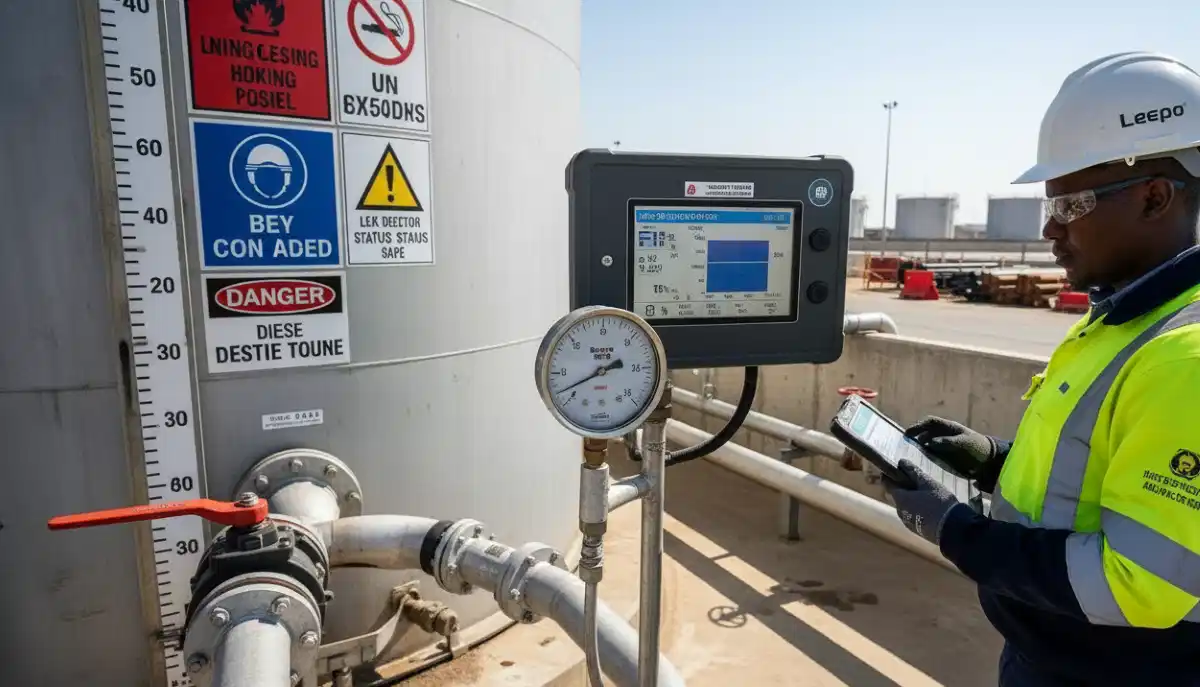
Depot tank features checklist:
- ✅ Double-skinned (bunded) construction
- ✅ SABS certification (SANS 10089-3)
- ✅ Electronic tank level monitoring
- ✅ Overfill protection (alarm or automatic shut-off)
- ✅ Lockable dispensing system
- ✅ High-flow pump (80-150 L/min for truck refuelling)
- ✅ Water drain valve
- ✅ Vent with flame arrestor
- ✅ Hazchem signage
- ✅ Fire extinguisher included
Popular depot tank sizes by business type:
| Business Type | Recommended Tank Size | Days of Autonomy | Typical Installation Cost |
|---|---|---|---|
| Small logistics (10 trucks) | 10,000-15,000L | 5-7 days | R50,000-R80,000 |
| Medium logistics (25 trucks) | 20,000-30,000L | 5-7 days | R80,000-R120,000 |
| Large logistics (50+ trucks) | 50,000-100,000L | 5-7 days | R150,000-R300,000 |
| Manufacturing plant | 10,000-20,000L | 7-14 days | R60,000-R100,000 |
| Construction depot | 15,000-30,000L | 5-10 days | R70,000-R120,000 |
For more on depot setup, read commercial fuel storage tanks.
📏 Tank Sizing for Commercial Operations
Proper sizing of commercial diesel storage is critical for ROI and operational reliability:
Step 1: Calculate daily consumption
List all diesel-powered equipment/vehicles and estimate daily usage:
Example for a logistics depot with 25 trucks:
- 25 trucks @ 200L/day average = 5,000 L/day
- 2 forklifts @ 30L/day = 60 L/day
- 1 generator (test runs) = 50 L/day
- Total daily consumption: 5,110 L/day
Step 2: Determine desired days of autonomy
Recommended minimum storage for commercial operations:
- Logistics depots: 5-7 days
- Manufacturing plants (generator backup): 7-14 days
- Construction depots: 5-10 days
- Remote operations: 10-14 days
Step 3: Calculate required capacity
Required Capacity = Daily Consumption × Days of Autonomy × 1.2 (buffer)
Example for logistics depot:
5,110 L/day × 7 days × 1.2 = 42,924 L → recommend 45,000L (or 50,000L tank)
Tank sizing recommendations by consumption:
| Daily Consumption | 5-Day Storage | 7-Day Storage | 10-Day Storage | 14-Day Storage |
|---|---|---|---|---|
| 1,000L | 6,000L | 8,500L | 12,000L | 17,000L |
| 2,000L | 12,000L | 17,000L | 24,000L | 34,000L |
| 5,000L | 30,000L | 42,000L | 60,000L | 84,000L |
| 10,000L | 60,000L | 84,000L | 120,000L | 168,000L |
| 20,000L | 120,000L | 168,000L | 240,000L | 336,000L |
Buffer considerations:
The 20% buffer accounts for:
– Unexpected consumption increases (peak seasons, extra shifts)
– Delivery delays (weather, supplier issues, road closures)
– Equipment breakdowns (can’t rotate stock as planned)
– Emergency usage (unplanned generator runs during load shedding)
For more on storage planning, read bulk diesel storage regulations.
Ready to Install Commercial Fuel Storage?
ServiceLink SA connects you with verified tank installers specialising in commercial fuel storage. Get free quotes today. If we can’t assist directly, we’ll connect you with our trusted partner companies to carry out your fuel storage projects professionally and timeously.
Get Free Commercial Tank Quotes
Commercial fuel storage tanks for logistics companies and other businesses—find certified installers near you.
📋 SABS Commercial Storage Standards
Commercial fuel storage tanks must comply with SABS standards. See SABS – Commercial storage standards.
SANS 10089-3 key requirements:
- Tank construction: Designed and manufactured to SABS specifications
- Secondary containment: Bunding or double-skinned at 110% capacity
- Overfill protection: Alarm or automatic shut-off required
- Venting: Proper venting with flame arrestor
- Markings: Tank must display capacity, manufacturer, and date
- Access: Safe access for filling, inspection, and maintenance
- Dispensing: Pump, hose, and nozzle must meet safety standards
Compliance checklist for commercial tanks:
- ✅ Tank certified to SANS 10089-3
- ✅ Double-skinned or properly bunded (110% capacity)
- ✅ Overfill protection installed and functional
- ✅ Vent with flame arrestor
- ✅ Lockable dispensing system
- ✅ Hazchem signage clearly displayed
- ✅ Fire extinguisher within easy access
- ✅ Spill kit available
- ✅ Regular inspections documented
Consequences of non-compliance:
- Fines from DMRE and local authorities
- Invalidated insurance (if tank causes damage)
- Environmental damage liability
- Legal action from neighbours or authorities
- Business interruption from compliance orders
For more on standards, read bulk diesel storage regulations.
🌿 Environmental Compliance for Commercial Storage
Commercial fuel storage must comply with DFFE environmental regulations. See DFFE – Environmental compliance.
Key environmental requirements:
- Spill containment: Bunding or double-skinned tank at 110% capacity
- Location restrictions: Tanks away from water sources, wetlands, flood zones
- Spill response plan: Documented procedures for fuel spills
- Spill kit: Equipment to contain and clean up spills
- Regular inspections: Monthly visual, annual professional
- Record keeping: Inspection logs, delivery records, maintenance records
- Reporting: Spills reported to DFFE within 24 hours
DMRE commercial storage regulations:
See DMRE – Commercial storage regulations. Key requirements:
- Storage permits for tanks over certain capacity
- Regular inspections by DMRE officials
- Record keeping for fuel deliveries and usage
- Staff training requirements
- Emergency response planning
Best practices for environmental compliance:
- Install tanks on impervious surface within bunded area
- Conduct weekly visual inspections for leaks
- Keep spill kit accessible and staff trained in use
- Test bunding integrity annually (fill with water, check for leaks)
- Document all inspections and maintenance
- Train staff on spill response procedures
- Conduct annual spill response drills
For more on environmental compliance, read bulk diesel storage regulations.
🔧 Installation Best Practices
Professional installation of business fuel tanks is essential for safety and compliance:
Site preparation:
- Level, stable ground (concrete pad recommended for >20,000L tanks)
- Adequate drainage away from tank area
- Clear access for delivery tankers (3-4 metres width, adequate turning radius)
- Distance from buildings, property lines (check local regulations)
- Security lighting and CCTV coverage
Installation steps:
- Prepare concrete foundation or compacted gravel base
- Position tank on foundation (ensure level)
- Install bunding (if separate bunding used)
- Connect dispensing system (pump, hose, nozzle)
- Install level gauge and overfill protection
- Install vent with flame arrestor
- Install lockable dispensing cabinet or lock on pump
- Apply hazchem and safety signage
- Position fire extinguisher and spill kit
- Conduct fill test (check for leaks)
- Schedule first delivery and inspection
Common installation mistakes to avoid:
- ❌ Installing on unstable or uneven ground
- ❌ Forgetting bunding or inadequate bunding capacity
- ❌ No overfill protection (risk of spill during delivery)
- ❌ Inaccessible for delivery tankers (tight turns, low clearance)
- ❌ Poor security (unlocked dispensing, no lighting)
- ❌ No fire extinguisher or spill kit
- ❌ Missing hazchem signage
- ❌ Improper electrical installation for pumps
Do I need a professional installer?
Yes, for any permanent commercial installation. Professional installers ensure compliance with SABS standards, DMRE regulations, and local by-laws. DIY installation risks leaks, fines, invalidated insurance, and environmental damage.
For more on installation, read fuel tank installation.
💰 Cost-Benefit Analysis
Understanding the economics of commercial diesel storage:
Typical cost components:
| Component | Typical Cost Range | Notes |
|---|---|---|
| 10,000L double-skinned tank | R40,000-R60,000 | Includes bunding, basic fittings |
| 20,000L double-skinned tank | R60,000-R90,000 | Popular for medium fleets |
| 30,000L double-skinned tank | R80,000-R120,000 | For larger operations |
| 50,000L double-skinned tank | R120,000-R180,000 | Large fleet depot |
| Concrete foundation | R5,000-R20,000 | Depends on size |
| Professional installation | R5,000-R15,000 | Labour and setup |
| High-flow pump (electric) | R5,000-R12,000 | 80-150 L/min for trucks |
| Access control system | R10,000-R30,000 | Card or keypad system |
| Tank monitoring system | R10,000-R25,000 | Electronic level monitoring |
| Hazchem signage | R500-R1,500 | Required for compliance |
| Fire extinguisher (9kg) | R800-R1,500 | Required near tank |
| Spill kit | R1,000-R3,000 | Environmental compliance |
| Total (20,000L tank installed) | R100,000-R180,000 | Fully installed and compliant |
Return on investment calculation:
For a logistics company using 50,000L monthly:
- Retail price: R23.00/L = R1,150,000 monthly
- Wholesale price with storage: R18.50/L = R925,000 monthly
- Monthly saving: R225,000
- Tank investment: R150,000
- Payback period: Less than 1 month
- Annual saving after payback: R2,700,000
Additional savings not included:
- Driver time savings (15-30 minutes daily per driver)
- Reduced vehicle wear (no travel to fuel stations)
- Fuel theft reduction (controlled dispensing)
- Emergency fuel availability (no premium for urgent delivery)
For more on cost savings, read bulk diesel vs retail diesel price.
❓ Frequently Asked Questions About Commercial Fuel Tanks
What size commercial fuel storage tank do I need?
Commercial fuel storage tanks should be sized for daily consumption × desired days of autonomy × 1.2 buffer. Example: 5,000 L/day × 7 days × 1.2 = 42,000L. Most logistics depots choose 20,000-50,000L tanks. Get a professional assessment for accurate sizing.
What are commercial fuel storage tanks for logistics companies?
Commercial fuel storage tanks for logistics companies are specialised depot tanks with high-flow pumps (80-150 L/min), access control systems, and large capacity (20,000-100,000L). They enable overnight refuelling, eliminate driver fueling time, and reduce fuel costs by 15-25%.
How much do business fuel tanks cost?
Business fuel tanks cost R40,000-R180,000 for the tank alone, depending on capacity. A fully installed 20,000L double-skinned tank with pump, monitoring, and safety equipment costs R100,000-R180,000. Payback is typically 1-3 months through wholesale fuel savings.
What is fleet storage for diesel?
Fleet storage refers to on-site diesel storage tanks at logistics depots or company yards. They allow fleets to refuel at the depot (often overnight) rather than at public fuel stations, saving driver time (15-30 minutes daily) and reducing fuel costs (wholesale vs retail).
What is a depot tank?
A depot tank is a commercial fuel storage tank installed at a company’s depot or yard. It enables bulk diesel purchasing, on-site refuelling of fleet vehicles, and significant cost savings compared to retail fuel stations. Depot tanks are typically 10,000-100,000L capacity.
What SABS standards apply to commercial diesel storage?
Commercial diesel storage must comply with SANS 10089-3: secondary containment (bunding at 110% capacity), overfill protection, proper venting with flame arrestor, lockable dispensing, hazchem signage, and regular inspections. See SABS – Commercial storage standards.
What environmental regulations apply to commercial fuel storage?
Commercial fuel storage must comply with DFFE environmental regulations: spill containment (bunding at 110% capacity), spill response plan, spill kit on-site, regular inspections, and 24-hour spill reporting. DMRE also requires storage permits and regular inspections. See DFFE – Environmental compliance.
How quickly do commercial fuel tanks pay for themselves?
Payback for commercial fuel storage tanks is typically 1-3 months through wholesale fuel savings alone. For a logistics company using 50,000L monthly, saving R4.50/L vs retail = R225,000 monthly saving. A R150,000 tank investment pays back in less than 1 month. Driver time savings provide additional value.
✅ Final Thoughts: Invest in Commercial Fuel Storage
Commercial fuel storage tanks are one of the smartest investments a diesel-dependent business can make. The combination of wholesale fuel savings (15-25%), driver time recovery, and operational reliability delivers exceptional ROI—typically paying for itself in 1-3 months.
Key takeaways from this guide:
- Commercial fuel storage tanks enable wholesale diesel purchasing (15-25% savings)
- Business fuel tanks pay for themselves in 1-3 months through fuel savings alone
- Commercial diesel storage eliminates driver time spent at fuel stations (15-30 minutes daily per driver)
- Commercial fuel storage tanks for logistics companies should include high-flow pumps and access control
- Fleet storage enables overnight refuelling—trucks ready when drivers arrive
- Depot tank installations require proper sizing based on daily consumption
- Double-skinned (bunded) tanks are recommended for built-in spill containment
- SABS compliance (SANS 10089-3) is mandatory for legal operation
- DFFE environmental compliance requires spill containment and response plans
- Professional installation ensures safety, compliance, and optimal performance
- ServiceLink SA connects you with verified commercial tank installers
Your action plan: Calculate your monthly diesel consumption and current retail cost. Estimate wholesale savings (15-25%). Determine payback period (tank cost ÷ monthly saving). Get quotes from multiple verified installers. Choose a double-skinned SABS-compliant tank sized for 5-10 days autonomy. Ensure professional installation with proper safety equipment. Start saving from your first wholesale delivery.
Ready to Install Commercial Fuel Storage?
ServiceLink SA connects you with verified tank installers specialising in commercial fuel storage. Get free quotes today. If we can’t assist directly, we’ll connect you with our trusted partner companies to carry out your fuel storage projects professionally and timeously.
📞 Call us: 073 138 4726 for immediate help finding commercial tank installers near you.
Fuel Tank Installation •
Diesel Delivery •
Fleet Fueling Solutions •
Fuel Management Systems •
Tank Cleaning & Maintenance
📚 Official resources & standards referenced:
- SABS – South African Bureau of Standards – Commercial storage standards (SANS 10089-3) and tank certification.
- DMRE – Department of Mineral Resources and Energy – Commercial storage regulations and permits.
- DFFE – Department of Forestry, Fisheries and the Environment – Environmental compliance for fuel storage.
- CIDB – Construction Industry Development Board – Contractor grading for tank installation.
Information provided for general guidance based on independent research and official sources. Storage regulations, compliance requirements, and standards change periodically. Always verify current requirements directly with SABS, DMRE, and DFFE.
Written by: ServiceLink SA Research Team
Commercial Fuel Storage & Logistics Specialists
The ServiceLink SA Research Team combines expertise from commercial fuel storage, logistics operations, and regulatory compliance. Our analysts track SABS commercial storage standards (SANS 10089-3), monitor DMRE commercial storage regulations, analyse DFFE environmental compliance requirements, and maintain relationships with accredited tank installers serving businesses across South Africa. This guide draws on primary research, official SABS, DMRE, and DFFE documentation, and direct experience with logistics depots, manufacturing plants, construction companies, and agricultural operations. Our mission is to help businesses select, install, and maintain proper commercial fuel storage tanks that deliver rapid ROI through wholesale fuel savings. If we can’t assist directly, we’ll connect you with our trusted partner companies who specialise in commercial fuel storage solutions.
For more information about commercial fuel storage, explore our related resources: fuel tank installation and setup, bulk diesel storage regulations, fuel tank cleaning and maintenance, how to choose a bulk fuel supplier, fleet fueling solutions, and fuel management systems. See our location-specific guides for Johannesburg, Sandton, Pretoria, Durban, and Cape Town.