
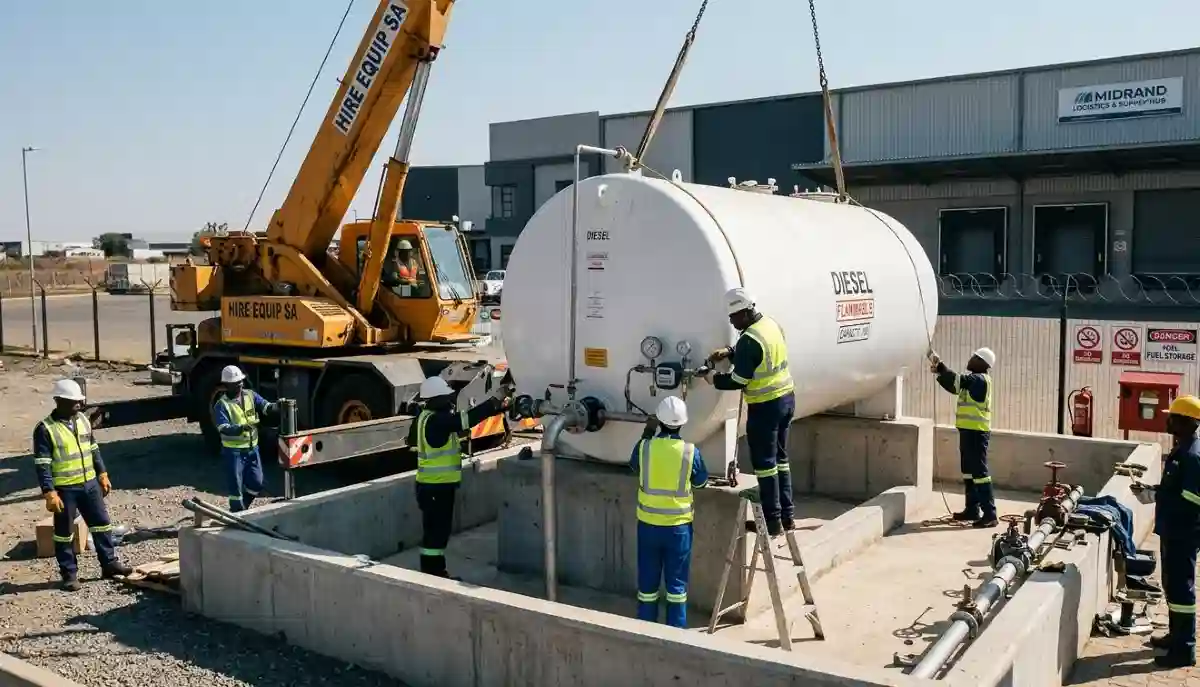
Not Sure What Size Tank You Need?
ServiceLink SA connects you with verified tank installers who can help size the right tank for your business. Get free quotes today. If we can’t assist directly, we’ll connect you with our trusted partner companies to carry out your fuel storage projects professionally and timeously.
Servicing Johannesburg, Pretoria, Durban, Cape Town, Sandton, and across South Africa
Fuel Storage Tank Sizes Explained: Choosing the Right Capacity
📏 From 1,000L to 100,000L—your complete guide to selecting the optimal tank capacity
I once watched a business owner make a R500,000 mistake. He owned a logistics company with 15 trucks and decided to install a fuel tank. Without any diesel tank capacity guide, he bought the smallest tank available—5,000 litres. Within a month, he realised his trucks consumed 4,000 litres daily. His “fuel storage” barely covered one day’s needs. He was still buying from retail stations every other day, still paying retail prices, still wasting driver time.
He needed a 30,000-litre tank. The small tank was a complete waste of money.
Choosing the right bulk tank sizing is one of the most important decisions when investing in on-site fuel storage. Too small, and you don’t get the full benefit of wholesale pricing. Too large, and you waste capital on unnecessary capacity and may trigger additional regulatory requirements.
This comprehensive equipment guide answers the critical question: what size diesel tank do I need for my business? We’ll cover fuel storage tank sizes explained across all applications, tank volume calculations, capacity planning strategies, and regulatory thresholds. For more on tank selection, read fuel tank installation.
Ready to find your perfect tank size? Let’s dive in.
📋 Table of Contents – Tank Sizing Guide
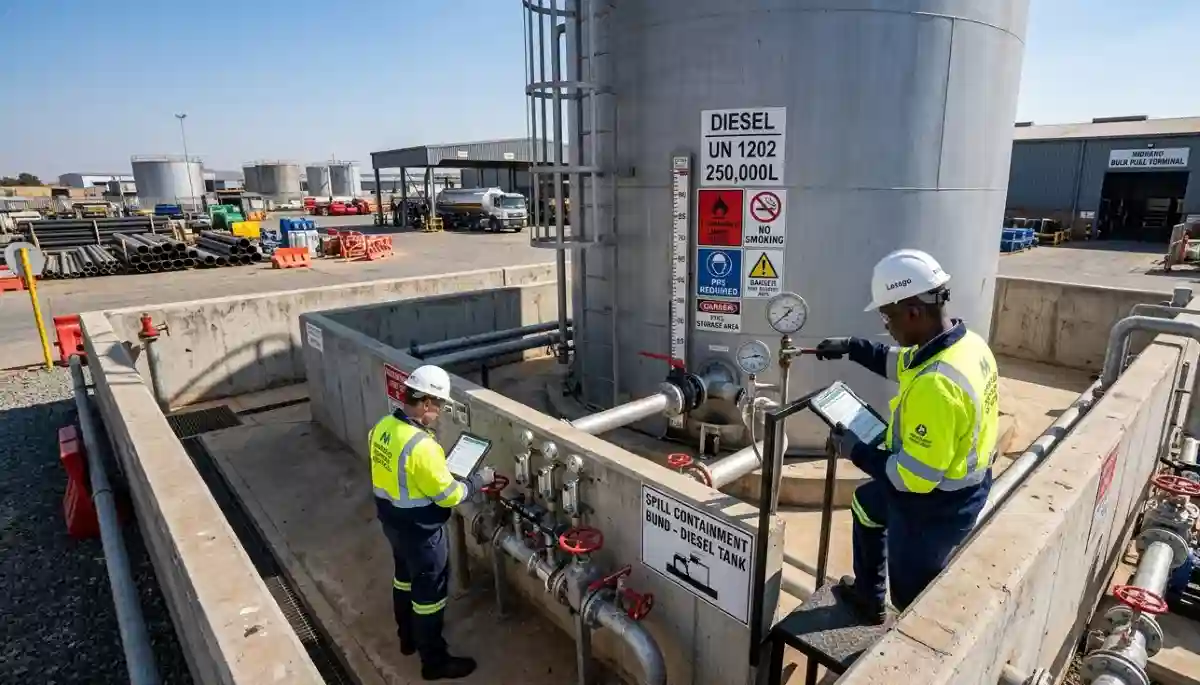
⚠️ Why Tank Sizing Matters
Proper fuel storage tank sizes explained starts with understanding why size matters:
⚠️ The Cost of Wrong Tank Sizing
Too small: You still rely on retail fuel (15-25% higher cost), waste driver time, and miss wholesale savings. Too large: You waste capital on unnecessary capacity, pay higher installation costs, and may trigger additional regulatory requirements. The right size maximizes ROI.
Consequences of undersizing:
- Still buying from retail stations frequently (higher cost)
- Multiple small deliveries instead of fewer bulk deliveries (higher transport cost per litre)
- Risk of running out during peak consumption
- Driver time still wasted on refuelling trips
- Poor return on investment
Consequences of oversizing:
- Wasted capital on unnecessary capacity
- Higher installation and foundation costs
- More regulatory requirements (permits, inspections)
- Fuel degradation from long storage times
- Higher environmental compliance burden
- Larger footprint (may not fit available space)
Benefits of correct sizing:
- Maximum wholesale purchasing (15-25% savings)
- Optimal delivery frequency (typically weekly or bi-weekly)
- Adequate buffer for peak consumption
- Best ROI on your tank investment
- Compliance with regulatory thresholds
For more on tank benefits, read bulk diesel storage regulations.
📏 Common Fuel Storage Tank Sizes
Fuel storage tank sizes explained by typical capacity ranges:
Small tanks (1,000L – 5,000L):
- Best for: Small businesses, backup generators, farms with low consumption
- Typical users: Small workshops, guest lodges, small farms, generator backup
- Delivery frequency: Monthly or as needed
- Typical cost: R8,000-R30,000
Medium tanks (5,000L – 20,000L):
- Best for: Medium businesses, small fleets (5-15 trucks), manufacturing plants
- Typical users: Logistics depots with small fleets, construction companies, medium farms
- Delivery frequency: Weekly or bi-weekly
- Typical cost: R30,000-R80,000
Large tanks (20,000L – 50,000L):
- Best for: Large fleets (15-50 trucks), major manufacturing plants, large farms
- Typical users: Logistics depots, mining operations, agricultural co-ops
- Delivery frequency: Weekly
- Typical cost: R80,000-R150,000
Very large tanks (50,000L – 100,000L+):
- Best for: Major fleets (50+ trucks), mines, fuel distributors
- Typical users: Large logistics companies, mining operations, fuel resellers
- Delivery frequency: Weekly or multiple times weekly
- Typical cost: R150,000-R300,000+
Complete tank size reference table:
| Tank Size | Dimensions (approx) | Typical Users | Delivery Frequency | Typical Cost (tank only) |
|---|---|---|---|---|
| 1,000L | 1.2m × 1.2m × 1.5m | Generator backup | Monthly+ | R8,000-R15,000 |
| 2,500L | 1.5m × 1.5m × 2m | Small workshop | Monthly | R15,000-R25,000 |
| 5,000L | 2m × 2m × 2.5m | Small fleet (2-5 trucks) | Bi-weekly | R25,000-R40,000 |
| 10,000L | 2.5m × 2.5m × 3m | Small fleet (5-10 trucks) | Weekly/bi-weekly | R40,000-R60,000 |
| 15,000L | 3m × 2.5m × 3.5m | Medium fleet (10-15 trucks) | Weekly | R55,000-R80,000 |
| 20,000L | 3.5m × 3m × 3.5m | Medium fleet (15-25 trucks) | Weekly | R60,000-R90,000 |
| 30,000L | 4m × 3m × 4m | Large fleet (25-40 trucks) | Weekly | R80,000-R120,000 |
| 50,000L | 5m × 4m × 4.5m | Large fleet (40-60 trucks) | Weekly | R120,000-R180,000 |
| 100,000L | 7m × 5m × 5m | Major fleet (60+ trucks), mines | 2-3 times weekly | R180,000-R300,000 |
For more on tank specifications, read fuel tank installation and setup.
🧮 How to Calculate Your Required Tank Size
A diesel tank capacity guide starts with this simple formula:
The Tank Sizing Formula:
Required Capacity = Daily Consumption × Desired Days of Autonomy × Safety Buffer (1.2-1.5)
Step 1: Calculate your daily consumption
List all diesel-powered equipment/vehicles and estimate daily usage:
Example for a logistics depot with 20 trucks:
- 20 trucks @ 200L/day average = 4,000 L/day
- 2 forklifts @ 30L/day = 60 L/day
- 1 generator (test runs) = 40 L/day
- Total daily consumption: 4,100 L/day
Step 2: Determine desired days of autonomy
How many days of fuel storage do you need? Recommended minimums:
- Logistics depots: 5-7 days
- Manufacturing plants (generator backup): 7-14 days
- Construction depots: 5-10 days
- Farms (peak season): 10-14 days
- Remote operations: 10-14 days
- Mines: 7-14 days
Step 3: Apply the safety buffer
Add 20-50% buffer for:
– Unexpected consumption increases (peak seasons, extra shifts)
– Delivery delays (weather, supplier issues, road closures)
– Equipment breakdowns (can’t rotate stock as planned)
– Emergency usage
Example calculation for logistics depot:
4,100 L/day × 7 days × 1.3 (30% buffer) = 37,310 L → recommend 40,000L tank
Tank size calculator table by daily consumption:
| Daily Consumption | 5-Day Storage (+20%) | 7-Day Storage (+30%) | 10-Day Storage (+40%) | 14-Day Storage (+50%) |
|---|---|---|---|---|
| 500L | 3,000L | 4,500L | 7,000L | 10,500L |
| 1,000L | 6,000L | 9,000L | 14,000L | 21,000L |
| 2,000L | 12,000L | 18,000L | 28,000L | 42,000L |
| 3,000L | 18,000L | 27,000L | 42,000L | 63,000L |
| 5,000L | 30,000L | 45,000L | 70,000L | 105,000L |
| 10,000L | 60,000L | 90,000L | 140,000L | 210,000L |
Practical example scenarios:
- 5 trucks (1,000 L/day): 7-day storage +30% = 9,000L → 10,000L tank
- 15 trucks (3,000 L/day): 7-day storage +30% = 27,000L → 30,000L tank
- 30 trucks (6,000 L/day): 5-day storage +20% = 36,000L → 40,000L tank (or 2 × 20,000L)
- 50 trucks (10,000 L/day): 5-day storage +20% = 60,000L → 60,000-80,000L tank farm
For more on consumption calculation, read fleet fueling solutions.
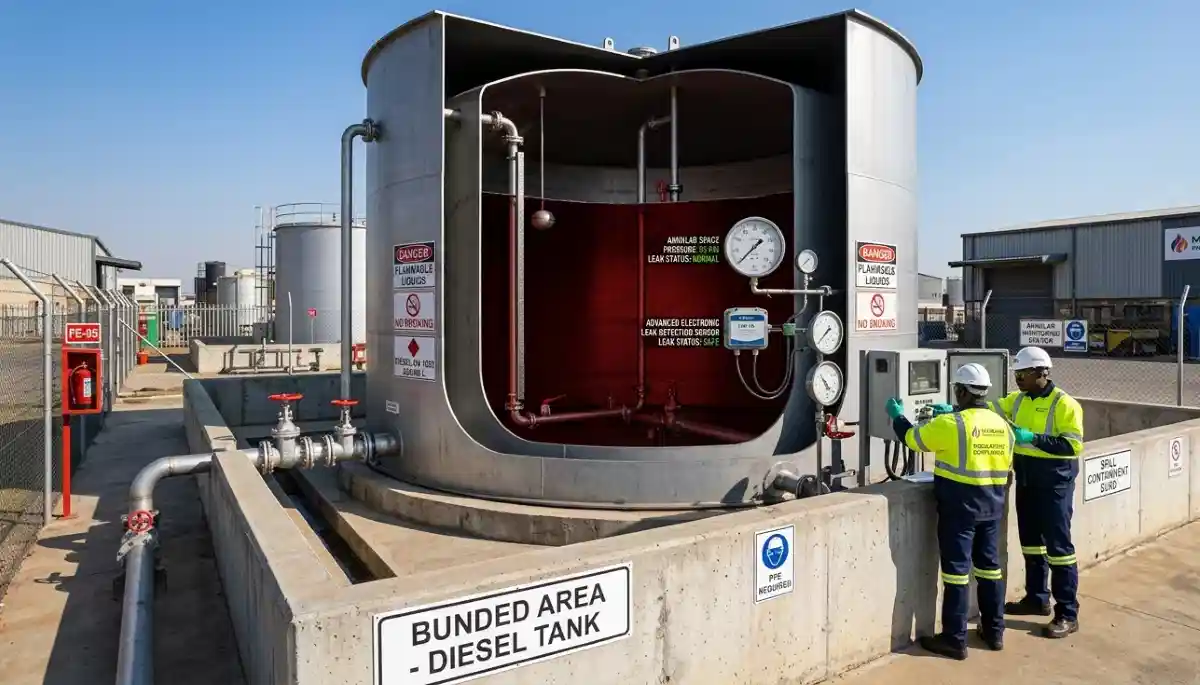
🏭 Tank Sizing by Business Type
What size diesel tank do I need for my business depends on your industry:
Logistics and transport companies:
- Calculate based on fleet size (see table below)
- Target 5-7 days autonomy with 20-30% buffer
- Consider growth—size for expected fleet expansion
- Install high-flow pumps (80-150 L/min) for fast refuelling
Manufacturing plants (generator backup):
- Calculate generator fuel consumption during load shedding
- Target 7-14 days autonomy (stage 6 load shedding = 8-12 hours daily)
- Example: 1MW generator at 70% load = 180 L/hour × 10 hours = 1,800 L/day × 10 days = 18,000L + buffer = 20,000-25,000L tank
Construction companies:
- Calculate based on equipment fleet and project requirements
- Consider mobile tanks if sites change frequently
- Target 5-10 days autonomy with 30% buffer for variable consumption
Farms:
- Calculate based on peak season consumption (planting/harvest)
- Target 10-14 days autonomy during peak seasons
- Consider separate storage for different fuel grades if needed
Mining operations:
- Calculate based on continuous operation (24/7)
- Target 7-14 days autonomy with 30-50% buffer
- Often require multiple large tanks (100,000L+ each)
- Consider redundancy (if one tank fails, others still work)
Recommended tank sizes by fleet size (logistics):
| Fleet Size | Daily Consumption | Recommended Tank Size | Days Autonomy | Configuration |
|---|---|---|---|---|
| 2-5 trucks | 400-1,000L | 5,000-10,000L | 7-10 days | 1 × 5,000-10,000L |
| 5-10 trucks | 1,000-2,000L | 10,000-15,000L | 7-10 days | 1 × 10,000-15,000L |
| 10-15 trucks | 2,000-3,000L | 15,000-20,000L | 5-7 days | 1 × 15,000-20,000L |
| 15-25 trucks | 3,000-5,000L | 20,000-30,000L | 5-7 days | 1 × 20,000-30,000L |
| 25-40 trucks | 5,000-8,000L | 30,000-50,000L | 5-7 days | 1 × 30,000-50,000L or 2 × 15,000-25,000L |
| 40-60 trucks | 8,000-12,000L | 50,000-80,000L | 5-7 days | 2-3 × 20,000-30,000L |
| 60-100 trucks | 12,000-20,000L | 80,000-150,000L | 5-7 days | 3-5 × 30,000L or tank farm |
For more on business-specific sizing, read commercial fuel storage tanks.
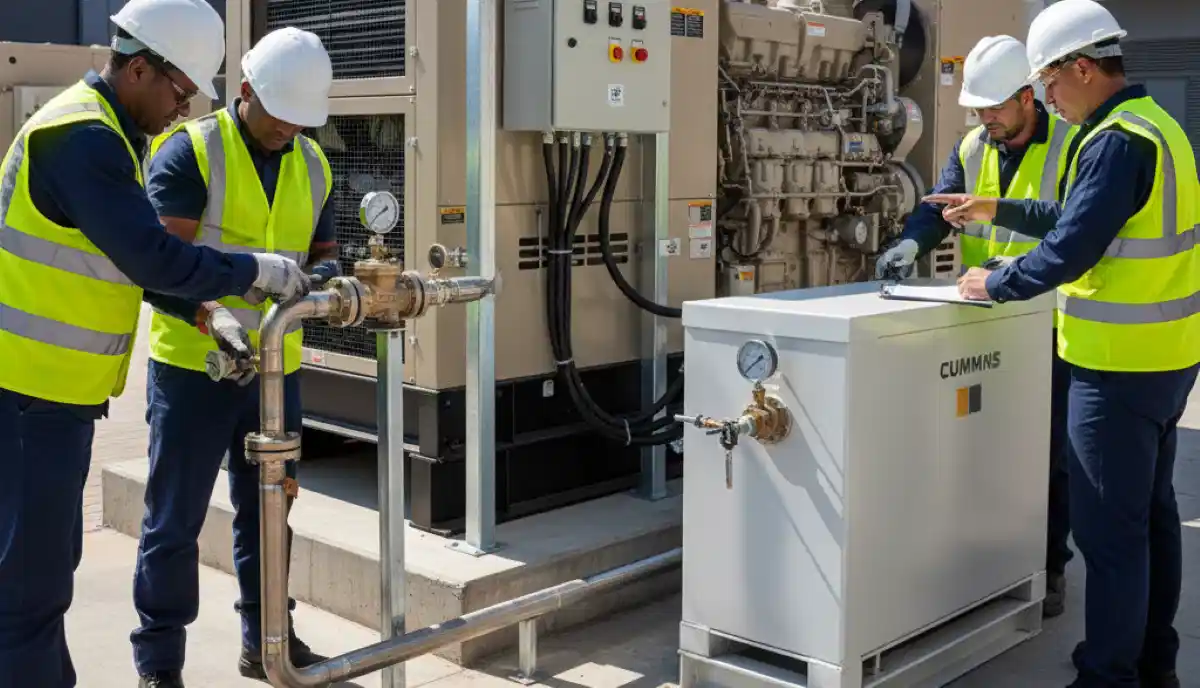
⚖️ Regulatory Thresholds by Tank Size
Capacity planning must consider regulatory thresholds. See SABS – Tank size standards and DMRE – Capacity regulations.
Key regulatory thresholds:
| Tank Size | Regulatory Requirements | Applicable Regulations |
|---|---|---|
| Under 5,000L | Basic SABS compliance, local by-laws only | SANS 10089-3 (basic) |
| 5,000L – 10,000L | SABS certification, basic environmental compliance, local permits | SANS 10089-3, local by-laws |
| 10,000L – 30,000L | SABS certification, DMRE registration, environmental authorization, regular inspections | SANS 10089-3, DMRE regulations, DFFE compliance |
| 30,000L – 80,000L | Full DMRE permit, DFFE environmental impact assessment, annual professional inspections, fire suppression requirements | SANS 10089-3, DMRE, DFFE, fire regulations |
| 80,000L+ | Full environmental impact assessment, public participation, complex permitting, dedicated fire suppression, groundwater monitoring | Full regulatory framework |
DFFE environmental thresholds:
See DFFE – Environmental thresholds for detailed requirements. Key thresholds:
- Under 10,000L: Basic environmental compliance, spill kit required
- 10,000L – 30,000L: Environmental authorization required, regular reporting
- 30,000L – 80,000L: Full environmental impact assessment may be required
- 80,000L+: Mandatory environmental impact assessment, public participation
Why thresholds matter for sizing:
If your calculated requirement is 28,000L, consider a 25,000L tank (under the 30,000L threshold) to avoid additional regulatory burden. The slightly smaller tank may be worth the simpler compliance. If you need 32,000L, consider two 15,000L tanks instead of one 30,000L+ tank.
For more on regulations, read bulk diesel storage regulations.
Need Help Sizing Your Fuel Tank?
ServiceLink SA connects you with verified tank installers who can help calculate the right size for your business. Get free quotes today. If we can’t assist directly, we’ll connect you with our trusted partner companies to carry out your fuel storage projects professionally and timeously.
What size diesel tank do I need for my business—get professional advice from certified installers.
🔄 Multiple Tanks vs One Large Tank
When bulk tank sizing, consider multiple smaller tanks instead of one large tank:
Advantages of multiple tanks:
- Redundancy: If one tank fails, others still provide fuel
- Regulatory avoidance: Stay under threshold (e.g., two 15,000L tanks vs one 30,000L+ tank)
- Flexibility: Segregate different fuel grades (50ppm vs 500ppm, diesel vs petrol)
- Easier installation: Smaller tanks may be easier to position and install
- Maintenance flexibility: Take one tank offline for cleaning while others operate
- Fuel rotation: Use different tanks in sequence to prevent fuel degradation
- Scalability: Add tanks as your business grows
Advantages of one large tank:
- Lower cost per litre of capacity (economies of scale)
- Smaller footprint (one large tank vs multiple smaller tanks)
- Simpler installation (one foundation, one set of connections)
- Easier management (single level gauge, single filling point)
Decision framework:
| Total Capacity Needed | Recommendation | Reason |
|---|---|---|
| Under 20,000L | One tank | Simpler, cost-effective, below regulatory thresholds |
| 20,000L – 30,000L | One tank or two tanks | Consider two 15,000L tanks to stay under 30,000L threshold if avoiding permits |
| 30,000L – 50,000L | Two tanks (2 × 15,000-25,000L) | Redundancy, regulatory avoidance, flexibility |
| 50,000L – 100,000L | Three or more tanks | Redundancy, scalability, maintenance flexibility |
| 100,000L+ | Tank farm (multiple tanks) | Industry standard for large operations |
Practical example:
A logistics company needs 40,000L capacity. Options:
- Option A: One 40,000L tank. Pros: lower cost per litre, smaller footprint. Cons: above 30,000L threshold (more regulation), single point of failure.
- Option B: Two 20,000L tanks. Pros: redundancy (if one fails, 20,000L still available), below 30,000L per tank (simpler compliance). Cons: higher cost, larger footprint.
- Recommendation: Two 20,000L tanks for most businesses (redundancy + simpler compliance).
For more on tank configuration, read fuel tank installation.
💰 Cost Implications by Tank Size
Fuel storage tank sizes explained with cost implications:
Typical tank costs (double-skinned, installed):
| Tank Size | Tank Only | Installation + Foundation | Pump + Accessories | Total Installed | Cost per Litre |
|---|---|---|---|---|---|
| 5,000L | R25,000-R40,000 | R5,000-R10,000 | R5,000-R10,000 | R35,000-R60,000 | R7-12/L |
| 10,000L | R40,000-R60,000 | R8,000-R15,000 | R8,000-R15,000 | R56,000-R90,000 | R5.60-9/L |
| 20,000L | R60,000-R90,000 | R10,000-R20,000 | R10,000-R20,000 | R80,000-R130,000 | R4-6.50/L |
| 30,000L | R80,000-R120,000 | R15,000-R25,000 | R15,000-R25,000 | R110,000-R170,000 | R3.70-5.70/L |
| 50,000L | R120,000-R180,000 | R20,000-R30,000 | R20,000-R30,000 | R160,000-R240,000 | R3.20-4.80/L |
| 100,000L | R180,000-R300,000 | R30,000-R50,000 | R30,000-R50,000 | R240,000-R400,000 | R2.40-4/L |
Economies of scale:
Larger tanks have lower cost per litre of capacity. A 100,000L tank costs R2.40-4/L while a 5,000L tank costs R7-12/L. However, larger tanks also mean larger capital outlay and more regulatory requirements.
ROI by tank size (example: 50,000L/month consumption, R4.50/L saving):
| Tank Size | Total Cost | Monthly Saving | Payback (months) |
|---|---|---|---|
| 5,000L | R50,000 | R225,000 | 0.2 (6 days) |
| 10,000L | R75,000 | R225,000 | 0.3 (9 days) |
| 20,000L | R105,000 | R225,000 | 0.5 (15 days) |
| 30,000L | R140,000 | R225,000 | 0.6 (18 days) |
| 50,000L | R200,000 | R225,000 | 0.9 (27 days) |
Note: Monthly saving is based on wholesale vs retail difference, independent of tank size. Larger tanks don’t increase monthly savings—they just provide more autonomy.
For more on cost analysis, read bulk diesel vs retail diesel price.
📐 Space Requirements by Tank Size
Capacity planning must consider physical space:
Approximate footprint requirements (tank + bunding + access):
| Tank Size | Tank Footprint | Bunding Area Required | Total Space Needed | Delivery Access Required |
|---|---|---|---|---|
| 5,000L | 2m × 2m (4m²) | 3m × 3m (9m²) | ~10-15m² | Standard truck |
| 10,000L | 2.5m × 2.5m (6m²) | 3.5m × 3.5m (12m²) | ~15-20m² | Standard truck |
| 20,000L | 3.5m × 3m (10.5m²) | 4.5m × 4m (18m²) | ~25-35m² | Tanker access |
| 30,000L | 4m × 3m (12m²) | 5m × 4m (20m²) | ~30-40m² | Tanker access + turning |
| 50,000L | 5m × 4m (20m²) | 6m × 5m (30m²) | ~40-60m² | Good turning radius |
| 100,000L | 7m × 5m (35m²) | 8m × 6m (48m²) | ~60-80m² | Large turning radius |
Additional space considerations:
- Distance from buildings: Minimum 5-10 metres depending on local regulations
- Distance from property lines: Minimum 3-5 metres
- Fire separation: Between tanks and between tanks and buildings
- Delivery access: Clear path for tanker trucks (minimum 3-4 metres width)
- Turning radius: 15-20 metres for large tankers
- Security perimeter: Fencing, lighting, CCTV coverage
Space-saving strategies:
- Vertical tanks have smaller footprint than horizontal tanks (but may have height restrictions)
- Underground tanks save surface space but cost more to install
- Multiple smaller tanks can be arranged to fit irregular spaces
For more on installation, read fuel tank installation.
❌ Common Sizing Mistakes to Avoid
Fuel storage tank sizes explained includes avoiding these common errors:
⚠️ Common Tank Sizing Mistakes
- Mistake #1: Basing size on average consumption (not peak consumption). Always size for peak season, not average.
- Mistake #2: No buffer for delivery delays. Always add 20-50% buffer.
- Mistake #3: Ignoring regulatory thresholds. A slightly smaller tank can avoid significant compliance burden.
- Mistake #4: Buying the smallest tank available to save upfront cost. Small tanks don’t deliver full wholesale savings.
- Mistake #5: Buying the largest tank “to be safe” without considering regulatory thresholds or fuel degradation.
- Mistake #6: Not planning for future growth. Size for expected fleet expansion.
- Mistake #7: Forgetting delivery access. Tank placement must accommodate tanker trucks.
- Mistake #8: Not considering multiple tank options for redundancy and regulatory avoidance.
How to avoid these mistakes:
- Track consumption for at least 3-6 months before sizing
- Consult with a professional installer who understands regulations
- Add 20-50% buffer to your calculated requirement
- Consider multiple smaller tanks vs one large tank
- Plan for 2-3 years of business growth
- Verify delivery access before finalising tank location
- Get quotes for multiple tank configurations
For more on planning, read how to choose a bulk fuel supplier.
❓ Frequently Asked Questions About Tank Sizing
What size diesel tank do I need for my business?
To answer what size diesel tank do I need for my business, calculate: daily consumption × desired days of autonomy × 1.2-1.5 buffer. A logistics depot with 4,000 L/day consumption × 7 days × 1.3 = 36,400L → recommend 40,000L tank. Use the calculator table in Section 3 for guidance.
How do I calculate diesel tank capacity?
Diesel tank capacity guide formula: Capacity = Daily Consumption × Desired Autonomy Days × Safety Buffer (1.2-1.5). First, calculate daily consumption by summing all equipment/vehicles. Second, choose autonomy days (5-14 depending on business). Third, add buffer for emergencies and delivery delays.
What are common fuel storage tank sizes?
Fuel storage tank sizes explained by category: small (1,000-5,000L for generator backup), medium (5,000-20,000L for small fleets), large (20,000-50,000L for medium-large fleets), very large (50,000-100,000L+ for major fleets and mines). See complete table in Section 2.
What is bulk tank sizing for logistics companies?
Bulk tank sizing for logistics: 5-10 trucks = 10,000-15,000L, 10-15 trucks = 15,000-20,000L, 15-25 trucks = 20,000-30,000L, 25-40 trucks = 30,000-50,000L, 40-60 trucks = 50,000-80,000L, 60-100 trucks = 80,000-150,000L. Add buffer for peak seasons and growth.
What regulatory thresholds apply to tank sizes?
Tank volume regulatory thresholds: under 5,000L (basic compliance), 5,000-10,000L (SABS + local permits), 10,000-30,000L (DMRE registration + environmental authorization), 30,000-80,000L (full DMRE permit + EIA), 80,000L+ (full EIA + public participation). See Section 5 for details.
Should I buy one large tank or multiple smaller tanks?
Capacity planning decision: under 20,000L → one tank. 20,000-30,000L → consider two 15,000L tanks to stay under 30,000L threshold. 30,000-50,000L → two tanks recommended (redundancy). 50,000L+ → multiple tanks (industry standard). Multiple tanks offer redundancy and regulatory avoidance.
How much space do I need for a fuel tank?
Space requirements: 5,000L tank needs ~10-15m² total (tank + bunding + access), 10,000L needs ~15-20m², 20,000L needs ~25-35m², 30,000L needs ~30-40m², 50,000L needs ~40-60m², 100,000L needs ~60-80m². Add delivery access (3-4m width, 15-20m turning radius).
How quickly will my tank investment pay back?
Payback for fuel storage tank sizes explained by ROI: most businesses recover tank investment in 1-3 months through wholesale fuel savings (15-25% vs retail). For a 50,000L/month consumer saving R4.50/L = R225,000 monthly saving. A R150,000 tank pays back in less than 1 month.
✅ Final Thoughts: Size Your Tank for Success
Fuel storage tank sizes explained properly shows that the right size balances capital investment, operational reliability, regulatory compliance, and future growth. Too small wastes money on retail fuel and driver time. Too large wastes capital and triggers unnecessary regulation.
Key takeaways from this guide:
- Fuel storage tank sizes explained starts with daily consumption × autonomy days × buffer
- Diesel tank capacity guide formula: Capacity = Daily Consumption × Days × 1.2-1.5
- Bulk tank sizing for logistics: 5-10 trucks = 10,000-15,000L; 10-25 trucks = 20,000-30,000L; 25-50 trucks = 40,000-60,000L
- What size diesel tank do I need for my business depends on consumption, industry, and growth plans
- Tank volume determines regulatory burden—stay under thresholds where possible
- Capacity planning should include 20-50% buffer for peak seasons and emergencies
- Multiple smaller tanks offer redundancy and regulatory avoidance vs one large tank
- Larger tanks have lower cost per litre but higher capital outlay
- Payback is typically 1-3 months through wholesale fuel savings
- ServiceLink SA connects you with installers who can help size your tank correctly
Your action plan: Calculate your daily consumption. Determine desired days of autonomy (5-14). Apply 20-50% buffer. Check regulatory thresholds for your calculated size. Consider multiple tanks vs one large tank. Get quotes from verified installers. Choose the size that maximises ROI while ensuring reliable fuel supply.
Ready to Find the Right Tank Size for Your Business?
ServiceLink SA connects you with verified tank installers who can help calculate the right size for your needs. Get free quotes today. If we can’t assist directly, we’ll connect you with our trusted partner companies to carry out your fuel storage projects professionally and timeously.
📞 Call us: 073 138 4726 for immediate help sizing your fuel storage tank.
Fuel Tank Installation •
Diesel Delivery •
Fleet Fueling Solutions •
Generator Fuel Services •
Fuel Management Systems
📚 Official resources & standards referenced:
- SABS – South African Bureau of Standards – Tank size standards (SANS 10089-3) and dimensional specifications.
- DMRE – Department of Mineral Resources and Energy – Capacity regulations and storage permits by size.
- DFFE – Department of Forestry, Fisheries and the Environment – Environmental thresholds by tank capacity.
- CIDB – Construction Industry Development Board – Installation standards for tank sizes.
Information provided for general guidance based on independent research and official sources. Tank size regulations, threshold limits, and compliance requirements change periodically. Always verify current requirements directly with SABS, DMRE, and DFFE.
Written by: ServiceLink SA Research Team
Fuel Storage & Capacity Planning Specialists
The ServiceLink SA Research Team combines expertise from fuel storage engineering, capacity planning, and regulatory compliance. Our analysts track SABS tank size standards (SANS 10089-3), monitor DMRE capacity regulations, analyse DFFE environmental thresholds, and maintain relationships with accredited tank installers across South Africa. This guide draws on primary research, official SABS, DMRE, and DFFE documentation, and direct experience with logistics depots, manufacturing plants, construction companies, farms, and mining operations. Our mission is to help businesses understand fuel storage tank sizes explained properly, apply diesel tank capacity guide principles, and answer what size diesel tank do I need for my business with confidence. If we can’t assist directly, we’ll connect you with our trusted partner companies who specialise in professional tank sizing and installation.
For more information about fuel storage tank sizing, explore our related resources: fuel tank installation and setup, bulk diesel storage regulations, how to choose a bulk fuel supplier, commercial fuel storage tanks, and fleet fueling solutions. See our location-specific guides for Johannesburg, Pretoria, Durban, Cape Town, and Sandton.