
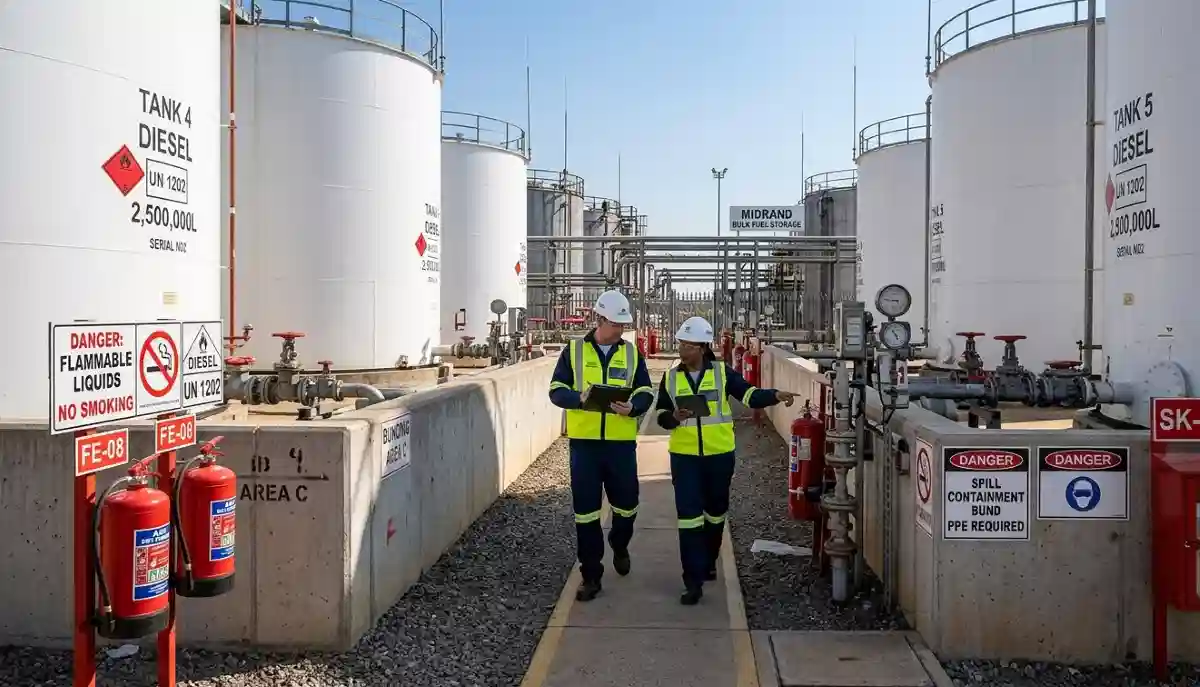
Need Compliant Fuel Bunding?
ServiceLink SA connects you with verified tank installers who understand SANS 10089-3 bunding requirements. Get free quotes today. If we can’t assist directly, we’ll connect you with our trusted partner companies to carry out your fuel storage projects professionally and timeously.
Get Free Bunding Compliance Quotes
Servicing Johannesburg, Pretoria, Durban, Cape Town, Emalahleni, and across South Africa
Fuel Bunding Requirements South Africa: SANS 10089-3 Compliance
🛡️ From bund walls to secondary containment—your complete guide to legal fuel storage compliance
I once visited a farm in the Free State where the owner had installed a 20,000-litre diesel tank without any bunding. “It’s been fine for years,” he said. Two months later, a small leak went unnoticed. By the time it was discovered, 5,000 litres of diesel had seeped into the groundwater. The cleanup cost him over R500,000. The DFFE fines added another R200,000. And his neighbour sued for contamination of a shared borehole.
That farmer learned the hard way that fuel bunding requirements South Africa are not optional suggestions—they are legal requirements with serious consequences. Secondary containment regulations exist to protect our environment, water sources, and communities from fuel spills.
This comprehensive compliance guide covers everything you need to know about tank bunding standards, including what are the bunding requirements for diesel tanks, spill containment best practices, bund wall construction, SANS 10089-3 specifications, and enforcement consequences. For more on storage regulations, read bulk diesel storage regulations in South Africa.
Ready to ensure your fuel storage is fully compliant? Let’s dive in.
📋 Table of Contents – Fuel Bunding Compliance Guide
🛡️ What Is Fuel Bunding?
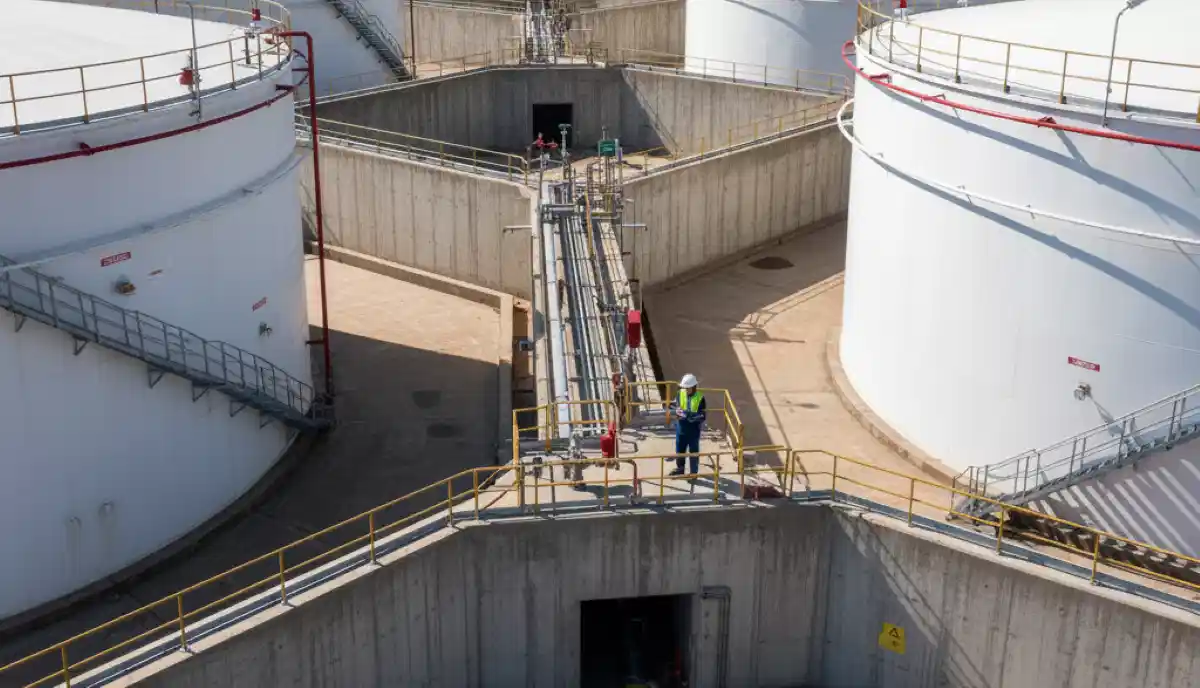
Fuel bunding is a secondary containment system designed to capture any fuel that leaks or spills from a storage tank. It acts as a safety net—if the primary tank fails, the bunding contains the fuel, preventing environmental contamination.
⚠️ The Core Concept of Bunding
A bund is an impervious barrier around a fuel tank that holds 110% of the tank’s capacity. If the tank leaks or ruptures, all fuel is contained within the bund—not in the soil, groundwater, or nearby water sources.
What bunding includes:
- Bund wall: A wall or barrier surrounding the tank area
- Bund floor: An impervious base that prevents fuel from soaking into the ground
- Impervious lining: Material that prevents fuel penetration (concrete, geomembrane, or coated steel)
- Drainage system: Controlled drainage that prevents rainwater accumulation (with valve that can be closed)
- Access: Safe entry points for inspection and maintenance
What bunding is NOT:
- A simple gravel catchment area (gravel is not impervious)
- An earthen berm without lining (earth absorbs fuel)
- A shallow dip without sufficient capacity
- An open drainage system that allows fuel to escape
Why the term “bunding”?
The term comes from the German word “Bund” meaning “wall” or “barrier.” In South African regulations, it’s the standard term for secondary containment around fuel storage.
For more on storage basics, read bulk diesel storage regulations.
⚖️ Why Bunding Is Legally Required
Secondary containment regulations exist to protect South Africa’s environment:
Legal framework for bunding requirements:
- SANS 10089-3: The primary standard for fuel storage tanks and bunding. See SABS – SANS 10089-3 bunding standards.
- DFFE regulations: Environmental laws requiring spill containment. See DFFE – Spill containment regulations.
- DMRE licensing: Storage permits require proof of bunding compliance. See DMRE – Storage licensing.
- National Water Act: Prohibits pollution of water resources—bunding prevents such pollution.
- Local by-laws: Municipal regulations often require bunding for fuel storage.
Why bunding is mandatory:
- Groundwater protection: A single litre of diesel can contaminate 1,000,000 litres of groundwater
- Soil protection: Fuel spills make soil unusable for years, requiring expensive remediation
- Water source protection: Spills can contaminate rivers, dams, and boreholes
- Public health: Contaminated water affects communities downstream
- Liability prevention: Without bunding, tank owners are liable for all environmental damage
Who is responsible for bunding?
The tank owner is legally responsible for ensuring proper bunding. This includes:
- Installing compliant bunding before fuel delivery
- Maintaining bunding integrity
- Regular inspections and documentation
- Prompt repair of any damage
- Liability for spills regardless of cause
For more on legal requirements, read bulk diesel storage regulations.
📋 SANS 10089-3 Bunding Requirements
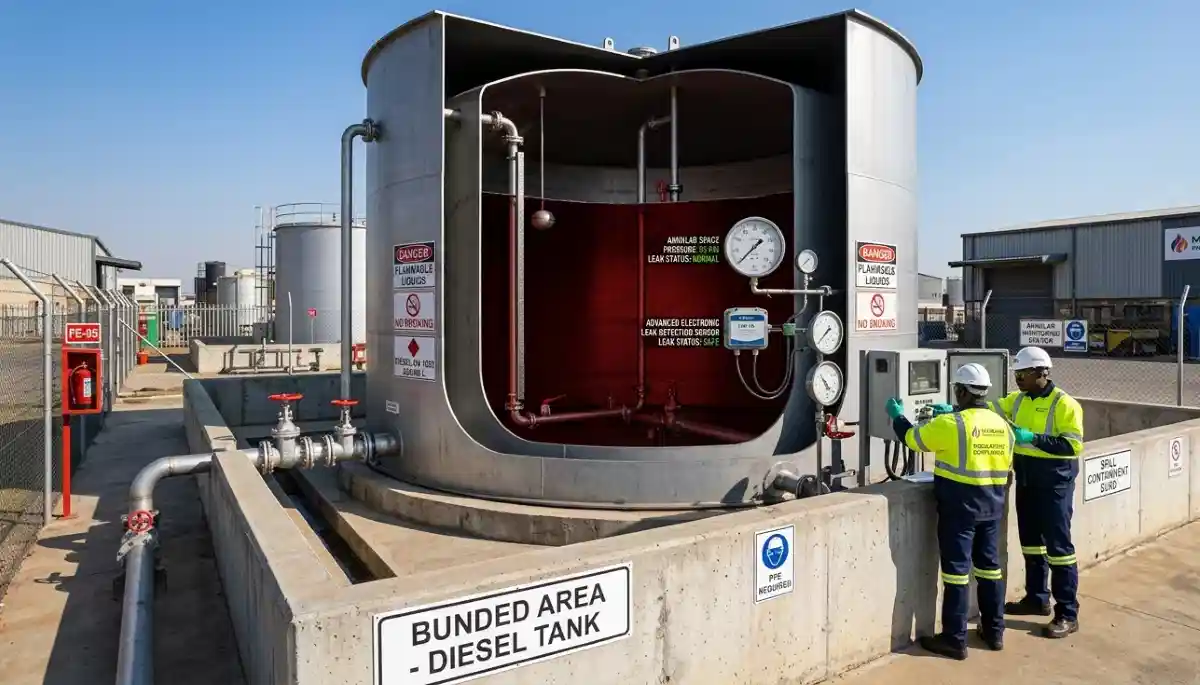
The tank bunding standards in SANS 10089-3 specify detailed requirements:
Key SANS 10089-3 bunding requirements:
- Capacity: Bund must hold 110% of the largest tank’s capacity (see Section 4)
- Imperviousness: Bund floor and walls must be impervious to fuel (no seepage)
- Material: Concrete (minimum 150mm thick with reinforcement), steel, or approved geomembrane
- Height: Bund wall height must account for tank displacement (see Section 6)
- Drainage: Rainwater drainage with normally closed valve (must not allow fuel to escape)
- Access: Safe entry points for inspection and maintenance
- Markings: Clear identification of bund boundaries and capacity
- Compatibility: Materials must be compatible with diesel (no degradation)
Bunding compliance checklist:
- ✅ Bund capacity at least 110% of tank capacity
- ✅ Bund floor and walls impervious (no cracks, holes, or porous materials)
- ✅ Concrete thickness minimum 150mm with reinforcement
- ✅ Bund wall height sufficient (accounting for tank displacement)
- ✅ Rainwater drain with normally closed valve (locked or sealed)
- ✅ No openings or penetrations that could leak
- ✅ Safe access for inspection
- ✅ Clear markings and signage
- ✅ Regular inspections documented
- ✅ No water accumulation without proper drainage procedure
Exemptions from bunding:
Limited exemptions exist for very small tanks (under 500L in some jurisdictions) but are rare. Most commercial tanks require full bunding compliance.
For more on SABS standards, read bulk diesel storage regulations.
📏 Bunding Capacity Requirements (110% Rule)
The most critical requirement in fuel bunding requirements South Africa is the 110% capacity rule:
The 110% rule explained:
The bund must have capacity to hold 110% of the volume of the largest tank within the bund. This ensures that even in a complete tank failure, all fuel is contained.
Calculation examples:
| Tank Size | Required Bund Capacity (110%) | Notes |
|---|---|---|
| 5,000L | 5,500L | Minimum capacity |
| 10,000L | 11,000L | Common farm size |
| 20,000L | 22,000L | Logistics depot size |
| 30,000L | 33,000L | Large fleet size |
| 50,000L | 55,000L | Major installation |
| 100,000L | 110,000L | Mine or major depot |
Multiple tanks in one bund:
If multiple tanks share a bund, the bund must hold 110% of the LARGEST single tank, PLUS the volume of all other tanks (except the largest) if a failure could drain multiple tanks. However, with proper separation, only the largest tank’s 110% is required.
Calculating bund dimensions:
For a rectangular bund: Capacity (L) = Length (m) × Width (m) × Height (m) × 1,000
Example: A 10,000L tank requires 11,000L bund capacity. A bund measuring 3m × 3m × 1.3m = 11.7m³ = 11,700L capacity.
Important considerations:
- Bund capacity must account for tank displacement—the tank itself takes up space in the bund
- Effective capacity = total bund volume – volume occupied by tank(s) and supports
- Bund walls must be high enough to contain fuel after accounting for displacement
- Rainwater accumulation reduces effective capacity—must be regularly removed
For more on capacity calculations, read fuel storage tank sizes explained.
🏗️ Types of Bunding Systems
Spill containment can be achieved through several bunding systems:
1. Concrete bunding (most common for permanent installations):
- Reinforced concrete walls and floor (minimum 150mm thickness)
- Impervious, durable, long-lasting
- Best for: Permanent installations, commercial depots, mines
- Cost: R20,000-R100,000+ depending on size
- Pros: Very durable, low maintenance, professional appearance
- Cons: High upfront cost, requires professional construction
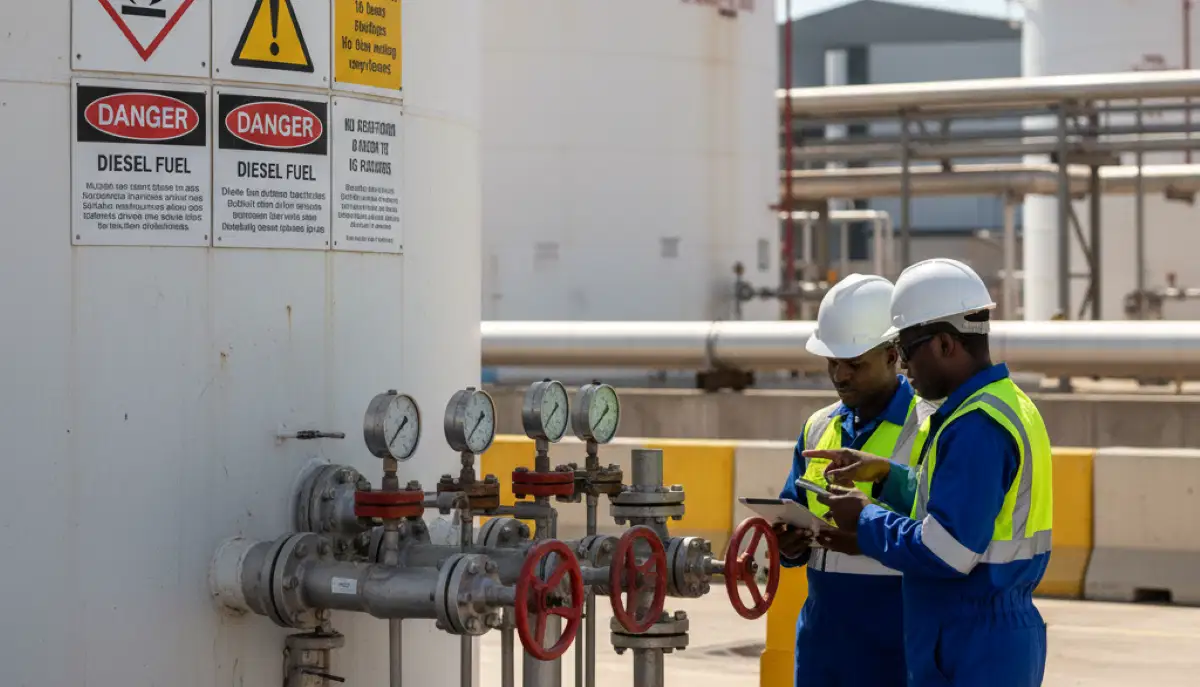
2. Steel bunding (integrated with tank):
- Double-skinned (bunded) tanks with integrated secondary containment
- Steel outer skin acts as bund
- Best for: Most commercial applications, logistics depots
- Cost: Included in double-skinned tank price (R35,000-R200,000+)
- Pros: No separate bunding installation, space-efficient, SABS compliant
- Cons: Higher tank cost than single-wall, limited to tank footprint
3. Geomembrane bunding (portable or temporary):
- Impervious liner (HDPE or similar) over compacted earth with earth bund walls
- Best for: Temporary sites, rental applications, emergency containment
- Cost: R10,000-R50,000 depending on size
- Pros: Lower cost, portable, can be installed on uneven ground
- Cons: Less durable, susceptible to punctures, shorter lifespan
4. Precast concrete bunding (modular):
- Precast concrete sections assembled on site
- Best for: Medium to large permanent installations
- Cost: R30,000-R150,000 depending on size
- Pros: Faster installation than cast-in-place, consistent quality
- Cons: Requires crane for installation, joints must be sealed
Comparison of bunding types:
| Bunding Type | Durability | Cost | Installation Time | Best For |
|---|---|---|---|---|
| Concrete cast-in-place | Very high | High | 2-4 weeks | Permanent, large installations |
| Double-skinned tank | High | Medium-high | 1-3 days | Most commercial applications |
| Geomembrane | Medium | Low-medium | 1-5 days | Temporary, rental, emergency |
| Precast concrete | High | Medium-high | 1-2 weeks | Permanent, faster than cast-in-place |
Recommended bunding type for most businesses:
Double-skinned (bunded) tanks are the most popular choice for commercial applications. They provide integrated secondary containment without separate bunding installation, save space, and are fully SABS compliant when purchased from certified manufacturers.
For more on tank types, read commercial fuel storage tanks.
Need Compliant Fuel Bunding Installed?
ServiceLink SA connects you with verified tank installers who understand SANS 10089-3 bunding requirements. Get free quotes today. If we can’t assist directly, we’ll connect you with our trusted partner companies to carry out your fuel storage projects professionally and timeously.
Get Free Bunding Compliance Quotes
What are the bunding requirements for diesel tanks—get professional compliance advice from certified installers.
🧱 Bund Wall Construction Standards
Bund wall construction must meet specific standards under SANS 10089-3:
Material requirements:
- Concrete: Minimum 150mm thickness, reinforced with steel mesh or rebar, 25MPa strength minimum
- Steel: Minimum 3mm thickness, welded seams, corrosion-protected
- Geomembrane: HDPE or equivalent, minimum 1.5mm thickness, UV-stabilised
- Masonry: Only if rendered impervious (plastered or coated)
Height requirements:
Bund wall height must be sufficient to contain 110% of tank capacity after accounting for tank displacement. For a cylindrical horizontal tank:
- Calculate tank volume displaced in bund (tank occupies space that cannot hold fuel)
- Add 110% of tank volume to displacement
- Divide by bund floor area to get required height
- Add 200-300mm freeboard (safety margin)
Structural requirements:
- Walls must withstand hydrostatic pressure of contained liquid
- Reinforcement must extend into foundation
- Expansion joints required for concrete walls over 10m length
- Water stops required at construction joints
- Corners must be reinforced
Floor requirements:
- Sloped to drainage point (minimum 1:100 gradient)
- Minimum 150mm concrete thickness with reinforcement
- Impervious surface finish (steel trowel or sealer)
- No cracks, holes, or penetrations
Drainage system requirements:
- Rainwater drain with normally closed valve (locked or sealed)
- Valve must be operated only when bund is free of fuel
- Drain must discharge to safe location (not to stormwater or watercourses)
- Alternative: Pump-out system for rainwater removal
Access requirements:
- Safe entry points for inspection and maintenance
- Steps or ladder if bund wall height >1m
- Handrails for heights >1.5m
- Clear signage indicating bund boundaries and hazards
For more on construction standards, read fuel tank installation.
🛢️ Double-Skinned Tanks as Bunding
Double-skinned (bunded) tanks are an alternative to separate bunding structures:
What is a double-skinned tank?
A double-skinned tank has an inner tank (holding the fuel) and an outer tank (the bund). The space between the skins acts as secondary containment. If the inner tank leaks, fuel is captured in the outer skin.
Advantages of double-skinned tanks:
- Integrated bunding: No separate bunding construction required
- Space-efficient: Smaller footprint than tank + separate bund
- Lower installation cost: One installation instead of tank + bund
- Leak detection: Interstitial space can be monitored for leaks
- Compliance: SABS-certified double-skinned tanks meet bunding requirements
- Portability: Can be relocated if needed (unlike concrete bunds)
Capacity requirements for double-skinned tanks:
The outer tank must have capacity equal to at least 110% of the inner tank’s capacity. Most SABS-certified double-skinned tanks meet or exceed this requirement.
Leak detection requirements:
SANS 10089-3 requires leak detection in double-skinned tanks:
- Visual inspection ports to check interstitial space
- Electronic leak detection sensors (recommended for larger tanks)
- Regular monitoring of interstitial space for fuel presence
When to choose double-skinned vs separate bunding:
- Choose double-skinned tank for: Most commercial applications, space-constrained sites, lower installation cost, portability needs
- Choose separate bunding for: Very large tanks (100,000L+), multiple tanks sharing one bund, sites where double-skinned tanks not available in required size, existing single-wall tanks needing bunding
Cost comparison:
- Single-wall tank + concrete bund: Lower tank cost + higher bund cost
- Double-skinned tank: Higher tank cost + no bund cost
- Result: Similar total cost, but double-skinned offers simpler installation and portability
For more on double-skinned tanks, read commercial fuel storage tanks.
🔍 Inspection and Maintenance Requirements
Spill containment systems require regular inspection and maintenance:
Weekly inspections (owner responsibility):
- Visual check for cracks, holes, or damage to bund walls and floor
- Check for water accumulation in bund (record depth)
- Inspect drainage valve for proper closure and seal
- Look for signs of fuel leakage (sheen on water, fuel smell, staining)
- Check bund markings and signage for visibility
Monthly inspections (owner responsibility):
- Check for vegetation growth in bund (roots can damage concrete)
- Inspect sealants and joints for deterioration
- Check leak detection system (if fitted) for proper operation
- Remove any debris or foreign material from bund
- Document all inspections in logbook
Annual inspections (professional required):
- Professional structural inspection of bund integrity
- Bunding integrity test (fill with water, check for leaks)
- Concrete testing for strength and permeability (for concrete bunds)
- Geomembrane testing for punctures or degradation (for liner bunds)
- Leak detection system calibration (if fitted)
- Documentation and compliance certification
Maintenance requirements:
- Repair cracks or damage immediately (temporary patching allowed until permanent repair)
- Remove water from bund regularly (using pump or drain with valve closed after)
- Never leave drain valve open—only open when pumping water, close immediately after
- Apply sealant or coating to concrete as needed to maintain imperviousness
- Replace damaged geomembrane sections
- Keep spill kit accessible for bund area
Record keeping requirements:
- Weekly inspection log (date, inspector, findings, actions)
- Monthly inspection log
- Annual professional inspection report
- Maintenance and repair records
- Water removal records
- Keep records for 5 years minimum (or longer if required by DMRE/DFFE)
For more on maintenance, read fuel tank cleaning and maintenance.
⚖️ Penalties for Non-Compliance
Failure to meet fuel bunding requirements South Africa carries severe penalties:
DMRE penalties (storage licensing):
- Fines up to R10 million for serious violations
- Shutdown orders until compliance achieved
- Revocation of storage permits
- Blacklisting from future permits
- Daily penalties for continued non-compliance
DFFE penalties (environmental):
- Fines based on extent of environmental damage
- Cleanup costs (can exceed R1 million for groundwater contamination)
- Third-party liability (neighbours, water users)
- Criminal charges for knowing violations
- Director liability (personal fines and imprisonment)
Local authority penalties:
- Fines for by-law violations
- Removal orders
- Prohibition on fuel deliveries until compliance
- Legal action
Insurance implications:
- Policy void if non-compliant tank causes damage
- Claim denial for spills from non-compliant bunding
- Increased premiums for known compliance issues
- Difficulty obtaining coverage
Real-world penalty examples (illustrative):
| Violation | Typical Penalty Range | Additional Consequences |
|---|---|---|
| No bunding at all | R50,000-R500,000 | Tank must be emptied until bunding installed |
| Insufficient bunding capacity (<110%) | R20,000-R200,000 | Must upgrade bunding |
| Cracked/damaged bunding | R10,000-R100,000 | Must repair within 30 days |
| No drainage valve or valve left open | R5,000-R50,000 | Must install/repair valve |
| Fuel spill due to bunding failure | Cleanup cost + R100,000-R1,000,000+ | Third-party liability, potential criminal charges |
How to avoid penalties:
- Install compliant bunding before fuel delivery
- Conduct regular inspections (weekly, monthly, annual)
- Document all inspections and maintenance
- Repair any damage immediately
- Train staff on bunding requirements and procedures
- Use professional installers for new installations
For more on compliance, read bulk diesel storage regulations.
❓ Frequently Asked Questions About Fuel Bunding
What are the fuel bunding requirements in South Africa?
Fuel bunding requirements South Africa under SANS 10089-3 require secondary containment capable of holding 110% of the largest tank’s capacity. Bunding must be impervious (concrete, steel, or approved liner), with proper drainage, access, and regular inspections. Double-skinned tanks are an acceptable alternative.
What is the 110% bunding rule?
The 110% rule requires bunding to have capacity to hold 110% of the largest tank’s volume. For a 10,000L tank, bunding must hold 11,000L. This ensures that even in a complete tank failure, all fuel is contained. The rule accounts for tank displacement and provides a safety margin.
What are the secondary containment regulations for diesel tanks?
Secondary containment regulations under SANS 10089-3, DFFE, and DMRE require bunding or double-skinned tanks for all commercial fuel storage. Requirements include 110% capacity, impervious materials, proper drainage, regular inspections, and documentation. Penalties for non-compliance include fines up to R10 million.
What is a bund wall and how is it constructed?
A bund wall is an impervious barrier surrounding a fuel tank for spill containment. Construction requires reinforced concrete (minimum 150mm thickness, 25MPa), steel, or approved geomembrane. Walls must withstand hydrostatic pressure, with proper reinforcement, expansion joints, and water stops.
Do I need bunding for my diesel tank?
Yes, most commercial diesel tanks require bunding under SANS 10089-3. Exceptions are rare and typically only for very small tanks (under 500L in some jurisdictions). For any tank over 1,000L, bunding or double-skinned construction is mandatory. Check with local authorities for specific requirements.
What is the difference between bunding and a double-skinned tank?
Bunding is a separate structure (walls and floor) surrounding a single-wall tank. A double-skinned tank has an integrated outer skin that acts as bunding. Both meet tank bunding standards when properly designed. Double-skinned tanks are often preferred for space efficiency and simpler installation.
How often must bunding be inspected?
Bunding requires weekly visual inspections (owner), monthly detailed inspections (owner), and annual professional inspections. Regular inspections check for cracks, damage, water accumulation, valve function, and signs of leakage. All inspections must be documented and records kept for minimum 5 years.
What are the penalties for non-compliant bunding?
Penalties include DMRE fines up to R10 million, DFFE fines plus cleanup costs (potentially R1M+), local authority fines, insurance voidance, and potential criminal charges for serious violations. Non-compliant bunding can also result in shutdown orders and prohibition of fuel deliveries.
✅ Final Thoughts: Comply with Bunding Requirements
Fuel bunding requirements South Africa exist to protect our environment, water sources, and communities. Non-compliance carries severe penalties—financial, legal, and reputational. But more importantly, proper bunding prevents environmental disasters that can affect generations.
Key takeaways from this guide:
- Fuel bunding requirements South Africa are mandated by SANS 10089-3, DFFE, and DMRE
- Secondary containment regulations require 110% capacity bunding or double-skinned tanks
- Tank bunding standards specify impervious materials, proper drainage, and regular inspections
- What are the bunding requirements for diesel tanks—bunding must hold 110% of tank capacity
- Spill containment prevents groundwater contamination (1L diesel contaminates 1,000,000L water)
- Bund wall construction requires reinforced concrete, steel, or approved geomembrane
- Double-skinned tanks offer integrated bunding without separate construction
- Weekly, monthly, and annual inspections are mandatory
- Non-compliance penalties include fines up to R10 million and potential criminal charges
- ServiceLink SA connects you with verified installers who understand SANS 10089-3 compliance
Your action plan: Assess your current fuel storage for bunding compliance. If no bunding or inadequate bunding, stop using the tank immediately. Get quotes from verified installers for compliant bunding or double-skinned tank replacement. Implement regular inspection schedule. Document everything. Protect your business, your community, and your environment.
Ready to Ensure Your Fuel Storage Is Compliant?
ServiceLink SA connects you with verified tank installers who understand SANS 10089-3 bunding requirements. Get free quotes today. If we can’t assist directly, we’ll connect you with our trusted partner companies to carry out your fuel storage projects professionally and timeously.
📞 Call us: 073 138 4726 for immediate help finding bunding compliance installers near you.
Fuel Tank Installation •
Tank Cleaning & Maintenance •
Diesel Delivery •
Generator Fuel Services •
Fuel Management Systems
📚 Official resources & standards referenced:
- SABS – South African Bureau of Standards – SANS 10089-3 bunding standards, tank specifications, and certification requirements.
- DFFE – Department of Forestry, Fisheries and the Environment – Spill containment regulations, environmental compliance, and reporting requirements.
- DMRE – Department of Mineral Resources and Energy – Storage licensing, permits, and inspection requirements.
- DWS – Department of Water and Sanitation – Water resource protection regulations relevant to fuel storage.
Information provided for general guidance based on independent research and official sources. Bunding requirements, regulatory standards, and compliance thresholds change periodically. Always verify current requirements directly with SABS, DFFE, and DMRE.
Written by: ServiceLink SA Research Team
Environmental Compliance & Fuel Storage Specialists
The ServiceLink SA Research Team combines expertise from environmental engineering, regulatory compliance, and fuel storage systems. Our analysts track SABS SANS 10089-3 bunding standards, monitor DFFE spill containment regulations, analyse DMRE storage licensing requirements, and maintain relationships with accredited tank installers across South Africa. This guide draws on primary research, official SABS, DFFE, and DMRE documentation, and direct experience with environmental compliance audits and spill remediation projects. Our mission is to help South African businesses understand fuel bunding requirements South Africa, comply with secondary containment regulations, and meet tank bunding standards to protect the environment and avoid penalties. If we can’t assist directly, we’ll connect you with our trusted partner companies who specialise in compliant fuel storage solutions.
For more information about fuel bunding and compliance, explore our related resources: bulk diesel storage regulations, fuel tank installation and setup, fuel tank cleaning and maintenance, how to choose a bulk fuel supplier, commercial fuel storage tanks, and fuel storage tank sizes explained. See our location-specific guides for Johannesburg, Pretoria, Durban, Cape Town, and Emalahleni.