Ready to Book Your DSTV Installation?
Ensure all requirements are met. Get a free quote from a verified, accredited DSTV installer near you.
Same-day service available across South Africa.
Servicing Gauteng, Northern Cape, Free State, Kimberley, Bloemfontein, and across South Africa
DSTV Installation Requirements in South Africa: What You Need Before You Book
📡 Before you book an installer, use this complete checklist to ensure your home is ready for DSTV.
You’ve decided to get DSTV. You’ve chosen your package. Now you need installation.
But before you book, there’s something most homeowners don’t realise: not every home is automatically ready for DSTV.
I’ve seen it happen too many times. An installer arrives, only to discover the homeowner doesn’t have a clear line of sight,
the body corporate requires approval, or the roof isn’t suitable for mounting. The installation is delayed,
costs increase, and everyone is frustrated.
In this guide, I’ll walk you through all the dstv installation requirements you need to know before booking.
You’ll learn the technical specifications, the legal requirements, and the requirements for dstv
that most homeowners overlook. Use this dstv installation checklist to prepare your home properly.
If you’re asking “what do i need for dstv installation”, start with the checklist below.
For a complete walkthrough of the installation process, read our
how to install DSTV guide.
And for cost information, see installation costs.
📋 Table of Contents – DSTV Installation Requirements Guide
✅ Quick DSTV Installation Requirements Checklist
Before reading the detailed requirements, use this quick installation checklist
to see if your home is ready for DSTV.
📋 Pre-Installation Quick Checklist:
- □ Clear line of sight to the northeast (no trees, buildings, or obstructions)
- □ Suitable mounting surface (brick, concrete, or sturdy roof trusses)
- □ Power outlet within 1.5m of decoder location
- □ TV with available HDMI or AV input
- □ Body corporate approval (if you live in a complex or estate)
- □ Active DSTV subscription or plan to activate
- □ Budget for installation (R800-R1,500 for standard setup)
- □ Safe access to installation area (for the installer)
💡 Pro Tip:
Print this checklist and review it before booking your installation.
Being prepared saves time and prevents costly call-out fees for issues that could have been resolved beforehand.
⚙️ Technical DSTV Installation Requirements & Specifications
Understanding the technical dstv installation requirements helps you ensure your home is ready
and helps you spot when an installer is cutting corners.
| Component | Minimum Requirement | Optimal Specification | Why It Matters |
|---|---|---|---|
| Satellite Dish | 60cm steel | 80cm galvanized steel | Larger dish provides better rain margin and signal in fringe areas |
| LNB Type | Universal LNB (single output) | Quad or Smart LNB | Future-proofs for Extra View or Explora upgrades |
| Coaxial Cable | RG59 | RG6 copper core, double-shielded | Better shielding reduces interference and signal loss over distance |
| Signal Strength | 70% | 85%+ | Higher strength provides margin for rain fade and long-term degradation |
| Signal Quality | 70% | 85%+ | Quality determines picture clarity – more important than strength |
| Connector Type | Screw-on F-type | Compression F-type | Compression connectors are more weather-resistant and reliable |
For complete information on what’s included in a standard installation, read our
what’s included guide.
And for satellite dish specifics, see satellite dish installation guide.
📍 Site & Line of Sight Requirements
The most critical requirements for dstv is a clear line of sight to the satellite.
Without this, no amount of equipment or expertise will give you a good signal.
Line of sight requirements:
- Direction: Your dish must point northeast (approximately 45° magnetic azimuth)
- Elevation: Approximately 35° above the horizon (varies slightly by location in South Africa)
- Clear view: No trees, buildings, walls, or other obstructions in this path
- Distance to obstructions: Maintain at least 3 times the dish diameter distance from potential blockers
How to check your line of sight:
- Stand where the dish will be mounted (ground level is fine for checking)
- Face northeast (use a compass app on your phone)
- Look up at approximately 35° angle (about the height of a two-story building at 20m distance)
- Check for any trees, buildings, or other obstructions
Common obstructions in South Africa:
- Trees (especially problematic in older suburbs with mature vegetation)
- Neighbour’s houses or extensions
- Your own roof structures or solar panels
- New developments (apartment blocks can appear after your installation)
⚠️ Important:
Even a small tree branch in your line of sight can reduce signal quality by 50% or more.
If you’re in a complex, check with neighbours – their existing dishes indicate a clear line of sight is possible.
📦 Equipment Requirements (Dish, LNB, Cables)
Proper equipment is essential for meeting dstv installation requirements.
Here’s what you need to know about each component.
Satellite dish requirements:
- Minimum size: 60cm diameter for most of South Africa
- Coastal areas (Durban, Cape Town): 80cm recommended due to rain fade
- Fringe areas (deep valleys, far north): 80cm-1.2m may be required
- Material: Steel (galvanized preferred for rust resistance)
- Mounting: Must be secure enough to withstand local wind conditions
LNB requirements:
- Type: Universal Ku-band LNB (10.7–12.75 GHz)
- Outputs: Single for one decoder, Quad for multiple decoders or future expansion
- Smart LNB: Required for Explora Ultra and internet features
- Skew adjustment: LNB must be rotatable for polarization alignment
Cable requirements:
- Type: RG6 coaxial cable (minimum), RG11 for runs over 30m
- Copper core: Avoid copper-clad steel (CCS) which has higher signal loss
- Shielding: Dual or quad-shielded for interference rejection
- Weatherproofing: UV-resistant outer jacket for outdoor sections
For LNB selection guidance, read our
Smart LNB vs Universal LNB guide
and LNB replacement guide.
Not Sure If Your Home Meets the Requirements?
Get a free site assessment from a verified, accredited DSTV installer.
They’ll check line of sight, equipment needs, and provide a detailed quote.
No obligation. We’ll identify any issues before you book.
📜 Legal & Body Corporate Requirements
One of the most overlooked dstv installation requirements is legal approval.
In complexes and estates, you cannot simply install a dish without permission.
For sectional title properties (complexes, townhouses, apartments):
- Body corporate approval: Most require written permission before installation
- Communal systems: Many complexes have communal DSTV systems that you MUST use instead of individual dishes
- Placement restrictions: Some restrict dish placement to specific areas (e.g., back of unit only)
- Size restrictions: Some limit dish size to 60cm for aesthetic reasons
- Removal requirements: You may be required to remove the dish when you move out
For full-title properties (standalone houses):
- Generally no body corporate approval needed
- Check municipal bylaws (rarely enforced for standard dishes)
- Heritage or conservation areas may have restrictions
- If you rent, you need landlord permission
For apartments:
- Check your lease agreement first
- Body corporate rules often prohibit balcony mounting
- Communal system may be your only option
- Read our apartment installation guide
💡 Critical Tip:
Never install a dish without body corporate approval. I’ve seen homeowners forced to remove dishes
at their own expense (R800-R1,500) because they didn’t get permission first.
Always check before drilling holes.
For complex-specific guidance, read our
townhouse installation guide.
⚡ Electrical & Power Requirements
Your decoder needs power, and your installation must meet electrical safety standards.
Here are the dstv installation requirements for power.
Power requirements:
- Outlet proximity: Power outlet within 1.5m of decoder location
- Surge protection: Use a surge-protected power strip (protects against lightning and power surges)
- Load shedding: Consider a UPS/inverter if you want to watch during power outages
- Grounding: The dish should be properly grounded (SANS standards) to protect against lightning
Electrical interference prevention:
- Keep coaxial cables at least 15cm away from electrical wiring
- Don’t run cables parallel to power cables for long distances
- Avoid placing decoders near large appliances (fridges, microwaves) that cause interference
- Use quality shielded RG6 cable to reject interference
For electrical services related to DSTV installation, see our
electrical services page.
🏢 Apartment & Complex Requirements
If you live in an apartment or complex, the dstv installation requirements are different.
Here’s what you need to know.
Communal DSTV systems:
- Many complexes have a single dish feeding all units via a distribution system
- You simply connect your decoder to the wall outlet – no individual dish needed
- Connection cost is typically lower (R500-R1,000) than a full installation
- Monthly fees are the same as standard DSTV packages
- Read our communal installation guide
If individual dishes are allowed:
- Balcony mounting is common but often restricted
- Ground-floor units may mount on garden poles
- Line of sight is often challenging in apartments
- Professional site assessment is essential
- Read our apartment installation guide
🌾 Rural & Fringe Area Requirements
If you live in a rural area or on the edge of DSTV’s coverage footprint,
the dstv installation requirements are more demanding.
For rural/fringe areas:
- Larger dish: 80cm to 1.2m diameter (signal is weaker at the edge of coverage)
- Better LNB: Premium low-noise LNB (0.5dB or lower noise figure)
- Quality cable: RG11 for runs over 30m (lower signal loss than RG6)
- Professional alignment: Essential – fringe areas have zero margin for error
- Regular maintenance: Annual checks recommended as signal can degrade over time
For specific regional guidance, see our location pages for
Northern Cape,
Free State,
Kimberley, and
Bloemfontein.
📋 What’s Included in a Standard DSTV Installation?
Understanding what’s included helps you ensure all dstv installation requirements are met
and prevents unexpected charges.
- Satellite dish: 60cm (or larger depending on location)
- LNB: Single or Quad depending on your needs
- Coaxial cable: Up to 20m of RG6 (additional cable may cost extra)
- Mounting hardware: Brackets, bolts, wall anchors
- F-connectors: Compression type (professional grade)
- Weatherproofing: Self-amalgamating tape for outdoor connections
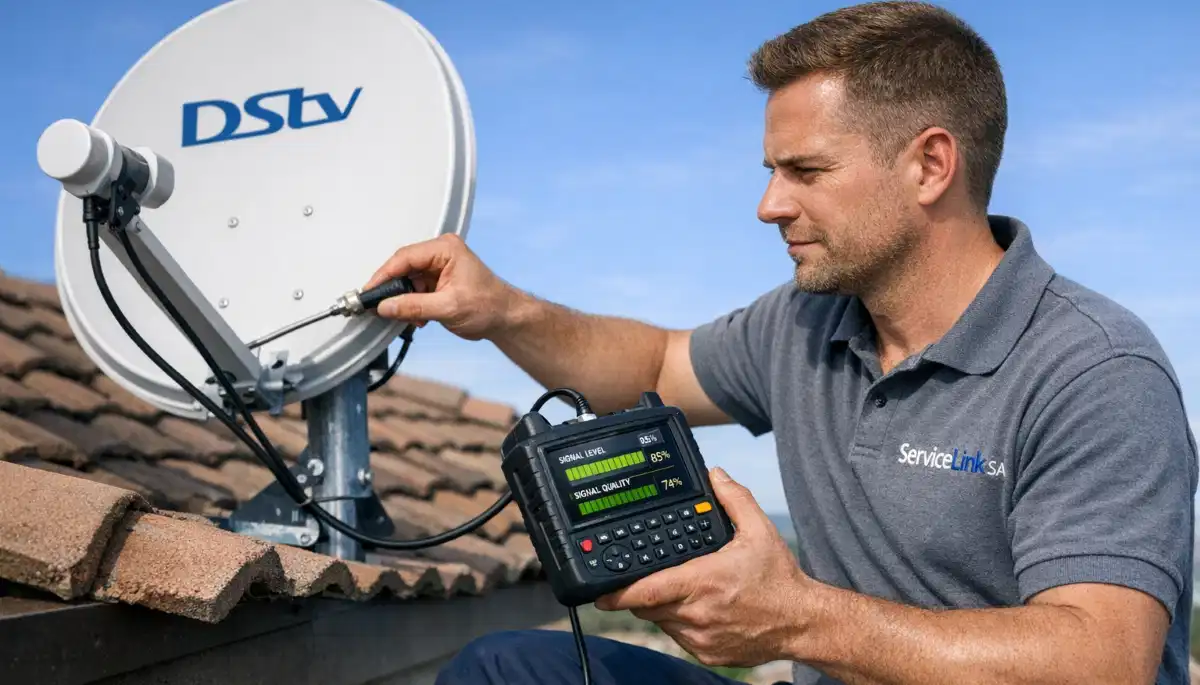
- Dish alignment: Professional alignment using signal meter
- Decoder connection: Connect and configure your decoder
- Signal testing: Verify strength and quality (target 85%+)
- Warranty: 12-month workmanship guarantee
For complete details, read our
what’s included in DSTV installation guide.
📝 Homeowner Preparation Checklist (Before Installer Arrives)
To ensure a smooth installation that meets all dstv installation requirements,
complete these steps before your installer arrives.
- Clear the installation area: Remove furniture, plants, or obstacles near where the dish will be mounted
- Provide clear access: Ensure the installer can access your roof, attic, or crawl spaces if needed
- Prepare the decoder location: Clear the area where your decoder will sit (ensure ventilation)
- Check your TV: Ensure your TV has an available HDMI port (most modern TVs do)
- Have your DSTV smartcard ready: You’ll need it for activation
- Secure pets: Keep pets away from the work area for their safety and the installer’s
- Discuss placement with the installer: Walk through the proposed dish location before they start drilling
- Confirm body corporate approval: Have written approval ready if required
💰 Cost Factors & Regional Variations
The dstv installation requirements and costs vary by location.
Here’s what to expect in different regions.
| Region | Typical Dish Size | Installation Cost Range | Special Considerations |
|---|---|---|---|
| Gauteng (Johannesburg, Pretoria) | 60cm | R800 – R1,300 | Urban density, many installers = competitive pricing |
| Western Cape (Cape Town) | 80cm recommended | R900 – R1,500 | Coastal corrosion, rain fade, mountainous terrain |
| KwaZulu-Natal (Durban) | 80cm recommended | R850 – R1,450 | High humidity, tropical rain, salt air |
| Northern Cape (Kimberley) | 60cm-80cm | R900 – R1,600 | Fewer installers, longer travel distances, dust storms |
| Free State (Bloemfontein) | 60cm-80cm | R850 – R1,500 | Extreme temperatures, open landscapes with wind |
For location-specific quotes, see our service pages or
request a free quote.
For detailed pricing, read our installation cost guide.
❓ Frequently Asked Questions About DSTV Installation Requirements
What are the basic DSTV installation requirements for a house?
The basic dstv installation requirements are: a clear line of sight to the northeast,
a suitable mounting surface (brick, concrete, or sturdy roof), a power outlet within 1.5m of the decoder,
a TV with HDMI input, and an active DSTV subscription.
For complexes, you also need body corporate approval.
What size dish do I need for DSTV in South Africa?
A 60cm dish meets requirements for dstv in most of South Africa.
Coastal areas (Durban, Cape Town) and fringe areas may need 80cm-1.2m dishes for reliable signal during rain.
Your installer should recommend the right size based on your specific location.
Do I need body corporate approval for DSTV installation?
Yes, if you live in a complex, townhouse, or apartment. Most body corporates require written approval
before dish installation. Some complexes have communal DSTV systems
that you must use instead of individual dishes. Never install without checking – you could be forced to remove it.
What cable is required for DSTV installation?
RG6 coaxial cable is the minimum requirement. For runs over 30 meters, RG11 is recommended.
The cable should have a copper core (not copper-clad steel) and proper shielding.
Dstv installation requirements specify weatherproof, UV-resistant cable for outdoor sections.
Can I install DSTV in an apartment?
Yes, but check your body corporate rules first. Many apartments have communal systems
that you must use. If individual dishes are allowed, balcony mounting may be restricted.
Read our apartment installation guide for complete requirements.
What is the minimum signal strength for DSTV?
The minimum installation checklist requirement is 70% signal strength AND 70% signal quality.
For reliable viewing without pixelation or rain fade, aim for 85%+ on both metrics.
Professional installers will show you the readings before they leave.
Do I need a TV licence for DSTV?
Yes. Any device capable of receiving television broadcasts (including DSTV) requires a valid TV licence
under South African law. The annual fee is approximately R265.
This is a legal requirement separate from your DSTV subscription.
What happens if my property doesn’t meet the installation requirements?
If your property doesn’t meet the dstv installation requirements, options include:
relocating the dish to a different position, trimming trees, using a larger dish,
installing a ground pole mount, or using DSTV Stream
instead of satellite. A professional site assessment will identify the best solution.
How long does a standard DSTV installation take?
A standard installation that meets all dstv installation requirements typically takes 2-3 hours.
Complex installations (Extra View, communal systems, difficult roof access) may take 4-6 hours.
Your installer should provide a time estimate before starting.
What’s included in a standard DSTV installation?
A standard installation includes: 60cm dish, LNB, up to 20m RG6 cable, mounting hardware,
F-connectors, weatherproofing, professional alignment, decoder connection, signal testing,
and a 12-month workmanship warranty. Read our
complete guide for details.
✅ Final Thoughts: Be Prepared, Save Time and Money
Understanding the dstv installation requirements before you book saves time, money, and frustration.
By using this checklist, you’ll know if your home is ready, what equipment you need, and what legal approvals are required.
The most common issues I see are: lack of body corporate approval (causing delays or forced removal),
poor line of sight (requiring dish relocation or larger dish), and inadequate power outlets near the decoder location.
All of these can be identified and resolved before the installer arrives.
If you’re unsure about any of these requirements, request a free site assessment
from a verified, accredited DSTV installer. They’ll identify any issues and provide a detailed quote.
And if you’re ready to book, get free quotes from local professionals through ServiceLink SA.
Ready to Book Your DSTV Installation?
Ensure all requirements are met. Get free, no-obligation quotes from verified, accredited DSTV installers near you.
Compare prices, check reviews, and book with confidence.
📞 Call us: 073 138 4726 for immediate installation assistance.
How to choose an installer •
Beat Your Quote guarantee •
12-month warranty
📚 Official resources & standards referenced:
- Official DSTV installation requirements – Official technical specifications.
- SABS – South African Bureau of Standards compliance standards.
Information provided for general guidance. DSTV is a registered trademark of MultiChoice.
Requirements may vary by property type and location. Always verify with your installer before proceeding.
Written by: Innocent T Hanyani
Satellite & Home Entertainment Installation Specialist | 21+ Years Experience
Innocent T Hanyani has over two decades of experience in satellite television installations across South Africa.
He has helped thousands of homeowners navigate DSTV installation requirements, from technical specifications
to body corporate approvals. His practical checklists and guides help South Africans prepare their homes correctly,
saving time and preventing costly installation delays.
For more information about DSTV installation requirements, explore our related resources:
how to install DSTV guide,
what’s included in installation,
installation costs,
satellite dish installation guide,
apartment installation guide,
townhouse installation guide.
See our service areas page for coverage in your region.