
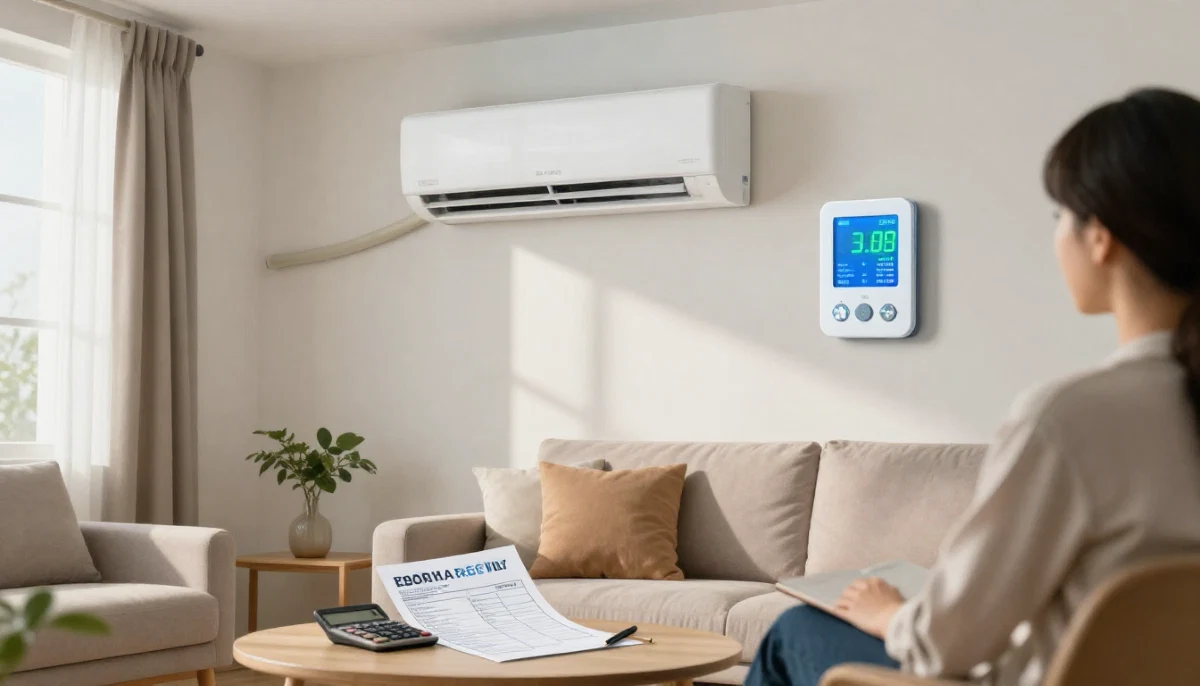
Want to Reduce Your Aircon Electricity Bill?
Get free quotes from verified local specialists for energy-efficient installations and smart AC setups.
Find Energy-Efficient Aircon Specialists Near Me
Servicing Johannesburg, Pretoria, Cape Town, Durban, and across South Africa
How Much Electricity Does an Aircon Use? The Shocking Cost Breakdown
⚡💰 From BTU to kWh—the complete guide to aircon power consumption and real electricity costs in South Africa
You’ve just received your electricity bill. Your eyes widen. It’s R800 higher than last month. You look at the calendar—yes, it’s summer. Yes, you’ve been running the aircon. But R800 extra? That seems excessive.
You start wondering: “How much electricity does my aircon actually use? Is this normal? Is there something wrong with my unit? Should I be using it differently?”
I’ve heard these questions hundreds of times. The truth is, most homeowners have no idea what their aircon costs to run. They know it uses “a lot” of electricity, but they can’t put a number on it. And without numbers, you can’t make informed decisions about usage, upgrades, or energy-saving strategies.
In this guide, I’ll give you the complete breakdown of aircon electricity usage. I’ll show you exactly how many watts different aircon sizes consume, how to calculate your actual running costs based on Eskom tariffs, and—most importantly—how to slash your bill without sacrificing comfort.
For more energy guidance, check aircon running costs explained and how to reduce electricity bills. Ready to understand your aircon’s appetite for power? Let’s go.
📋 Table of Contents – Aircon Electricity Usage Guide
⚡ Quick Answer: How Much Power Does an Aircon Use?
Here’s the short answer before we dive into details:
🏠 Small Bedroom (9,000 BTU)
Power: 700-900 watts
Cost per hour: R1.75 – R2.25
Cost per month (8hrs/day): R210 – R270
🛋️ Living Room (12,000 BTU)
Power: 1,000-1,300 watts
Cost per hour: R2.50 – R3.25
Cost per month (8hrs/day): R300 – R390
🏠 Large Open Plan (18,000 BTU)
Power: 1,600-2,000 watts
Cost per hour: R4.00 – R5.00
Cost per month (8hrs/day): R480 – R600
🏢 Whole Home (24,000 BTU)
Power: 2,200-2,800 watts
Cost per hour: R5.50 – R7.00
Cost per month (8hrs/day): R660 – R840
Key takeaway: A typical 12,000 BTU aircon used 8 hours daily costs R300-R390 per month at current Eskom tariffs (R2.50-R3.50 per kWh). Inverter models use 30-50% less electricity.
Read our detailed running costs guide.
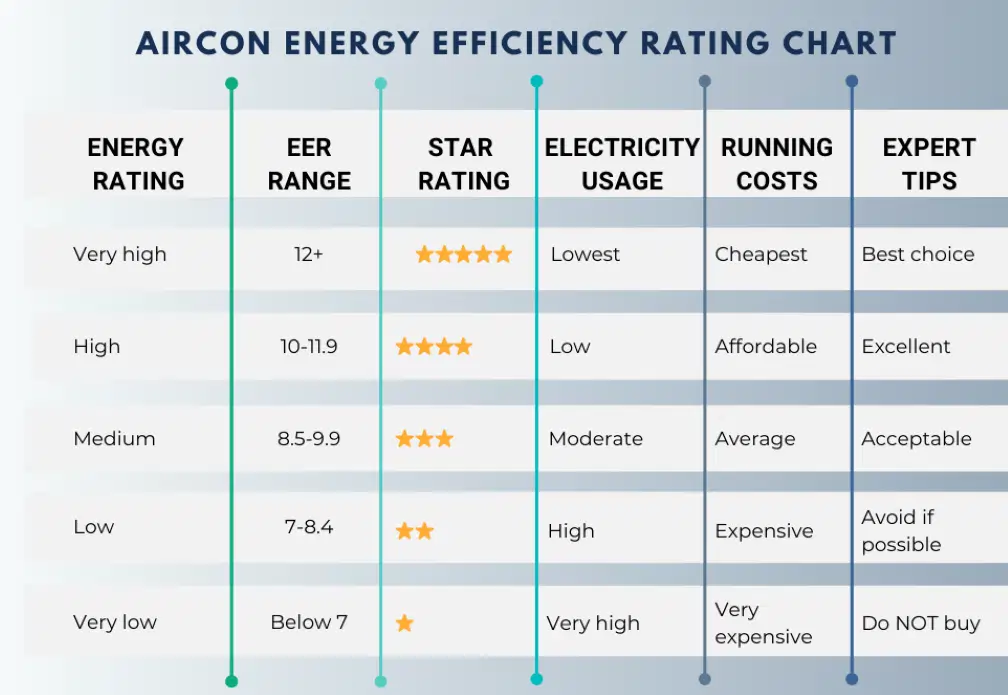
📊 Electricity Usage by Aircon Size (BTU to Watts)
Aircon power consumption varies primarily by size (BTU). Here’s the breakdown for standard split systems:
| Aircon Size (BTU) | Typical Room Size | Power (Watts) | Power (kWh per hour) | Cost per hour* |
|---|---|---|---|---|
| 7,000 BTU | 10-12 m² (small bedroom) | 550-700 W | 0.55-0.70 kWh | R1.38 – R1.75 |
| 9,000 BTU | 12-15 m² (standard bedroom) | 700-900 W | 0.70-0.90 kWh | R1.75 – R2.25 |
| 12,000 BTU | 15-20 m² (living room) | 1,000-1,300 W | 1.00-1.30 kWh | R2.50 – R3.25 |
| 18,000 BTU | 20-30 m² (large living area) | 1,600-2,000 W | 1.60-2.00 kWh | R4.00 – R5.00 |
| 24,000 BTU | 30-40 m² (open plan) | 2,200-2,800 W | 2.20-2.80 kWh | R5.50 – R7.00 |
*Based on Eskom average tariff of R2.50-R3.50 per kWh (includes VAT and all charges). Actual costs vary by municipality and tariff structure.
🔄 By Type: Split vs Window vs Portable
The type of aircon dramatically affects aircon electricity usage. Here’s how different types compare (all 12,000 BTU equivalent):
| Aircon Type | Power (Watts) | kWh per hour | Cost per hour | Cost per month (8hrs/day) | Efficiency vs Split |
|---|---|---|---|---|---|
| Inverter Split | 600-900 W | 0.60-0.90 kWh | R1.50 – R2.25 | R180 – R270 | Baseline (best) |
| Non-Inverter Split | 1,000-1,300 W | 1.00-1.30 kWh | R2.50 – R3.25 | R300 – R390 | 40-70% more than inverter |
| Window Unit | 1,100-1,400 W | 1.10-1.40 kWh | R2.75 – R3.50 | R330 – R420 | 50-80% more than inverter |
| Portable Unit | 1,300-1,800 W | 1.30-1.80 kWh | R3.25 – R4.50 | R390 – R540 | 80-120% more than inverter |
⚠️ The Portable Aircon Trap:
Portable aircons use 80-120% MORE electricity than inverter split systems for the same cooling. A portable unit might seem cheaper to buy (R4,000 vs R10,000), but over 3-5 years, the electricity savings of an inverter split system more than make up the difference. Read our portable vs split comparison.
Want to Calculate Your Exact Aircon Running Costs?
Get free quotes from local specialists for energy-efficient installations and smart AC setups that reduce electricity bills.
Get Free Quotes From Local Specialists
Compare inverter vs non-inverter pricing.
⚙️ Inverter vs Non-Inverter: The Efficiency Gap
This is the most important factor in how much electricity air conditioner uses. The difference is enormous.
How non-inverter works: The compressor runs at 100% or 0%. It cycles on and off to maintain temperature. Each start draws a surge of power.
How inverter works: The compressor varies its speed (20-100%) based on cooling demand. It runs continuously at lower speeds, avoiding power-hungry starts.
| Factor | Non-Inverter | Inverter | Difference |
|---|---|---|---|
| Electricity consumption | Baseline | 30-50% less | Inverter wins by large margin |
| Temperature stability | Fluctuates (on/off cycles) | Very stable (continuous) | Inverter more comfortable |
| Noise level | Louder (compressor starts/stops) | Quieter (runs continuously at low speed) | Inverter much quieter |
| Upfront cost | Lower (R6,000-R10,000 for 12,000 BTU) | Higher (R8,000-R15,000 for 12,000 BTU) | Non-inverter cheaper to buy |
| 5-year electricity cost | R18,000 – R23,400 | R9,000 – R16,200 | Inverter saves R3,000-R10,000+ over 5 years |
✅ The Verdict on Inverter:
Buy inverter. Always. The higher upfront cost pays back in electricity savings within 2-3 years. After that, pure savings. Plus, inverter units are quieter, more comfortable, and last longer. Read our complete inverter guide.

🧮 Running Cost Calculator (By Hours of Use)
Use this table to estimate your monthly aircon electricity usage costs based on daily hours of operation:
| Aircon Size | 2 hours/day | 4 hours/day | 6 hours/day | 8 hours/day | 12 hours/day |
|---|---|---|---|---|---|
| 7,000 BTU (inverter) | R40-55/mo | R80-110/mo | R120-165/mo | R160-220/mo | R240-330/mo |
| 9,000 BTU (inverter) | R55-70/mo | R110-140/mo | R165-210/mo | R220-280/mo | R330-420/mo |
| 12,000 BTU (inverter) | R75-95/mo | R150-190/mo | R225-285/mo | R300-380/mo | R450-570/mo |
| 12,000 BTU (non-inverter) | R125-160/mo | R250-320/mo | R375-480/mo | R500-640/mo | R750-960/mo |
Based on Eskom tariff R2.50-R3.50/kWh. Assumes inverter uses 30-50% less than non-inverter. Actual costs vary by unit efficiency, room conditions, and temperature settings.
📅 Cost Per Month: Realistic Scenarios
Here are real-world examples of monthly aircon power consumption costs for South African homes:
| Scenario | Aircon Setup | Daily Use | Monthly Cost |
|---|---|---|---|
| Single bedroom (night only) | 9,000 BTU inverter | 8 hours (sleeping) | R220 – R280 |
| Living room (evenings) | 12,000 BTU inverter | 4-5 hours | R150 – R240 |
| Home office (working hours) | 9,000 BTU inverter | 9 hours (workday) | R250 – R320 |
| Whole home (multiple units) | 12,000 BTU + 9,000 BTU inverters | Varies | R500 – R800 |
| Same as above (non-inverter) | 12,000 BTU + 9,000 BTU non-inverter | Varies | R800 – R1,400 |
🌞 Cost Per Summer: Seasonal Breakdown
Assuming a 4-month summer season (December-March) with daily usage:
| Usage Pattern | Aircon Type | Cost Per Summer | Cost Over 5 Summers |
|---|---|---|---|
| Bedroom only (8hrs/night) | 9,000 BTU inverter | R880 – R1,120 | R4,400 – R5,600 |
| Bedroom only (8hrs/night) | 9,000 BTU non-inverter | R1,600 – R2,200 | R8,000 – R11,000 |
| Living room only (5hrs/evening) | 12,000 BTU inverter | R750 – R1,000 | R3,750 – R5,000 |
| Whole home (2 units) | Inverter | R2,000 – R3,200 | R10,000 – R16,000 |
| Whole home (2 units) | Non-inverter | R3,200 – R5,600 | R16,000 – R28,000 |
The savings add up: An inverter aircon saves R3,000-R10,000+ in electricity over 5 years compared to non-inverter. Read our running costs guide.
📈 7 Factors That Increase Aircon Electricity Usage
Your actual how much electricity air conditioner uses depends on these factors:
- Temperature setting: Every 1°C lower increases consumption by 5-10%. Setting to 22°C vs 18°C saves 20-40%.
- Room insulation: Poor insulation means heat enters faster → aircon runs longer → higher bills.
- Sun exposure: North/west-facing rooms get afternoon sun → higher cooling demand.
- Dirty filters: Clogged filters increase consumption by 15-30%. Clean monthly.
- Dirty coils: Dirty outdoor coils increase consumption by 20-40%. Clean annually.
- Low refrigerant: Gas leak causes compressor to run longer → 20-40% higher bills.
- Oversized unit: Short cycling wastes electricity. Size correctly using our BTU calculator.
💰 Eskom Tariffs: What You’re Actually Paying
Understanding your electricity tariff is essential for accurate cost calculation:
| Tariff Type | Typical Rate (R/kWh) | Who It Applies To |
|---|---|---|
| Homelight (Eskom direct) | R2.50 – R3.00 | Customers billed directly by Eskom |
| Municipal (e.g., City of Cape Town, City Power) | R3.00 – R4.50 | Customers billed by local municipality |
| Prepaid meter | R2.80 – R4.00 | Prepaid customers (depends on block usage) |
| Business/Commercial | R3.50 – R5.00+ | Commercial properties |
Read Eskom tariff rates and Department of Energy consumption data.
💡 How to Reduce Aircon Electricity Usage (10 Tips)
Here are practical ways to lower your aircon power consumption without sacrificing comfort:
- Set temperature to 22-24°C, not 16-18°C. Every degree lower increases consumption by 5-10%. You won’t notice the difference in comfort, but your wallet will.
- Clean filters monthly. Dirty filters increase consumption by 15-30%. Takes 5 minutes, costs nothing.
- Use a timer or smart control. Don’t run the aircon when no one is home. Read our smart AC setup guide.
- Close windows and doors. Don’t try to cool the whole neighbourhood. Seal gaps with weatherstripping.
- Use ceiling fans with aircon. Fans circulate cool air, allowing you to set the thermostat 2-4°C higher.
- Close curtains/blinds during the day. Block afternoon sun before it enters your home.
- Service your aircon annually. Dirty coils and low refrigerant increase consumption by 20-40%.
- Buy inverter technology. Uses 30-50% less electricity than non-inverter. Read our inverter guide.
- Right-size your unit. Oversized units short cycle and waste electricity. Use our BTU calculator.
- Consider solar power. Run your aircon for free during the day. Read our solar guide.
Read our complete energy-saving guide and efficiency tips.
❓ Frequently Asked Questions About Aircon Electricity Usage
How much electricity does an aircon use per hour?
Aircon electricity usage per hour depends on size: 7,000 BTU uses 0.55-0.70 kWh (R1.38-R1.75), 9,000 BTU uses 0.70-0.90 kWh (R1.75-R2.25), 12,000 BTU uses 1.00-1.30 kWh (R2.50-R3.25), 18,000 BTU uses 1.60-2.00 kWh (R4.00-R5.00). Inverter models use 30-50% less than non-inverter. Read our running costs guide.
Does an aircon use more electricity than a heater?
No. Air conditioners (especially heat pumps) are much more efficient than space heaters. A 2,000W space heater uses 2 kWh per hour (R5-R7). A 12,000 BTU aircon in heating mode uses 1.0-1.3 kWh per hour (R2.50-R3.25) but produces 3-4x more heat. Heat pumps are 300-400% efficient; space heaters are 100% efficient.
How much does it cost to run an aircon for 8 hours in South Africa?
For a typical 12,000 BTU inverter aircon: 8 hours × 1.0-1.3 kWh × R2.50-R3.50 = R20-R36 per day, or R600-R1,080 per month. For a non-inverter unit: R33-R58 per day, or R1,000-R1,740 per month. Inverter saves 30-50%.
Does leaving the aircon on all day use more electricity?
It depends. For inverter aircons, leaving them on at a moderate temperature (24°C) can be more efficient than cycling on/off because they avoid power-hungry starts. For non-inverter units, turn off when not home. Use a timer or smart control to optimise.
Is it cheaper to run an aircon at night?
Yes, if you’re on a time-of-use tariff (some municipalities). Night rates (22:00-06:00) can be 30-50% lower than peak rates. However, most residential tariffs are flat-rate, so night vs day makes no difference. Check your municipal tariff structure.
Does a dirty filter increase electricity consumption?
Yes, significantly. A dirty filter restricts airflow, causing the unit to work harder and run longer. Electricity consumption increases by 15-30%. Clean your filter monthly—it takes 5 minutes and costs nothing. Read our filter cleaning guide.
How many solar panels to run an aircon?
A 12,000 BTU inverter aircon uses 1,000-1,300 watts running. You need 3-4 solar panels (400-500W each) to run it during sunlight hours. Add batteries for night operation. Read our solar guide for detailed calculations.
What temperature should I set my aircon to save electricity?
Set to 22-24°C for optimal balance of comfort and efficiency. Every degree lower than 22°C increases consumption by 5-10%. Setting to 18°C vs 22°C can double your electricity bill. You won’t notice the difference in comfort, but your wallet will.
Why is my aircon electricity bill so high?
Possible causes: dirty filter (15-30% higher), dirty coils (20-40% higher), low refrigerant (20-40% higher), incorrect temperature setting (10-30% higher), poor insulation (20-50% higher), or an oversized unit (short cycling). Read our troubleshooting guide and energy-saving tips.
Does inverter aircon really save electricity?
Yes, inverter aircons use 30-50% less electricity than non-inverter models. For a 12,000 BTU unit used 8 hours daily, inverter saves R100-R200 per month (R1,200-R2,400 per summer). The higher upfront cost pays back in 2-3 years. Read our inverter guide.
✅ Final Thoughts: Knowledge Is Power (Literally)
Understanding how much electricity air conditioner uses empowers you to make smart decisions about usage, upgrades, and energy-saving strategies.
Key takeaways for aircon electricity usage:
- A 12,000 BTU inverter aircon costs R20-R36 per day (8 hours) at current Eskom tariffs. That’s R600-R1,080 per month.
- Inverter models use 30-50% less electricity than non-inverter. The higher upfront cost pays back in 2-3 years.
- Portable aircons use 80-120% MORE electricity than inverter splits. Avoid them if possible.
- Every 1°C lower than 22°C increases consumption by 5-10%. Set to 22-24°C for optimal efficiency.
- Dirty filters increase consumption by 15-30%. Clean monthly—free and takes 5 minutes.
- Annual professional service saves money. Dirty coils and low refrigerant increase consumption by 20-40%.
- Solar power can eliminate aircon electricity costs. 3-4 panels run a 12,000 BTU unit during daylight hours.
Your action plan: First, calculate your current usage using the tables above. Second, check your filter—clean it if dirty. Third, adjust your temperature setting to 22-24°C. Fourth, if you have an old non-inverter unit, calculate potential savings from upgrading to inverter. Fifth, request quotes from local specialists for energy-efficient installations or smart AC upgrades.
Want to Reduce Your Aircon Electricity Bill?
Get free quotes from verified local specialists for energy-efficient installations, smart AC setups, and solar integration.
📞 Call us: 073 138 4726 for immediate help finding energy-efficient aircon specialists near you.
Free site inspections •
Beat Your Quote guarantee •
Solar backup guide
📚 Official resources & standards referenced:
- Department of Energy – Electricity consumption data and energy efficiency guidelines
- Eskom – Current tariff rates and load-shedding schedules
- SABS – Energy efficiency standards for air conditioning equipment
Information provided for general guidance based on South African market conditions and typical Eskom tariffs (R2.50-R3.50/kWh). Actual costs vary by municipality, tariff structure, unit efficiency, and usage patterns. Always check your specific electricity tariff.
Written by: Innocent T Hanyani
Construction & Home Services Industry Specialist | 21+ Years Experience
Innocent T Hanyani has over two decades of experience working across South Africa’s construction, maintenance, and home services sectors. Throughout his career, he has worked closely with contractors, service providers, and property owners, gaining practical insight into how projects are quoted, managed, and completed. His work focuses on helping homeowners understand how to find reliable contractors, compare quotes, and avoid common industry pitfalls when hiring service professionals. His insights are based on practical industry experience as well as ongoing research into contractor platforms, service marketplaces, and hiring trends across South Africa.