
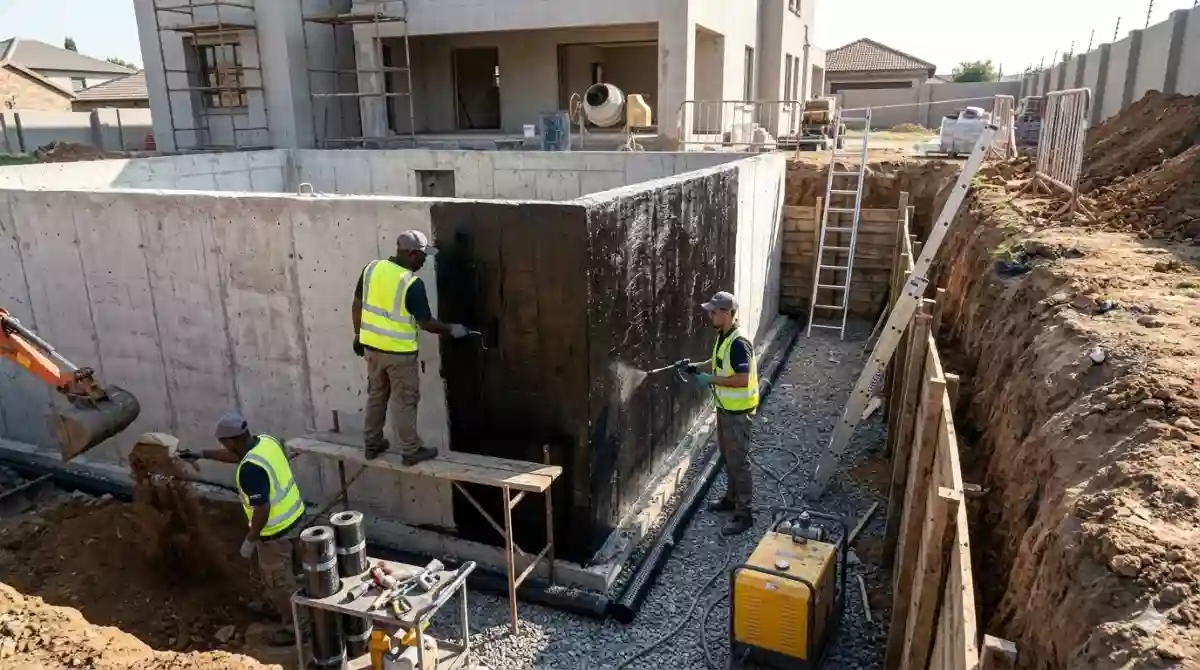
Basement & Foundation Waterproofing South Africa – Complete Guide to Dry Basements
🏗️ That musty smell in your Sandton basement? Damp walls in your Cape Town foundation? Here’s how to waterproof below-grade spaces properly.
You’ve invested in a beautiful home in Bryanston with a basement entertainment area. But after rain, that musty smell appears. Or you’re planning a new build in Umhlanga with a underground parking and need to get the foundation waterproofing right from the start.
Basement foundation waterproofing South Africa is complex because you’re fighting against hydrostatic pressure – water in the soil pushing against your walls. Get it wrong, and you’ll have persistent damp, structural damage, and expensive remedial work.
This guide covers everything: internal vs external systems, cavity drain membranes, crystalline waterproofing, French drains, sump pumps, and costs. Whether you’re building new or fixing a leaky basement, you’ll understand what’s involved and how to choose the right solution.
If you’re ready for professional help, explore our Services Overview or visit our Waterproofing Services page to find vetted contractors near you. For more on how we work, see How It Works.
📋 GEOTECHNICAL CONSIDERATIONS: Basement waterproofing must account for site-specific water tables. Geotechnical consulting is essential for new builds. The NHBRC requires certified waterproofing for basements in new homes, and CESA registered engineers should oversee structural aspects.
Need a Dry, Usable Basement?
Get free, no-obligation quotes from vetted basement waterproofing specialists who understand below-grade challenges.
Find Basement Specialists Near Me
Servicing Johannesburg, Pretoria, Cape Town, Durban, and nationwide
📋 Table of Contents – Basement Waterproofing Guide
💧 Understanding Hydrostatic Pressure – The Enemy Below
Hydrostatic pressure is the force exerted by groundwater against your basement walls and floor. It’s the primary reason basements leak.
How It Works
- Water in the soil around your foundation creates pressure
- The deeper the basement, the greater the pressure
- Pressure forces water through any crack, joint, or porous area
- In severe cases, it can cause structural damage
Factors Affecting Hydrostatic Pressure
- Water table level: High water tables mean constant pressure
- Soil type: Clay soils retain water longer than sandy soils
- Drainage: Poor surface drainage increases pressure
- Rainfall: Seasonal rain temporarily increases pressure
- Depth: Deeper basements face higher pressure
Understanding your site’s conditions is the first step. For new builds in Sandton or Constantia, geotechnical investigation is essential.
Learn more about our approach on our About Us page or read why clients choose us on our Benefits page.
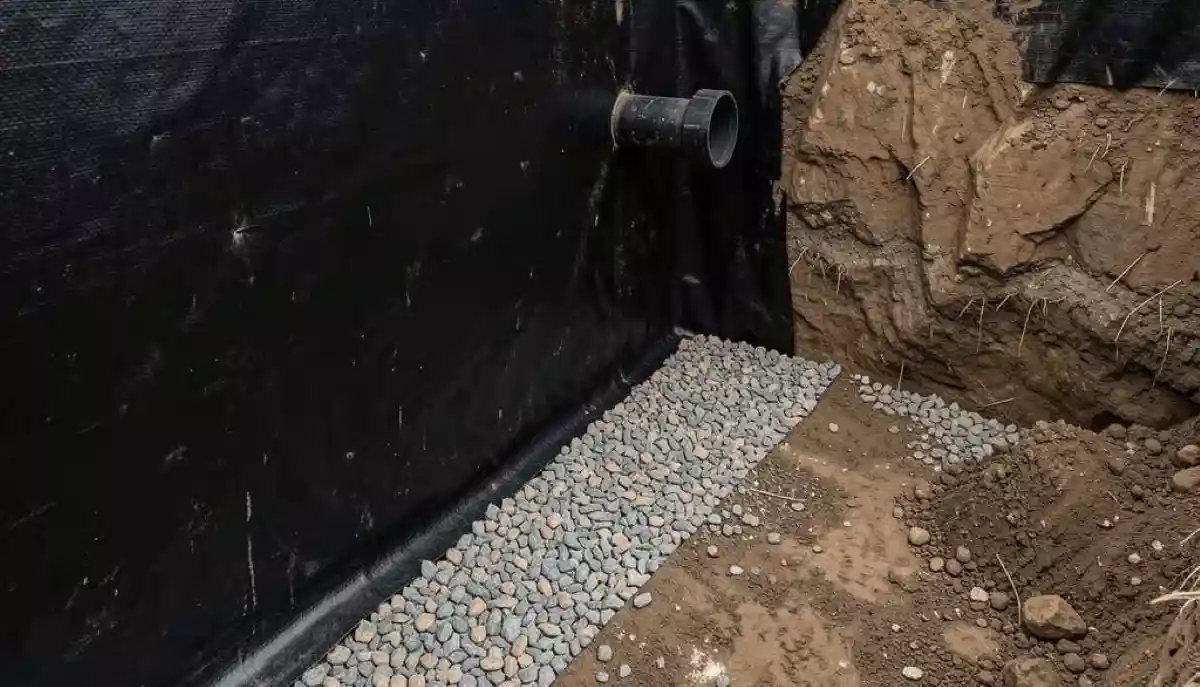
🔄 Positive Side vs Negative Side Waterproofing
Understanding the difference between positive side and negative side waterproofing is fundamental.
Positive Side Waterproofing
Applied to the outside of basement walls – the side where water pressure originates. This is always preferable and more effective.
- Stops water before it reaches the structure
- Only possible during construction or with excavation
- Includes external membranes, drainage boards, and protection layers
Negative Side Waterproofing
Applied to the inside of basement walls after construction. Works against the pressure – water is trying to push through.
- Used for retrofits when external access is impossible
- Requires systems that can withstand back-pressure
- Includes cementitious coatings, crystalline systems, and cavity drains
- Generally less effective than positive side systems
For existing homes in Pretoria with leaking basements, negative side systems are often the only option.
🏗️ External Basement Waterproofing (Tanking)
External basement waterproofing (also called tanking) is the gold standard for new builds. It involves applying a waterproof membrane to the outside of foundation walls.
How It Works
- Excavate around foundation walls (for new builds, done during construction)
- Apply primer and membrane to clean concrete surface
- Membrane types: torch-on bitumen, liquid polyurethane, bentonite panels
- Add protection board to prevent damage during backfill
- Install drainage board or layer to channel water to drains
- Backfill with suitable material
Pros
- Most effective – stops water at the source
- Protects structure from water contact
- Can be combined with drainage systems
- Long-lasting when properly installed
Cons
- Only practical during construction
- Very expensive to retrofit (requires excavation)
- Requires careful detailing at joints and penetrations
Cost
R400 – R800 per m² for new build installation, depending on membrane type and depth.
🏠 Internal Basement Waterproofing Systems
For existing basements, internal basement waterproofing systems are the practical solution. They manage water that enters rather than stopping it completely.
Types of Internal Systems
- Cementitious coatings: Render-like coating that resists water penetration
- Crystalline systems: React with concrete to block pores
- Cavity drain membranes: Create a drained cavity inside walls
- Injection grouting: For sealing specific cracks
Pros
- No excavation required
- Can be done at any time
- Less expensive than external retrofit
- Immediate results
Cons
- Less effective than external systems
- Water still contacts structure
- May require ongoing maintenance
- Some systems reduce interior space
Cost
R300 – R800 per m² depending on system, plus drainage and sump pump costs if needed.
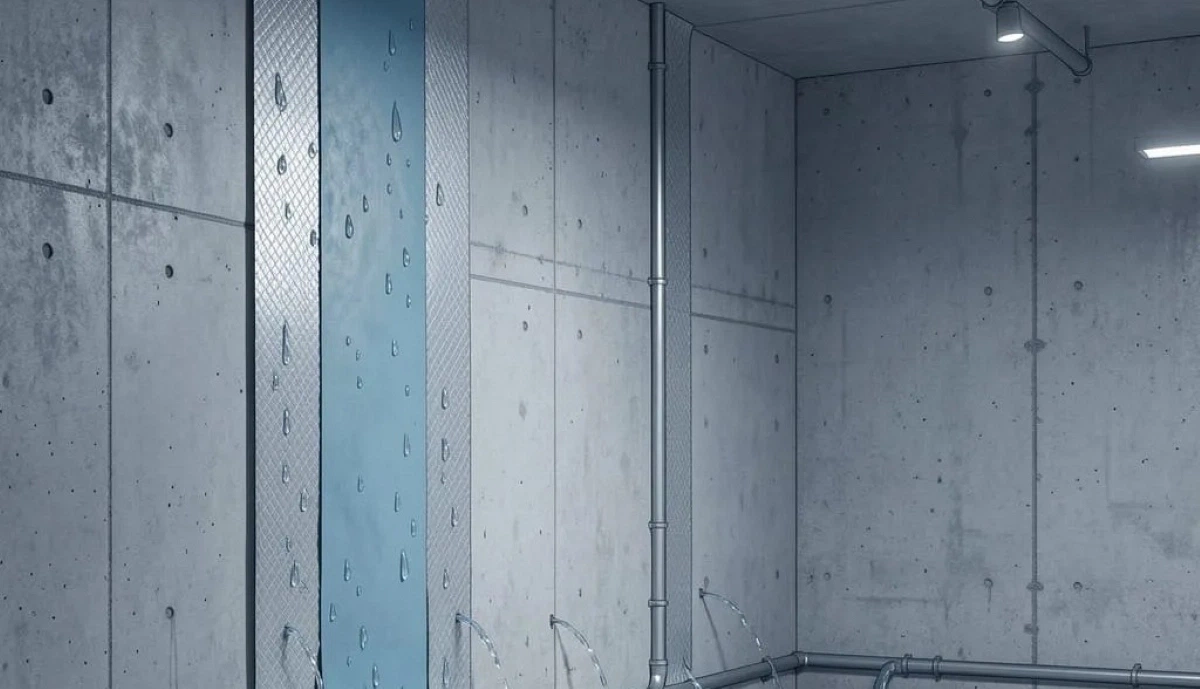
🕳️ Cavity Drain Membrane System – The Retrofit Solution
The cavity drain membrane system is the most popular internal solution for existing basements. It doesn’t try to stop water – it manages it.
How It Works
- Dimpled plastic membrane fixed to walls and floor
- Creates a cavity between membrane and structure
- Water that enters drains down the cavity
- Channeled to a perimeter drain and sump pump
- Interior remains dry – water is hidden behind membrane
Pros
- Works even with active leaks
- Handles high hydrostatic pressure
- No need to stop every crack
- Can be finished with plasterboard or stud walls
- Provides insulation layer
Cons
- Reduces floor area slightly (membrane thickness)
- Requires reliable sump pump and backup
- Ongoing maintenance of pump
- Higher cost than simple coatings
Cost
R600 – R1,200 per m² installed, plus drainage and sump pump (R8,000-R15,000 extra).
💎 Crystalline Waterproofing – Concrete Chemistry
Crystalline waterproofing uses chemicals that react with concrete to form insoluble crystals in pores and capillaries. It becomes part of the concrete.
How It Works
- Applied as a coating or added to concrete mix
- Chemicals penetrate concrete
- React with moisture and cement byproducts
- Form crystals that block water paths
- Crystals grow over time with moisture exposure
Pros
- Becomes part of the structure – can’t be damaged
- Self-healing – crystals grow in new cracks
- Withstands high hydrostatic pressure
- Can be applied to positive or negative side
- Breathable – allows vapour transmission
Cons
- Only works on concrete – not on blockwork
- Requires proper concrete preparation
- More expensive than basic coatings
- Effectiveness depends on concrete quality
Crystalline Waterproofing Cost
R300 – R600 per m² for applied systems. Integral (added to concrete mix) adds R150-R250 per m³ to concrete cost.
🧪 Bentonite Clay Panels – Natural Swelling Action
Bentonite clay panels use natural clay that swells when wet, creating a waterproof barrier. Used primarily for external waterproofing.
How It Works
- Panels contain sodium bentonite clay
- Installed against foundation walls before backfill
- When water contacts clay, it swells up to 15 times
- Swelling creates a dense, impermeable barrier
- Self-sealing if small cracks develop
Pros
- Self-sealing properties
- Environmentally friendly
- Easy to install on large areas
- Good for blind-side waterproofing
Cons
- Requires confinement pressure to work
- Not suitable for all soil types
- Can wash out if exposed to flowing water before swelling
- Limited to external applications
Cost
R500 – R900 per m² installed, depending on panel type and thickness.
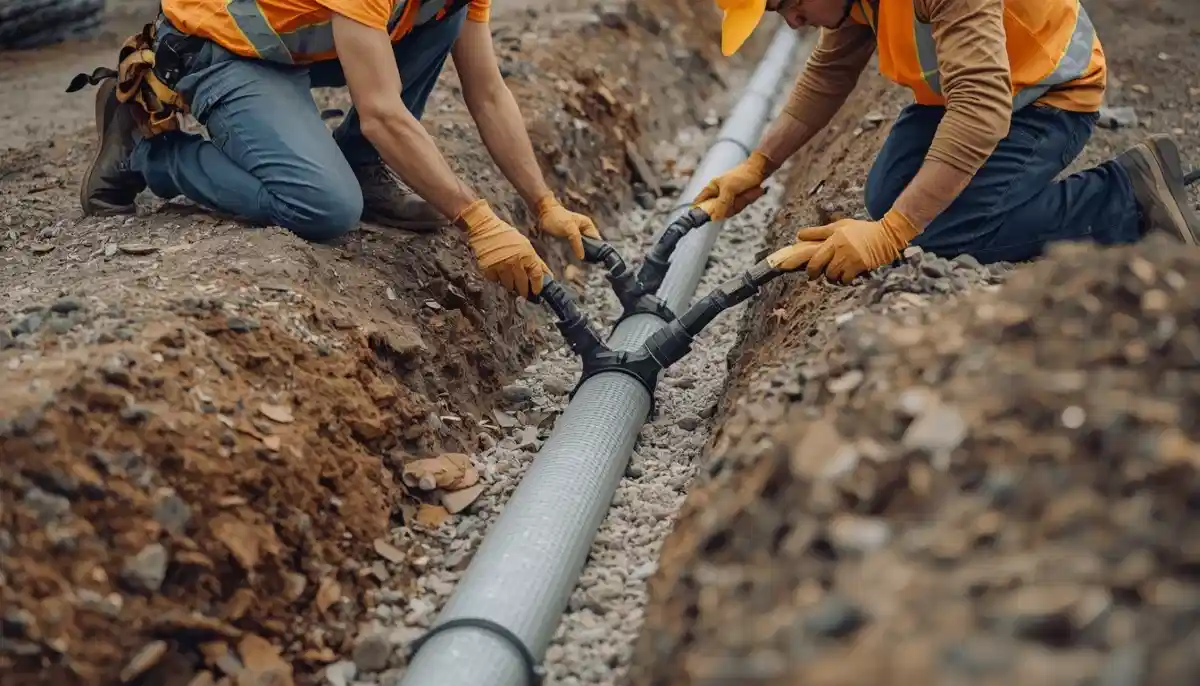
💧 French Drain Foundation Installation – Relieving Pressure
A French drain foundation installation relieves hydrostatic pressure by providing a path for water to escape. Often combined with waterproofing systems.
How It Works
- Trench excavated around foundation (or inside for retrofits)
- Perforated pipe laid in gravel bed
- Water collects in trench, flows to pipe
- Pipe carries water to sump pump or daylight outlet
- Gravel allows water movement while supporting soil
Types of French Drains
- External French drain: Around outside of foundation – most effective
- Internal French drain: Along inside perimeter – used with cavity drain systems
- Curtain drain: Uphill of structure to intercept groundwater
Cost
External French drain: R1,500 – R3,000 per linear metre (including excavation)
Internal French drain: R800 – R1,500 per linear metre
⚙️ Sump Pump Installation – Removing Collected Water
Sump pump installation is essential for any internal drainage system. The pump removes water collected by drains and cavity membranes.
How It Works
- Sump pit excavated at lowest point
- Water drains into pit by gravity
- Float switch activates pump when water rises
- Pump discharges water away from foundation
- Check valve prevents backflow
Types of Sump Pumps
- Submersible pump: Sits in water, quieter, more efficient
- Pedestal pump: Motor above sump, easier to service
- Battery backup: Essential for power outages during storms
- Water-powered backup: Uses water pressure if power fails
Cost
Basic installation: R5,000 – R8,000
With battery backup: R8,000 – R15,000
Commercial-grade system: R15,000 – R25,000
📊 Complete Basement Waterproofing System Comparison
Here’s how all the systems compare:
| System | Best For | Cost per m² | Pros | Cons |
|---|---|---|---|---|
| External Membrane (Tanking) | New builds | R400 – R800 | Most effective, stops water at source | Impractical for retrofits |
| Cavity Drain Membrane | Existing basements, high pressure | R600 – R1,200 | Works with active leaks, reliable | Needs sump pump, reduces space |
| Crystalline Waterproofing | Concrete structures | R300 – R600 | Self-healing, permanent | Concrete only, requires good concrete |
| Bentonite Clay Panels | External, blind-side | R500 – R900 | Self-sealing, natural | Needs confinement pressure |
| Cementitious Coating | Light damp, negative side | R150 – R300 | Low cost, easy to apply | Not for high pressure |
| Injection Grouting | Crack repair | R1,000 – R2,500 per crack | Targeted repair | Only fixes cracks, not general seepage |
⚖️ Internal vs External Basement Waterproofing – Which is Better?
The internal vs external basement waterproofing decision depends on your situation.
External Wins For
- New construction – always choose external if possible
- Maximum protection
- Preventing water contact with structure
- Long-term durability
Internal Wins For
- Existing buildings (no excavation)
- Budget constraints
- Sites where external access is impossible
- When combined with drainage systems
Best Practice
For new builds, install external waterproofing with a drainage system. For existing basements with water problems, a cavity drain system with internal French drain and sump pump is the most reliable solution.
💰 Basement Waterproofing Cost Per m² – Complete Breakdown
Here’s what you’ll pay for different systems, fully installed:
| System | New Build (per m²) | Retrofit (per m²) | Notes |
|---|---|---|---|
| External membrane (tanking) | R400 – R800 | R2,500 – R5,000 | Retrofit requires excavation |
| Cavity drain membrane | R500 – R1,000 | R600 – R1,200 | Plus drainage and pump |
| Crystalline coating | R250 – R500 | R300 – R600 | Concrete only |
| Bentonite panels | R500 – R900 | Not practical | External only |
| Cementitious coating | R120 – R250 | R150 – R300 | Light damp only |
Additional costs:
- French drain: R800 – R3,000 per linear metre
- Sump pump system: R5,000 – R15,000
- Geotechnical investigation: R5,000 – R15,000 (for new builds)
- Structural engineer consultation: R3,000 – R8,000
For detailed pricing, see our waterproofing cost guide.
🏗️ New Build vs Retrofit Considerations
For New Builds
- Conduct geotechnical investigation first
- Design for the water table – may need deeper drainage
- Install external membrane during construction
- Include perimeter drainage system
- Consider waterproofing specification in structural design
- Cost is much lower than retrofitting later
For Retrofits
- Diagnose the problem first – where is water entering?
- Improve surface drainage around foundation
- Consider cavity drain systems for severe cases
- Seal major cracks with injection grouting
- Install internal French drain and sump pump
- Accept that some water management may be needed
For new home construction in building projects, see our building costs and regulations guide.
📋 NHBRC Warranty Requirements for Basements
The NHBRC has specific requirements for basement waterproofing in new homes to qualify for the warranty.
Key Requirements
- Waterproofing must be designed by a registered professional
- Systems must be appropriate for site conditions
- Installation by registered contractors
- Inspection and certification before backfilling
- Compliance with SANS 10400
- Documentation for warranty claims
Failure to comply can void your NHBRC warranty. Always use registered contractors familiar with NHBRC requirements.
📍 Regional Basement Considerations by City
📌 Johannesburg & Sandton
In Johannesburg and Sandton, clay soils are common. These retain water and create high hydrostatic pressure after rain. External tanking with drainage boards is recommended. For retrofits, cavity drain systems work well.
📌 Pretoria & Bryanston
In Pretoria and Bryanston, variable water tables require site-specific solutions. Geotechnical investigation is essential for new builds.
📌 Durban & Umhlanga
In Durban and Umhlanga, high water tables near the coast mean basements need robust systems. External tanking with pumped drainage is often required.
📌 Cape Town & Constantia
In Cape Town and Constantia, winter rainfall creates seasonal pressure. Systems must handle prolonged wet periods. Cavity drain systems are popular for retrofits in older homes.
❌ 8 Common Basement Waterproofing Mistakes
Avoid these costly errors:
- Mistake #1: No geotechnical investigation. Building without knowing water table levels is gambling. You may choose the wrong system.
- Mistake #2: Ignoring external drainage. Waterproofing without drainage is like sealing a submarine without a bilge pump. You must relieve pressure.
- Mistake #3: Using the wrong system for the pressure. Light coatings won’t stop hydrostatic pressure. Match the system to the conditions.
- Mistake #4: Poor detailing at joints and penetrations. Most leaks occur at corners, pipe entries, and construction joints. These need special attention.
- Mistake #5: No backup for sump pumps. Storms often cause power outages. Without backup, your basement floods when you need the pump most.
- Mistake #6: Inadequate surface drainage. If surface water isn’t directed away, your basement waterproofing works overtime.
- Mistake #7: DIY waterproofing for basements. This is not a DIY job. Incorrect installation leads to expensive failures.
- Mistake #8: Ignoring warranty requirements. For new builds, ensure NHBRC compliance – or lose your warranty.
For more guidance, see our contractor selection guide.
❓ Frequently Asked Questions
What is the best basement waterproofing method in South Africa?
The basement foundation waterproofing South Africa best method depends on your situation. For new builds, external tanking (R400-R800 per m²) is best. For existing basements with water problems, cavity drain membrane systems (R600-R1,200 per m²) with sump pump are most reliable. Always combine with proper drainage.
How much does basement waterproofing cost in South Africa?
Basement waterproofing cost per m² ranges from R400-R800 for new build external systems, R600-R1,200 for cavity drain membranes, and R300-R600 for crystalline systems. Additional costs: French drains R800-R3,000 per linear metre, sump pumps R5,000-R15,000. A typical 50m² basement costs R40,000-R100,000+ depending on system.
What is the difference between internal and external basement waterproofing?
Internal vs external basement waterproofing – external is applied to the outside of walls, stopping water before it reaches the structure. It’s best for new builds. Internal is applied inside, managing water that enters. It’s used for retrofits. External is more effective but expensive to retrofit.
How does a cavity drain membrane system work?
A cavity drain membrane system uses dimpled plastic sheets fixed to walls and floor, creating a cavity. Water that enters drains down the cavity to perimeter drains and a sump pump, which removes it. The interior remains dry. It’s the most reliable internal solution for active leaks and high hydrostatic pressure.
Do I need a sump pump for my basement?
If you have an internal drainage system or cavity drain membrane, yes – a sump pump installation is essential. It removes collected water. For new builds with external drainage, a sump pump may still be needed if water can’t drain by gravity. Always include battery backup for storm reliability.
What is crystalline waterproofing?
Crystalline waterproofing uses chemicals that react with concrete to form insoluble crystals in pores and capillaries. It becomes part of the structure, can self-heal small cracks, and withstands high hydrostatic pressure. Cost is R300-R600 per m². Only works on concrete, not blockwork.
What is a French drain and do I need one?
A French drain foundation installation is a trench with perforated pipe and gravel that collects and redirects groundwater. It relieves hydrostatic pressure around foundations. For basements, it’s essential – without it, waterproofing works against constant pressure. External French drains cost R1,500-R3,000 per linear metre.
Does NHBRC cover basement waterproofing?
The NHBRC requires specific basement waterproofing warranty requirements for new homes. Systems must be designed by professionals, installed by registered contractors, and inspected. Failure to comply can void your warranty. Always ensure your contractor understands NHBRC requirements.
✅ Final Thoughts – Your Basement Waterproofing Action Plan
A dry basement adds valuable living space and protects your home’s structure. With the right approach, even challenging sites can be managed.
Key takeaways:
- Understand your site: Geotechnical investigation first for new builds
- Choose the right system: External for new, cavity drain for retrofits
- Don’t forget drainage: Waterproofing without drainage will fail
- Plan for power failures: Backup sump pumps are essential
- Use qualified professionals: This is not DIY territory
- Check warranties: NHBRC compliance for new homes
🏗️ The Bottom Line:
R40,000 – R150,000+
is what a properly waterproofed basement costs – a worthwhile investment for usable, dry below-grade space.
Your 5-Step Action Plan
- Assess your situation – new build or existing? What are the signs?
- Get professional advice – geotechnical engineer for new, waterproofing specialist for existing
- Choose appropriate system – based on site conditions and budget
- Get detailed quotes from vetted contractors – use our free quote system
- Ensure proper installation – with warranties and inspections
Ready for a Dry, Usable Basement?
Get free, no-obligation quotes from vetted basement waterproofing specialists who understand below-grade challenges.
📞 Call us: 073 138 4726 for personalised assistance
Free site inspections •
Beat-your-quote guarantee •
Our guarantees
📚 Official resources & standards:
- GEOSS – Geotechnical consulting for foundation water tables
- NHBRC – Basement waterproofing warranty requirements
- CESA – Structural engineering for below-grade structures
Information accurate as of publication. Prices are indicative and may vary by location and contractor. This guide is for informational purposes.
Written by: Innocent T Hanyani
21+ years construction and digital industry experience, ServiceLink SA
Innocent has overseen basement waterproofing on numerous high-end residential projects across South Africa, working with geotechnical engineers and CESA-registered structural engineers. His expertise ensures this guide reflects current industry best practices for below-grade waterproofing.
For more detailed information, explore our waterproofing cost guide for comprehensive pricing, our damp proofing vs waterproofing guide to understand the distinction, our failure signs guide to identify problems, and our contractor selection guide for finding qualified specialists. For new home construction, also see our building costs and regulations guide.