
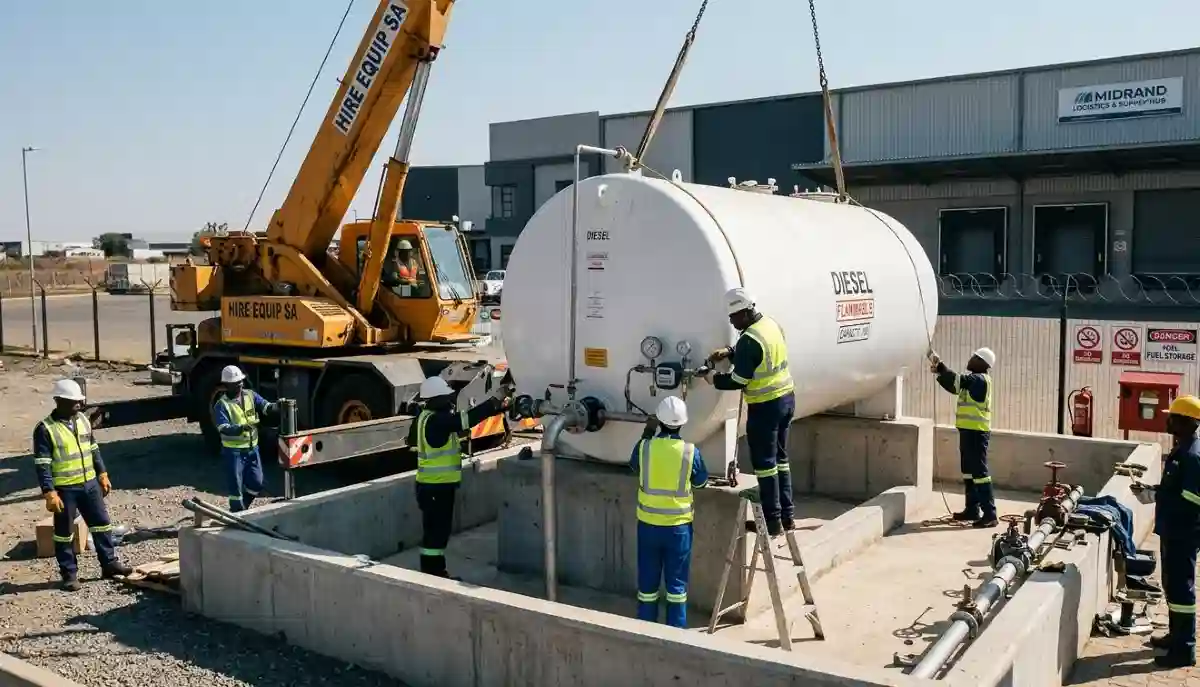
Need Mining Fuel Storage Solutions?
ServiceLink SA connects you with verified tank installers specialising in mining fuel storage. Get free quotes today. If we can’t assist directly, we’ll connect you with our trusted partner companies to carry out your fuel storage projects professionally and timeously.
Servicing Mpumalanga, Limpopo, North West, Northern Cape, Gauteng, and across South Africa’s mining regions
Diesel Storage Tanks for Mines: Bulk Fuel Storage Solutions
⛏️ From open-pit haul trucks to underground loaders—your complete guide to mining fuel storage
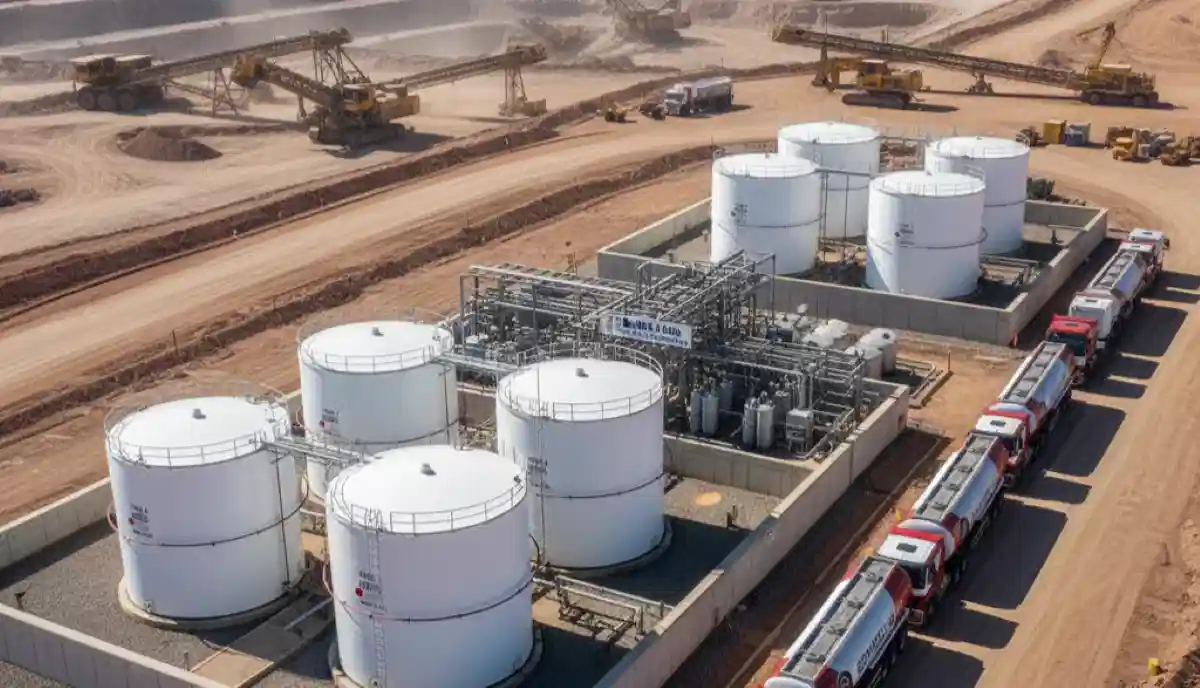
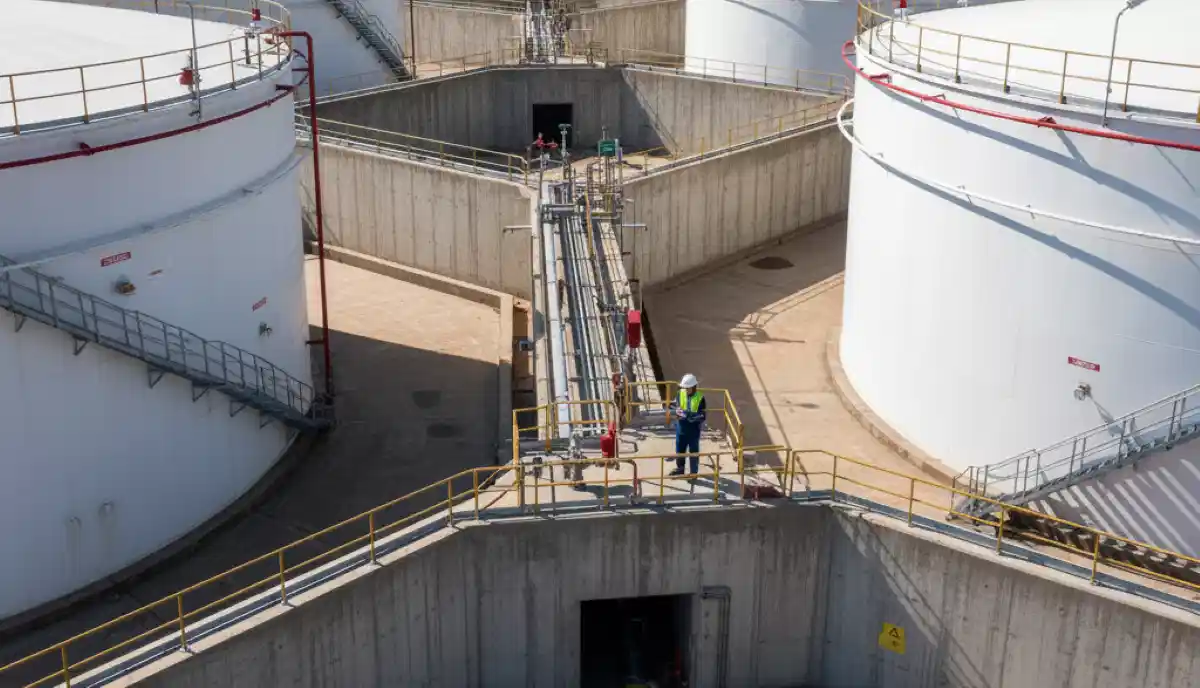
I once stood at a platinum mine in Rustenburg, watching a fleet of 300-ton haul trucks crawl up the haul road. The mine manager pointed to a massive tank farm with eight 200,000-litre diesel storage tanks. “That’s our insurance policy,” he said. “If those tanks run dry, this mine stops. R15 million per day in lost production. No second chances.”
For mining operations, diesel storage tanks for mines are not optional infrastructure—they’re critical to survival. Unlike farms or logistics depots, mines can’t pause operations. Dewatering pumps must run 24/7. Ventilation fans can’t stop. Haul trucks must keep moving.
This comprehensive equipment guide covers everything you need to know about mining fuel storage, including mine site tanks selection, bulk diesel storage tanks for underground mines, mine storage best practices, mining tank specifications, SABS and DMRE compliance, and environmental regulations. For more on mining fuel supply, read bulk fuel for mining operations.
Ready to secure your mine’s fuel storage? Let’s dive in.
📋 Table of Contents – Mining Fuel Storage Guide
⚠️ Why Mining Fuel Storage Matters
For mining operations, diesel storage tanks for mines are critical infrastructure with unique requirements:
⚠️ The High Cost of Mining Fuel Storage Failure
A single day without diesel can cost a medium coal mine R3-R8 million in lost production. For larger operations, losses can exceed R15 million daily. Beyond direct losses, underground safety systems (ventilation, dewatering) depend on diesel generators—fuel storage failure creates safety risks.
Why mining fuel storage is different from other industries:
- Continuous operations: Most mines run 24/7/365. No downtime for refuelling.
- Massive volumes: Large mines consume 500,000-2,000,000+ litres monthly.
- Remote locations: Mines are often 200-500km from fuel depots.
- Underground requirements: Specialised explosion-proof storage for underground mines.
- Quality sensitivity: Mining equipment costs R5M-R50M+ per unit. Contaminated fuel causes catastrophic damage.
- Regulatory scrutiny: DMRE mining regulations and DFFE environmental compliance are strict.
- High consequences of failure: Production stoppages cost millions daily.
Consequences of inadequate mining fuel storage:
- Production stoppages: Running out of fuel stops all diesel-powered equipment.
- Equipment damage: Water or microbial contamination damages injectors and pumps.
- Environmental fines: Leaking tanks without bunding violate DFFE regulations.
- Safety incidents: Underground fuel storage failures can cause fires or explosions.
- Regulatory penalties: DMRE non-compliance can result in mine shutdown orders.
- Increased costs: Emergency deliveries cost 2-4x normal rates.
Typical mining fuel consumption by operation type:
| Mine Type | Monthly Diesel Consumption | Recommended Storage Capacity | Days of Autonomy |
|---|---|---|---|
| Small coal/platinum mine | 100,000-300,000L | 700,000-2,100,000L | 7-10 days |
| Medium coal/platinum mine | 300,000-1,000,000L | 2,100,000-7,000,000L | 7-10 days |
| Large open-pit mine | 1,000,000-3,000,000L+ | 7,000,000-21,000,000L+ | 5-7 days |
| Underground mine | 200,000-800,000L | 1,400,000-5,600,000L | 10-14 days |
For more on mining fuel needs, read bulk fuel for mining operations.
🏭 Types of Mining Fuel Storage Tanks
Mining fuel storage comes in several configurations depending on location and volume:
Above-ground bulk storage tanks (surface mines):
- Capacity: 50,000L – 500,000L+ per tank
- Material: Heavy-duty steel with corrosion protection
- Configuration: Multiple tanks in tank farm arrangement
- Pros: Large capacity, easy inspection and maintenance
- Cons: Requires significant surface area, visible to potential thieves
- Best for: Open-pit mines, surface operations
Underground storage tanks (underground mines):
- Capacity: 10,000L – 100,000L per tank
- Material: Explosion-proof steel with special coatings
- Configuration: Multiple smaller tanks in underground chambers
- Pros: Saves surface space, closer to underground equipment
- Cons: Higher installation cost, explosion-proof requirements
- Best for: Underground mines, deep-level operations
Mobile fuel bowsers (mine site distribution):
- Capacity: 5,000L – 20,000L
- Material: Steel on heavy-duty trailer or truck chassis
- Pros: Portable, can refuel equipment across mine site
- Cons: Smaller capacity, requires towing vehicle
- Best for: Distributing fuel from bulk storage to equipment
Comparison of mining tank types:
| Tank Type | Capacity Range | Pros | Cons | Best For |
|---|---|---|---|---|
| Above-ground bulk | 50,000-500,000L | Large capacity, accessible | Surface space required | Open-pit mines |
| Underground storage | 10,000-100,000L | Space-saving, closer to equipment | Explosion-proof required | Underground mines |
| Mobile bowser | 5,000-20,000L | Portable, flexible | Smaller capacity | Site distribution |
| Double-skinned (bunded) | 20,000-200,000L | Integrated spill containment | Higher cost | All mines (recommended) |
For more on tank selection, read fuel tank installation.
🏗️ Above-Ground Mining Storage Tanks
Mine site tanks for above-ground installation must meet rigorous standards:
Key features of mining above-ground tanks:
- Heavy-duty construction: Reinforced steel for mining environment
- Corrosion protection: Special coatings for harsh mining conditions
- Double-skinned or bunded: Integrated secondary containment (mandatory)
- Overfill protection: Automatic shut-off or alarm system
- Level monitoring: Electronic tank gauging with remote reporting
- Lockable dispensing: Access control for theft prevention
- Fire protection: Foam or deluge systems for large tanks
- Lightning protection: Earthing and surge protection
Popular above-ground tank sizes for mines:
- 50,000L: Suitable for small mines or as backup storage
- 100,000L: Common size for medium mines
- 200,000L: Popular for larger operations
- 300,000-500,000L: For large open-pit mines
- Tank farms: Multiple tanks connected for total capacity up to several million litres
Tank farm layout considerations:
- Adequate spacing between tanks for fire safety (minimum 1.5 x diameter)
- Containment bunding around entire tank farm (110% of largest tank capacity)
- Access roads for delivery tankers and maintenance vehicles
- Security fencing and lighting around tank farm
- Firewater system with adequate flow and pressure
- Emergency response equipment strategically positioned
- Spill containment and recovery systems
Positioning above-ground tanks on mine sites:
- Locate away from active mining areas (blast zones)
- Position downwind from worker accommodation areas
- Ensure clear access for fuel delivery tankers
- Locate in well-lit area with CCTV coverage
- Consider proximity to equipment refuelling points (minimise bowser travel)
- Avoid low-lying areas where water collects (flood risk)
- Maintain distance from sensitive environmental areas
For more on tank positioning, read commercial fuel storage tanks.
🕳️ Underground Mining Fuel Storage
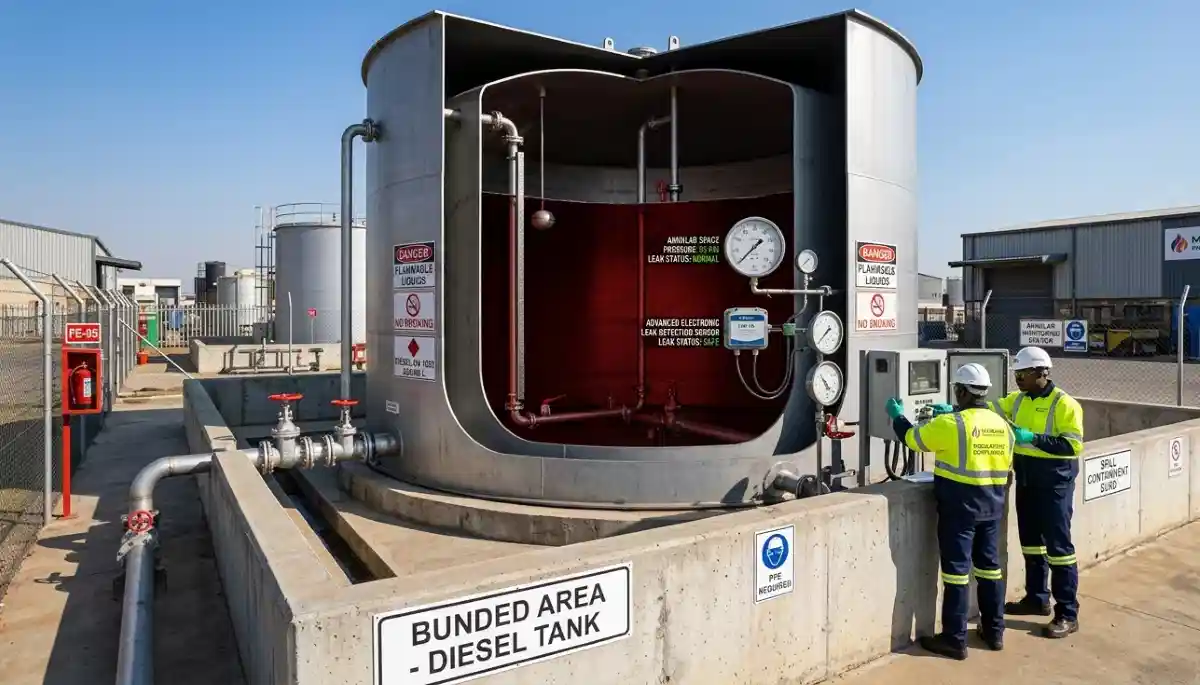
Bulk diesel storage tanks for underground mines require specialised design and safety features:
Underground storage requirements:
- Explosion-proof construction: Tanks must withstand potential methane or dust explosions
- Flame arrestors: On all vents and openings
- Ventilation integration: Fuel storage areas must have adequate airflow
- Emergency shut-off: Remote and local emergency shut-off systems
- Fire suppression: Automatic fire suppression in storage chambers
- Spill containment: Bunding with capacity for 110% of tank volume
- Gas monitoring: Continuous monitoring for flammable gases
- Remote monitoring: Tank levels monitored from surface control room
Underground storage chamber design:
- Excavated chamber with reinforced walls and roof
- Water-resistant lining to prevent groundwater contamination
- Proper drainage away from storage area
- Adequate lighting (explosion-proof fittings)
- Emergency escape routes and signage
- Fire-resistant materials throughout chamber
- Regular inspection access and maintenance space
Typical underground tank sizes:
- 10,000L: Suitable for smaller underground operations
- 20,000-30,000L: Common for medium underground mines
- 50,000-100,000L: For larger underground operations
- Multiple tanks: Often multiple smaller tanks rather than one large tank
Safety considerations for underground fuel storage:
- No smoking or open flames within 25 metres
- Explosion-proof electrical equipment throughout
- Regular inspection of flame arrestors and vent systems
- Training for all personnel on emergency procedures
- Emergency communication to surface control room
- Regular testing of gas monitoring systems
- Documented emergency response plan
DMRE requirements for underground fuel storage:
See DMRE – Mining storage regulations for complete requirements. Key provisions:
- Underground fuel storage permits required
- Regular inspections by mine safety officials
- Emergency response drills annually
- Record keeping of all fuel movements
For more on underground operations, read bulk fuel for mining operations.
📏 Tank Sizing for Mining Operations
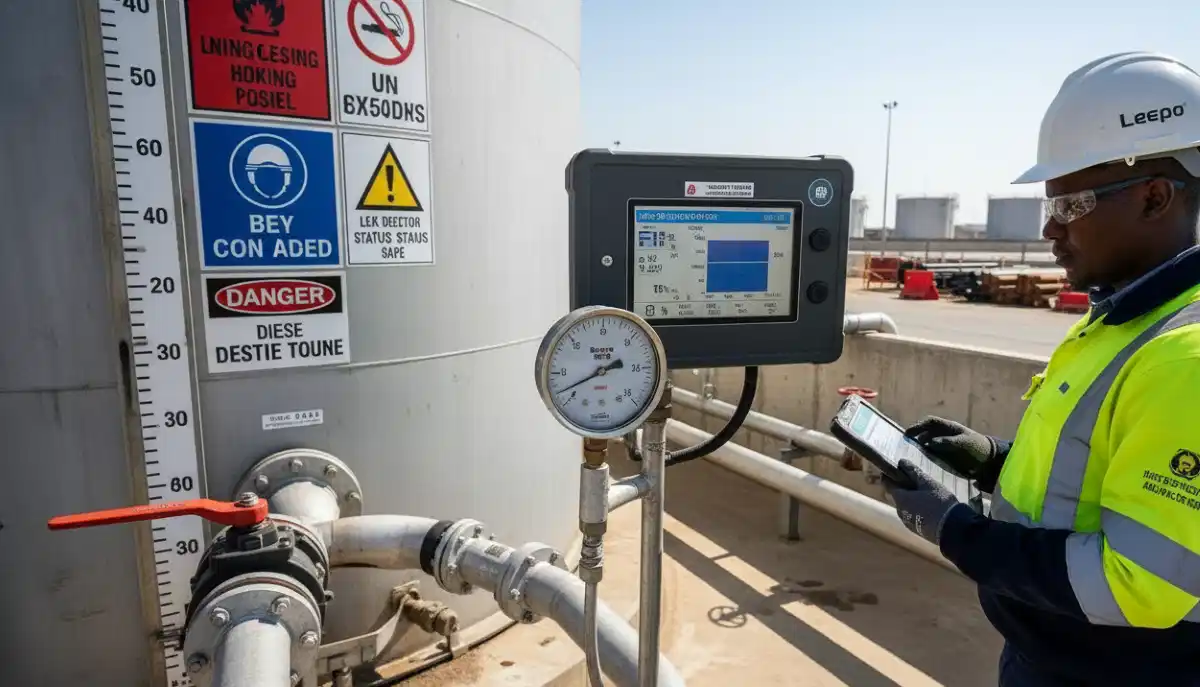
Proper sizing of diesel storage tanks for mines is critical for operational continuity:
Step 1: Calculate daily consumption
List all diesel-powered equipment and calculate daily consumption:
Example for a medium open-pit mine:
- 10 haul trucks @ 300 L/hour × 20 hours = 60,000 L/day
- 4 excavators @ 250 L/hour × 20 hours = 20,000 L/day
- 6 wheel loaders @ 150 L/hour × 20 hours = 18,000 L/day
- 3 drills @ 100 L/hour × 20 hours = 6,000 L/day
- Generators and support equipment = 10,000 L/day
- Total daily consumption: 114,000 L/day
Step 2: Determine desired days of autonomy
Recommended minimum storage for mines:
- Open-pit mines: 5-7 days
- Underground mines: 7-14 days (safety critical)
- Remote mines: 10-14 days (long delivery lead times)
- Mines with poor road access: 14-21 days (weather buffers)
Step 3: Calculate required capacity
Required Capacity = Daily Consumption × Days of Autonomy × 1.2 (buffer)
Example for medium open-pit mine:
114,000 L/day × 7 days × 1.2 = 957,600 L → recommend 1,000,000L capacity (10 × 100,000L tanks)
Tank sizing recommendations by mine type:
| Mine Type | Daily Consumption | Recommended Storage | Number of Tanks |
|---|---|---|---|
| Small open-pit | 30,000-50,000L | 250,000-350,000L | 3-5 × 70,000L |
| Medium open-pit | 80,000-150,000L | 600,000-1,200,000L | 6-12 × 100,000L |
| Large open-pit | 200,000-400,000L+ | 1,500,000-3,500,000L+ | 15-35 × 100,000L |
| Underground mine | 50,000-100,000L | 500,000-1,000,000L | 5-10 × 100,000L (explosion-proof) |
Multiple tank strategy for mines:
- Redundancy: If one tank fails, others still provide fuel
- Maintenance flexibility: Take tanks offline for cleaning without stopping operations
- Fuel rotation: Use different tanks in sequence to prevent fuel degradation
- Segregation: Dedicated tanks for different fuel grades (500ppm vs 50ppm)
For more on storage planning, read bulk diesel storage regulations.
📋 SABS Mining Storage Standards
Mining fuel storage must comply with SABS standards for safety and legality. See SABS – Mining storage standards.
SANS 10089-3 key requirements for mines:
- Tank construction: Heavy-duty steel meeting mining specifications
- Secondary containment: Bunding or double-skinned at 110% capacity
- Corrosion protection: Special coatings for mining environment
- Overfill protection: Automatic shut-off or alarm systems
- Venting: Flame arrestors on all vents
- Fire protection: Fire suppression systems for large tanks
- Lightning protection: Earthing and surge protection
- Inspection access: Safe access for regular inspections
Compliance checklist for mining tanks:
- ✅ Tanks certified to SANS 10089-3 for mining use
- ✅ Secondary containment (bunding or double-skinned) at 110% capacity
- ✅ Overfill protection installed and functional
- ✅ Flame arrestors on all vents
- ✅ Fire suppression system (for tanks >100,000L)
- ✅ Lightning protection and earthing
- ✅ Lockable dispensing with access control
- ✅ Hazchem signage clearly displayed
- ✅ Fire extinguishers positioned throughout
- ✅ Spill kits accessible
- ✅ Regular inspections documented
Consequences of non-compliance:
- Fines from DMRE (up to R10 million for serious violations)
- Mine shutdown orders until compliance achieved
- Invalidated insurance
- Environmental damage liability
- Loss of operating license
For more on standards, read bulk diesel storage regulations.
Ready to Install Mining Fuel Storage?
ServiceLink SA connects you with verified tank installers specialising in mining fuel storage. Get free quotes today. If we can’t assist directly, we’ll connect you with our trusted partner companies to carry out your fuel storage projects professionally and timeously.
Bulk diesel storage tanks for underground mines and surface operations—find certified installers serving your mining region.
⚖️ DMRE Mining Storage Regulations
The Department of Mineral Resources and Energy has specific regulations for mine site tanks. See DMRE – Mining storage regulations.
Key DMRE requirements:
- Storage permits: Required for all mining fuel storage facilities
- Regular inspections: DMRE officials inspect fuel storage annually
- Safety file: Documented risk assessments and safety protocols
- Emergency response plan: DMRE-approved plan for fuel-related incidents
- Record keeping: Fuel delivery and usage records maintained for 5 years
- Staff training: All personnel handling fuel must be trained and certified
- Incident reporting: Fuel spills or safety incidents reported within 24 hours
DMRE inspection checklist:
- Tank condition (no leaks, corrosion, or damage)
- Bunding integrity (no cracks, holes, or water accumulation)
- Secondary containment effectiveness
- Overfill protection functionality
- Fire suppression system condition
- Spill kit completeness
- Record keeping accuracy
- Staff training documentation
- Emergency response plan currency
- Hazchem signage visibility
Preparing for DMRE inspections:
- Conduct internal inspections monthly
- Document all maintenance and repairs
- Keep training records up to date
- Maintain fuel delivery and usage logs
- Test emergency response equipment regularly
- Address any compliance issues immediately
- Designate responsible person for fuel storage compliance
For more on regulatory compliance, read bulk diesel storage regulations.
🌿 Environmental Compliance for Mines
Mining fuel storage must comply with DFFE environmental regulations. See DFFE – Mining environmental compliance.
Key DFFE requirements for mining fuel storage:
- Environmental authorization: Required for fuel storage facilities over certain capacities
- Spill containment: Bunding at 110% capacity for all tanks
- Groundwater monitoring: Boreholes around tank farm for leak detection
- Spill response plan: DFFE-approved plan for fuel spills
- Spill kit: Equipment to contain and clean up spills
- Regular inspections: Monthly visual, annual professional
- Record keeping: All inspections and incidents documented
- Reporting: Spills reported to DFFE within 24 hours
Environmental risk assessment for mine fuel storage:
- Identify sensitive receptors (water sources, wetlands, endangered species)
- Assess spill pathways (groundwater, surface water, soil)
- Evaluate containment effectiveness
- Determine response capabilities
- Document mitigation measures
- Review and update annually
Best practices for environmental compliance:
- Install tanks on impervious surface within bunded area
- Conduct weekly visual inspections for leaks
- Keep spill kit accessible and staff trained
- Test bunding integrity annually (fill with water, check for leaks)
- Monitor groundwater quarterly
- Document all inspections and maintenance
- Train mine staff on spill response procedures
- Conduct annual spill response drills
For more on environmental compliance, read bulk diesel storage regulations.
📊 Fuel Monitoring and Management Systems
Modern mining tank installations include electronic monitoring systems:
Key monitoring features:
- Real-time level monitoring: Accurate tank level data displayed on control room screens
- Low-level alerts: Automatic notifications when fuel reaches threshold levels
- High-level alerts: Prevent overfills during deliveries
- Water detection: Sensors detect water in tank bottom
- Temperature monitoring: Track fuel temperature for quality management
- Leak detection: Sensors in bunding detect fuel leaks
- Access control: Track who dispensed fuel, how much, and when
- Integration: Connect to mine management system or ERP
Benefits of monitoring systems for mines:
- Prevent production stoppages: Alerts before tanks run dry
- Reduce theft: Track all fuel movements
- Improve efficiency: Optimise delivery scheduling
- Quality management: Early warning of water or contamination
- Compliance: Automated record keeping for DMRE and DFFE
- Cost control: Accurate consumption data by equipment type
Typical monitoring system components:
| Component | Function | Typical Cost Range |
|---|---|---|
| Tank level sensor (submersible) | Measure fuel level and volume | R5,000-R15,000 per tank |
| Water detection sensor | Detect water in tank bottom | R2,000-R5,000 per tank |
| Leak detection sensor | Detect fuel in bunding | R3,000-R8,000 per bund |
| Control unit / gateway | Collect and transmit data | R10,000-R25,000 per site |
| Monitoring software | Display and analyse data | R5,000-R20,000 annually |
| Access control system | Authorise and track dispensing | R15,000-R50,000 per site |
For more on monitoring, read fuel management systems in South Africa.
❓ Frequently Asked Questions About Mining Diesel Tanks
What size diesel storage tanks do mines need?
Diesel storage tanks for mines should provide 5-14 days of autonomy. For a medium mine consuming 100,000L daily, recommended storage is 700,000-1,000,000L (7-10 × 100,000L tanks). Larger open-pit mines may need several million litres of storage capacity.
What are the requirements for bulk diesel storage tanks for underground mines?
Bulk diesel storage tanks for underground mines must be explosion-proof with flame arrestors on all vents, integrated ventilation monitoring, emergency shut-off systems, fire suppression, remote monitoring from surface, and bunding at 110% capacity. DMRE approval required.
What SABS standards apply to mining fuel storage?
Mining fuel storage must comply with SANS 10089-3 for tank construction, secondary containment, overfill protection, flame arrestors, fire suppression (for large tanks), lightning protection, and regular inspections. See SABS – Mining storage standards.
What DMRE regulations apply to mine site tanks?
Mine site tanks require DMRE storage permits, annual inspections, documented safety files, approved emergency response plans, 5-year record keeping, trained fuel handling personnel, and 24-hour incident reporting. See DMRE – Mining storage regulations.
How do I prevent diesel contamination in mine storage?
Prevent contamination through: regular water draining (weekly), quarterly fuel testing, biocide additives for long-term storage, filtration on dispensing systems, keeping tanks full to reduce condensation, regular professional tank cleaning (every 3-5 years), and electronic water detection sensors.
What environmental regulations apply to mining fuel storage?
Mining fuel storage must comply with DFFE environmental regulations: environmental authorization, spill containment (bunding at 110% capacity), groundwater monitoring, approved spill response plan, spill kit on-site, regular inspections, and 24-hour spill reporting. See DFFE – Mining environmental compliance.
How much do mining diesel storage tanks cost?
A 100,000L above-ground mining tank costs R150,000-R250,000. For a 1,000,000L tank farm (10 tanks), total installed cost including bunding, foundations, piping, fire suppression, and monitoring systems is R2.5-R4.5 million. Underground tanks cost 30-50% more due to explosion-proof requirements.
How often should mine fuel tanks be inspected?
Mine storage tanks require weekly visual inspections (staff), monthly detailed inspections (supervisor), quarterly fuel quality testing, annual professional tank inspections (structural), and DMRE annual regulatory inspections. Bunding integrity should be tested annually by filling with water.
✅ Final Thoughts: Invest in Proper Mining Fuel Storage
Diesel storage tanks for mines are critical infrastructure that protects production continuity, equipment reliability, and regulatory compliance. The right storage solution ensures your mine never runs out of fuel, protects expensive equipment from contaminated fuel, and keeps you compliant with DMRE and DFFE regulations.
Key takeaways from this guide:
- Diesel storage tanks for mines must provide 5-14 days of autonomy
- Mining fuel storage requires specialised above-ground or underground tanks
- Mine site tanks must be double-skinned or bunded at 110% capacity
- Bulk diesel storage tanks for underground mines require explosion-proof construction
- SABS SANS 10089-3 specifies construction and safety standards
- DMRE requires permits, inspections, and record keeping
- DFFE environmental compliance mandates spill containment and monitoring
- Electronic monitoring systems prevent production stoppages and theft
- Regular maintenance and fuel testing protect equipment
- ServiceLink SA connects you with verified installers specialising in mine storage
Your action plan: Calculate your mine’s daily fuel consumption. Determine desired days of autonomy (7-14 days). Get quotes from multiple verified mining tank installers. Choose SABS-compliant double-skinned tanks. Ensure professional installation with proper bunding, fire suppression, and monitoring systems. Implement regular maintenance and fuel quality testing. Stay compliant with DMRE and DFFE requirements. Never let fuel storage be the reason your mine stops.
Ready to Install Mining Fuel Storage?
ServiceLink SA connects you with verified tank installers specialising in mining fuel storage. Get free quotes today. If we can’t assist directly, we’ll connect you with our trusted partner companies to carry out your fuel storage projects professionally and timeously.
📞 Call us: 073 138 4726 for immediate help finding mining tank installers near your operation.
Fuel Tank Installation •
Diesel Delivery •
Tank Cleaning & Maintenance •
Fuel Management Systems •
Emergency Fuel Delivery
📚 Official resources & standards referenced:
- SABS – South African Bureau of Standards – Mining storage standards (SANS 10089-3) and tank certification.
- DMRE – Department of Mineral Resources and Energy – Mining storage regulations, permits, and inspections.
- DFFE – Department of Forestry, Fisheries and the Environment – Environmental compliance for mining fuel storage.
- CIDB – Construction Industry Development Board – Mining contractor grading for tank installation.
Information provided for general guidance based on independent research and official sources. Mining regulations, environmental requirements, and compliance standards change periodically. Always verify current requirements directly with SABS, DMRE, and DFFE.
Written by: ServiceLink SA Research Team
Mining Fuel Storage & Compliance Specialists
The ServiceLink SA Research Team combines expertise from mining engineering, fuel storage systems, and regulatory compliance. Our analysts track SABS mining storage standards (SANS 10089-3), monitor DMRE mining storage regulations, analyse DFFE environmental compliance requirements, and maintain relationships with accredited tank installers serving South Africa’s major mining regions—Mpumalanga, Limpopo, North West, Northern Cape, and Gauteng. This guide draws on primary research, official SABS, DMRE, and DFFE documentation, and direct experience with coal mines, platinum mines, gold mines, and diamond operations. Our mission is to help mining operations select, install, and maintain proper diesel storage tanks for mines that ensure uninterrupted fuel supply, equipment protection, and regulatory compliance. If we can’t assist directly, we’ll connect you with our trusted partner companies who specialise in mining fuel storage solutions.
For more information about mining fuel storage, explore our related resources: fuel tank installation and setup, bulk diesel storage regulations, fuel tank cleaning and maintenance, how to choose a bulk fuel supplier, bulk fuel for mining operations, and fuel management systems. See our location-specific guides for Emalahleni, Secunda, Rustenburg, Middelburg, and Polokwane.