

Considering Granite for Your Home?
Get free quotes from verified tiling specialists who have experience with natural stone. Whether you want granite floor tiles or countertops, we’ll connect you with the right pros.
Get Free Granite Installation Quotes
Servicing Gauteng, Johannesburg, Pretoria, and across South Africa
Granite Tiles for Floors and Countertops: Complete Guide SA
🏔️ The ultimate guide to one of nature’s hardest, most durable stones – perfect for busy South African homes
You need a surface that can handle anything. Kids dropping pots? No problem. Hot pans straight from the oven? Bring them on. Spilled red wine at a dinner party? Wipe it up without panic. You need granite.
I’ve specified and installed granite floor tiles in homes across Gauteng, from Johannesburg to Pretoria, for over two decades. And there’s a reason granite remains one of the most popular natural stones: it’s incredibly tough. While marble etches from lemon juice and travertine requires constant sealing, granite stands up to the chaos of daily life.
In this complete granite tiles guide, I’ll answer the question are granite tiles good for floors and countertops with a resounding YES – but with important caveats. You’ll learn about different granite types, installation requirements for floors versus countertops, maintenance needs, costs, and how granite compares to other materials like porcelain and marble.
Whether you’re planning a kitchen renovation or a durable floor for your family home, this guide will help you decide if granite countertop tiles or flooring are right for you.
For more natural stone comparisons, check out our guides on natural stone vs porcelain, marble tiles guide, and travertine tiles explained. For ongoing care, read tile maintenance tips.
📋 Table of Contents – Granite Tiles Guide
🗻 What Is Granite? Understanding This Igneous Stone
Granite is an igneous stone formed when molten magma cools slowly beneath the earth’s surface. This slow cooling process allows large crystals of minerals like quartz, feldspar, and mica to form – giving granite its distinctive speckled appearance.
Key Properties of Granite:
- Composition: Primarily quartz (20-60%) and feldspar, with mica and other minerals
- Hardness: 6-7 on Mohs scale (very hard – harder than steel)
- Porosity: Low to moderate – less porous than marble, more porous than porcelain
- Acid resistance: Excellent – granite does not etch like marble (very important for kitchens)
- Heat resistance: Excellent – can withstand hot pots directly from oven
- Appearance: Speckled or granular pattern – no veining like marble
- Finish options: Polished (high gloss), honed (matte), flamed (textured)
Why Granite Is Different from Other Natural Stones:
Unlike marble (metamorphic) or travertine (sedimentary), granite is igneous. It’s formed under extreme heat and pressure, making it one of the hardest natural materials available. This is why granite floor tiles can handle heavy foot traffic, and why granite countertop tiles resist scratches, heat, and acids.
For a complete material comparison, see the tile type comparison chart.
🎨 Types of Granite – Colours and Patterns
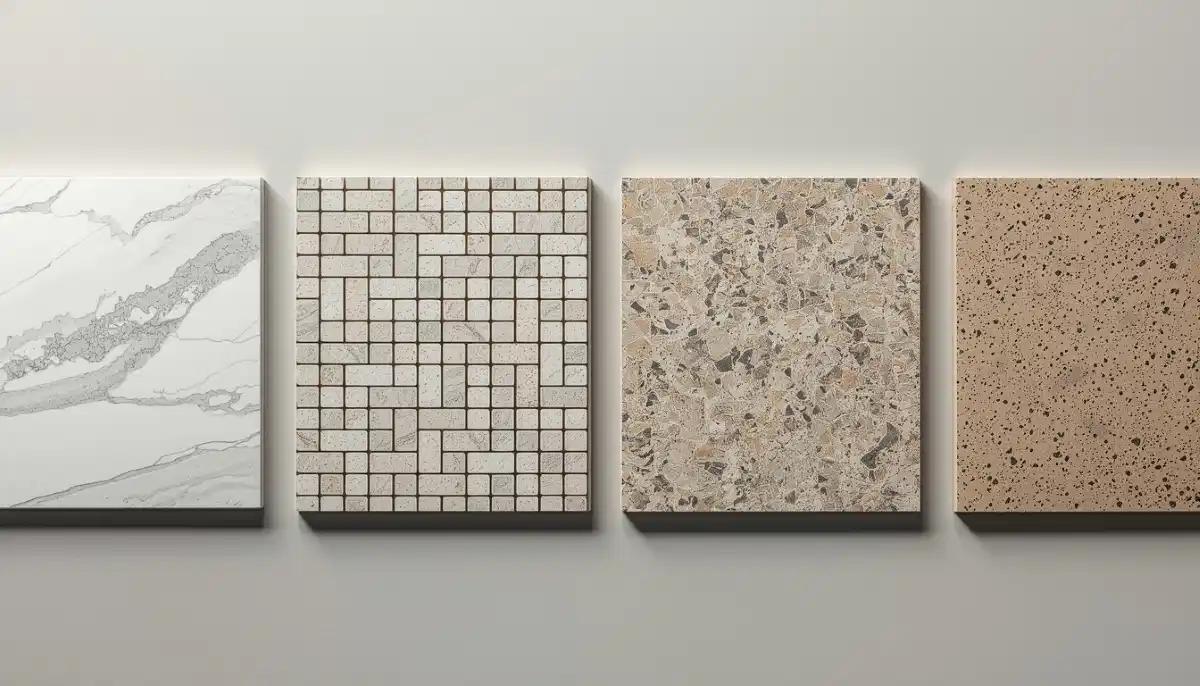
Granite comes in hundreds of colours and patterns. Here are the most common types available in South Africa:
| Granite Type | Appearance | Best For | Price Range/m² |
|---|---|---|---|
| Absolute Black | Solid black, minimal speckles, very uniform | Modern kitchens, countertops, floors | R500 – R900 |
| Black Galaxy | Black with gold or silver specks that sparkle | Luxury kitchens, feature areas | R800 – R1,500 |
| Baltic Brown | Brown with black and grey speckles, very consistent | Traditional kitchens, floors, high traffic | R500 – R800 |
| Santa Cecilia | Gold, beige, and brown speckles – warm tones | Mediterranean style, warm interiors | R600 – R1,000 |
| Verde Ubatuba | Deep green with black and gold flecks | Unique accent areas, outdoor kitchens | R700 – R1,200 |
| White Ice | White/light grey with subtle grey speckles | Light, airy kitchens, modern design | R800 – R1,500 |
Finish Options:
- Polished: High-gloss, reflective, shows colours vividly. Most common for countertops and floors.
- Honed: Matte, smooth, non-reflective. Hides scratches better. Good for high-traffic floors.
- Flamed: Textured, rough surface created by intense heat. Excellent for outdoor use and wet areas (slip-resistant).
- Leathered: Soft, textured finish with slight sheen. Hides fingerprints and water spots.
⚖️ Granite vs Marble vs Porcelain – Comparison
When considering granite floor tiles or countertops, understand how they compare to alternatives:
| Property | Granite | Marble | Porcelain |
|---|---|---|---|
| Hardness (Mohs) | 6-7 | 3-5 | 7-8 |
| Scratch resistance | Excellent | Fair | Excellent |
| Acid resistance (etching) | Excellent | Poor – etches easily | Excellent |
| Heat resistance | Excellent | Good | Good |
| Water absorption | 0.4%-0.5% | 0.5%-1% | 0.1%-0.5% |
| Sealing required | Yes (every 1-2 years) | Yes (every 6-12 months) | No (grout only) |
| Price range/m² | R500 – R1,500 | R600 – R2,000+ | R250 – R800 |
Verdict for floors: Granite is excellent – durable, scratch-resistant, and beautiful. Porcelain is cheaper and lower maintenance but lacks natural stone authenticity.
Verdict for countertops: Granite is arguably the best natural stone choice – heat-resistant, acid-resistant, and incredibly durable. Marble is too soft and etches easily. Porcelain countertops are gaining popularity but require professional fabrication.
For a deeper dive into these comparisons, read natural stone vs porcelain and marble tiles guide.
Ready to Install Granite in Your Home?
Get free quotes from verified natural stone specialists who have experience with granite floor tiles and countertop installation.
Find Granite Specialists Near You
Free inspections available. Workmanship guarantees.
🏠 Granite Floor Tiles – Benefits and Installation
Granite floor tiles are among the most durable flooring options available. Here’s what you need to know:
Benefits of Granite Flooring:
- Extremely durable: Withstands heavy foot traffic, furniture movement, and dropped items
- Scratch-resistant: Harder than steel – pet claws and high heels won’t damage it
- Stain-resistant when sealed: Low porosity means fewer stains than marble
- Heat-resistant: Sunlight from windows won’t fade or damage granite
- Adds home value: Natural stone flooring is a premium feature
- Available in many colours: From black to white to green to brown
- Cools naturally: Stays cool in summer – great for SA climate
Considerations for Granite Floors:
- Hard and cold: Not as warm or forgiving as wood or vinyl underfoot
- Requires professional installation: Heavy and difficult to cut
- Must be sealed: Every 1-2 years depending on traffic
- Can be slippery when polished and wet: Choose honed or textured for wet areas
- Expensive: Higher material and installation costs than ceramic or porcelain
Best Rooms for Granite Floors:
- Entryways and foyers (makes a stunning first impression)
- Kitchens (durable, heat-resistant, easy to clean)
- Living rooms and dining rooms (elegant and durable)
- Bathrooms (choose honed or textured for slip resistance)
- Hallways (handles heavy traffic beautifully)
- Outdoor patios (flamed or textured finish required)
🍳 Granite Countertop Tiles – Benefits and Installation
Granite countertop tiles offer an alternative to solid slab granite. Here’s the complete picture:
Granite Tile Countertops vs Solid Slab:
- Cost: Tile countertops are significantly cheaper than solid slab (50-70% less)
- Installation: Tiles can be DIY-friendly; slab requires professional templating and fabrication
- Appearance: Slab has continuous pattern; tiles have grout lines (can be minimised with rectified tiles)
- Durability: Both are durable, but grout lines on tile countertops can stain or crack
- Repair: Tile countertops allow individual tile replacement; slab repair is more complex
Benefits of Granite Countertop Tiles:
- Heat-resistant – place hot pots directly on surface
- Scratch-resistant – won’t damage from knives or utensils
- Stain-resistant when properly sealed
- Does not etch from acids (unlike marble)
- Available in hundreds of colours and patterns
- More affordable than solid slab granite
- DIY-possible for experienced tilers
Considerations for Granite Tile Countertops:
- Grout lines need sealing and can trap food particles
- Tile edges may need trim or bullnose pieces
- Requires perfectly flat substrate (plywood or cement board)
- Professional polishing of cut edges may be needed
Installation Tips for Granite Countertops:
- Use epoxy grout for stain resistance (standard grout stains easily)
- Use unsanded grout for narrow joints (under 3mm)
- Apply multiple coats of high-quality penetrating sealer
- Consider using larger tiles (300x300mm or larger) to minimise grout lines
- Use bullnose trim pieces for exposed edges
🔧 Installation Requirements for Granite
Proper installation of granite floor tiles and countertops requires attention to these details:
Subfloor Requirements for Floors:
- Must be extremely flat – within 3mm over 2 meters
- Must be structurally sound – no deflection (movement)
- Concrete subfloor: fully cured (minimum 28 days), clean, and primed
- Wooden subfloor: minimum 28mm thickness, may require additional plywood
- Use uncoupling membrane (recommended) to prevent cracks from subfloor movement
Substrate Requirements for Countertops:
- Use 18-25mm exterior-grade plywood or cement backer board
- Must be perfectly flat and level
- Seal plywood before tiling to prevent moisture absorption
- Reinforce overhangs (more than 300mm) with additional support
Adhesive and Grout:
- Use white, polymer-modified thin-set (grey can show through lighter granite)
- Back-butter each tile for full coverage – essential for natural stone
- Use unsanded grout for joints under 3mm
- For countertops, use epoxy grout for stain resistance
Cutting Granite:
- Requires wet saw with diamond blade – cannot be cut with manual cutter
- Granite is extremely hard – cutting creates significant dust
- Professional fabrication recommended for complex cuts (sink openings, corners)
For complete preparation guidance, read our floor leveling guide.

🛡️ Sealing and Maintenance – Easier Than Marble
While granite requires sealing, it’s less demanding than marble. Here’s your granite tiles guide to maintenance:
Sealing Schedule:
- Initial sealing: Seal immediately after installation (once grout cures – 72 hours)
- Regular sealing: Every 1-2 years depending on traffic and use
- Test for sealing need: Drop water on surface – if it beads up, sealer is working. If it darkens or absorbs, reseal.
- Countertops: Seal every 6-12 months (more exposure to spills)
Daily and Weekly Cleaning:
- Sweep or vacuum floors daily to prevent grit from scratching
- Damp mop with pH-neutral stone cleaner or mild dish soap and water
- Wipe countertops after each use – especially acidic spills (wine, juice, tomato sauce)
- Never use vinegar, bleach, ammonia, or abrasive cleaners
- Use cutting boards on countertops – while granite is scratch-resistant, knives will dull on stone
- Use trivets or hot pads – granite can handle heat, but sudden extreme temperature changes can crack
What NOT to Use on Granite:
- ❌ Vinegar or acidic cleaners (won’t etch like marble, but can damage sealer)
- ❌ Bleach or ammonia – harsh chemicals dull finish
- ❌ Abrasive scrubbers (steel wool, scouring pads) – can scratch
- ❌ Stone cleaners with wax or acrylic – cause build-up
Stain Removal:
For oil-based stains, use baking soda poultice (mix baking soda with water to paste). Apply, cover with plastic wrap, leave 24-48 hours. Remove, rinse, dry. Granite rarely stains deeply when properly sealed.
For more cleaning guidance, read our tile cleaning methods guide and tile maintenance tips.
✅❌ Pros and Cons of Granite Tiles
Pros – Why Choose Granite:
- ✓ Extremely durable – one of the hardest natural stones
- ✓ Heat-resistant – hot pots directly on surface (countertops)
- ✓ Scratch-resistant – harder than steel
- ✓ Acid-resistant – does not etch like marble (perfect for kitchens)
- ✓ Stain-resistant when properly sealed
- ✓ Unique natural patterns – no two tiles identical
- ✓ Adds significant home value
- ✓ Available in hundreds of colours
- ✓ Cools naturally – great for SA summers
Cons – Considerations Before Buying:
- ✗ Expensive – higher material and installation costs
- ✗ Requires sealing every 1-2 years
- ✗ Hard and cold underfoot (flooring)
- ✗ Heavy – requires strong subfloor
- ✗ Difficult to cut – professional installation recommended
- ✗ Polished granite can be slippery when wet
- ✗ Grout lines on tile countertops can trap food (consider slab for countertops)
💰 Granite Tile Cost Guide
Here’s what you can expect to pay for granite floor tiles and countertops in South Africa:
| Item | Cost Range | Notes |
|---|---|---|
| Granite tiles (material/m²) | R500 – R1,500 | Absolute Black R500-900, White Ice R800-1,500 |
| Installation (floors)/m² | R200 – R400 | Specialist natural stone installer required |
| Installation (countertops)/m² | R300 – R600 | More complex than floors – cuts for sinks, taps |
| Solid slab granite countertop/m² | R1,500 – R3,500 | Professional templating and fabrication included |
| Sealing (professional)/m² | R50 – R100 | DIY sealer: R200-R500 per bottle (covers 20-40m²) |
| Total installed floor (50m²) | R35,000 – R95,000+ | Material + installation + preparation |
| Total tile countertop (5m²) | R4,000 – R10,000 | Material + installation + edging |
| Solid slab countertop (5m²) | R7,500 – R17,500 | No grout lines, continuous pattern |
For a complete breakdown of tile costs, read our tile installation cost per square meter guide.
🏠 Best Uses for Granite in Your Home
Here’s where are granite tiles good for floors and countertops – the definitive answer by room:
Kitchen Countertops: ✅ Excellent choice. Heat-resistant, scratch-resistant, acid-resistant. Does not etch from lemon juice or vinegar like marble. Perfect for busy cooks.
Kitchen Floors: ✅ Very good. Extremely durable, handles dropped pots, easy to clean. Choose honed or textured finish for slip resistance.
Bathroom Vanities: ✅ Excellent. Moisture-resistant when sealed, beautiful appearance, easy to clean. Black granite with white veining is very popular.
Bathroom Floors: ✅ Good – but choose honed or flamed finish. Polished granite becomes dangerously slippery when wet.
Entryways and Foyers: ✅ Excellent. Makes stunning first impression, handles heavy traffic and dirt.
Outdoor Patios and Kitchens: ✅ Excellent – but must use flamed or textured finish. Flamed granite is non-slip and withstands weather beautifully.
Fireplace Surrounds: ✅ Excellent. Heat-resistant and beautiful. Dark granite creates dramatic focal point.
Where NOT to Use Granite:
- Bedrooms (too cold underfoot – consider wood or carpet instead)
- Areas requiring slip resistance (use honed or flamed, not polished)
- DIY projects without professional tools (granite is very difficult to cut)
❓ Frequently Asked Questions About Granite Tiles
Are granite tiles good for floors and countertops?
Yes – granite floor tiles and countertops are among the most durable natural stone options available. Granite is harder than marble, resistant to scratches, heat, and acids, and requires less maintenance than other natural stones. For busy kitchens and high-traffic areas, granite is an excellent choice. The only downside is cost and the need for professional installation.
How often does granite need to be sealed?
Granite should be sealed every 1-2 years, depending on traffic and use. Countertops may need sealing every 6-12 months due to frequent spills. Test by dropping water on the surface – if it beads up, sealer is working. If it darkens or absorbs, reseal immediately. Proper sealing prevents stains and makes cleaning easier.
Is granite more expensive than marble?
Generally, granite is less expensive than marble. Granite tiles range from R500-R1,500/m²; marble tiles from R600-R2,000+/m². Installation costs are similar. Solid slab granite countertops (R1,500-3,500/m²) are typically cheaper than marble slabs (R2,000-5,000+/m²). However, both are premium materials compared to ceramic or porcelain.
Can I install granite tiles myself?
Only if you have significant tiling experience AND natural stone expertise. Granite is extremely hard and heavy. It requires a wet saw with diamond blade, white thin-set, back-buttering, and unsanded grout. Mistakes are expensive – granite tiles cost R500-1,500/m². For countertops, professional fabrication is strongly recommended. Hire a verified natural stone specialist through ServiceLink SA.
What’s the difference between granite tile and solid slab countertops?
Granite tile countertops use individual tiles with grout lines between them. They’re 50-70% cheaper than solid slab but have visible joints that can trap food. Solid slab countertops are cut from a single piece of stone – seamless, continuous pattern, no grout lines, but significantly more expensive. For high-end kitchens, slab is preferred. For budget-conscious projects or DIY, tile works well.
Does granite stain easily?
No – when properly sealed, granite is stain-resistant. Its low porosity (0.4%-0.5%) means liquids don’t penetrate quickly. However, unsealed granite or neglected sealers can stain – especially oil-based spills (cooking oil, lotions). Regular sealing (every 1-2 years) prevents stains. Compared to marble (0.5%-1% porosity), granite is more stain-resistant.
Can you put hot pans directly on granite countertops?
Yes – granite is heat-resistant and can withstand hot pots directly from the oven or stove. However, avoid extreme temperature changes (e.g., placing an ice-cold pan on a hot granite surface), which could theoretically cause thermal shock cracking. For daily use, granite handles heat beautifully – one of its biggest advantages over wood or laminate.
Is granite flooring slippery?
Polished granite can be slippery, especially when wet. For bathrooms, entryways, or any area prone to moisture, choose honed (matte) or flamed (textured) granite instead. Flamed granite has a rough, non-slip surface perfect for pool decks and outdoor areas. For kitchens and living rooms, polished granite is fine since spills are wiped up quickly.
✅ Final Thoughts: Granite – The Tough, Beautiful Natural Stone
If you want natural stone that can handle real life, choose granite. Unlike marble (which etches and scratches) or travertine (which requires constant sealing), granite stands up to kitchens, kids, pets, and everything in between.
Granite floor tiles provide decades of durable service. Granite countertop tiles offer heat and scratch resistance that other materials can’t match. And while the upfront cost is higher than ceramic or porcelain, the longevity and beauty of granite make it a worthwhile investment – especially in homes where you plan to stay for years.
Key takeaways for granite tiles:
- Granite is one of the hardest natural stones – very durable
- Does not etch from acids (unlike marble) – perfect for kitchens
- Requires sealing every 1-2 years – less frequent than marble
- Professional installation required – granite is difficult to cut
- Cost: R500-1,500/m² for tiles; R1,500-3,500/m² for solid slab countertops
- Choose honed or flamed finish for wet areas (polished can be slippery)
- For budget-conscious homeowners, porcelain stone-look tiles offer similar appearance at lower cost
Your next step: Ready to install granite in your home? Get free quotes from verified natural stone specialists who can handle proper installation of granite floor tiles or granite countertop tiles.
Ready to Install Granite in Your Home?
Get free quotes from verified natural stone specialists. Whether you need granite floor tiles or countertops, we’ll connect you with the right pros.
📞 Call us: 073 138 4726 to discuss your granite project.
Are You a Natural Stone Installation Specialist?
Join ServiceLink SA’s network of verified tiling contractors. Get qualified leads, showcase your natural stone expertise, and grow your business.
📚 Official resources & standards referenced:
- SABS – South African Bureau of Standards for granite standards, including hardness, porosity, and quality specifications.
- SANS 10400 – South African National Standard for material specifications and installation requirements for natural stone.
Information provided for general guidance. Granite installation requires specialist knowledge – always consult qualified professionals.
Written by: Innocent T Hanyani
Construction & Home Services Industry Specialist | 21+ Years Experience
Innocent T Hanyani has over two decades of experience working across South Africa’s construction and home improvement sectors. Throughout his career, he has specified and installed thousands of square meters of granite floor tiles and countertops. His practical experience helps homeowners understand why granite outperforms marble in kitchens and why professional installation is essential for this hard, heavy stone. He has seen granite floors last decades with minimal maintenance and granite countertops survive daily cooking abuse that would ruin other materials.
For more information about granite and natural stone, explore our related resources: natural stone vs porcelain, marble tiles guide, travertine tiles explained, and tile maintenance tips. Learn about our process on what is ServiceLink SA and how our service works. Find tilers in your area: Gauteng, Johannesburg, and Pretoria. For related services, see our flooring services and building construction guides.