

Ready to Transform Your Small Bathroom?
Get free quotes from verified tiling specialists who understand bathroom tile layout techniques that make small spaces feel larger.
Get Free Bathroom Tiling Quotes
Servicing Gauteng, Johannesburg, Pretoria, and across South Africa
Best Tile Patterns for Small Bathrooms: Make Your Space Look Bigger SA
🛁 Transform your cramped bathroom into a spacious retreat with these clever tile layout techniques
You know the feeling. You step into your bathroom, and it feels like a closet. Your elbows hit the walls. The shower feels like a phone booth. You dream of a spa-like retreat, but you’re working with a footprint that’s anything but generous.
I’ve worked on hundreds of bathroom renovations across Gauteng, from Johannesburg to Pretoria, and the number one challenge homeowners face is making small bathrooms feel larger. The good news? You don’t need to knock down walls or add expensive extensions. The solution is often as simple as choosing the right tile patterns for small bathrooms.
The way you lay your tiles dramatically affects how spacious a room feels. The right bathroom tile layout can trick the eye, elongate walls, and create visual enlargement without changing a single square meter of floor space. In this guide, I’ll share the best tile patterns to make a small bathroom look bigger – techniques I’ve used successfully in hundreds of compact bathrooms.
You’ll learn about vertical stacking, diagonal layouts, large format tiles, and the magic of matching floor and wall tiles. I’ll also cover common mistakes that make small bathrooms feel even smaller. By the end, you’ll have a clear plan for your small bathroom tiling ideas.
For more bathroom inspiration, check out our guides on modern tile design trends, herringbone tile pattern guide, hexagon tiles design ideas, and large vs small tiles design.
📋 Table of Contents – Small Bathroom Tile Patterns Guide
🛁 Why Tile Pattern Matters in Small Bathrooms
Before diving into specific small bathroom tiling ideas, let’s understand the psychology of visual space:
How Tile Patterns Affect Perception:
- Horizontal lines make rooms feel wider (good for narrow bathrooms)
- Vertical lines make ceilings feel higher (good for low ceilings)
- Diagonal lines add depth and make rooms feel larger in all directions
- Large tiles with few grout lines create seamless, expansive feel
- Matching floor and wall tiles eliminates visual breaks, making space feel continuous
- Light colours reflect more light, making spaces feel larger
- Busy patterns can overwhelm small spaces – use sparingly
The Goal: Create visual enlargement – trick the eye into perceiving more space than actually exists. The right tile layout can add the illusion of square meterage without any structural changes.
For more design principles, read our modern tile design trends guide.
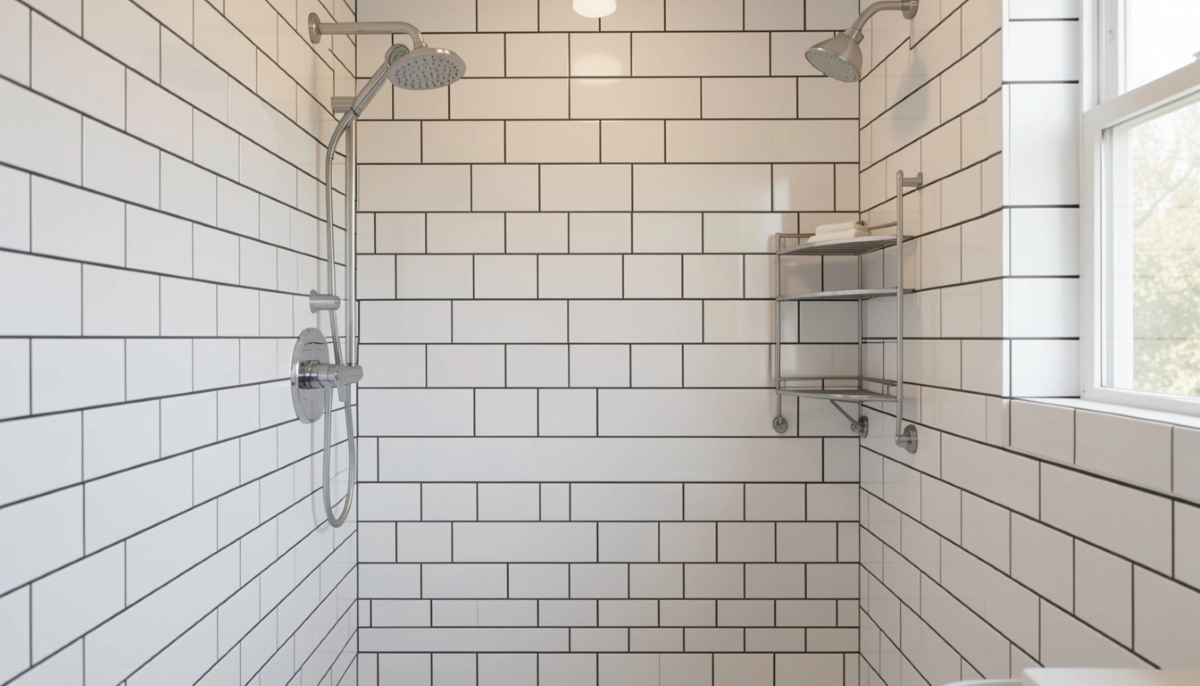
⬆️ Vertical Stacking – Elongate Your Walls
This is my go-to recommendation for small bathrooms with standard or low ceilings:
What Is Vertical Stacking?
Instead of laying rectangular tiles horizontally (the classic subway pattern), you lay them vertically. Tiles are stacked directly above each other in straight columns.
Why It Works:
- Vertical lines draw the eye upward, making ceilings appear higher
- Creates a sense of height and airiness
- Works beautifully with subway tiles (75x150mm or 100x200mm laid vertically)
- Also works with rectangular tiles in other proportions
- Particularly effective in showers and on feature walls
Best Tile Choices for Vertical Stacking:
- Subway tiles (75x150mm, 100x200mm) laid vertically
- Rectangular tiles (100x300mm, 150x300mm) in vertical orientation
- Plank-style tiles (wood-look porcelain) installed vertically
Pro Tip: For maximum height illusion, use tiles that are at least twice as long as they are wide, and stack them in straight columns without offset. Keep grout lines fine (2-3mm) and match grout colour to tiles for seamless look.
For more on subway tile applications, read our subway tile installation guide.
📏 Large Format Tiles – Fewer Grout Lines
This is one of the most effective tile patterns for small bathrooms – and it’s not really a pattern at all:
What Are Large Format Tiles?
Tiles with at least one side measuring 600mm or more – 600x600mm, 600x1200mm, or even larger.
Why They Work in Small Bathrooms:
- Fewer grout lines create a seamless, uninterrupted surface
- Less visual clutter – grout lines can make small spaces feel busy
- Large tiles on walls and floors make the space feel more expansive
- Works especially well on floors – fewer cuts and joints
- Modern, clean aesthetic that doesn’t overwhelm
Best Applications:
- Floor: 600x600mm or 600x1200mm porcelain tiles
- Walls: 600x600mm or 300x600mm (laid horizontally or vertically)
- Shower walls: 600x1200mm tiles (fewer grout lines = less mould potential)
Pro Tip: Use rectified large format tiles for very narrow grout lines (2mm). Match grout colour to tile colour to make joints nearly invisible. For small bathrooms, lighter colours work best – white, cream, light grey, pale beige.
For installation requirements, read our large format tiles installation guide.
🔷 Diagonal (Diamond) Layout – Add Depth
This classic technique adds visual interest and perceived space:
What Is a Diagonal Layout?
Tiles are rotated 45 degrees so they sit on their corners (diamond orientation) rather than parallel to walls.
Why It Works:
- Diagonal lines create depth perception – the eye travels across the room at angles, making space feel larger
- Works especially well on floors in narrow or irregularly shaped bathrooms
- Draws attention away from room’s actual dimensions
- Can make a long, narrow bathroom feel wider
Best Tile Choices for Diagonal Layout:
- Square tiles (300x300mm, 400x400mm, 600x600mm) on floors
- Can also work with rectangular tiles, but cutting is more complex
- Large format tiles (600x600mm) in diamond pattern on floors
Important Considerations:
- Diagonal layout creates more waste (more cuts, especially at walls)
- Installation is more labour-intensive (costs more)
- Requires experienced tiler – not a DIY pattern
Pro Tip: Use diagonal layout on floors only, not walls. Keep walls in a simple straight lay to avoid overwhelming the space. Combine with large format tiles for maximum effect.
Need Help Designing Your Small Bathroom?
Get free quotes from verified tiling specialists who understand bathroom tile layout techniques that maximise small spaces.
Get Free Bathroom Design Quotes
Free inspections available. Beat Your Quote guarantee.
🧱 Subway Tile Patterns – Classic and Clever
Subway tiles are timeless, but the pattern matters in small spaces:
Standard Brick Bond (1/2 Offset):
Rows offset by half a tile. This classic pattern works well but can feel busy in very small spaces. Use larger subway tiles (100x200mm or 75x150mm) rather than small mosaics.
Vertical Subway (Best for Low Ceilings):
Subway tiles installed vertically, stacked in columns. As discussed earlier, this elongates walls. This is often the best choice for small bathrooms with standard or low ceilings.
Stack Bond (Straight Stack):
Tiles aligned directly above each other with no offset. Creates a clean, grid-like pattern. Modern and minimalist. Fewer visual breaks than brick bond – good for small spaces.
1/3 Offset (Stretcher Bond):
Rows offset by one-third of a tile. More subtle than standard brick bond. Creates gentle movement without overwhelming small spaces.
Pro Tip for Small Bathrooms: Use larger subway tiles (100x200mm or 75x150mm) – avoid the very small subway mosaics (25x75mm) which create too many grout lines and visual clutter. Install vertically for height, or use stack bond for clean minimalism.
For complete subway tile guidance, read our subway tile installation guide.
〰️ Herringbone – Movement and Interest
Herringbone adds elegance and movement, but use with caution in small bathrooms:
What Is Herringbone?
Rectangular tiles laid in a V-shaped pattern, creating a zigzag effect. Very classic and sophisticated.
Why It Can Work:
- Adds dynamic movement and visual interest
- Can distract from awkward room shapes or proportions
- Creates a sense of flow
When to Use (and When to Avoid):
- Use: On floors only, in bathrooms that are very small but have simple layouts. Use large-format herringbone (larger tiles) to minimise grout lines.
- Avoid: On walls (too busy). In bathrooms with lots of fixtures (toilet, vanity, shower) – pattern gets lost. In already busy bathrooms.
- Avoid: Small herringbone mosaics (too many grout lines, visual clutter).
Pro Tip: If you love herringbone, use it as an accent – a small floor area (like a shower floor) or a narrow accent strip. Don’t cover entire walls. For larger herringbone applications, read our herringbone tile pattern guide.
⬡ Hexagon and Geometric Patterns
Geometric tiles can add personality, but choose wisely for small spaces:
Hexagon Tiles:
Six-sided tiles that create a honeycomb pattern. Popular and modern.
Best Uses in Small Bathrooms:
- Shower floors (small hexagons – 25-50mm – provide good grip)
- Small accent areas (niches, behind vanity)
- Floor accent within larger tile field (feature medallion)
Size Matters:
- Small hexagons (25-50mm): Create many grout lines – can feel busy. Best for shower floors only.
- Large hexagons (150-300mm): Fewer grout lines – better for main bathroom floors. Creates modern, spacious feel.
Other Geometric Patterns:
- Penny round: Small circles – generally too busy for small bathrooms (lots of grout lines). Use sparingly as accents.
- Basketweave: Interlocking rectangles – can work on floors but use larger-scale version.
- Moroccan/fish scale: Curved pattern – beautiful but best as accent only (single wall or niche).
Pro Tip: In small bathrooms, use geometric patterns as accents, not entire walls or floors. A hexagon shower floor, a patterned niche back, or a geometric accent strip adds interest without overwhelming. For more hexagon ideas, read our hexagon tiles design ideas.

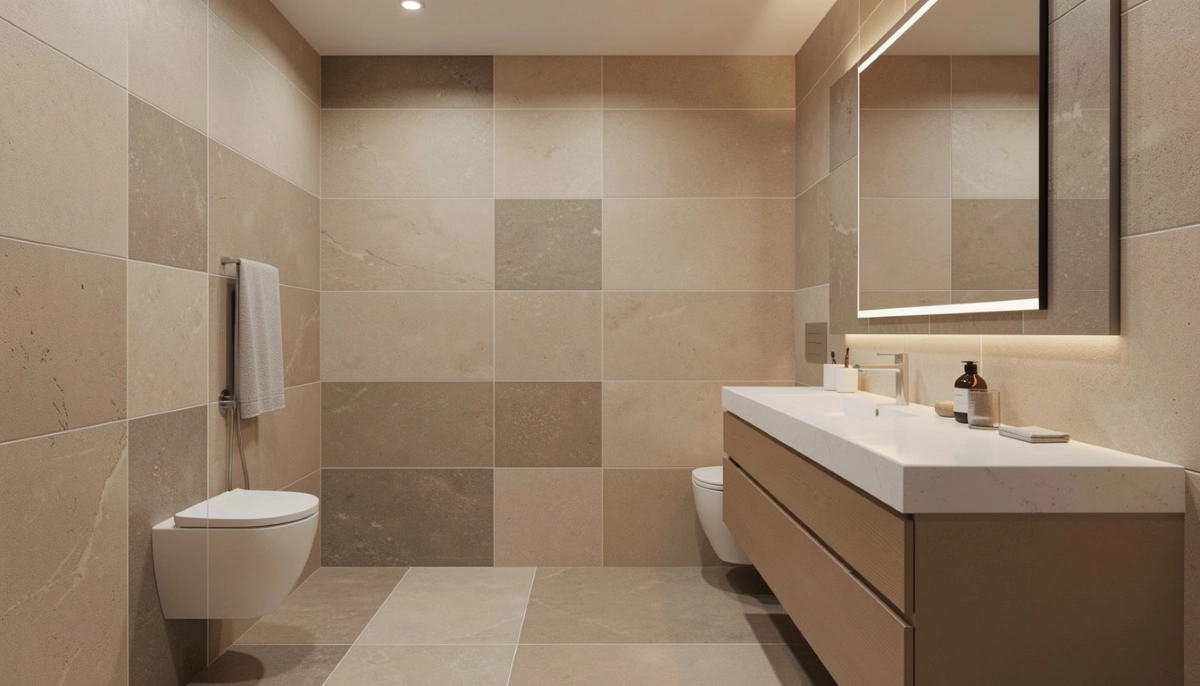
🔄 Matching Floor and Wall Tiles – Seamless Flow
This is one of the most powerful small bathroom tiling ideas for visual enlargement:
What It Means:
Using the exact same tile on both floors and walls (or coordinating tiles that are very similar in colour and finish).
Why It Works:
- Eliminates visual breaks between floor and walls
- Creates a continuous, uninterrupted surface
- The eye doesn’t stop at floor-wall junction – space feels larger
- Particularly effective in very small bathrooms and wet rooms
- Modern, spa-like aesthetic
How to Execute:
- Use large format tiles (600x600mm or 600x1200mm) on both surfaces
- Same colour and finish throughout
- Match grout colour to tiles for seamless look
- Consider floor tiles rated for slip resistance (R10-R11)
Pro Tip: For bathroom floor and wall tile match, use porcelain tiles – they work for both surfaces and offer durability and water resistance. Choose a light, neutral colour for maximum space-enhancing effect.
For more on this technique, read our modern tile design trends guide.

🎨 Colour and Grout – The Finishing Touch
Tile colour and grout choice dramatically affect perceived space:
Best Colours for Small Bathrooms:
- White and off-white: Maximum light reflection, classic, clean, makes space feel largest
- Light cream and beige: Warm, inviting, slightly less reflective but still effective
- Pale grey: Modern, sophisticated, works well with contemporary design
- Pastel colours (pale blue, sage green): Can work but keep very light
- Dark colours: Generally avoid in small bathrooms – they absorb light and make spaces feel smaller
Grout Colour Strategy:
- Match grout to tile colour: Best for small spaces – grout lines disappear, creating seamless look. This maximises visual enlargement.
- Contrasting grout (dark grout with white tiles): Can work but creates grid pattern that can make spaces feel smaller. Use only in larger small bathrooms or as an accent.
- Grout line width: Use narrow joints (2-3mm) for minimal visual interruption. Rectified tiles allow 2mm joints.
Pro Tip: For maximum space-enhancing effect, choose glossy or matte white tiles (not cream – true white) with matching white grout. The seamless, monochromatic look is incredibly effective at making small bathrooms feel twice their size. Read our grout colour selection guide for more.
🚫 Tile Patterns to Avoid in Small Bathrooms
⚠️ Warning: These Patterns Make Small Bathrooms Feel Smaller
Avoid these common mistakes when planning your bathroom tile layout.
- Small mosaic tiles on large areas: Too many grout lines create visual clutter and make spaces feel busy and cramped. Use sparingly as accents only.
- Busy patterns on all surfaces: Patterned tiles on floor AND walls AND shower – overwhelming. Limit pattern to one surface (e.g., floor only).
- Horizontal brick bond on walls (with standard orientation): Emphasises width, which is usually not the problem in small bathrooms. Vertical stacking is better.
- Large contrasting grout lines: Dark grout with white tiles creates a strong grid pattern that visually chops up the space. Match grout to tiles for seamless look.
- Dark colours: Dark tiles absorb light and make rooms feel smaller and cave-like. If you love dark colours, use them on one accent wall only.
- Too many different tiles: Floor tile, wall tile, shower tile, accent tile – all different. Too much visual chaos. Stick to 2-3 coordinated tiles maximum.
- Horizontal stripe accents: Creates a visual line that can make ceilings feel lower. Vertical stripes are better for height.
The Golden Rule: In small bathrooms, simpler is better. Fewer grout lines, fewer colours, fewer patterns, more light. When in doubt, choose large light-coloured tiles with matching grout in a simple vertical or stack pattern.
❓ Frequently Asked Questions About Tile Patterns for Small Bathrooms
What is the best tile pattern to make a small bathroom look bigger?
The best tile patterns to make a small bathroom look bigger are: vertical stacking (elongates walls), large format tiles (fewer grout lines), and diagonal layouts (adds depth). Combining these – large format tiles (600x600mm or 600x1200mm) in a vertical stack pattern – is highly effective. Also use light colours and match grout to tile colour for seamless look.
Are large or small tiles better for a small bathroom?
Large tiles are better for small bathrooms. Large format tiles (600x600mm or larger) have fewer grout lines, creating a seamless, uninterrupted surface that makes the space feel larger. Small mosaic tiles create many grout lines, which add visual clutter and make small spaces feel busy and cramped. Save small tiles for shower floors only.
Should bathroom tiles be horizontal or vertical?
For small bathrooms, vertical tile placement is generally better. Vertical lines draw the eye upward, making ceilings appear higher and rooms feel taller and more spacious. Horizontal placement emphasises width, which is rarely the issue in small bathrooms. This applies especially to subway tiles and rectangular tiles.
What colour tiles make a small bathroom look bigger?
Light colours make small bathrooms look bigger – white, off-white, cream, pale grey, light beige. White is most effective because it reflects the most light. Dark colours absorb light and make rooms feel smaller. If you want colour, use pastels (pale blue, sage green) but keep them very light. Save darker colours for accent walls only.
Should floor and wall tiles match in a small bathroom?
Yes – bathroom floor and wall tile match is highly recommended for small bathrooms. Using the same tile on both surfaces eliminates visual breaks, creating a continuous, seamless flow that makes the space feel larger. This technique is very effective in small bathrooms and wet rooms. Choose large format tiles for best results.
Is herringbone tile pattern good for small bathrooms?
Herringbone can work but use with caution. In small bathrooms, use herringbone on floors only (not walls) and in larger-scale format (not small mosaics). Avoid herringbone in bathrooms with many fixtures (toilet, vanity, shower) – the pattern gets lost. For most small bathrooms, simpler patterns (vertical stack, large format) are more effective. Read our herringbone tile pattern guide for more.
Does grout colour affect how big a bathroom looks?
Yes – significantly. Matching grout colour to tile colour makes grout lines disappear, creating a seamless look that maximises visual enlargement. Contrasting grout (e.g., dark grout with white tiles) creates a visible grid pattern that visually chops up the space, making it feel smaller and busier. For small bathrooms, always match grout to tile colour.
Can I use patterned tiles in a small bathroom?
Yes, but sparingly. Limit patterned tiles to one surface only – e.g., floor only, or shower niche back, or one accent wall. Avoid pattern on all surfaces. Use larger-scale patterns (not tiny busy patterns). Consider using patterned tiles as a border or accent strip rather than full coverage. When in doubt, keep it simple – pattern can overwhelm small spaces.
✅ Final Thoughts: Small Bathroom, Big Possibilities
A small bathroom doesn’t have to feel cramped. With the right tile patterns for small bathrooms, you can create a space that feels open, airy, and spa-like. The key is understanding how pattern, scale, colour, and layout affect perception.
My top recommendations for most small bathrooms: large format light-coloured tiles (600x600mm or 600x1200mm), vertical stacking on walls, matching floor and wall tiles, and matching grout colour to tiles. This combination consistently creates the most visual enlargement.
Key takeaways for small bathroom tiling ideas:
- Large format tiles (600x600mm+) – fewer grout lines, seamless look
- Vertical stacking – draws eye upward, makes ceilings feel higher
- Matching floor and wall tiles – eliminates visual breaks
- Light colours (white, cream, pale grey) – reflect light, expand space
- Match grout colour to tiles – makes grout lines disappear
- Avoid busy patterns, small mosaics, dark colours, and horizontal layouts
- When in doubt, simpler is better – less visual clutter = more perceived space
Your next step: Ready to transform your small bathroom? Get free quotes from verified tiling specialists who understand bathroom tile layout techniques that maximise small spaces.
Ready to Transform Your Small Bathroom?
Get free quotes from verified tiling specialists who understand tile patterns for small bathrooms and can help you maximise your space.
📞 Call us: 073 138 4726 to discuss your bathroom project.
Are You a Tiling Specialist?
Join ServiceLink SA’s network of verified tiling contractors. Get qualified leads for bathroom renovation and tiling projects.
📚 Official resources & standards referenced:
- SANS 10400 – South African National Standard for bathroom standards, including ventilation, waterproofing, and safety requirements for wet areas.
- SABS – South African Bureau of Standards for tile standards, including slip resistance and quality specifications for bathroom tiles.
Information provided for general guidance. Always consult local building regulations and a qualified professional for bathroom renovations.
Written by: Innocent T Hanyani
Construction & Home Services Industry Specialist | 21+ Years Experience
Innocent T Hanyani has over two decades of experience working across South Africa’s construction and home improvement sectors. Throughout his career, he has designed and installed hundreds of small bathroom renovations, specialising in tile patterns that maximise perceived space. His practical experience helps homeowners understand how vertical stacking, large format tiles, and matching floor and wall tiles can transform cramped bathrooms. He has seen the dramatic difference that the right pattern makes – and the mistakes that make small spaces feel even smaller.
For more information about bathroom tiling and design, explore our related resources: modern tile design trends, herringbone tile pattern guide, hexagon tiles design ideas, and large vs small tiles design. Learn about our process on what is ServiceLink SA and how we verify contractors. Find tilers in your area: Gauteng, Johannesburg, and Pretoria. For related services, see our plumbing services and painting services guides.