

Want to Understand Your Fuel Costs?
ServiceLink SA connects you with verified wholesale suppliers who offer transparent pricing based on the official formula. Get free quotes today. If we can’t assist directly, we’ll connect you with our trusted partner companies to carry out your fuel supply projects professionally and timeously.
Servicing Johannesburg, Pretoria, Durban, Cape Town, Secunda, and across South Africa
What Factors Determine Fuel Price in South Africa? The Formula Revealed
🧮 From international oil markets to your fuel tank—your complete guide to the diesel price formula
I once sat with a transport company owner who was convinced his fuel supplier was manipulating prices. “Last month the price went up by 50 cents,” he said angrily. “This month it’s up another 30 cents. They’re just greedy.”
I pulled up the DMRE’s monthly price announcement and showed him the basic fuel price explained in simple terms. The 50-cent increase was entirely due to a weaker rand and higher international oil prices. His supplier’s margin hadn’t changed at all. He had been blaming the wrong people for years.
Understanding how fuel prices are calculated South Africa is essential for any business that buys diesel. When you know the fuel price formula, you can distinguish between fair market movements and supplier exploitation. You can anticipate price changes. And you can negotiate with confidence.
This comprehensive educational guide walks you through the exact calculation methodology used by the DMRE. We’ll cover basic fuel price explained, what factors determine fuel price in South Africa, the slate levy mechanism, and wholesale margin structures. For more on price components, read fuel price breakdown South Africa.
Ready to become a fuel pricing expert? Let’s dive into the formula.
📋 Table of Contents – Fuel Price Calculation Guide
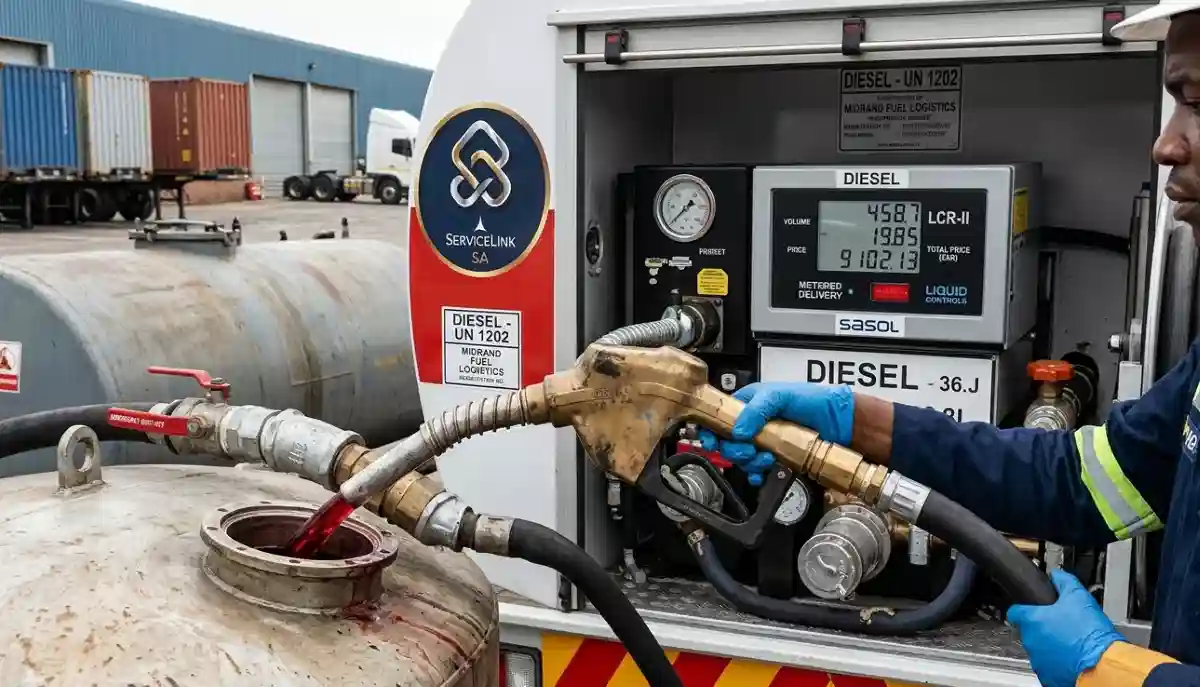
📊 Fuel Price Calculation Overview
How fuel prices are calculated South Africa follows a transparent, regulated formula. Here’s the high-level overview:
⚠️ The Core Formula
The retail fuel price is calculated as: BFP + Government Levies + Slate Levy + Retail Margin + Transport Differential. Each component has a specific calculation methodology published by the DMRE.
The five main components of the fuel price formula:
| Component | Description | Who Calculates | Update Frequency |
|---|---|---|---|
| Basic Fuel Price (BFP) | International product + freight + insurance + handling | DMRE基于现有数据 | Monthly |
| Government Levies | General Fuel Levy + RAF Levy + Carbon Tax | National Treasury/SARS | Annually (Feb budget) |
| Slate Levy | Recovery of under/over-recoveries | DMRE | Monthly |
| Wholesale/Retail Margin | Supplier and service station profit | Market/DMRE regulation | As negotiated (wholesale) or regulated (retail) |
| Transport Differential | Cost to deliver from depot to location | Distance-based formula | Per delivery/contract |
Who sets the fuel price formula?
The DMRE (Department of Mineral Resources and Energy) oversees the fuel pricing mechanism. See DMRE – Pricing formula for official documentation. The CEF (Central Energy Fund) provides technical calculation support. See CEF – Calculation methodology.
Why this matters to you:
When you understand the formula, you can:
- Verify that your supplier’s pricing is fair
- Anticipate monthly price changes
- Negotiate wholesale margins effectively
- Understand why prices move even when local factors seem stable
For more on price components, read fuel price breakdown South Africa.
🌍 Basic Fuel Price (BFP) Calculation
The basic fuel price explained starts with understanding its components. The BFP is the foundation of the entire fuel price formula.
BFP calculation formula:
BFP = Platts Assessment + Ocean Freight + Insurance + Handling + Financing Costs
Detailed BFP components:
- Platts Assessment: The international product price for diesel (CIF Mediterranean or Arabian Gulf benchmark). This is a 30-day average of daily Platts assessments.
- Ocean Freight: Cost to ship diesel from international refineries to South African ports (Durban, Cape Town, Port Elizabeth, Ngqura). Based on actual shipping rates.
- Insurance: Marine insurance for the shipment during transit.
- Handling: Port and wharfage fees, including unloading and storage at the port.
- Financing Costs: Interest cost on the product value during the 30-day averaging period.
How BFP is calculated monthly:
- DMRE collects daily Platts assessments for the relevant benchmark over 30 days
- Daily assessments are averaged to determine the monthly average product price
- Ocean freight rates are averaged over the same period
- Insurance, handling, and financing costs are added using standard formulas
- The final BFP is published around the 25th-28th of each month
- The new BFP takes effect on the first Wednesday of the following month
What influences BFP changes:
- Global crude oil prices (Brent crude) – most significant driver
- USD/ZAR exchange rate – second most significant
- Global refinery margins (crack spreads)
- Shipping costs (Baltic Dry Index, freight rates)
- Supply disruptions (weather, geopolitical events, refinery maintenance)
Why BFP is important to understand:
The BFP accounts for 50-60% of your final diesel price. You cannot negotiate BFP—it’s the same for all buyers. However, understanding BFP helps you:
- Anticipate monthly price direction (track Brent crude and USD/ZAR)
- Verify supplier quotes (wholesale = BFP + reasonable margin)
- Understand global market influences on your local price
For more on BFP, read wholesale diesel prices and how fuel prices are calculated.
🏛️ Government Levy Calculation
Government levies are fixed per-litre amounts set by the National Treasury and collected by SARS. See SARS – Levy calculation for official rates.
Government levy components:
| Levy Type | Calculation Method | Update Frequency | Recipient |
|---|---|---|---|
| General Fuel Levy | Fixed cents per litre set in budget | Annually (February) | National Treasury |
| RAF Levy | Fixed cents per litre set in budget | Annually (February) | Road Accident Fund |
| Carbon Tax | Fixed cents per litre based on carbon content | Annually (phased increases) | National Treasury |
How government levies are calculated:
- The Minister of Finance announces levy changes during the annual Budget Speech (typically February)
- Parliament must approve the changes
- Levies are expressed as fixed cents per litre (e.g., 390c/L = R3.90/L)
- Once set, levies do not change monthly—only annually unless special adjustments are made
- See SARS – Levy calculation for current rates
Typical levy calculation example (for reference):
If the General Fuel Levy is 385c/L (R3.85), RAF Levy is 210c/L (R2.10), and Carbon Tax is 11c/L (R0.11), total government levies = 606c/L (R6.06).
Why levies matter to your business:
Government levies typically account for 30-40% of your fuel cost. For qualifying businesses (agriculture, mining, etc.), these levies can be rebated. Read diesel rebate system for details.
For more on levies, read fuel tax and levies in South Africa.
📉 Slate Levy Mechanism Explained
The slate levy is a unique component that many buyers don’t understand. Here’s how it works in the fuel price formula:
What is the slate levy mechanism?
The slate levy recovers (or refunds) under-recoveries and over-recoveries from the Slate Account. When international prices move significantly during a month, the formula price may not match actual landed cost.
- Under-recovery: International prices rise during the month → formula price too low → consumers pay less than actual cost → deficit goes into Slate Account → recovered later via slate levy
- Over-recovery: International prices drop during the month → formula price too high → consumers pay more than actual cost → surplus goes into Slate Account → may be refunded via negative slate levy
How the slate levy is calculated monthly:
- DMRE tracks the Slate Account balance throughout the month
- At month-end, the net under/over-recovery position is calculated
- DMRE determines the slate levy required to recover (or refund) the balance over a reasonable period
- The slate levy is announced with the monthly price adjustment
- The levy is applied to all fuel sales in the following month(s)
Typical slate levy range:
The slate levy typically ranges from R0.00 to R0.50/L. During periods of extreme price volatility, it can be higher. When the Slate Account has a surplus, the slate levy may be negative (refund).
Why the slate levy matters to you:
The slate levy explains why diesel prices sometimes increase even when international oil prices have been stable. Past under-recoveries are being recovered through the slate levy.
For more on the slate mechanism, read fuel slate levy explained.
💰 Wholesale and Retail Margin Calculation
Understanding wholesale margin calculation is critical for bulk buyers negotiating better prices.
Retail margin (regulated):
Retail margins for service stations are regulated by DMRE to prevent price gouging. However, there is still a range. Typical retail margins: 15-25% of base price (BFP + levies).
Wholesale margin (negotiable):
Wholesale margins are not regulated—they are negotiated between buyer and supplier. The wholesale margin is typically expressed as:
- A fixed cents-per-litre amount (e.g., R0.80/L)
- A percentage of BFP + levies (e.g., 5%)
- A combination (e.g., R0.50/L + 2%)
Typical wholesale margin ranges by volume:
| Monthly Volume | Typical Margin (c/L) | Typical Margin (%) | Negotiability |
|---|---|---|---|
| 20,000-50,000L | R1.50-R2.50 | 8-12% | Low to Medium |
| 50,000-100,000L | R1.00-R1.80 | 6-9% | Medium |
| 100,000-250,000L | R0.70-R1.30 | 4-7% | High |
| 250,000-500,000L | R0.50-R0.90 | 3-5% | Very High |
| 500,000L+ | R0.30-R0.70 | 2-4% | Very High |
How to negotiate better wholesale margins:
- Get multiple quotes and use competition
- Commit to higher volumes
- Offer longer contract terms (24-36 months)
- Ask for transparent margin disclosure (c/L or %)
- Reference competitor offers during negotiation
For more on negotiation, read diesel wholesale discount structures.

🚚 Transport Differential Calculation
The transport differential is the cost to move fuel from the depot to your location. Here’s how it’s calculated:
Transport differential formula:
Transport Differential = (Distance × Cost per km) ÷ Volume + Depot Handling Fees
Components of transport differential:
- Distance: Round trip distance from depot to delivery location
- Cost per km: Includes fuel for truck, driver wages, maintenance, depreciation, insurance, permits
- Volume: Larger deliveries spread fixed costs over more litres
- Depot handling fees: Loading fees, administration, and depot access costs
Typical transport differential ranges:
| Distance from Depot | Typical Transport Differential (R/L) | Example Locations |
|---|---|---|
| 0-50km (urban) | R0.30-R0.60 | Johannesburg CBD, Pretoria, Cape Town CBD |
| 50-150km (regional) | R0.60-R1.20 | Mpumalanga towns, KZN interior |
| 150-300km (remote) | R1.20-R2.00 | Northern Cape, remote Limpopo |
| 300km+ (very remote) | R2.00-R3.50+ | Deep rural, border posts |
How to reduce transport differential:
- Increase delivery volumes (spread fixed costs over more litres)
- Reduce delivery frequency (fewer trips = lower total transport cost)
- Negotiate with suppliers who have depots closer to you
- Pick up from depot if you have suitable transport
For more on delivery, read diesel delivery services.
📐 The Complete Fuel Price Formula
Putting it all together, here’s the complete fuel price formula for diesel in South Africa:
Retail diesel price formula:
Retail Price = BFP + Government Levies + Slate Levy + Retail Margin + Transport Differential
Wholesale diesel price formula (for bulk buyers):
Wholesale Price = BFP + Government Levies + Slate Levy + Wholesale Margin + Transport Differential
Worked example (retail, for illustration):
| Component | Amount (R/L) | Calculation Notes |
|---|---|---|
| Basic Fuel Price (BFP) | R11.50 | 30-day Platts average + freight + insurance |
| General Fuel Levy | R3.85 | Fixed annual budget amount |
| RAF Levy | R2.10 | Fixed annual budget amount |
| Carbon Tax | R0.11 | Fixed per litre based on carbon content |
| Slate Levy | R0.20 | Based on Slate Account balance |
| Retail Margin | R4.00 | Service station profit and overheads |
| Transport Differential | R1.24 | Based on distance from depot |
| Total Retail Price | R23.00 | Sum of all components |
Worked example (wholesale, 100,000L/month buyer):
| Component | Amount (R/L) | Calculation Notes |
|---|---|---|
| Basic Fuel Price (BFP) | R11.50 | Same as retail (not negotiable) |
| Government Levies (total) | R6.06 | Same as retail (not negotiable) |
| Slate Levy | R0.20 | Same as retail (not negotiable) |
| Wholesale Margin | R0.80 | Negotiated (4% of BFP+levies) |
| Transport Differential | R0.40 | Negotiated (urban depot proximity) |
| Total Wholesale Price | R18.96 | Sum of all components |
Key insights from the formula:
- The only negotiable components are wholesale margin and transport differential
- BFP, government levies, and slate levy are fixed for all buyers
- Wholesale buyers save primarily by eliminating the retail margin
For more on wholesale pricing, read wholesale diesel prices.
Want to Apply This Formula to Your Fuel Costs?
ServiceLink SA connects you with verified wholesale suppliers who follow the official pricing formula transparently. Get free quotes today. If we can’t assist directly, we’ll connect you with our trusted partner companies.
What factors determine fuel price in South Africa? Get transparent quotes based on the official formula.
📅 Monthly Price Adjustment Process
Understanding the monthly adjustment timeline helps you anticipate how fuel prices are calculated South Africa month to month:
Typical monthly timeline:
| Date | Event | What Changes |
|---|---|---|
| Throughout month | Daily Platts assessments recorded | BFP calculation data collection |
| Last week of month | DMRE calculates BFP and slate levy | BFP and slate levy determined |
| 25th-28th of month | DMRE announces price adjustment | Public announcement of new prices |
| First Wednesday of month | New prices take effect | BFP, slate levy, and final price change |
How to anticipate price changes:
You can track the daily BFP calculation yourself by monitoring:
- Brent crude oil prices (daily)
- USD/ZAR exchange rate (daily)
- Platts diesel assessments (daily)
Approximately 7-10 days before month-end, you can estimate whether the price will increase or decrease.
Where to find official announcements:
DMRE publishes monthly price adjustments on their website. See DMRE – Pricing formula for announcements. CEF also publishes calculation details. See CEF – Calculation methodology.
For more on price forecasting, read diesel price forecast South Africa.
📈 What Factors Determine Fuel Price in South Africa?
Understanding what factors determine fuel price in South Africa helps you anticipate movements:
External factors (outside South Africa):
- Global crude oil prices: Most significant driver (60-70% of BFP movement)
- USD/ZAR exchange rate: Second most significant (20-30% of BFP movement)
- Global refinery margins (crack spreads): Affects diesel vs crude price difference
- Shipping costs: Freight rates affect BFP
- Geopolitical events: Wars, sanctions, OPEC decisions
- Global demand: Economic growth in China, US, Europe, India
- Refinery maintenance: Seasonal refinery closures reduce supply
Internal factors (within South Africa):
- Government levy changes: Annual budget adjustments
- Slate levy adjustments: Based on previous month’s under/over-recoveries
- Transport differentials: Distance-specific, change rarely
- Local demand: Agricultural seasons, mining activity, logistics demand
- Load shedding intensity: Affects generator diesel demand
What you can control:
- Wholesale margin: Negotiable based on volume and contract terms
- Transport differential: Can reduce by choosing closer depots or increasing volumes
- Fuel efficiency: Reduce consumption through better management
- Rebate claims: Recover government levies if your business qualifies
What you cannot control:
- Global crude oil prices
- USD/ZAR exchange rate
- Government levies (except through rebate claims)
- Slate levy adjustments
For more on price drivers, read diesel price forecast.
❓ Frequently Asked Questions About Fuel Price Calculation
How are fuel prices calculated in South Africa?
How fuel prices are calculated South Africa uses the formula: BFP + Government Levies + Slate Levy + Margin + Transport Differential. The DMRE calculates BFP based on 30-day average international prices. Levies are set annually by National Treasury. Margins are market-driven (retail regulated, wholesale negotiable).
What is the Basic Fuel Price and how is it calculated?
Basic fuel price explained simply: it’s the international cost of diesel including product price, shipping, insurance, and handling. Calculated monthly by DMRE using 30-day average Platts assessments for diesel (CIF Mediterranean/Arabian Gulf benchmark) plus freight, insurance, and handling costs.
What is the fuel price formula for diesel?
The fuel price formula is: Final Price = BFP + General Fuel Levy + RAF Levy + Carbon Tax + Slate Levy + Wholesale/Retail Margin + Transport Differential. BFP and levies are fixed per formula. Margins are negotiable for wholesale buyers.
What factors determine fuel price in South Africa?
What factors determine fuel price in South Africa include: global crude oil prices (Brent crude), USD/ZAR exchange rate, government levies (General Fuel Levy, RAF Levy, Carbon Tax), slate levy (under/over-recovery mechanism), supplier margins, and transport differential.
What is the slate levy and how is it calculated?
The slate levy recovers under/over-recoveries from the Slate Account. When international prices move during the month, the formula price may not match actual cost. The difference is tracked in the Slate Account and recovered (or refunded) via the slate levy in following months. Calculated monthly by DMRE.
What is a fair wholesale margin for diesel?
Wholesale margin fairness depends on volume: 20,000-50,000L: R1.50-R2.50/L (8-12%), 50,000-100,000L: R1.00-R1.80/L (6-9%), 100,000-250,000L: R0.70-R1.30/L (4-7%), 250,000L+: R0.50-R0.90/L (3-5%). Negotiate based on your volume.
How often do fuel prices change in South Africa?
Fuel prices are adjusted monthly by DMRE, effective the first Wednesday of each month. However, government levies change annually (February budget). Wholesale contract prices may change monthly (index-based) or be fixed for contract term (fixed-price contracts).
Can I calculate my own wholesale diesel price using the formula?
Yes—track monthly BFP from DMRE, add current government levies (from SARS), add slate levy (from DMRE monthly announcement), add negotiated wholesale margin, and add transport differential. Compare this calculated price to supplier quotes to verify fairness.
✅ Final Thoughts: Master the Fuel Price Formula
Understanding how fuel prices are calculated South Africa empowers you to make smarter purchasing decisions. When you know the formula, you can verify supplier fairness, anticipate price movements, and negotiate better wholesale margins.
Key takeaways from this guide:
- The formula is: BFP + Government Levies + Slate Levy + Margin + Transport Differential
- Basic fuel price explained shows that 50-60% of your cost comes from international markets
- The fuel price formula is transparent and published monthly by DMRE
- What factors determine fuel price in South Africa are mostly outside local control
- Wholesale margin is the most negotiable component for bulk buyers
- The slate levy explains why prices sometimes change even when oil prices are stable
- Monthly adjustments follow a predictable timeline (announcement 25th-28th, effective first Wednesday)
- You can track daily BFP by monitoring Brent crude and USD/ZAR
- ServiceLink SA connects you with transparent wholesale suppliers who follow the official formula
Your action plan: Use this formula to analyze your current fuel invoices. Calculate what your price should be based on published BFP and levies. If your margin is above fair ranges, negotiate or switch suppliers. Use ServiceLink SA to find transparent wholesale suppliers who provide clear price breakdowns based on the official formula.
Ready to Apply the Fuel Price Formula to Your Purchases?
ServiceLink SA connects you with verified wholesale suppliers who follow the official pricing formula transparently. Get free quotes today. If we can’t assist directly, we’ll connect you with our trusted partner companies to carry out your fuel supply projects professionally and timeously.
📞 Call us: 073 138 4726 for immediate help understanding your fuel costs.
Diesel Delivery •
Fleet Fueling Solutions •
Generator Fuel Services •
Fuel Management Systems
📚 Official resources & data sources referenced:
- DMRE – Department of Mineral Resources and Energy – Official fuel pricing formula and monthly price adjustments.
- CEF – Central Energy Fund – Calculation methodology and fuel price data.
- SARS – South African Revenue Service – Levy calculation and fuel tax information.
- Sasol – Diesel specifications – Technical diesel specifications.
Information provided for general guidance based on independent research and official sources. Fuel pricing formula components and calculation methods are published by DMRE and CEF. Always verify current methodology directly with official sources.
Written by: ServiceLink SA Research Team
Fuel Pricing & Regulatory Analysis Specialists
The ServiceLink SA Research Team combines expertise from energy economics, regulatory analysis, and fuel supply chain management. Our analysts track DMRE pricing formula changes, monitor CEF calculation methodologies, analyse SARS levy structures, and maintain relationships with accredited wholesale suppliers across South Africa. This guide draws on primary research, official DMRE and CEF documentation, and direct analysis of the fuel pricing mechanism. Our mission is to help South African businesses understand how fuel prices are calculated South Africa, enabling smarter purchasing decisions and better negotiation outcomes. If we can’t assist directly, we’ll connect you with our trusted partner companies who specialize in transparent fuel supply based on the official pricing formula.
For more information about fuel price calculation, explore our related resources: bulk fuel supply costs, how to choose a bulk fuel supplier, diesel delivery services, bulk diesel storage regulations, fuel price breakdown, diesel price forecast, and wholesale diesel prices. See our location-specific guides for Johannesburg, Pretoria, Durban, Cape Town, and Secunda.