

Not Sure Which Tile Size Is Right for Your Room?
Get free quotes from verified tiling specialists who can help you with tile size comparison and recommend the best option for your space.
Servicing Gauteng, Johannesburg, Sandton, and across South Africa
Large Tile vs Small Tile Designs: Which Is Better for Your Home SA?
📏 From spacious large formats to intricate mosaics – the complete guide to choosing the right tile size
You’re standing in a tile showroom, overwhelmed. There are tiles the size of your palm and tiles as big as a coffee table. Both are beautiful. Both are popular. But which one is right for YOUR room? The answer isn’t as simple as “large tiles are better” – it depends on the space, the look you want, and your practical needs.
I’ve helped hundreds of homeowners across Gauteng, from Johannesburg to Sandton, answer this exact question. And the truth is, there’s no single winner in the large vs small tiles design debate. Large format tiles create seamless, modern spaces with fewer grout lines. Small tiles offer intricate patterns, better grip, and flexibility around curves. The right choice depends on your room size, traffic, style, and budget.
In this complete tile size comparison guide, I’ll answer the question should I use large or small tiles for every room in your home. You’ll learn the pros and cons of each, see visual examples, understand cost differences, and get room-specific recommendations. By the end of this format comparison, you’ll know exactly which tile size will make your space shine.
For more design inspiration, check out our guides on modern tile design trends, large format tiles installation, tile patterns for small bathrooms, herringbone tile pattern guide, and hexagon tiles design ideas.
📋 Table of Contents – Large vs Small Tiles Guide
📏 Understanding Tile Size Categories
Before we dive into the tile size comparison, let’s define what we mean by “large” and “small”:
| Category | Typical Sizes | Common Names | Best Applications |
|---|---|---|---|
| Very Small | 10-50mm | Mosaics, penny round, mini hexagon | Shower floors, backsplashes, accents, curves |
| Small | 75-150mm | Standard small, subway, small hexagon | Bathroom floors, powder rooms, feature walls |
| Medium | 200-400mm | Standard floor tiles, 300x300mm, 400x400mm | Kitchens, entryways, bathrooms, laundry |
| Large | 450-600mm | 600x600mm, 600x1200mm planks | Living rooms, open-plan areas, modern homes |
| Extra Large | 800mm+ | 800x800mm, 900x900mm, 1200x1200mm | Large open spaces, commercial, statement floors |
For this format comparison, we’ll focus on the most common choices: small (75-150mm), medium (200-400mm), and large (450-600mm+).
For a complete visual reference, see the tile type comparison chart.
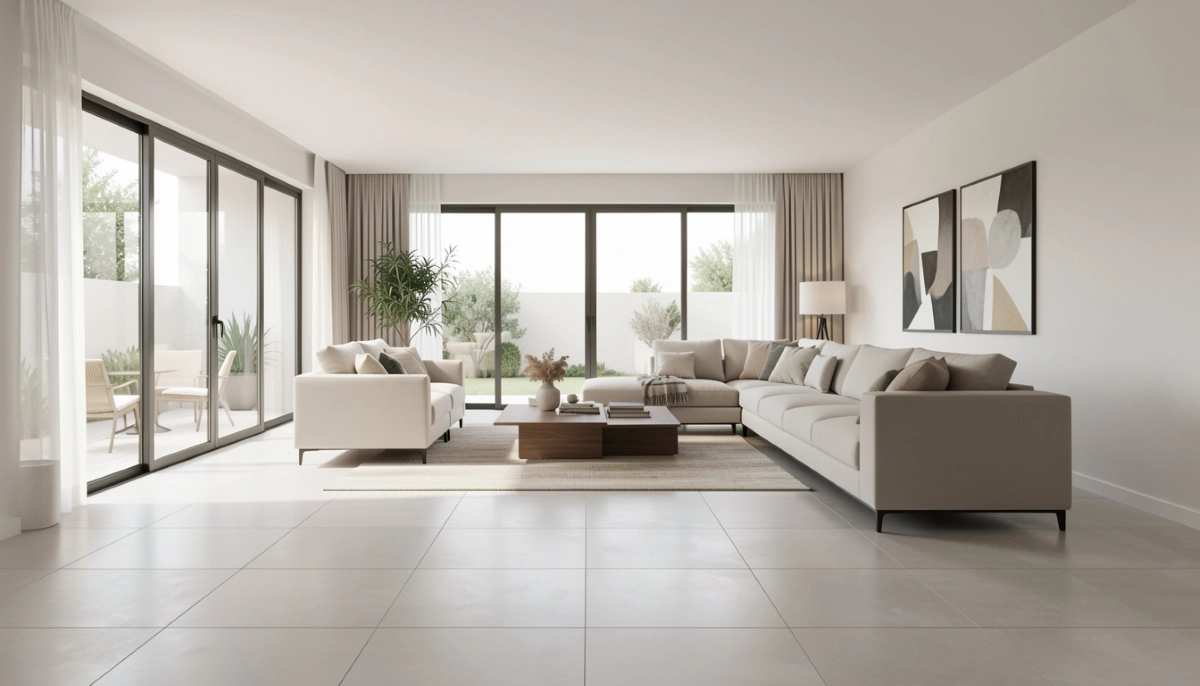
✅❌ Large Tiles – Pros and Cons
Large Tiles (450x450mm and larger) – Pros:
- ✓ Fewer grout lines: Creates a seamless, clean, modern look
- ✓ Makes spaces feel larger: Fewer visual interruptions expand perceived space
- ✓ Easier to clean: Less grout to scrub = less maintenance
- ✓ Less mould potential: Fewer grout lines in wet areas mean less mould growth
- ✓ Modern aesthetic: Large tiles are very on-trend for contemporary homes
- ✓ Better for open-plan spaces: Creates flow without visual breaks
- ✓ Works well with underfloor heating: Fewer joints, better heat distribution
Large Tiles – Cons:
- ✗ More expensive: Material costs are higher per square meter
- ✗ Difficult to install: Requires perfectly flat subfloor (within 2-3mm over 2m)
- ✗ Harder to cut: Requires wet saw, more waste (10-15%)
- ✗ Heavier: Requires stronger subfloor, harder to handle
- ✗ Not suitable for small rooms: Large tiles in tiny bathrooms can look overwhelming
- ✗ Difficult around curves: Large tiles can’t bend or conform to curved walls
- ✗ Lippage risk: Without perfect installation, edges can be uneven
For installation requirements, read our large format tiles installation guide.
✅❌ Small Tiles – Pros and Cons
Small Tiles (75-150mm) – Pros:
- ✓ Better grip: More grout lines = more traction (great for wet areas)
- ✓ Conforms to curves: Small tiles flex around curved walls, arches, and niches
- ✓ Works in small rooms: Creates scale-appropriate pattern in tiny bathrooms
- ✓ Forgiving of unflat subfloors: Small tiles can accommodate slight unevenness
- ✓ Easier to cut and handle: Lighter, can use manual cutters
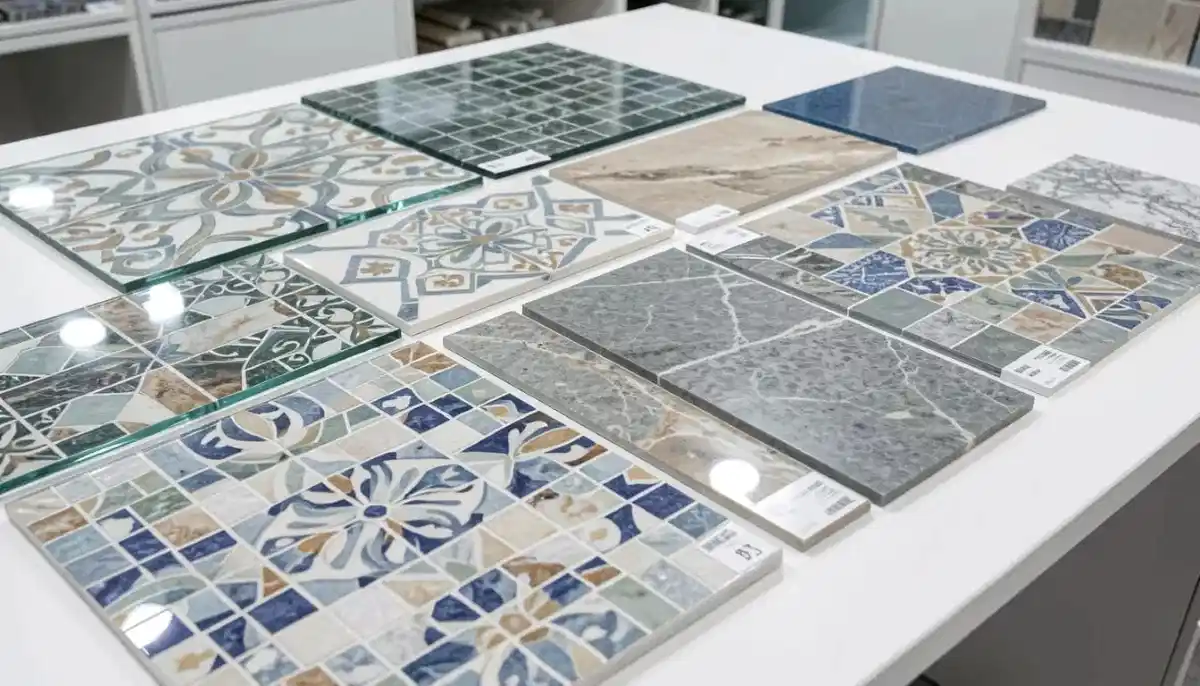
- ✓ More pattern options: Herringbone, basketweave, hexagon – patterns shine at small scale
- ✓ Less expensive material: Generally cheaper per square meter than large tiles
- ✓ Easier DIY installation: More forgiving for beginners
Small Tiles – Cons:
- ✗ More grout lines: Busier appearance, harder to clean, more mould potential
- ✗ Makes small rooms feel smaller: Many grout lines can make tiny spaces feel busy
- ✗ Less modern: Can feel dated compared to seamless large format
- ✗ More maintenance: More grout to seal and clean
- ✗ Slower installation: More tiles = more time to install
For small tile applications, read our mosaic tile installation guide.
Still Deciding Between Large and Small Tiles?
Get free quotes from verified tiling specialists who can help you with which tile size is right for your specific room and style.
Free inspections available. Benefits of choosing us.
👁️ Visual Impact – How Tile Size Affects Perception
The large vs small tiles design decision dramatically affects how a room feels:
Large Tiles (600x600mm or larger):
- Makes rooms feel larger: Fewer grout lines = fewer visual interruptions = expanded perception
- Creates seamless flow: Especially effective in open-plan areas and indoor-outdoor transitions
- Modern and clean: The minimal look is very on-trend
- Best for: Medium to large rooms, open-plan spaces, modern homes
Small Tiles (75-150mm):
- Adds texture and pattern: Many grout lines create visual interest
- Traditional or rustic feel: Classic look, especially with patterns
- Can make small rooms feel smaller: Too many grout lines in a tiny space can feel busy
- Best for: Small bathrooms (ironically), powder rooms, feature areas, traditional homes
Medium Tiles (300x300mm):
- Safe middle ground: Neither too busy nor too seamless
- Versatile: Works in most rooms and styles
- Classic: Never looks dated
- Best for: Most rooms – the default choice if unsure
✅ Key Takeaway:
For which tile size to choose: Large tiles make spaces feel larger. Small tiles add pattern and grip. Medium tiles are the safe, versatile choice. Match size to room scale – don’t put large tiles in tiny rooms or tiny tiles in huge rooms.
🏠 Which Tile Size for Each Room?
Here’s my room-by-room tile size comparison recommendation:
| Room | Recommended Size | Why | Alternative |
|---|---|---|---|
| Small Bathroom (<5m²) | 75-150mm OR 300x300mm | Small tiles add grip and scale-appropriate pattern; medium tiles work too | Avoid very large (600mm+) |
| Large Bathroom (>8m²) | 300x600mm or 600x600mm | Large tiles create seamless, spa-like feel | 600x1200mm for luxury |
| Shower Floor | 20-50mm mosaics | Small tiles conform to slope, provide grip | Small hexagons (50mm) |
| Kitchen Floor | 300x300mm or 600x600mm | Medium-large easy to clean, durable | Wood-look planks |
| Kitchen Backsplash | 75x150mm (subway) or mosaic | Small tiles fit outlets, add interest | 100x200mm subway |
| Living Room (small) | 300x300mm or 400x400mm | Medium tiles – not too busy, not overwhelming | Avoid 600mm+ in small rooms |
| Living Room (large/open) | 600x600mm or 600x1200mm | Large tiles create seamless flow, modern look | 800x800mm for dramatic |
| Entryway | 300x300mm or patterned small | Medium tiles or small pattern tiles for statement | Hexagon or herringbone |
| Laundry Room | 300x300mm | Durable, easy to clean, affordable | 600x600mm for modern |
| Outdoor Patio | 300x300mm to 600x600mm | Medium-large for fewer joints, slip-resistant finish required | Small tiles more grout = more grip |
For more bathroom-specific advice, read our tile patterns for small bathrooms guide.
💰 Cost Comparison – Large vs Small Tiles
Which tile size is more affordable? It depends on several factors:
| Cost Factor | Small Tiles (75-150mm) | Medium Tiles (300-400mm) | Large Tiles (600mm+) |
|---|---|---|---|
| Material cost/m² | R150 – R400 | R200 – R500 | R300 – R800+ |
| Installation cost/m² | R150 – R250 | R150 – R200 | R250 – R400 |
| Subfloor preparation | Minimal | Moderate | Extensive (must be very flat) |
| Waste percentage | 5-10% | 10% | 10-15% |
| Total installed (50m²) | R18,000 – R35,000 | R20,000 – R40,000 | R30,000 – R60,000+ |
Cost Verdict: Small tiles are cheapest in material but can have higher installation cost per m² due to more pieces. Large tiles have higher material cost and require more expensive installation (leveling systems, flatter subfloor). Medium tiles offer the best value for most homes.
For a complete breakdown, read our tile installation cost per square meter guide.
🔧 Installation Differences – Large vs Small Tiles
The installation process differs significantly based on which tile size you choose:
Large Tiles (600mm+):
- Requires perfectly flat subfloor (within 2-3mm over 2 meters)
- Needs back-buttering (applying adhesive to tile back) for full coverage
- Requires tile leveling system to prevent lippage
- Heavy – requires two people for large tiles
- Wet saw essential for cutting – manual cutters won’t work
- Slower installation – each tile takes more time
- Requires experienced tiler – not a DIY beginner project
Small Tiles (75-150mm):
- More forgiving of subfloor imperfections (can bridge small dips)
- No back-buttering needed for most small tiles
- Manual snap cutter works for straight cuts
- Lighter – easy for one person to handle
- Faster installation – more tiles but each is quicker
- More grouting time – many grout lines to fill
- DIY-friendly – good for beginners
Medium Tiles (300-400mm):
- Balanced – moderate subfloor requirements
- Often no back-buttering needed (but recommended for large rooms)
- Manual cutter or wet saw both work
- One person can handle comfortably
- Good for experienced DIYers
For installation guidance, read our large format tiles installation guide and mosaic tile installation guide.
🧹 Practical Considerations – Maintenance, Grip, Durability
Beyond aesthetics, consider these practical factors in your large vs small tiles design decision:
Maintenance (Cleaning):
- Large tiles win: Fewer grout lines = less scrubbing. Quicker to mop and sweep.
- Small tiles lose: Many grout lines trap dirt and require more maintenance.
- Verdict: For low-maintenance homes, choose larger tiles.
Slip Resistance (Safety):
- Small tiles win: More grout lines = more traction. Better for wet areas (showers, pool decks).
- Large tiles lose: Large smooth surfaces can be slippery when wet.
- Verdict: For wet areas, choose smaller tiles or textured large tiles.
Mould and Mildew:
- Large tiles win: Fewer grout lines = fewer places for mould to grow.
- Small tiles lose: Many grout lines in wet areas are mould magnets.
- Verdict: For bathrooms, larger tiles are more hygienic (if properly sloped).
Durability (Cracking):
- Small tiles win: More grout lines absorb movement – less likely to crack from subfloor settling.
- Large tiles lose: Large tiles are more prone to cracking from subfloor movement.
- Verdict: For areas with potential movement (wooden subfloors), smaller tiles are safer.
Underfloor Heating:
- Large tiles win: Fewer joints = better heat distribution.
- Small tiles lose: Many grout lines can create cold spots.
- Verdict: For underfloor heating, choose larger tiles.
🎨 Design Tips for Mixing Tile Sizes
You don’t have to choose just one size. Here are professional tips for mixing:
1. Large Field + Small Accent
Use large format tiles (600x600mm) on main floors/walls. Add a small tile accent strip (mosaic or 75x150mm) as a border or feature. Best for bathrooms and kitchens.
2. Small Feature Floor + Large Walls
Use small patterned tiles (hexagon or mosaic) on the floor. Use large format tiles on walls. Creates visual interest without overwhelming. Popular in powder rooms.
3. Medium Main + Large Border
Use medium tiles (300x300mm) as the field. Add a border of larger tiles (600x600mm) around the perimeter. Defines the space elegantly.
4. Transition Zones
Use different tile sizes to define zones in open-plan spaces. Large tiles in living area, medium in kitchen, small in entryway. Creates visual separation without walls.
5. Herringbone with Different Scales
Herringbone pattern works with many sizes. Small herringbone (100x200mm) for classic look. Large herringbone (300x600mm) for modern statement. Read our herringbone tile pattern guide.
For more design ideas, read our modern tile design trends guide.
🚫 Common Mistakes to Avoid When Choosing Tile Size
⚠️ Warning: These Mistakes Ruin Tile Installations
Avoid these errors when deciding should I use large or small tiles for your project.
- Large tiles in a very small room: 600x600mm tiles in a 3m² bathroom look overwhelming and out of scale. The large tiles also mean more cutting waste. Stick to 300x300mm or smaller.
- Small tiles in a very large room: 100x100mm mosaics in a 50m² living room create visual chaos. The many grout lines are distracting. Use large format for large spaces.
- Not considering grout colour: Dark grout with small tiles creates a very busy grid pattern. For small tiles, consider matching grout colour to tiles.
- Ignoring subfloor flatness for large tiles: Assuming your floor is flat enough leads to lippage and cracked tiles. Always check with a straight edge.
- Using small tiles where easy cleaning matters: Kitchen floors with many grout lines trap food and are harder to clean. Choose larger tiles for kitchens.
- Using large smooth tiles in wet areas: Large glossy tiles in showers are dangerously slippery. Choose textured or smaller tiles for grip.
- Not mixing sizes for visual interest: Using all one size can be monotonous. Consider mixing a feature area of small tiles within a large tile field.
- Budgeting only for material cost: Large tiles have higher installation costs (leveling systems, flatter subfloor). Factor this into your budget.
❓ Frequently Asked Questions About Large vs Small Tiles
Are larger tiles better than smaller tiles?
No – it depends on the room. Large vs small tiles design should match the space: large tiles excel in open-plan, modern rooms (fewer grout lines, seamless look). Small tiles work better for wet areas (more grip), curved surfaces, and traditional styles. The “better” choice is the one that fits your room’s size, style, and practical needs.
What tile size makes a small bathroom look bigger?
For a small bathroom, use medium tiles (300x300mm) or small tiles (100x100mm) in light colours. Surprisingly, very large tiles (600x600mm) can overwhelm a tiny bathroom. Small tiles with matching grout create a cohesive look. Avoid high-contrast grout – it creates a grid that makes the space feel smaller. Read our tile patterns for small bathrooms guide.
Are large tiles more expensive than small tiles?
Yes – large tiles typically cost more per square meter (R300-800/m² vs R150-400/m² for small). Installation is also more expensive (R250-400/m² vs R150-250/m²) due to flatter subfloor requirements, back-buttering, and leveling systems. Large tiles also create more waste (10-15% vs 5-10%). Budget 50-100% more for large tile installation.
Can you mix large and small tiles in the same room?
Absolutely – professional designers often mix sizes. Examples: large format tiles on walls with small mosaic shower floor; large floor tiles with small accent border; herringbone pattern using small tiles within large tile field; different sizes to define zones. The key is intentional design – not random mixing. Read our design trends guide for inspiration.
What size tile is best for a kitchen floor?
For kitchen floors, medium to large tiles (300x300mm to 600x600mm) work best. Fewer grout lines mean easier cleaning – kitchens need frequent sweeping and mopping. Large tiles also create a seamless look that makes the kitchen feel more spacious. Choose matte or textured finish for slip resistance. Avoid small tiles (too many grout lines trap food).
Do small tiles have more grip than large tiles?
Yes – small tiles have more grout lines, and grout provides traction. This is why small mosaics are popular for shower floors. However, you can also get large tiles with textured surfaces (slate-look, wood-look, or grip coatings) that provide excellent slip resistance. For wet areas, choose either small tiles OR textured large tiles – never smooth large tiles.
What is the most popular tile size for flooring?
Currently, 600x600mm is the most popular floor tile size in South Africa. It offers a good balance – fewer grout lines than smaller tiles but not as demanding as larger formats. For walls, 300x600mm (subway or stacked) is very popular. For bathrooms, 300x300mm remains a classic choice. Large format (600x1200mm) is growing in popularity for open-plan areas.
Can I use large tiles in a small bathroom?
Yes – but with caution. In a very small bathroom (under 4m²), 600x600mm tiles can feel overwhelming and create many cuts. Stick to 300x300mm or 400x400mm. In a medium bathroom (4-7m²), 600x600mm can work well if you use light colours and matching grout. For a large bathroom (7m²+), large tiles create a beautiful, seamless spa-like look.
✅ Final Thoughts: Choose the Size That Fits Your Space
The large vs small tiles design decision isn’t about which is objectively better – it’s about which fits your specific room, style, and lifestyle.
Large tiles create seamless, modern, easy-to-clean spaces. They’re perfect for open-plan areas, modern homes, and anyone who wants a minimalist look with minimal maintenance. But they require perfect subfloors, professional installation, and cost more.
Small tiles offer pattern, grip, and flexibility. They’re ideal for wet areas, curved walls, traditional homes, and DIY projects. But they have more grout lines to clean and can make small spaces feel busy.
Key takeaways for tile size comparison:
- Large tiles (600mm+): seamless, modern, expensive, professional installation
- Medium tiles (300-400mm): versatile, balanced cost, good for most rooms
- Small tiles (75-150mm): pattern, grip, flexible, DIY-friendly, more grout
- Match tile size to room scale – large in large rooms, small in small rooms
- Consider practical factors: cleaning, grip, mould, underfloor heating
- Mix sizes intentionally for visual interest
- When in doubt, 300x300mm or 600x600mm are safe, popular choices
Your next step: Ready to choose your tile size? Get free quotes from verified tiling specialists who can help you with which tile size is right for your specific project.
Ready to Choose the Perfect Tile Size for Your Home?
Get free quotes from verified tiling specialists who can help you with large vs small tiles design decisions and professional installation.
📞 Call us: 073 138 4726 to discuss your tile size questions.
Are You a Tiling Specialist?
Join ServiceLink SA’s network of verified tiling contractors. Get qualified leads for residential and commercial tiling projects.
📚 Official resources & standards referenced:
- SANS 10400 – South African National Standard for tile size standards, installation requirements, and building regulations.
- SABS – South African Bureau of Standards for quality standards and tile specifications.
Information provided for general guidance. Always consult professionals for tile size recommendations for your specific space.
Written by: Innocent T Hanyani
Construction & Home Services Industry Specialist | 21+ Years Experience
Innocent T Hanyani has over two decades of experience working across South Africa’s construction and home improvement sectors. Throughout his career, he has helped hundreds of homeowners choose the right tile size for their spaces – from tiny bathrooms to grand open-plan living areas. His practical experience helps homeowners understand how tile scale affects perception, maintenance, and budget. He has seen the mistake of large tiles in tiny rooms and small tiles in huge rooms – and knows how to get it right. His advice balances aesthetics, practicality, and cost.
For more information about tile design and selection, explore our related resources: modern tile design trends, large format tiles installation, tile patterns for small bathrooms, herringbone tile pattern guide, and hexagon tiles design ideas. Learn about our process on what is ServiceLink SA and how our service works. Find tilers in your area: Gauteng, Johannesburg, and Sandton. For related services, see our flooring services and building construction guides.