
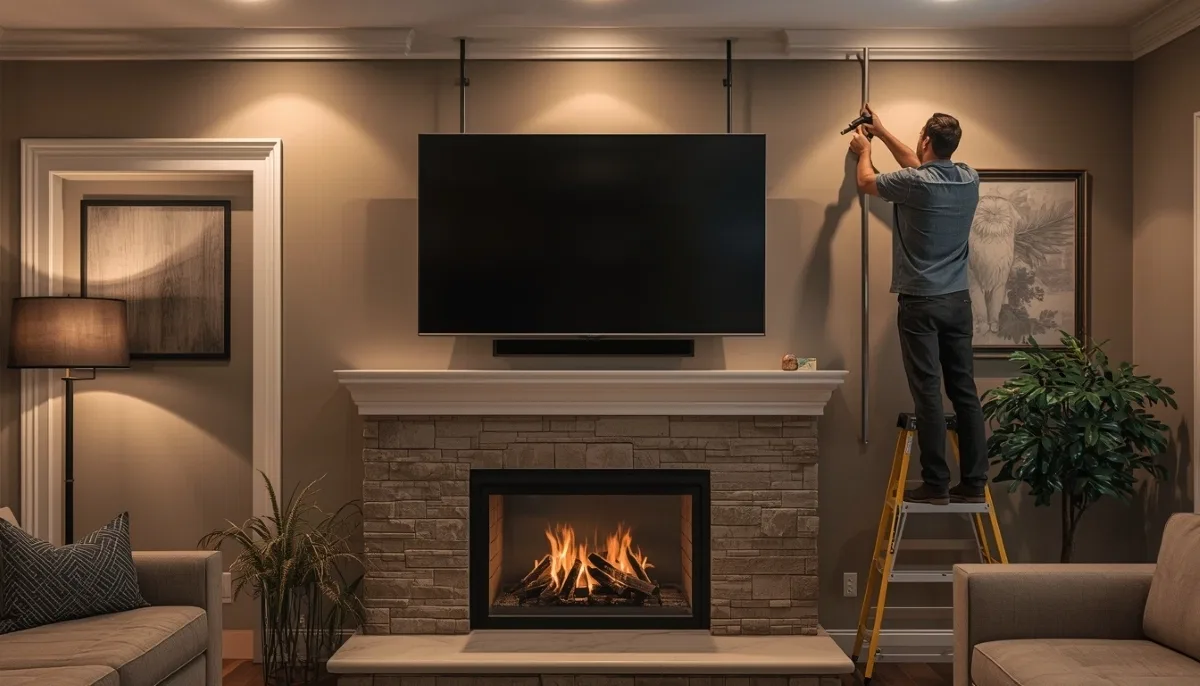
Mount TV Over Fireplace – The Complete South African Guide
🔥 Heat protection, viewing angles, and safety: everything you need to know before mounting your TV above the fireplace.
You’ve designed a beautiful living room in your Sandton home. The stone fireplace is the focal point, and you envision your sleek new TV mounted perfectly above it. It’s a stunning look. But before you drill any holes, you need to answer some critical questions: Can you mount a TV above a gas fireplace? Will the heat damage your expensive OLED? Will you get a sore neck from looking up? And how do you hide the cables on a chimney breast? Successfully learning how to mount TV over fireplace requires solving problems that don’t exist on a standard wall.
This guide is your comprehensive resource for this popular but challenging installation. We cover the three biggest concerns: TV heat damage prevention (what temperature is safe? when do you need a heat shield?), achieving a comfortable viewing angle (hint: you’ll almost certainly need a tilting bracket), and managing the practicalities of chimney breast mounting and cable concealment. We explain the concept of mantle clearance and the ambient temperature rating of your TV. We also introduce the ultimate solution: a pull-down TV mount for fireplace (mantel mount) that lets you lower the TV to a comfortable height when watching, and push it back up when not in use. Whether you have a wood, gas, or electric fireplace in Cape Town, Pretoria, or Stellenbosch, this guide helps you do it safely and beautifully.
If you’re ready for a professional installation with all the right precautions, explore our Services Overview or visit our TV Mounting page to find vetted installers near you. For more on how we work, see How It Works.
Get Expert Advice for Your Fireplace Mount
Get free, no-obligation quotes from local TV mounting specialists who have experience with fireplace installations and heat protection.
Find Fireplace Mounting Experts Near Me
Servicing Johannesburg, Pretoria, Cape Town, Durban, and nationwide
📋 Table of Contents – TV Over Fireplace Guide
🔥 Why Mounting Over a Fireplace is So Popular
It’s easy to see the appeal. The fireplace is often the natural focal point of a living room, especially in homes in Randburg or Stellenbosch. Placing the TV above it creates a unified, built-in look that saves space and feels architectural.
- Aesthetic integration: The TV becomes part of the fireplace design, rather than a separate piece of furniture.
- Space saving: Frees up floor space that would otherwise be taken by a TV stand.
- Clean lines: When done right, with concealed cables, it creates a very clean, modern look.
- Focal point synergy: The fire and the screen become the two main attractions in the room.
However, this popular look comes with challenges that must be addressed for a safe and comfortable installation.
Read more about our approach on our About Us page or see why clients choose us on our Benefits page.
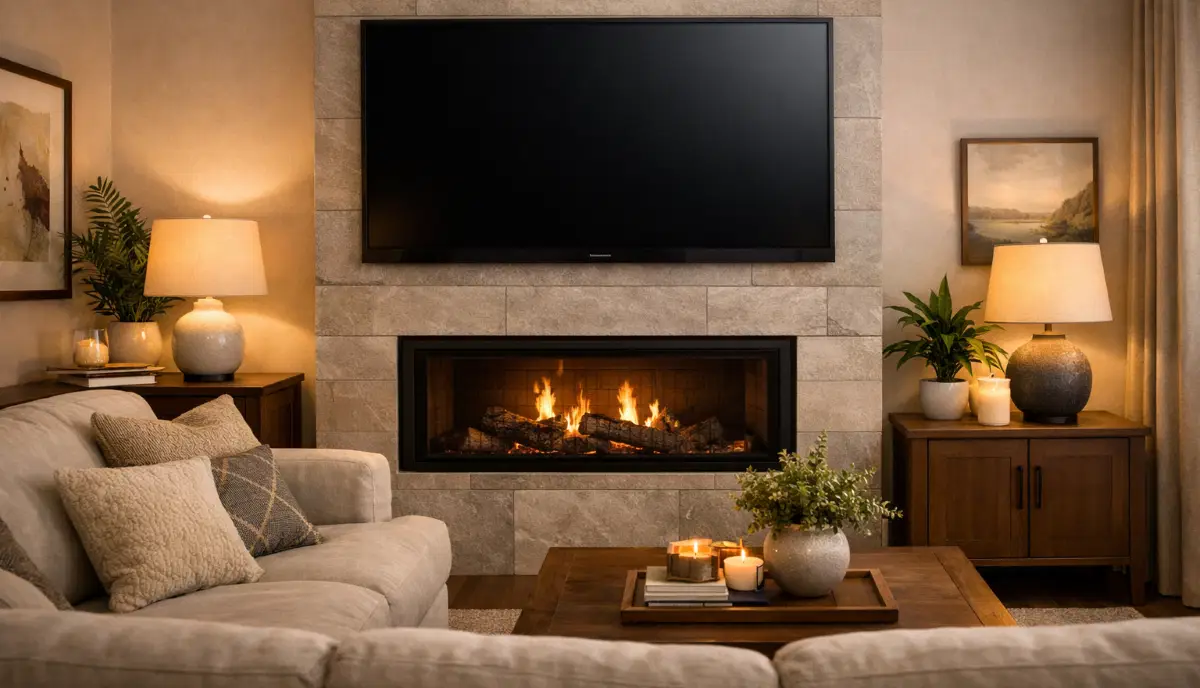
⚠️ The Three Big Challenges of a Fireplace Mount
Before you proceed, understand what you’re up against.
- 1. Heat: Fireplaces generate heat. Excessive heat can damage your TV’s internal components, cause image degradation, and even create a fire risk. This is the #1 concern.
- 2. Viewing Angle / Neck Strain: Fireplaces are usually at a height that puts the TV well above seated eye level. Watching a TV that’s too high for extended periods causes neck strain and fatigue. This is an ergonomics issue.
- 3. Cable Management: A chimney breast is often a solid brick or stone structure. Running and hiding cables is more difficult than on a standard plastered wall.
Addressing these three challenges is the key to a successful installation. See our safety tips for more.
🌡️ Heat Damage Prevention & Safe Temperatures
Heat is the silent killer of TVs. Here’s what you need to know.
- Ambient temperature rating: Most TVs are designed to operate in ambient temperatures between 10°C and 35°C. The area above a fireplace can easily exceed this, especially with a wood fire.
- What heat does: Prolonged exposure to high heat can warp internal components, damage the LCD panel or OLED pixels, and shorten the lifespan of the TV. It can also be a fire hazard if wires overheat.
- Measure the temperature: Before mounting, run your fireplace at its highest setting for an hour. Then, use a laser thermometer to measure the temperature where the TV will sit. If it exceeds 35°C, you have a problem.
- Safe threshold: Aim for a maximum temperature of 30-32°C to be safe. If it’s hotter, you need mitigation.
For official guidelines, refer to resources like the National Fire Protection Association.
🔥 Wood, Gas, or Electric? Which Fireplace is Safest?
The type of fireplace drastically affects the heat output and safety.
- Wood-burning fireplaces: The highest risk. They produce intense, radiant heat, especially if it’s an open hearth. Mounting a TV above a wood-burning fireplace is generally not recommended without significant heat shielding and a large mantel clearance. Heat can easily exceed safe limits.
- Gas fireplaces: Less risky than wood, but still produce significant heat. Many modern gas fireplaces are designed with heat circulation that directs heat outwards, not upwards. Check the manufacturer’s specifications. A mantel is often required to deflect heat.
- Electric fireplaces: The safest option. Most electric fires produce little to no heat above the unit (heat is blown out from the front or bottom). They are often perfectly safe for TV mounting, but still, check the temperature to be sure. Some are purely flame-effect with no heat.
If you have a wood or gas fireplace, TV heat damage prevention requires serious attention. Consult with your fireplace supplier (Safire is a good resource) for clearance specifications.
🪵 Mantle Clearance & Heat Shields
If you have a heat-producing fireplace, a mantel is not just decorative – it’s functional.
- How a mantel helps: A mantel projects out from the wall and deflects rising hot air away from the wall and TV. It creates a pocket of cooler air.
- Minimum clearance: There’s no single rule, but a mantel should typically extend at least 10-15cm from the wall and be positioned 10-20cm above the fireplace opening. The further the mantel projects, the more it deflects heat. You may need to mount the TV higher to clear the mantel, which worsens the viewing angle.
- Heat shields: These are panels made of fire-resistant material that can be installed between the fireplace and the TV to reflect heat away. Some are designed to be decorative and can be made of metal or stone. A professional can advise on this.
- Active cooling: In extreme cases, some installations include small fans to circulate air and remove hot air from behind the TV.
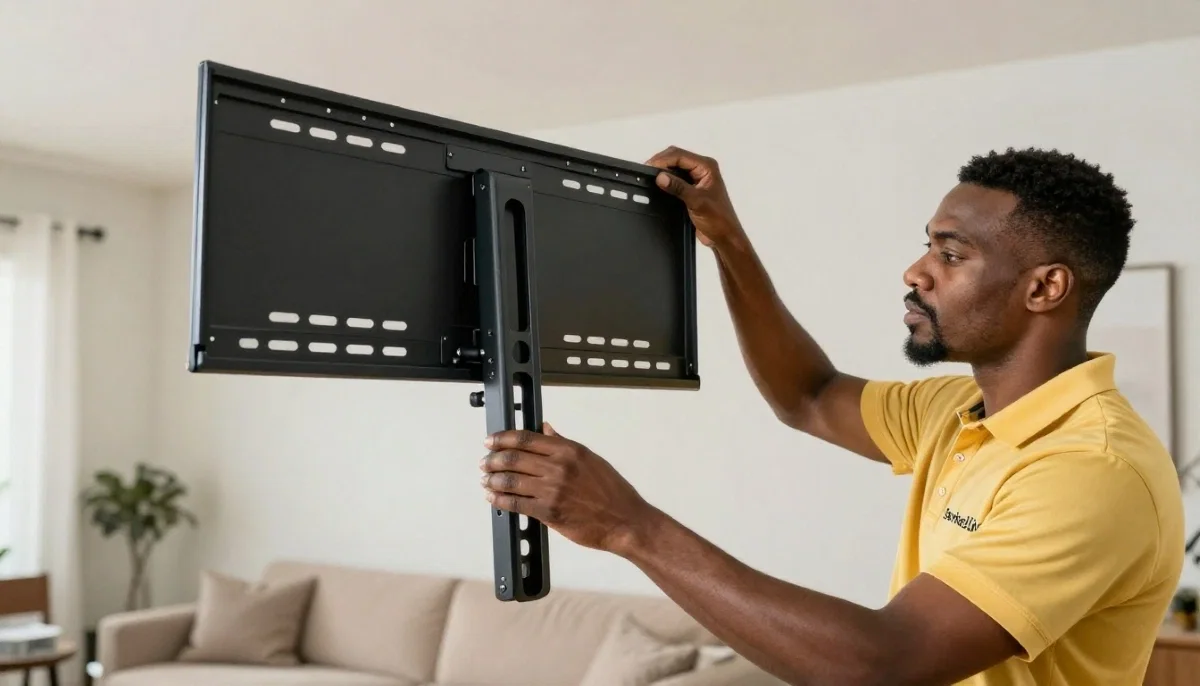
👀 Solving the Viewing Angle Problem
Even if heat isn’t an issue, height almost always is. A TV above a fireplace is typically mounted with its centre at 150-170cm from the floor – well above the recommended best TV mounting height of 100-120cm.
- The problem: Looking up for long periods strains the neck muscles (cervical spine). This can lead to headaches and discomfort.
- The solution: You must use a bracket that allows you to tilt the screen downwards. This redirects the image towards your eyes.
- How much tilt? For a TV mounted 50cm too high, you may need 10-15 degrees of tilt. The further the viewing distance, the less tilt is needed, but the angle is still critical.
📐 Tilting Brackets: The Minimum Requirement
For any fireplace mount, a fixed bracket is not an option. You need at least a tilting bracket.
- What it does: Allows you to angle the TV downwards. Most tilting brackets offer 0-15 degrees of downward tilt.
- Choosing one: Look for a bracket with smooth adjustment and the ability to lock the tilt in place. Ensure it can support your TV’s weight and VESA pattern. See our bracket types guide.
- Limitations: A tilting bracket helps, but the TV is still high on the wall. It doesn’t solve the height problem entirely, just mitigates it.
⬇️ Pull-Down TV Mounts (MantelMount) – The Ultimate Solution
If you want the best of both worlds – the aesthetic of a TV above the fireplace and a comfortable viewing height – a pull-down TV mount for fireplace is the answer.
- What it is: A specialised, heavy-duty articulating mount that allows you to pull the TV down from its high position to a comfortable viewing height in front of the fireplace. When not in use, you push it back up, flush against the wall.
- How it works: The mount has a spring-assisted or counterbalanced arm that allows smooth, controlled movement. The TV moves vertically down and slightly forward.
- Pros:
- Solves the viewing angle problem completely.
- TV is at perfect eye level when watching.
- Maintains the clean, above-fireplace look when the TV is not in use.
- Cons:
- Expensive (R3,000 – R8,000+ for the mount alone).
- Heavy and requires very secure fixing into brick/concrete.
- Installation is complex and definitely a job for a professional.
- May not be suitable for very deep mantels.
- Brands: MantelMount is the best-known brand. Our installers are familiar with these systems.
For a mantel mount installation in Durban or Umhlanga, contact us.
📏 Calculating the Right Height
Even with a tilting or pull-down mount, you need to choose the initial mounting height carefully.
- For a tilting bracket: Mount the TV as low as possible above the fireplace/mantel while still looking proportional. The goal is to minimise the required tilt. Measure the distance from the floor to the bottom of where the TV will hang. The centre will be higher than ideal, but every centimetre lower helps.
- For a pull-down mount: The mount will have a specified range of motion. You need to mount the top bracket high enough so that when the TV is pulled down, it clears the mantel and reaches the desired viewing height. This requires precise calculation and is best left to a pro. See our height guide for general principles.
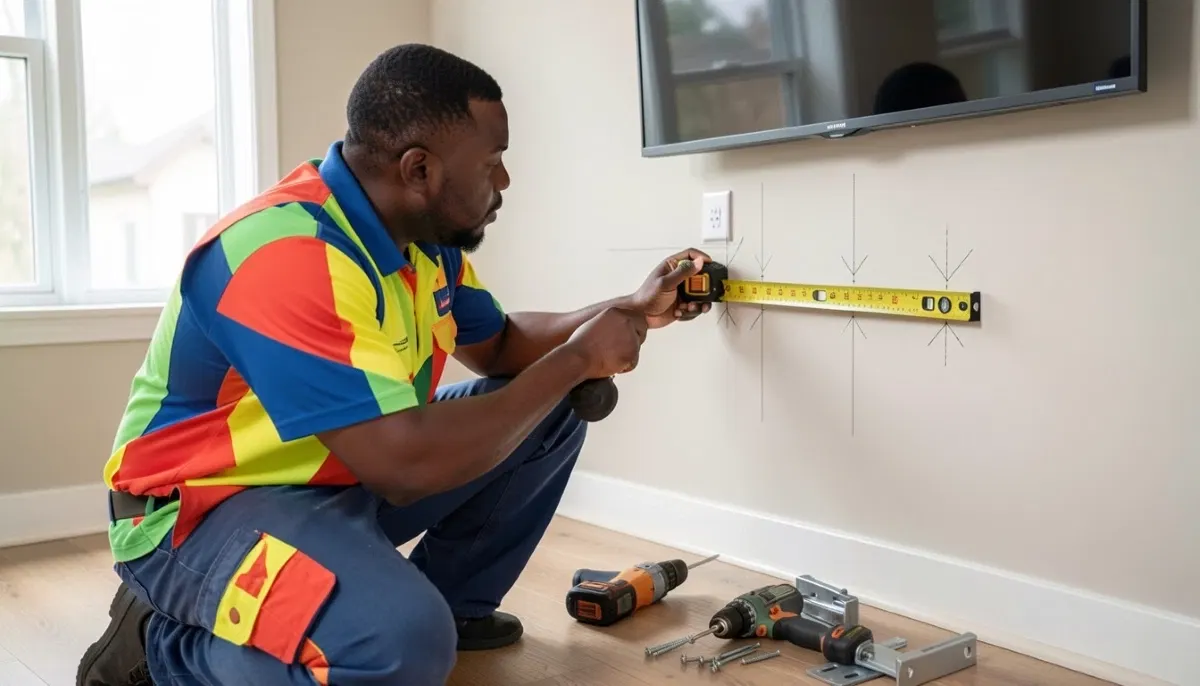
🔌 Cable Concealment on a Chimney Breast
Hiding cables on a chimney breast is trickier than on a standard wall, but essential for a clean look.
- The challenge: Chimney breasts are often solid brick or stone. You can’t simply cut into them for an in-wall kit without significant work.
- Options:
- Surface trunking: The simplest option. Use trunking painted to match the wall (or stone). Run it down the side of the chimney breast, preferably in a corner where it’s less noticeable.
- In-wall (with chase): If the chimney breast is plastered brick, it is possible to cut a channel (chase) into the plaster, run conduit, and then replaster. This is messy and requires a builder, but gives an invisible result. You must also consider the heat from the fireplace – cables should be in a protective conduit.
- Behind the mantel: Sometimes you can route cables behind a deep mantel, but they will still need to get down the wall eventually.
- Power: For power, you’ll likely need a new socket installed by an electrician. This is a good time to consider a recessed outlet behind the TV.
⚡ Recessed Boxes & Electrical Safety Near Heat
If you’re installing a power point behind the TV, electrical safety near a heat source is critical.
- Use a recessed box: A recessed box allows the TV’s plug to sit flush with the wall, enabling the TV to hang closer. This is especially important if you have a fixed or tilting bracket with limited space.
- Heat-resistant cabling: Ensure any electrical cabling used is rated for the potential ambient temperature. Standard PVC cabling may degrade in excessive heat.
- Professional electrician: Any new electrical work must be done by a registered electrician who can issue a Certificate of Compliance (COC). They will ensure the installation meets ECASA standards and is safe.
- Isolate power when not in use? Some people choose to switch off power to the TV when the fireplace is on, as an extra precaution.
🧱 Structural Considerations: Brick vs Drywall
A chimney breast is almost always solid brick or stone. This is good for mounting – it provides excellent holding power.
- Brick/stone: You’ll need a hammer drill and masonry bits. Use expanding wall plugs and masonry screws. A heavy TV, especially on a pull-down mount, will be very secure in brick.
- Drywall over brick: Sometimes a chimney breast is plasterboard over the brick. You must drill through the plasterboard into the brick behind. Use longer screws to reach the masonry. Don’t rely on plasterboard anchors alone.
- False chimneys: In some modern homes, chimneys are decorative and made of lightweight materials. If your “chimney breast” is just a stud wall with plasterboard, you must locate the studs. A heavy TV on a pull-down mount may not be suitable for a false chimney. See our wall type guide.
💰 Cost Factors for Fireplace TV Mounting
A fireplace mount is not a standard job. Here’s what affects the price.
- Bracket type: A heavy-duty tilting bracket (R800-R1,500) vs a pull-down mantel mount (R3,000-R8,000+).
- Labour: More complex than a standard wall. Installing on brick/concrete takes longer. Pull-down mounts require more time for setup and adjustment. Expect labour from R1,500 – R3,500+.
- Cable concealment: Surface trunking is cheap. Chasing into a brick wall and replastering is expensive (R2,000 – R5,000+ depending on complexity).
- Electrical work: Adding a new recessed socket by an electrician: R800 – R1,500.
- Heat shielding: If you need a custom heat shield, this will add cost.
For an accurate quote for your home in Johannesburg or Cape Town, request a quote.
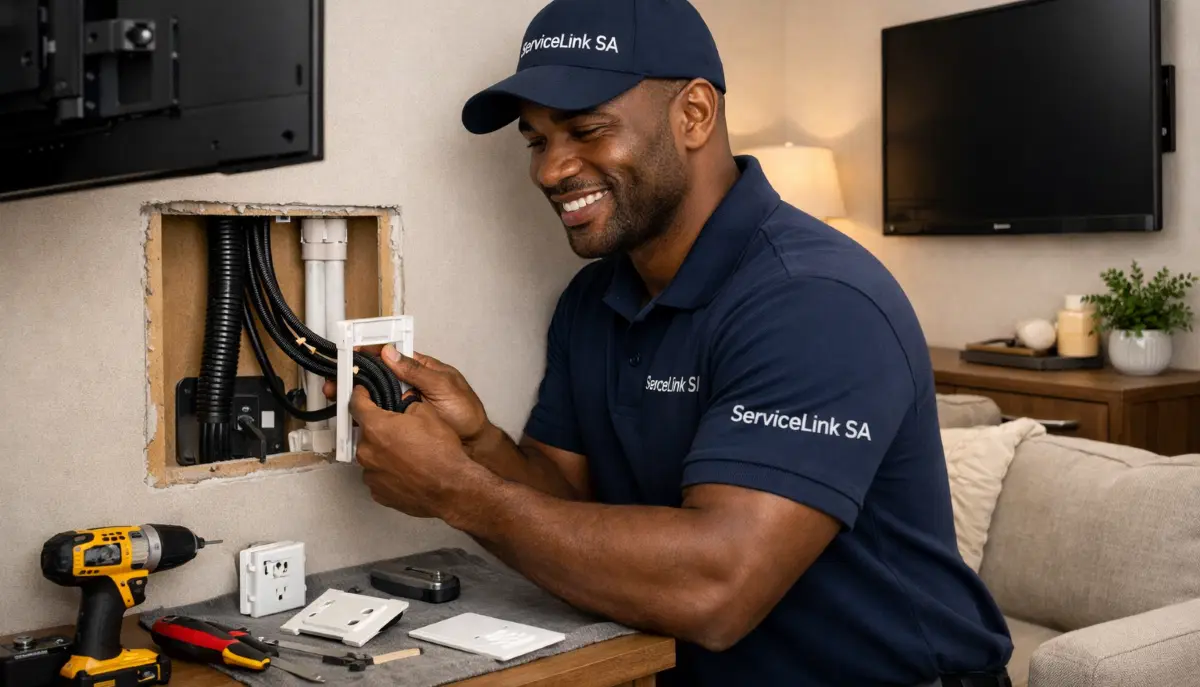
❌ 8 Common Fireplace Mounting Mistakes
- Mistake #1: Ignoring heat. Mounting without checking the temperature is gambling with your TV’s life. Always measure.
- Mistake #2: Using a fixed bracket. A fixed bracket above a fireplace guarantees neck strain. You need at least a tilting, and ideally a pull-down mount.
- Mistake #3: Not checking the fireplace type. Assuming a gas or electric fire is as safe as a wood fire can lead to overheating.
- Mistake #4: Poor cable management. Ugly cables dangling down a chimney breast ruin the aesthetic. Plan for concealment.
- Mistake #5: Mounting too high. Even with a tilting bracket, mounting as low as possible above the mantel is better.
- Mistake #6: Forgetting about the mantel. Not accounting for mantel depth can mean the TV hits it when tilted or pulled down.
- Mistake #7: DIY electrical work. Adding a socket behind the TV is electrical work. It must be done by a qualified electrician for safety and compliance.
- Mistake #8: Underestimating the weight on a pull-down mount. These mounts are heavy and require very secure fixing. If in doubt, hire a pro.
❓ Frequently Asked Questions
Can you mount a TV above a gas fireplace?
Can you mount a TV above a gas fireplace? Yes, but with precautions. Gas fires produce less radiant heat than wood, but you must still measure the temperature where the TV will sit. Ensure a mantel is present to deflect heat, and consider a tilting or pull-down bracket.
How do I prevent heat damage to my TV above a fireplace?
TV heat damage prevention involves several steps: measure the ambient temperature with the fire on (aim for below 35°C), ensure adequate mantel clearance, consider a heat shield, use a tilting or pull-down bracket to allow air circulation, and possibly install active cooling fans.
What is a pull-down TV mount for a fireplace?
A pull-down TV mount for fireplace (like MantelMount) is a specialised bracket that allows you to lower the TV from its high position above the fireplace down to a comfortable viewing height. It’s the best solution for both aesthetics and ergonomics.
Is it safe to mount a TV above an electric fireplace?
Generally, yes. Electric fireplaces produce little to no heat above the unit. Most heat is blown out from the front. However, you should still check the manufacturer’s instructions and measure the temperature to be absolutely sure.
What is mantle clearance for a TV?
Mantle clearance is the distance between the top of the fireplace opening and the bottom of the mantel, and the projection of the mantel. A properly sized mantel deflects rising hot air away from the wall, protecting the TV. Consult your fireplace manufacturer for specific recommendations.
How high should a TV be above a fireplace?
Ideally, as low as possible while still clearing the mantel. The centre will likely be at 150-170cm. To compensate, you must use a tilting bracket. For the best experience, a pull-down mount that brings the TV down to seated eye level (100-120cm) is recommended.
What is a heat shield for a TV above a fireplace?
A heat shield is a panel made of fire-resistant material (like metal) installed between the fireplace and the TV to reflect heat away. It can be decorative and is often used when mantel clearance is insufficient.
Can I hide TV cables on a chimney breast?
Yes. Options include painted surface trunking (simpler) or chasing cables into the plaster and replastering (invisible but major work). For power, you’ll need a new socket installed by an electrician.
What is the ambient temperature rating of a TV?
The ambient temperature rating is the range of room temperatures in which the TV is designed to operate safely, typically 10°C to 35°C. Exceeding this can damage the TV. This is a key specification to check for fireplace mounting.
Do I need a special bracket for a fireplace mount?
Yes. A fixed bracket is not suitable. You need at least a tilting bracket to angle the screen down. For the best ergonomics, a pull-down mount is the ultimate solution. See our bracket types guide.
✅ Final Thoughts – Your Fireplace Mount Action Plan
Mounting a TV over a fireplace is achievable, but it requires more planning than a standard wall mount. By addressing the three key challenges – heat, viewing angle, and cables – you can achieve a stunning result that is both safe and comfortable.
Key takeaways:
- Always measure the temperature with the fireplace on. If it’s too hot, don’t proceed without mitigation.
- You must use a tilting bracket at minimum. A pull-down mount is the premium solution for perfect ergonomics.
- Wood fires are the highest risk; electric fires are the safest.
- A mantel helps deflect heat. Ensure adequate clearance.
- Plan for cable concealment from the start.
- Use a qualified electrician for any power work.
Your 5-Step Action Plan
- Measure the heat: Run the fireplace and check the temperature where the TV will go.
- Assess your fireplace type: Wood, gas, or electric? Research its heat output.
- Choose your bracket: Tilting or pull-down? Factor in your budget and viewing comfort.
- Plan cable concealment: Decide on trunking or in-wall chasing, and arrange for an electrician if needed.
- Hire a professional: Given the complexity, this is a job best left to experienced installers.
Ready to Mount Your TV Safely Over a Fireplace?
Get free, no-obligation quotes from vetted TV mounting specialists with experience in fireplace installations, heat protection, and mantel mounts.
📞 Call us: 073 138 4726 for personalised assistance
Free site inspections •
Beat-your-quote guarantee •
Our guarantees
📚 Official resources & standards:
- Safire – Fireplace clearance standards and manufacturer guidelines.
- National Fire Protection Association (NFPA) – International fire safety standards for installations near heat sources.
- ECASA – Electrical compliance for installations near fireplaces.
Information accurate as of publication. This guide is for informational purposes. For specific advice, consult a professional.
Written by: Innocent T Hanyani
21+ years construction and digital industry experience, ServiceLink SA
Innocent has consulted on countless fireplace TV installations, from heritage homes with wood-burning hearths to modern houses with gas inserts. His expertise in both structural safety and heat dynamics ensures this guide provides practical, reliable advice for South African homes.
For more detailed information, explore our related guides: best TV mounting height for ergonomics, our safety tips for general precautions, our wall type guide for technical details, and our home entertainment setup guide for complete systems. For help finding the right professional, see our contractor selection guide and ensure they have proper liability insurance. Our free inspection and guarantees are also available.