
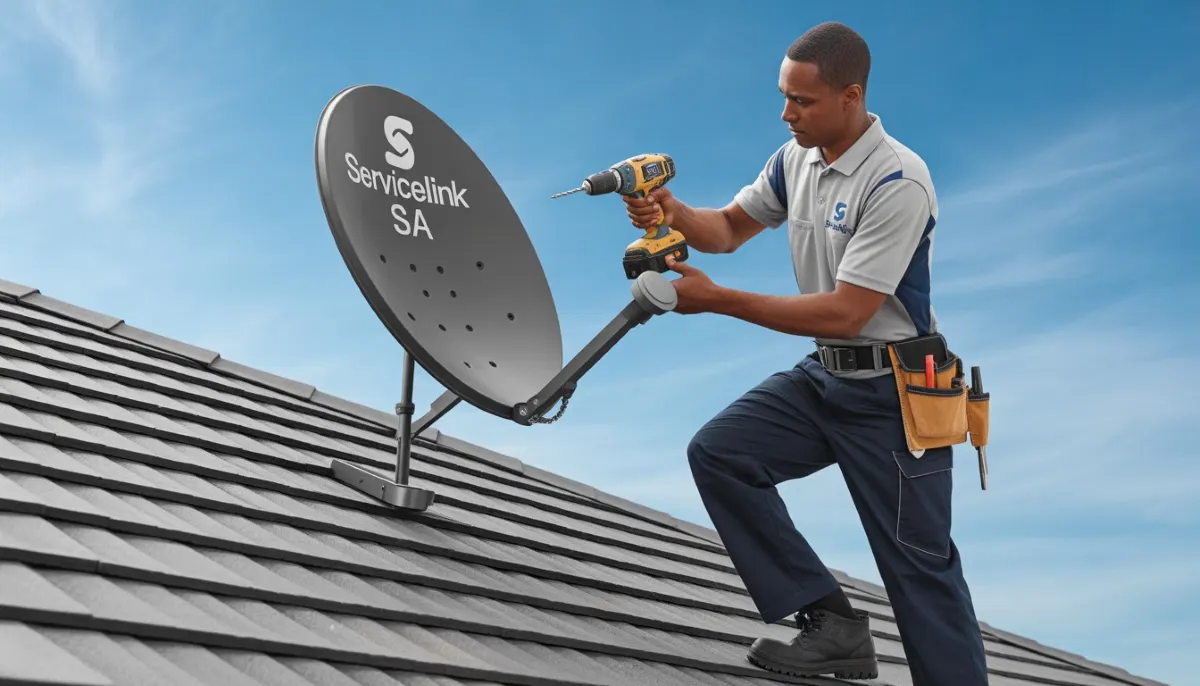
Not Confident Doing This Yourself?
Get a free quote from a verified, accredited DSTV installer near you.
Professional installation starts from R800 – often cheaper than fixing DIY mistakes.
Get Professional Installation Quote
Servicing Gauteng, Limpopo, Mpumalanga, Polokwane, Mbombela, Emalahleni, and across South Africa
Satellite Dish Installation for DSTV: Step-by-Step Guide from the Pros
📡 Master the art of satellite dish installation with this comprehensive guide – or hire a pro and skip the hassle.
You’ve signed up for DSTV. The decoder is sitting on your shelf. But there’s one problem:
you need a satellite dish, and it needs to be installed correctly.
Satellite dish installation might look simple – point the dish at the sky, connect some cables, done.
But after 21 years in this industry, I’ve seen countless DIY installations that failed within weeks.
A 2mm misalignment can reduce your signal by 80%. Poor weatherproofing leads to water damage and corrosion.
Improper mounting damages roofs and creates safety hazards.
In this complete guide to install satellite dish for dstv, I’ll walk you through every step of professional
dstv dish setup. You’ll learn how to choose the right location, mount the dish correctly,
run cables like a pro, and align the dish for perfect signal strength.
If you’re asking “how to install satellite dish for dstv”, read this guide completely before starting.
And if any step feels beyond your comfort level, hire a professional – it’s cheaper than fixing mistakes.
For a complete DIY walkthrough, read our
how to install DSTV guide.
For alignment specifics, see dish alignment guide.
And for mounting options, read roof vs wall comparison.
📋 Table of Contents – Satellite Dish Installation Guide
🛠️ Tools & Equipment Needed for Satellite Dish Installation
Before you begin any satellite dish installation, gather all your tools and equipment.
Nothing is more frustrating than being halfway through and realising you’re missing a critical component.
Essential tools you’ll need:
- Adjustable wrench – For tightening dish mounting bolts and F-connectors
- Phillips and flathead screwdrivers – For bracket assembly and decoder connections
- Spirit level – Critical for ensuring your mounting pole is perfectly vertical
- Power drill with masonry bits – For drilling into brick, concrete, or tile roofs
- Coaxial cable stripper – A proper stripper (not a knife!) prevents signal-killing nicks
- Compression tool for F-connectors – Screw-on connectors are unreliable; compression is professional-grade
- Satellite signal meter – The #1 tool that separates amateurs from pros (R300-R800)
- Compass or smartphone inclinometer app – For finding the correct azimuth direction
- Safety harness – If you’re going on any roof higher than a single story
- Silicone sealant – Waterproofing is NOT optional
- UV-resistant cable clips – To secure cables every 50cm
- Self-amalgamating tape – For weatherproofing outdoor connections
Components you’ll need (if not supplied):
- Satellite dish – 60cm for most areas, 80cm recommended for coastal or fringe areas
- LNB (Low Noise Block) – Single for one decoder, Quad for multi-room, Smart for Explora
- Mounting bracket – Wall, roof, or pole mount depending on your location
- RG6 coaxial cable – Buy 10-20 metres more than you think you need
- F-connectors (compression type) – One for each cable end
- Wall plates (optional) – For a clean look inside your home
💡 Pro Tip:
A satellite signal meter is not optional for professional-grade dstv dish setup.
It costs R300-R800 and pays for itself in saved time and frustration.
Without it, you’re guessing – and guessing rarely works with satellite alignment.
📍 Choosing the Perfect Dish Location: The #1 Most Important Decision
Where you place your satellite dish determines 80% of your signal quality.
This is the most critical decision in any satellite dish installation.
The non-negotiable rule:
Your dish MUST have an unobstructed view of the northeastern sky.
In South Africa, the Eutelsat satellites that carry DSTV are located at approximately 36° East.
This means your dish needs to face northeast, with a clear line of sight at an elevation angle of roughly 35° above the horizon.
How to check your line of sight:
- Stand where you plan to mount the dish (ground level is fine for checking)
- Face northeast (use a compass app on your phone)
- Look up at approximately 35° angle (about the height of a two-story building at 20m distance)
- Check for any trees, buildings, or other obstructions in this path
- Remember: trees grow – a branch that’s clear today may block signal in 6 months
Location options compared:
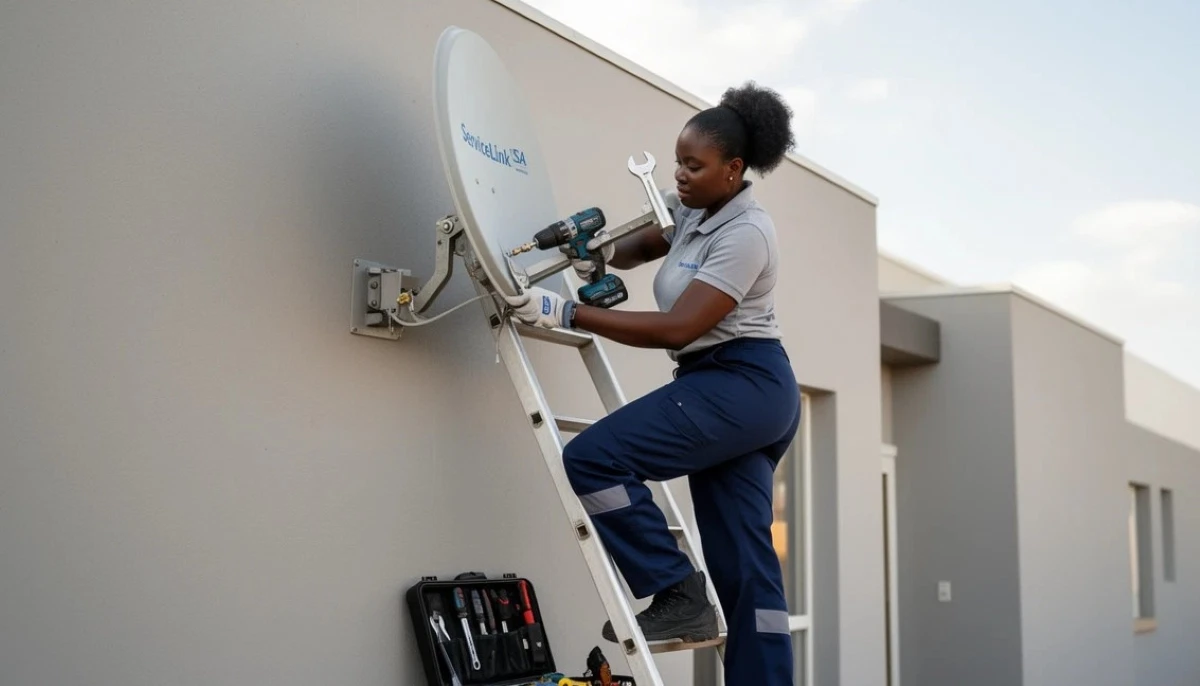
- Roof mount: Best signal, minimal obstructions, but highest safety risk and roof penetration
- Wall mount: Easier access, safer for DIY, but may need longer cable runs
- Ground pole mount: No roof work, highly adjustable, but requires concrete foundation
- Balcony mount (apartments): Only option for flats, but often restricted by body corporate
For detailed mounting comparisons, read our
roof vs wall installation guide.
And for dish size recommendations, see best dish size guide.
🔨 Mounting Options: Roof vs Wall vs Pole
Your choice of mounting method affects safety, signal quality, and installation difficulty.
Here’s a detailed comparison of each dish mounting option.
| Mount Type | Pros | Cons | Best For | DIY Difficulty |
|---|---|---|---|---|
| Roof Mount | Best signal, minimal obstructions, highest elevation | Safety risk, roof penetration, potential leaks | Urban areas with tall buildings/trees | Expert only |
| Wall Mount | Easier access, safer, no roof penetration | May need longer cable runs, possible obstruction | Single-story homes, DIY installations | Intermediate |
| Ground Pole Mount | No ladder work, fully adjustable, easy access | Requires concrete foundation, vulnerable to animals | Rural areas, large properties | Beginner (ground work only) |
| Balcony Mount | Only option for apartments | Often restricted, signal challenges, neighbour complaints | Apartment dwellers (check rules first) | Intermediate |
⚠️ Safety Warning:
If your dish needs to go on a second-story roof, steep pitch, or any location where you feel unsafe – DO NOT attempt this yourself.
Falls from height are the #1 cause of serious DIY injury. Request professional installation.
Your life is worth more than the R800 you’d save.
📋 Step-by-Step Dish Mounting Guide
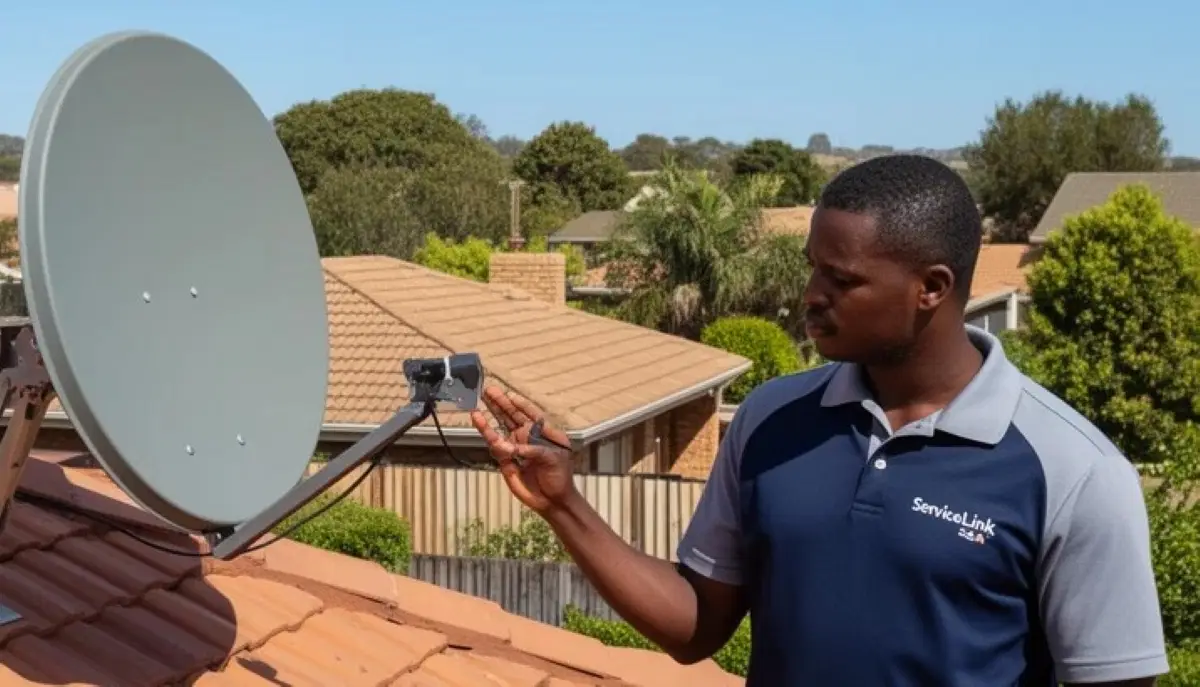
Once you’ve chosen your location, it’s time to mount the bracket and attach the dish.
Take your time here – rushed dish mounting leads to wobbly dishes that lose alignment in the wind.
Step 1: Mark your mounting holes
Hold your mounting bracket against the wall or roof rafter. Use a spirit level to ensure it’s perfectly vertical.
Mark the drill holes with a pencil or marker.
Step 2: Drill pilot holes
Use a masonry bit if you’re drilling into brick or concrete. For wooden roof rafters, use a standard wood bit.
Drill holes slightly smaller than your wall anchors for a tight fit.
Step 3: Insert wall anchors (for brick/concrete)
Tap the anchors into place with a hammer. They should be flush with the wall surface.
For roof mounting, use appropriate roof screws with rubber washers to prevent leaks.
Step 4: Attach the bracket
Secure the bracket using heavy-duty bolts. Tighten firmly – but don’t over-tighten and strip the threads.
Double-check that the bracket is still level after tightening.
Step 5: Attach the dish to the bracket
Most dishes have adjustment bolts for elevation (up/down angle) and azimuth (left/right rotation).
Leave these slightly loose for now – you’ll need to adjust them during alignment.
The dish should be secure enough not to move on its own, but loose enough to adjust with light pressure.
📐 Pro Tip:
Even if your wall looks straight, always use a spirit level. A bracket that’s off by even 2 degrees
will make dish alignment significantly harder and may prevent you from ever achieving optimal signal.
Level in both directions – vertical and horizontal.
🔌 Professional Cable Installation: Where Most DIYers Fail
I’ve seen it a hundred times: perfect dish alignment, good signal at the dish,
but terrible signal at the decoder. The culprit? Poor cable installation.
Cable routing rules (follow these or regret it):
- Keep cables away from electrical wiring – Electrical interference destroys satellite signals. Maintain at least 15cm separation.
- Use UV-resistant cable clips every 50cm – Prevents sagging and damage from wind or animals.
- Create a “drip loop” at entry points – Before the cable enters your wall, let it dip down then back up. Water runs off the loop instead of tracking into your home.
- Seal ALL wall penetrations with silicone – Water ingress is the #2 cause of signal problems (after bad alignment).
- Leave a 2-metre service loop near the decoder – Extra slack makes future troubleshooting and decoder moves much easier.
- Don’t kink or sharply bend the cable – The minimum bend radius is about 5cm. Tighter bends damage the internal conductor.
- Avoid running cables across walkways or driveways – Trip hazard and potential damage.
How to attach F-connectors (compression method – the professional way):
- Use a coaxial stripper to remove the outer jacket, exposing about 1cm of braided shielding
- Fold the shielding back over the outer jacket
- Strip the inner dielectric, leaving about 2-3mm of copper conductor exposed
- Slide the compression F-connector onto the cable
- Use a compression tool to crimp the connector firmly in place
- Gently tug on the connector to ensure it’s secure
For detailed cable guidance, read our
LNB and cable replacement guide.
🔧 LNB Installation & Weatherproofing
The LNB (Low Noise Block) is the component mounted on the arm of your dish that captures the signal.
Proper LNB installation is critical for signal quality.
LNB installation steps:
- Slide the LNB onto the dish arm and tighten the mounting bracket (leave slightly loose for skew adjustment)
- Connect the coaxial cable to the LNB output port (hand-tight plus quarter turn with wrench)
- Wrap the connection with self-amalgamating tape – start at the LNB and work outward, stretching as you wrap
- Set the initial LNB skew (rotation) – approximately -7° clockwise when looking from behind the dish
- Fine-tune skew during dish alignment for optimal signal quality
Weatherproofing checklist (non-negotiable):
- All outdoor F-connectors must be wrapped with self-amalgamating tape (not electrical tape)
- Drip loops at all entry points into your home
- Silicone sealant around wall penetrations – inside AND outside
- LNB cap must be intact (the plastic cover over the ports)
- If you’re in a coastal area, use stainless steel fittings and marine-grade LNB
For complete LNB guidance, read our
LNB replacement guide
and Smart LNB vs Universal LNB guide.
Feeling Overwhelmed? Let a Pro Handle It.
Satellite dish installation requires precision, safety, and the right tools.
Get free quotes from verified, accredited DSTV installers near you.
Same-day service available.
Get Professional Installation Quote
Free quotes. Verified installers. No obligation.
🎯 Satellite Dish Alignment: The Critical Step
This is the moment of truth. You’ve mounted the dish, run the cables, and connected everything.
Now it’s time to align the dish and lock onto the satellite signal.
Optimal alignment parameters for South Africa:
- Azimuth (compass direction): Approximately 45° magnetic northeast
- Elevation (vertical angle): Approximately 35° above the horizon
- LNB Skew (rotation): Approximately -7° clockwise (looking from behind the dish)
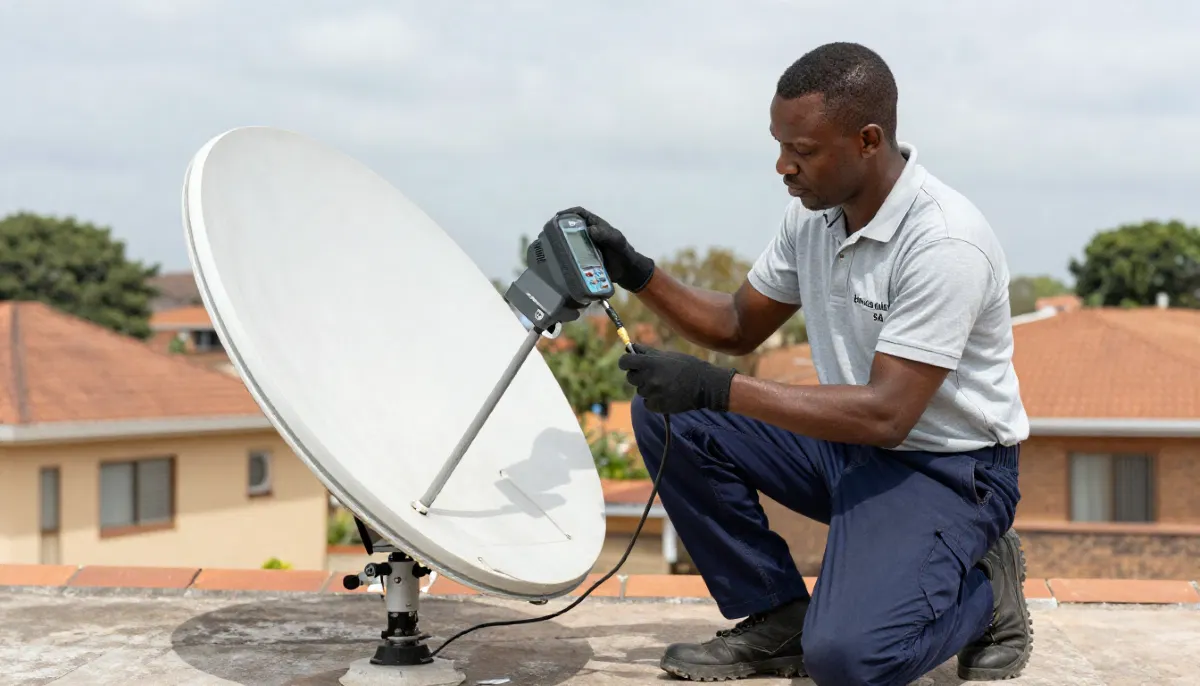
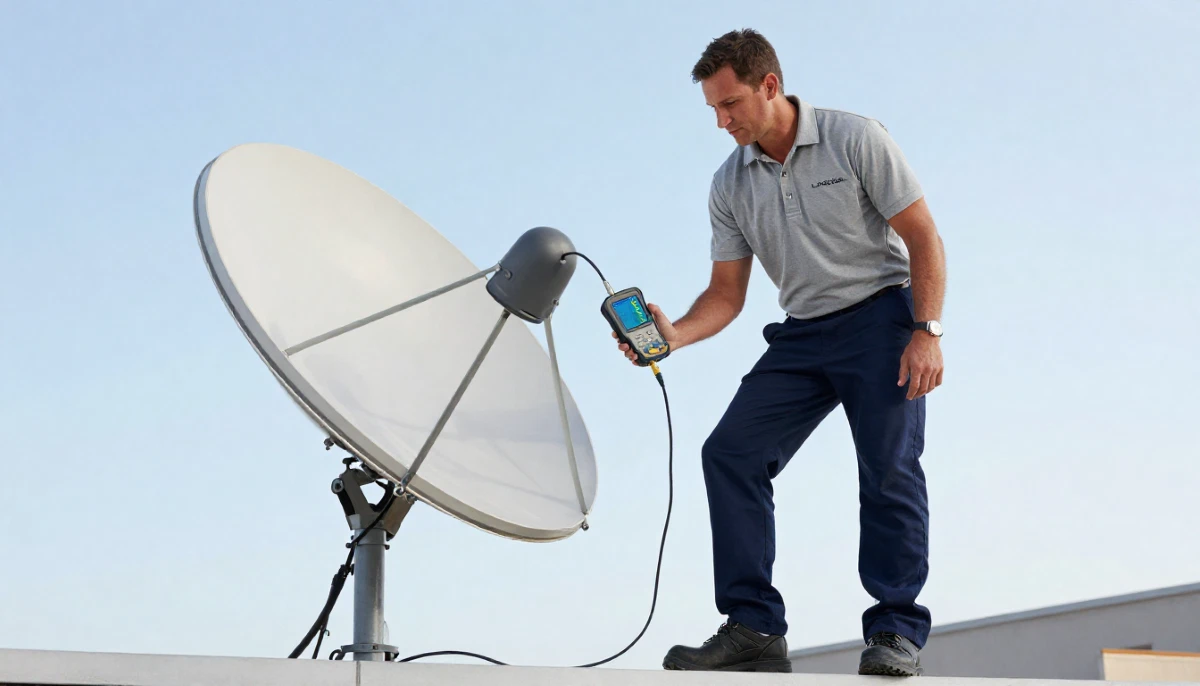
Professional alignment technique (using a signal meter):
- Connect your satellite signal meter between the LNB and your decoder
- Set your decoder to a known working channel (like SABC 1 or a DSTV promo channel)
- Access the signal meter screen: Menu → Settings → Signal Detection → Signal Meter
- Loosen the dish’s azimuth and elevation bolts just enough to allow slow movement
- Start with the dish pointing roughly northeast at a 35° angle
- Slowly sweep the dish left and right while watching the signal meter
- When you see signal appear (even 20-30%), stop and tighten the azimuth bolt slightly
- Fine-tune elevation by moving the dish up/down in tiny increments (2mm at a time)
- Adjust LNB skew for maximum quality (not just strength)
- Target at least 85% signal quality (not just strength)
- Once optimized, tighten all bolts firmly while continuously monitoring the signal
- If signal drops during tightening, loosen and re-adjust
For complete alignment instructions, read our
detailed dish alignment guide.
And to improve weak signals, see signal improvement guide.
📊 Signal Testing & Verification
After alignment, verify your signal is strong enough for reliable viewing.
Don’t just trust the meter – test thoroughly.
What good signal looks like:
- Signal Strength: 75% or higher (target 85%+)
- Signal Quality: 75% or higher (target 85%+) – quality is more important than strength
- Stability: Readings should be stable, not fluctuating wildly
- Multiple transponders: Check different channel frequencies – not just one
What to do if signal is poor:
- Strength below 70%, Quality below 70%: Dish misaligned or obstructed – realign
- Strength above 70%, Quality below 50%: LNB or cable problem – check connections, replace LNB
- Fluctuating readings: Loose connection or intermittent obstruction – check cables, trim trees
📺 Connecting Your Decoder
With your dish aligned and signal locked, it’s time to connect your decoder.
Connection steps:
- Connect the satellite cable to the “SAT IN” or “LNB IN” port on your decoder
- Connect HDMI cable from decoder’s HDMI OUT to your TV’s HDMI IN
- Plug power cable into a surge-protected power strip
- For internet features (Catch Up, streaming), connect Ethernet cable or set up Wi-Fi
- Turn on TV and decoder, select correct HDMI input
- The decoder will automatically scan for channels (2-5 minutes)
If you see “No Signal” on your TV after connecting:
- Check you’re on the correct HDMI input
- Verify the satellite cable is firmly connected
- Check decoder is powered on (lights should be visible)
- Try a different HDMI cable or port
For decoder-specific guidance, read our
HD and Explora installation guide
and OpenView setup guide.
❌ 7 Common DIY Satellite Dish Installation Mistakes
⚠️ Avoid These Costly Mistakes
- Skipping the signal meter: “I’ll guess” never works. A satellite signal meter is essential for install satellite dish for dstv correctly.
- Using screw-on F-connectors: These are unreliable and degrade over time. Use compression connectors with a proper crimping tool.
- Not weatherproofing connections: A little silicone today prevents “no signal” errors during the first thunderstorm.
- Mounting on a flexing surface: Gutters, thin metal sheeting, or loose roof tiles will move in the wind, killing your signal.
- Running cable parallel to electrical wiring: Electrical interference is real. Separate by at least 15cm.
- Over-tightening bolts: Stripped threads or crushed components mean starting over. “Snug plus a quarter turn” is usually enough.
- Not checking line of sight for future growth: A branch that’s clear today may block signal in 6 months. Look beyond immediate obstructions.
🛡️ Critical Safety Tips for Satellite Dish Installation
Your safety is more important than any TV signal. Follow these rules strictly.
- Never work on a roof alone – Have someone nearby who can call for help if you fall
- Use a stable ladder – Ensure it’s on level ground, at the correct angle (1:4 ratio), and extends at least 1m above the roof edge
- Wear non-slip shoes – Never work in socks, sandals, or smooth-soled shoes
- Check for power lines – Look up before positioning ladders or dishes. Contact with power lines can be fatal.
- Use a safety harness on high roofs – If you’re above single-story height, use proper fall protection
- Don’t work in bad weather – Wet roofs are slippery; wind can destabilise ladders; lightning is deadly
- If you feel unsafe, STOP – Professional installation is cheaper than a hospital visit
⚠️ Life-Saving Reminder:
We’ve responded to multiple emergency calls where DIY installers fell from roofs.
Medical costs exceeded R50,000 in some cases – more than 60x the cost of professional installation.
Hire a professional if you’re not 100% comfortable with heights.
🌍 Regional Considerations for Satellite Dish Installation
Your location in South Africa affects your satellite dish installation approach.
Different provinces have unique challenges.
Gauteng (Johannesburg, Pretoria):
- Highveld region – generally strong signal, but urban density causes multi-path interference
- Summer thunderstorms require robust weatherproofing and surge protection
- Many complexes have body corporate rules – check before drilling
- Installation services in Gauteng
Limpopo (Polokwane, Tzaneen):
- Hot climate affects LNB performance – use heat-resistant LNBs
- Tropical growth in eastern areas requires regular obstruction checks
- Fringe areas may need larger dish (80cm-1m)
- Installation services in Limpopo
Mpumalanga (Mbombela, Emalahleni):
- Highveld thunderstorms and mining area interference
- Robust grounding and quality cables essential
- Mountainous terrain in some areas affects line of sight
- Installation services in Mpumalanga
For location-specific services, see our pages for
Polokwane,
Mbombela, and
Emalahleni.
❓ Frequently Asked Questions About Satellite Dish Installation
Can I install a satellite dish for DSTV myself?
Yes, how to install satellite dish for dstv is possible if you have the right tools,
a signal meter, and safe access to the mounting location. However, professional installation (R800-R1,500)
is recommended for most homeowners – it’s safer, faster, and includes a warranty.
Read our DIY vs pro guide.
What size satellite dish do I need for DSTV in South Africa?
A 60cm dish is standard for most of South Africa. Coastal areas (Durban, Cape Town) and fringe areas
may need 80cm-1m dishes for reliable signal during rain.
Read our complete dish size guide for regional recommendations.
What direction should my satellite dish face?
For satellite dish installation in South Africa, your dish must face northeast
(approximately 45° magnetic azimuth) with an elevation of approximately 35° above the horizon.
Use a compass app on your phone to find the correct direction.
How long does satellite dish installation take?
Professional dstv dish setup typically takes 2-3 hours for a standard installation.
DIY installation can take 4-8 hours (or multiple weekends) for a first-timer.
The difference comes from experience, tools, and not having to learn as you go.
What tools do I need to install a satellite dish?
Essential tools for satellite dish installation: adjustable wrench, spirit level,
power drill with masonry bits, coaxial cable stripper, compression tool for F-connectors,
satellite signal meter (critical), compass or inclinometer app, silicone sealant,
UV-resistant cable clips, and a safety harness for roof work.
Can I use an existing satellite dish for DSTV?
Possibly, but you’ll need to check compatibility. The LNB must be DSTV-compatible (Universal or Smart LNB),
and the dish must be properly aligned to the correct satellite (Eutelsat 36° East).
An existing dish from a different provider likely won’t work without modifications.
Why is my satellite dish not getting a signal after installation?
Common causes of no signal after install satellite dish for dstv:
dish misalignment (most common), loose cable connections, faulty LNB,
water in cables, or obstructions (trees, buildings).
Use your signal meter to diagnose – low strength = alignment, good strength but low quality = LNB/cable.
How much does professional satellite dish installation cost?
Professional satellite dish installation costs R800-R1,500 for standard single-view,
R1,200-R2,500 for Extra View (multi-room), and R450-R900 for dish realignment.
Get a free quote from verified local installers.
Read our complete pricing guide.
Do I need body corporate approval to install a satellite dish?
Yes, if you live in a complex, townhouse, or apartment. Most body corporates require written approval
before dish installation. Some complexes have communal DSTV systems that you must use instead.
Read our communal installation guide.
What is the best cable for satellite dish installation?
RG6 quad-shield coaxial cable with copper core is the standard for dish mounting.
Avoid copper-clad steel (CCS) which has higher signal loss.
For runs over 30 metres, use RG11 cable. Always use compression F-connectors, not screw-on types.
✅ Final Thoughts: Do It Right or Hire a Pro
Satellite dish installation is achievable for handy homeowners with the right tools and patience.
But it’s not a job for everyone. The precision required (2mm alignment tolerance),
the safety risks (roof work), and the potential for costly mistakes make professional installation
the smarter choice for most South Africans.
If you decide to DIY, follow this guide carefully. Use a signal meter. Weatherproof everything.
And if you feel unsafe at any point, stop and call a professional.
If you’d rather skip the hassle, request a free quote from ServiceLink SA.
We’ll connect you with verified, accredited DSTV installers who will do the job safely and correctly.
Same-day service available in most areas.
Ready to Get Your Satellite Dish Installed?
Get free quotes from verified, accredited DSTV installers near you.
Professional installation ensures perfect signal, safety, and warranty protection.
📞 Call us: 073 138 4726 for immediate installation assistance.
Free site inspection •
How to choose an installer •
12-month warranty
📚 Official resources & standards referenced:
- Official DSTV installation guide – Official installation requirements and best practices.
- SABS – South African Bureau of Standards mounting and safety standards.
Information provided for general guidance. DSTV is a registered trademark of MultiChoice.
Installation standards referenced from SABS. Always prioritise safety and verify credentials before hiring.
Written by: Innocent T Hanyani
Satellite & Home Entertainment Installation Specialist | 21+ Years Experience
Innocent T Hanyani has over two decades of experience in satellite dish installation across South Africa.
He has personally supervised thousands of DSTV installations and developed training materials for new technicians.
His expertise covers everything from dish mounting and alignment to advanced multi-room distribution systems.
For more help with satellite dish installation, explore our related resources:
how to install DSTV,
dish alignment guide,
roof vs wall mounting,
best dish size guide,
improve signal strength.
See our service areas page for coverage in your region.