💧 Ready to Save Water and Money?
Get quotes from verified plumbers for water-efficient fixture installation. Start saving from day one.
Get Water Saving Quotes Near You
Servicing Gauteng, Western Cape, Eastern Cape, Johannesburg, Cape Town, Port Elizabeth, and across South Africa
Water Saving Plumbing Tips for Homes: Reduce Bills & Conserve Water
💧 From simple fixes to smart upgrades—complete guide to saving water in your South African home
Every month, you open your water bill and wince. In Cape Town, you remember “Day Zero.” In Johannesburg, you’ve seen municipal notices about restrictions. Water is becoming South Africa’s most precious—and expensive—resource. The average household uses 20-35 kilolitres per month, and water tariffs have increased 8-12% annually for years.
The good news? Most homes can cut water consumption by 30-50% with simple, affordable changes. A dripping tap wastes 11,000 litres per year. An old toilet uses 11-15 litres per flush—modern dual-flush uses 3-4.5 litres. The savings add up fast.
I’ve helped homeowners across South Africa reduce their water bills using these water saving plumbing tips. Some fixes cost nothing (checking for leaks). Others are small investments (tap aerators cost R50-R150). All of them pay for themselves—usually within months.
This comprehensive guide will teach you how to save water at home through smart plumbing practices, fixture upgrades, behaviour changes, and whole-home systems. Whether you’re motivated by environmental concerns, rising bills, or both, these water conservation tips will help you reduce your water bill and protect our precious resource.
For related information, read our water efficient fixtures guide, greywater system guide, rainwater harvesting guide, and low-flow fixtures guide. Let’s start saving.
📋 Table of Contents – Water Saving Plumbing Tips
📊 How Much Water Can You Save?
Before diving into specific water saving plumbing tips, understand the potential impact:
| Action | Cost | Water Saved/Year | Money Saved/Year (R30/kl) | Payback |
|---|---|---|---|---|
| Fix a dripping tap | R0-R200 | 11,000 litres | R330 | Immediate |
| Install tap aerators (4-pack) | R150-R400 | 10,000-15,000 litres | R300-R450 | 4-12 months |
| Upgrade to efficient showerhead | R300-R1,500 | 30,000-40,000 litres | R900-R1,200 | 3-18 months |
| Replace old toilet (dual-flush) | R2,500-R6,000 | 25,000-35,000 litres | R750-R1,050 | 3-6 years |
| Install geyser timer | R500-R1,500 | N/A (electricity saving) | R2,400-R4,800 (electricity) | 2-6 months |
| Greywater diverter | R2,000-R5,000 | 50,000-80,000 litres | R1,500-R2,400 | 1-3 years |
| Rainwater tank (5,000L) | R15,000-R30,000 | 80,000-120,000 litres | R2,400-R3,600 | 4-8 years |
A family of 4 can save 70,000-100,000 litres annually—R2,100-R3,000 per year—with basic upgrades. Larger investments pay off over time.
Read our water efficient fixtures guide for more product recommendations.
💧 Tip #1: Find and Fix Leaks (Free Savings)
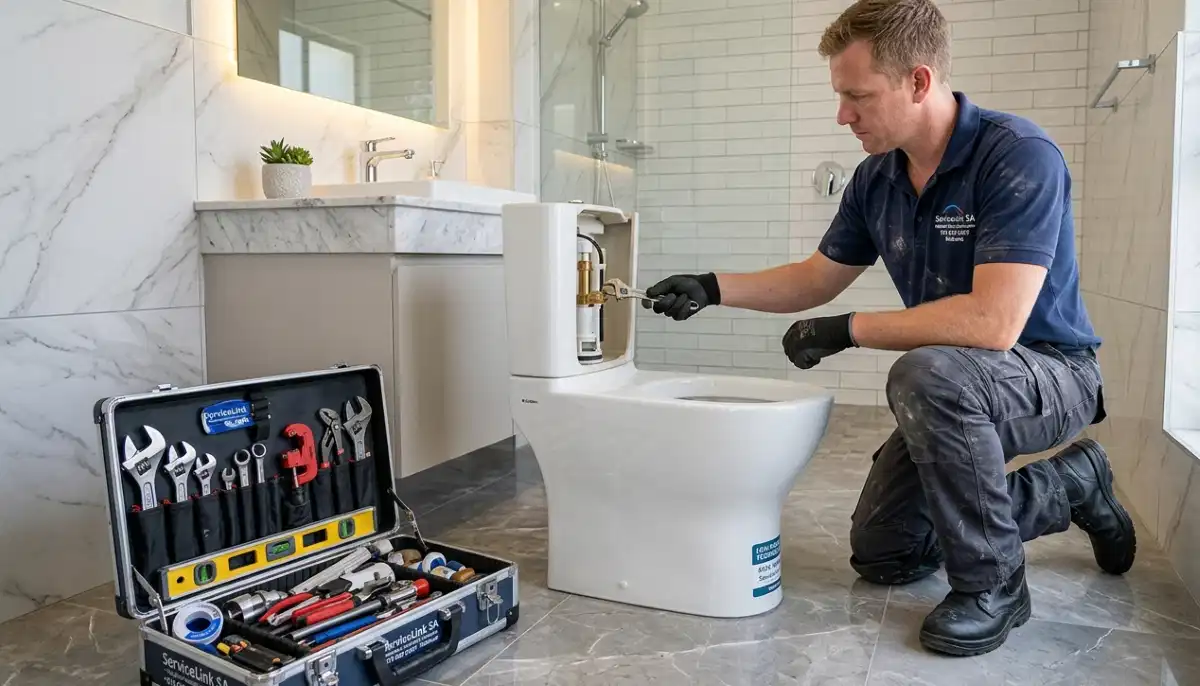
This is the most important of all water saving plumbing tips—and it’s often free.
How much water do leaks waste?
- 1 drip per second = 11,000 litres/year = R330/year
- 2 drips per second = 22,000 litres/year = R660/year
- Constant trickle = 200-400 litres/day = R2,190-R4,380/year
How to find hidden leaks:
- Turn off all water-using fixtures
- Check your water meter
- Wait 30 minutes without using water
- Check the meter again—if it moved, you have a leak
Common leak locations:
- Dripping taps (replace washer or cartridge, R20-R200)
- Running toilets (replace flapper, R50-R150)
- Leaking supply lines (tighten or replace, R50-R150)
- Hidden pipe leaks (professional detection, R850-R3,500)
Read our leak detection services guide for help finding hidden leaks.
🚰 Tip #2: Install Tap Aerators (R50-R150)
Tap aerators are the cheapest and easiest how to save water with plumbing upgrade.
What they do: Mix air with water, maintaining spray force while reducing flow from 10-15 L/min to 4-6 L/min.
Installation: Unscrew old aerator, screw in new one. Takes 2 minutes. Fits most taps.
Savings: A family of 4 using taps for 30 minutes daily saves 300 litres/day × 365 = 109,500 litres/year (R3,285/year).
Cost: R50-R150 per aerator. Available at any hardware store.
Payback: 3-6 months.
Read our low-flow plumbing fixtures guide for more.
💧 Ready to Save Water and Money?
Get quotes from verified plumbers for water-efficient fixture installation. Start saving from day one.
Free quotes • Verified specialists • Beat Your Quote guarantee
🚿 Tip #3: Upgrade Showerheads (R300-R1,500)
Modern efficient showerheads maintain pressure while using 50-70% less water.
Flow rates: Standard 15-20 L/min → Efficient 6-9 L/min
Savings: Family of 4 showering 10 minutes daily saves 360 litres/day × 365 = 131,400 litres/year (R3,942/year).
Cost: R300-R1,500. DIY installation (screws on like any showerhead).
Payback: 1-4 months.
What to look for: SABS-approved, flow rate clearly marked (aim for 9 L/min or less), multi-function settings.
Read our water efficient fixtures guide for product recommendations.
🚽 Tip #4: Install Dual-Flush Toilets (R2,500-R6,000)
Toilets are the largest water user in most homes—upgrading makes a huge difference in water conservation.
Water use comparison: Old toilet 11-15 L/flush → Dual-flush 3/4.5 L/flush
Savings: Family of 4 flushes 20 times/day: 260 litres/day (old) vs 80 litres/day (new) = 180 litres/day × 365 = 65,700 litres/year (R1,971/year).
Cost: R2,500-R6,000 installed (toilet + labour).
Payback: 3-4 years.
Alternative if replacement isn’t in budget: Install a “toilet displacement device”—a sealed bottle filled with pebbles placed in the cistern. Reduces water per flush by 1-2 litres. Free savings.
Read our toilet installation cost guide for pricing.
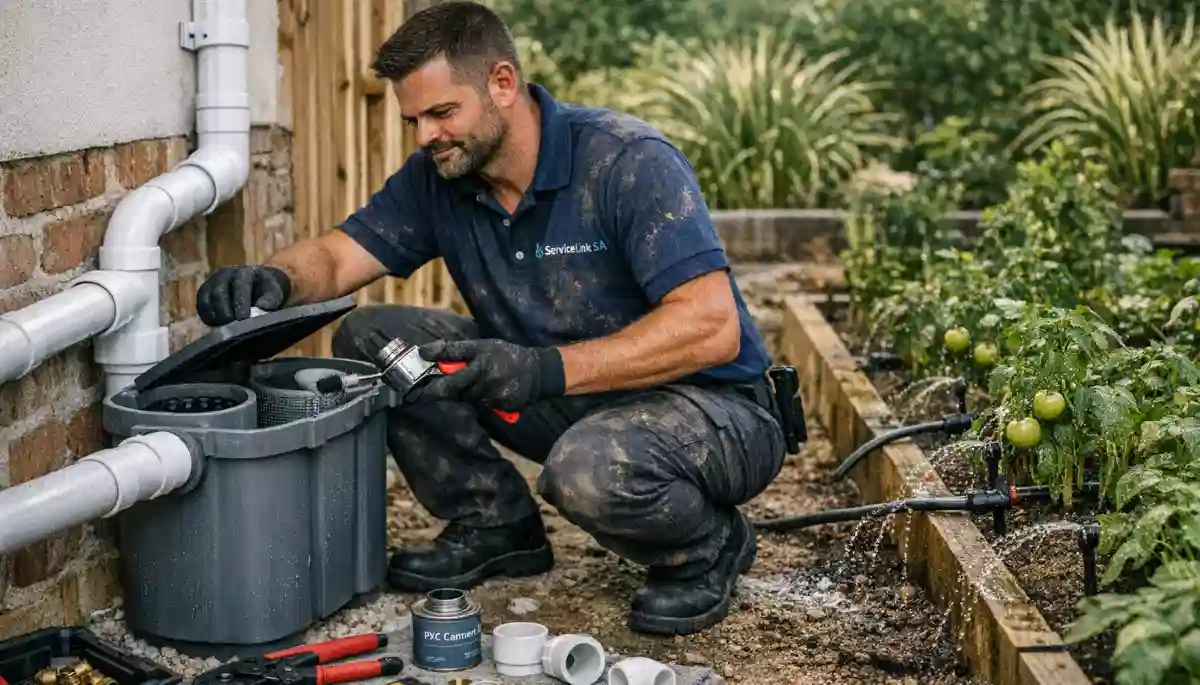
🧹 Tip #5: Use Drain Strainers (R50-R100)
A simple but effective save water at home tip—catch debris before it causes blockages.
How they help: Prevent hair and debris from entering drains, reducing the need for water-intensive drain cleaning and preventing blockages that waste water.
Cost: R50-R100. Fits over shower and sink drains.
Savings: Prevents R600-R1,200 drain cleaning calls and reduces water waste from slow drains.
Read our drain cleaning guide for more.
🧤 Tip #6: Insulate Hot Water Pipes (R200-R500)
Insulating hot water pipes reduces heat loss, meaning you get hot water faster and waste less water waiting for it to heat up.
Installation: Wrap foam pipe insulation around exposed hot water pipes (first 2-3 metres from geyser).
Savings: Reduces water wasted while waiting for hot water by 10-20 litres per day (3,650-7,300 litres/year).
Cost: R200-R500 for insulation materials.
Payback: 3-6 months.
Read our pipe insulation guide for detailed instructions.
⏰ Tip #7: Install a Geyser Timer (R500-R1,500)
A geyser timer heats water only when you need it—saving electricity and reducing water waste from overheating.
How it works: Set timer to heat water before morning showers and evening dishwashing, then turn off automatically.
Savings: R200-R500 per month on electricity (R2,400-R6,000/year). Also reduces water waste from overheating.
Cost: R500-R1,500 plus professional installation (R500-R1,000).
Payback: 2-6 months.
Read our geyser guide for more.
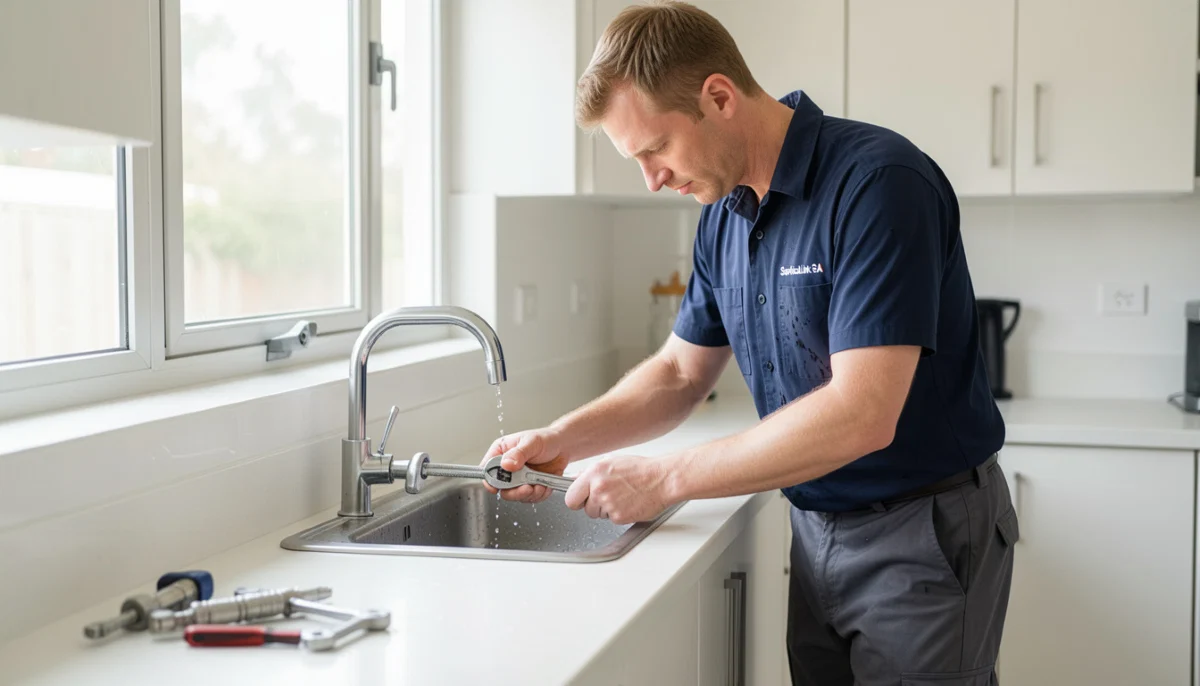
🎛️ Tip #8: Install a Pressure Reducing Valve (R1,500-R3,500)
If your water pressure exceeds 600 kPa, a Pressure Reducing Valve (PRV) saves water and protects your plumbing.
How it helps: High pressure increases flow rate, wasting water. A PRV reduces pressure to optimal 400-500 kPa, reducing flow without affecting performance.
Savings: 10-20% reduction in water consumption.
Cost: R1,500-R3,500 installed.
Payback: 1-3 years.
Read our water pressure guide for more.
💧 Tip #9: Install a Greywater System (R2,000-R35,000)
Greywater systems reuse bath, shower, and laundry water for garden irrigation—one of the most effective water conservation strategies.
Options:
- Simple diverter (R2,000-R5,000): Directs washing machine water to garden
- Treatment system (R15,000-R35,000): Filters and treats water for broader use
Savings: 30-50% reduction in household water consumption. A family of 4 can save 50,000-80,000 litres/year (R1,500-R2,400/year).
Payback: 1-4 years for simple diverter, 5-8 years for treatment system.
Read our greywater system guide for details.
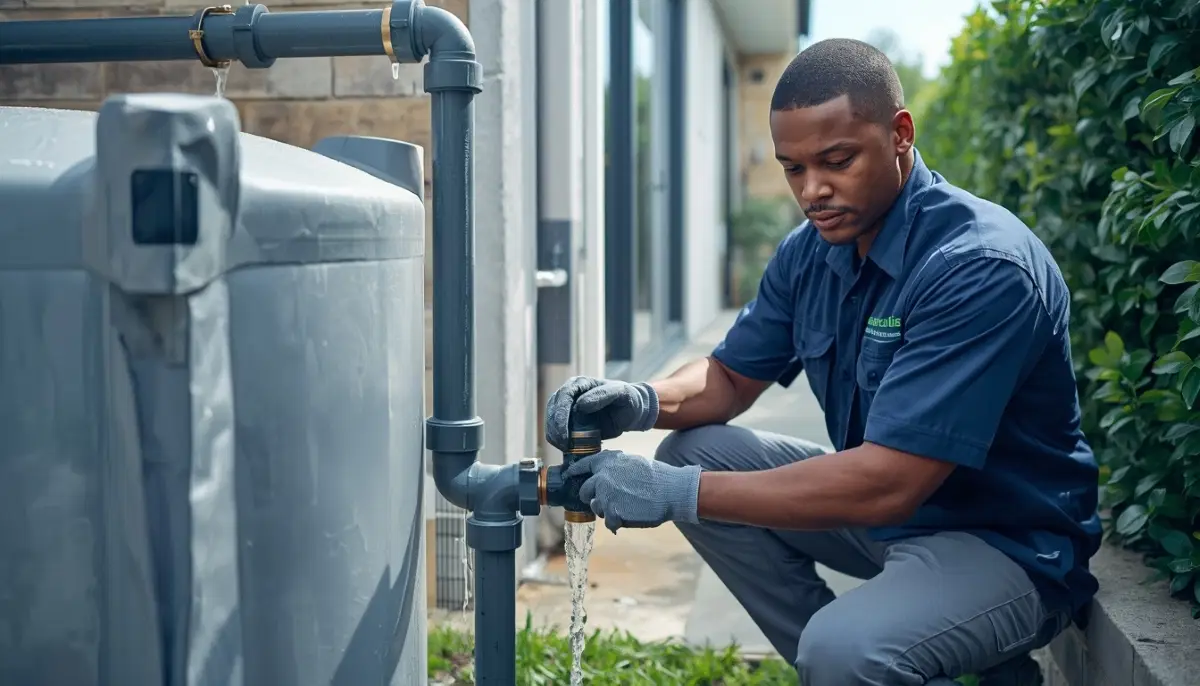
☔ Tip #10: Install Rainwater Harvesting (R8,000-R35,000)
Collect free rainwater from your roof for gardens, toilets, and laundry.
Savings: A 5,000L tank in Johannesburg (700mm rainfall) on a 150m² roof can collect 100,000+ litres annually—enough for most garden and toilet needs. Annual saving R3,000-R5,000.
Cost: R8,000-R35,000 depending on tank size and complexity.
Payback: 3-7 years.
Read our rainwater harvesting guide for details.
💡 Free Behaviour Changes That Save Water
These how to save water with plumbing habits cost nothing:
- Turn off taps while brushing teeth – Saves 10-15 litres per minute
- Take shorter showers – Reduce from 10 to 5 minutes saves 50-75 litres per shower
- Only run full loads – Dishwasher and washing machine use same water regardless of load size
- Collect shower warm-up water – Catch cold water in a bucket while waiting for hot water; use for plants
- Defrost food in fridge, not under running water – Saves 10-20 litres per defrost
- Use a basin for dishwashing – Sink spray uses 30-40 litres; basin uses 10-15 litres
📊 Savings Calculator: ROI by Investment
Here’s how different water saving plumbing tips compare on return on investment:
| Investment | Cost | Annual Saving | Payback | 10-Year Saving |
|---|---|---|---|---|
| Tap aerators (4-pack) | R200 | R400 | 6 months | R3,800 |
| Efficient showerhead | R500 | R1,000 | 6 months | R9,500 |
| Dual-flush toilet | R3,500 | R900 | 3.9 years | R5,500 |
| Geyser timer | R1,000 | R3,600 (electricity) | 3.3 months | R35,000 |
| Greywater diverter | R3,500 | R1,800 | 1.9 years | R14,500 |
| Rainwater tank (5,000L) | R18,000 | R3,000 | 6 years | R12,000 |
The best returns come from low-cost, high-impact fixes: aerators, showerheads, and fixing leaks.
🌍 Regional Water Considerations
Water-saving priorities vary by location in South Africa:
Gauteng (Johannesburg, Pretoria):
- High-altitude, summer rainfall. Focus on indoor efficiency (toilets, showers, taps).
- Water tariffs have increased significantly—every litre saved matters.
Western Cape (Cape Town):
- Mediterranean climate, winter rainfall. Drought risk is real.
- Prioritize rainwater harvesting and greywater systems. Many homes already have these.
Eastern Cape (Port Elizabeth):
- Moderate rainfall but aging infrastructure causes supply issues.
- Focus on leak detection and efficient fixtures.
For location-specific services, explore our Western Cape and Eastern Cape pages.
❌ 5 Costly Mistakes to Avoid
Mistake #1: Ignoring Small Leaks
“It’s just a drip” wastes 11,000 litres/year (R330). The drip will get worse. Fix leaks immediately—it’s the cheapest water saving you’ll ever find.
Mistake #2: Buying Cheap, Uncertified Fixtures
Non-SABS-approved fixtures may not perform as advertised and could fail prematurely. Look for the SABS mark—it ensures the product meets South African efficiency standards.
Mistake #3: Not Testing for Silent Leaks
A silent toilet leak wastes as much water as a noisy one. Do the food colouring test monthly. Add colour to tank—if colour appears in bowl, you have a leak.
Mistake #4: Overwatering Gardens
Most gardens need 20-30mm of water per week. Use a rain gauge and water only when needed. Early morning watering reduces evaporation.
Mistake #5: Ignoring Water-Efficient Rebates
Some municipalities offer rebates for water-efficient fixtures or rainwater tanks. Check with your local municipality before buying—you could save hundreds.
📋 Real-World Water Saving Case Studies
💧 Case 1: Low-Cost Upgrades in Johannesburg
Location: Johannesburg | Homeowner: The Nkosi Family
Upgrades: Tap aerators (R200), efficient showerheads (R600), fixed leaking tap (R150), toilet displacement bottles (free).
Total investment: R950
Savings: Water bill reduced from R1,200 to R750/month (R450/month, R5,400/year).
Payback: 2.1 months.
Lesson: Small, low-cost upgrades deliver the fastest payback.
🏠 Case 2: Whole-Home Retrofit in Cape Town
Location: Cape Town | Homeowner: The Williams Family
Upgrades: Dual-flush toilets (R5,000), greywater diverter (R3,500), rainwater tank 5,000L (R18,000), geyser timer (R1,000).
Total investment: R27,500
Savings: Water bill reduced from R1,600 to R600/month (R1,000/month, R12,000/year).
Payback: 2.3 years.
Lesson: Larger investments pay off over time—especially in high-tariff areas like Cape Town.
❓ Frequently Asked Questions About Water Saving Plumbing
How to save water with plumbing without spending money?
How to save water with plumbing for free: 1) Fix dripping taps (tighten or replace washer), 2) Check for toilet leaks (food colouring test), 3) Turn off taps while brushing teeth, 4) Take shorter showers, 5) Collect shower warm-up water for plants, 6) Run full loads only. These free habits can save 20-30% of household water use.
What is the fastest way to reduce my water bill?
The fastest way to reduce your water bill is to fix leaks. A dripping tap wastes 11,000 litres/year (R330). A running toilet can waste 200-1,000 litres/day (R2,190-R10,950/year). Check for leaks today—fixing them is free or cheap and provides immediate savings.
Do tap aerators really save water?
Yes—tap aerators reduce flow from 10-15 L/min to 4-6 L/min while maintaining spray force. A family of 4 can save 100,000+ litres/year (R3,000+/year). Cost is R50-R150 per aerator. Payback is 3-6 months. They’re one of the most effective water saving plumbing tips.
Are low-flow showerheads worth it?
Absolutely. A family of 4 can save 130,000+ litres/year (R3,900+/year) with efficient showerheads (6-9 L/min vs 15-20 L/min standard). Modern efficient showerheads use aerating or laminar-flow technology that maintains pressure—most users can’t tell the difference. Cost R300-R1,500, payback 1-4 months.
How much water does a dual-flush toilet save?
A dual-flush toilet uses 3-4.5 litres per flush vs 11-15 litres for old toilets. A family of 4 saves 65,000+ litres/year (R1,950+/year). Cost R2,500-R6,000 installed, payback 3-4 years. If replacement isn’t in budget, use a toilet displacement device (sealed bottle in cistern)—free savings.
Is a greywater system worth the investment?
For most South African homes, a greywater diverter (R2,000-R5,000) pays for itself in 1-3 years through reduced water bills. A family of 4 can save 50,000-80,000 litres/year (R1,500-R2,400/year). Full treatment systems (R15,000-R35,000) have longer paybacks (5-8 years) but offer convenience and safety. Read our greywater guide for details.
How do I check for a silent toilet leak?
Add a few drops of food colouring to the toilet tank (don’t flush). Wait 15-30 minutes. If colour appears in the bowl, you have a silent leak. Replace the flapper (R50-R150). A silent leak wastes 200-1,000 litres/day—fixing it is one of the fastest water conservation wins.
How do I find a reliable plumber for water-efficient upgrades?
To find a reliable plumber for water saving plumbing tips implementation: 1) Verify PIRB registration, 2) Ask for water efficiency experience, 3) Get detailed quotes, 4) Check reviews. ServiceLink SA connects you with verified plumbers in Gauteng, Western Cape, and Eastern Cape.
✅ Final Thoughts: Every Drop Counts
South Africa is a water-scarce country. Climate change, population growth, and aging infrastructure mean water will only become more expensive and restricted. Implementing these water saving plumbing tips is one of the smartest investments you can make—for your wallet, for your property value, and for our collective water future.
Key takeaways for South African homeowners:
- Fix leaks first – free or cheap, immediate savings
- Install tap aerators – R50-R150, payback 3-6 months
- Upgrade showerheads – R300-R1,500, payback 1-4 months
- Replace old toilets – R2,500-R6,000, payback 3-4 years
- Consider greywater and rainwater – larger investment, bigger savings
- Free behaviour changes – turn off taps, shorter showers, full loads
- Test for leaks monthly – meter test and food colouring test
Your action plan: Do the water meter test today. Check for drips. Install tap aerators this weekend. Plan for showerhead and toilet upgrades. Consider greywater or rainwater for long-term savings. Every drop you save today protects our water future for tomorrow.
💧 Ready to Save Water and Money?
Get quotes from verified plumbers for water-efficient fixture installation. Start saving from day one.
📞 Call us: 073 138 4726 for immediate help finding a water efficiency specialist near you.
Water efficient fixtures •
Greywater systems •
Rainwater harvesting •
Low flow fixtures •
Beat Your Quote guarantee
📚 Official resources & standards referenced:
- Department of Water and Sanitation – Water conservation tips and regulations.
- SANS 10400 – Efficiency standards and plumbing compliance.
- Plumbing Industry Registration Board (PIRB) – Find registered water efficiency specialists.
Information provided for general guidance based on industry research and DWS/SANS standards. For specific water saving plumbing tips advice for your home, consult multiple verified plumbers.
Written by: ServiceLink SA Research Team
Water Conservation & Plumbing Efficiency Specialists
The ServiceLink SA Research Team comprises water conservation experts, plumbing efficiency specialists, and industry professionals with decades of experience helping homeowners implement water saving plumbing tips across South Africa. Our team works directly with PIRB-registered plumbers, fixture manufacturers, and water authorities to bring you accurate, actionable information about how to save water with plumbing, fixture efficiency, and conservation strategies. We continuously update our guides to reflect current water tariffs, conservation technologies, and best practices for sustainable home plumbing.
For more information about water conservation and efficient plumbing, explore our related resources:
water efficient fixtures guide,
greywater system guide,
rainwater harvesting guide,
low-flow fixtures guide,
and water saving tips guide.
Our what is ServiceLink SA and
how we protect homeowners pages explain our verification process.
See our service areas page for water efficiency coverage in your region.